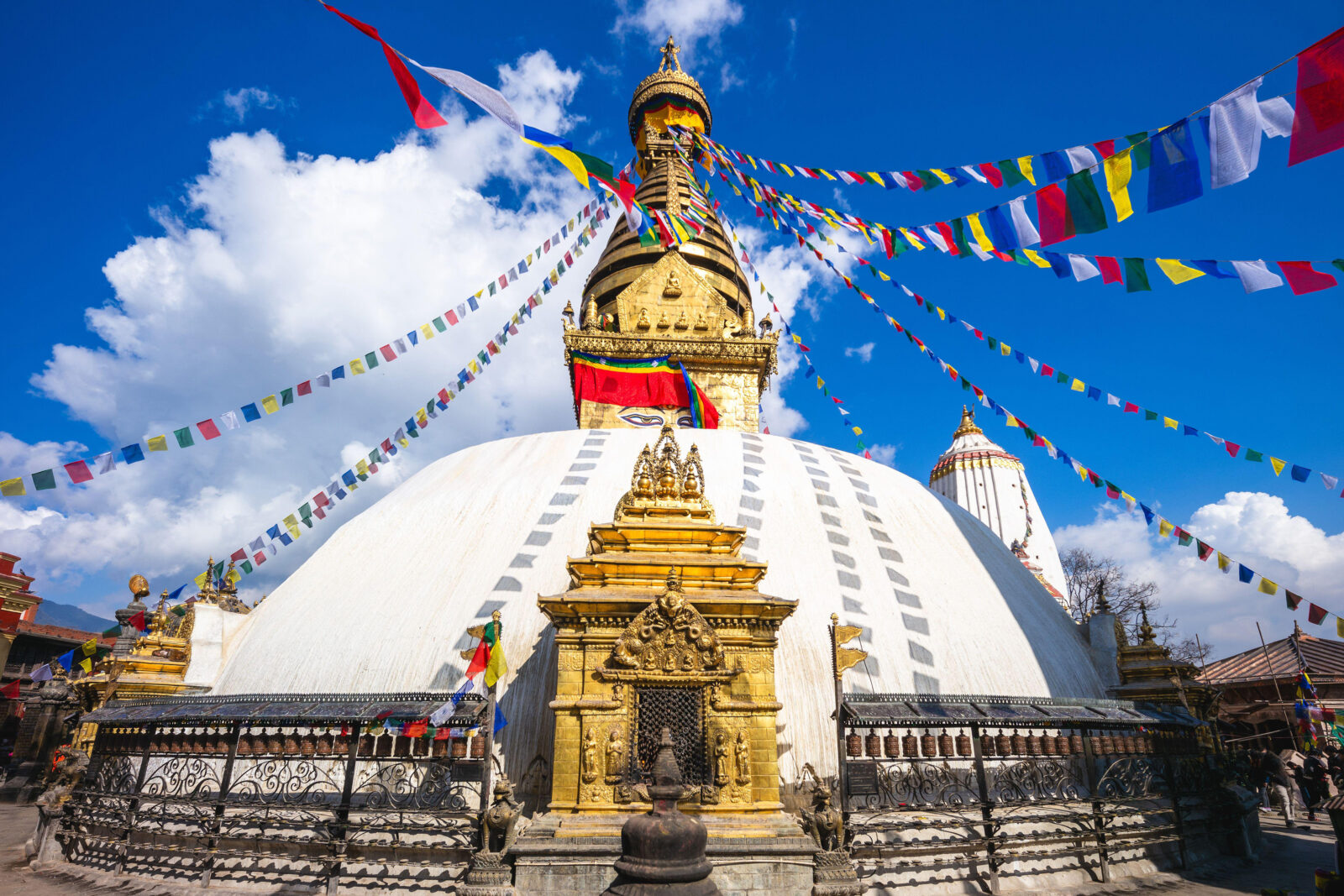
Svayambhu stupa, one of the most sacred Buddhist pilgrimage sites of the Kathmandu Valley, with fresh Losar prayer flags. Photograph via Alamy
Svayambhu stupa, one of the most sacred Buddhist pilgrimage sites of the Kathmandu Valley, with fresh Losar prayer flags. Photograph via Alamy
Different ways of marking the new year
Across Nepal’s Kathmandu Valley, winter brings a spirit of purification and renewal. The frenetic pitter-patter of the summer monsoon rains and the hustle-bustle of the autumnal festival season give way to a slower, more reflective pace. The air becomes crisp and lucid, the valley’s ever-present clouds of dust settle, and the snow-capped Himalayan peaks emerge triumphantly from the haze that stubbornly clings to the Shivapuri hills along the valley’s northern rim the rest of the year.
In Tibetan Buddhist neighborhoods like Boudha, surrounding the spectacular Boudhanath Stupa (a UNESCO World Heritage Site), the fragrance of incense offerings, purificatory juniper smoke, and the oily-sweet smell of khapse, a deep-fried holiday pastry, herald the approach of the new year, or Losar. However, this singular framing obscures a far richer reality. Across the Himalayas, there is not one Losar, but many distinct yet overlapping Losar traditions shaped by regional histories, communal customs, and local calendars.
Nowhere is this plurality more visible than the Himalayan crossroads of Nepal, which is inhabited by dozens of different ethnic, linguistic, and religious groups. Accordingly, Losar is not a single event, but a cluster of festivals celebrated at different times and in different ways by Gurung, Tamang, Sherpa, Tibetan, and other Himalayan communities. To understand Losar in Nepal is to glimpse how Himalayan cultures conceptualize time itself: profoundly interdependent and yet locally grounded, socially negotiated, and ritually enacted.
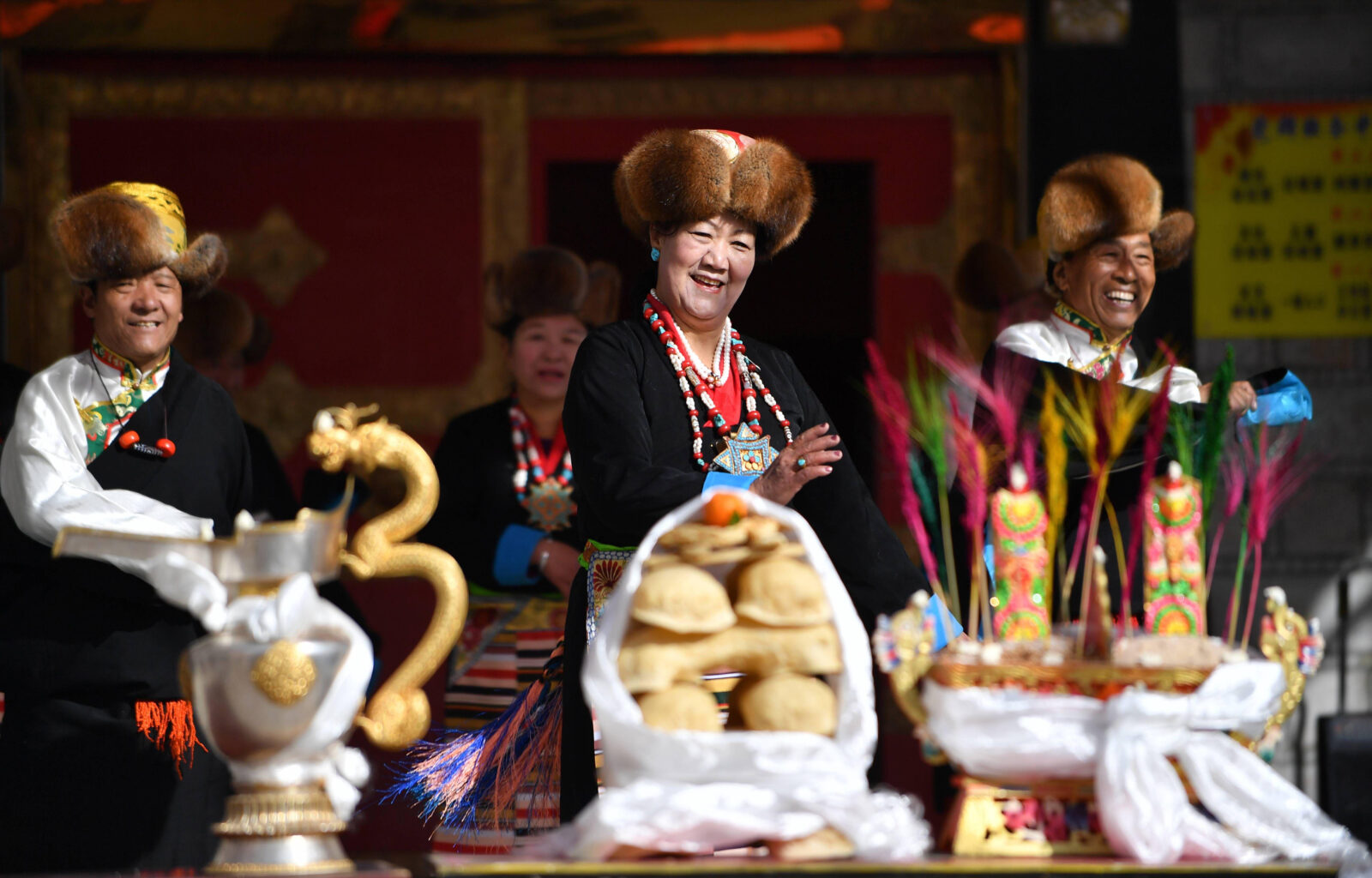
Tibetans in Lhasa, wearing traditional dress, celebrate Losar with khapse (fried pastries) and tsampa (roasted barley flour). Photograph by IMAGO/Xinhua via Alamy
The term Losar derives from the Tibetan language, in which lo means “year” and gsar means “new,” thus yielding “new year.” The associated Tibetan calendars combine both lunar and solar orientations, tracking months based on phases of the moon but looking to the cycles of the sun to determine years. Accordingly, an extra lunar month, or “leap month,” must be added every few years to keep the lunar and solar cycles aligned.
Yet there has never been a single, unified Tibetan calendar across all Himalayan communities. Rather, various ethnic groups, astrological lineages, political administrations, and monastic institutions have historically employed different methods for reckoning complex astrological calculations like leap months. These differences in calculation produce the different Losars celebrated across the Himalayas today, which include Ladakhi Losar, Tol Losar, Tamu Losar, Sonam Losar, and Gyalpo Losar.
Taking late 2025 and early 2026 as an example, Ladakhi Losar comes first, falling on December 20, 2025. Named after the North Indian region of Ladakh, Ladakhi Losar is celebrated across the western Himalayas, including some pockets of Nepal’s northwestern frontier. According to Ladakhi folklore, the 17th-century King Jamyang Namgyal wished to invade the nearby region of Baltistan in order to reclaim land lost to persistent revolts. Seeking divine support for his military campaign, King Jamyang consulted an oracle who advised him to wait until after Losar to invade Baltistan.
This presented the king with a conundrum. To transgress the oracle’s prophecy would surely bring bad luck, but postponing the invasion would give his enemies time to consolidate their forces and fortify their defenses. Therefore, King Jamyang elected to move the observance of Losar forward by two lunar months so that he could celebrate Losar without delaying his plans for the invasion of Baltistan. Today, those who observe Ladakhi Losar fondly recount this story as the justification for their unique tradition, revealing the deep interconnections between political and temporal concepts of renewal.
Chronologically, the next in succession is Tamu Losar, which occurs on December 30, 2025. Tamu is the name by which Nepal’s Gurung ethnic group refer to themselves, so Tamu Losar is also known as Gurung Losar. Gurung festivities emphasize traditional clothing, dancing, and feasting, including drinking home-brewed liquor called raksi. To start the new year off on a virtuous foot, Gurung communities hang new prayer flags in their villages and at prominent Buddhist pilgrimage sites like Boudhanath and Svayambhu. As the flags flutter in the wind, they are said to continually radiate to all sentient beings the auspicious prayers and mantras inscribed upon them.
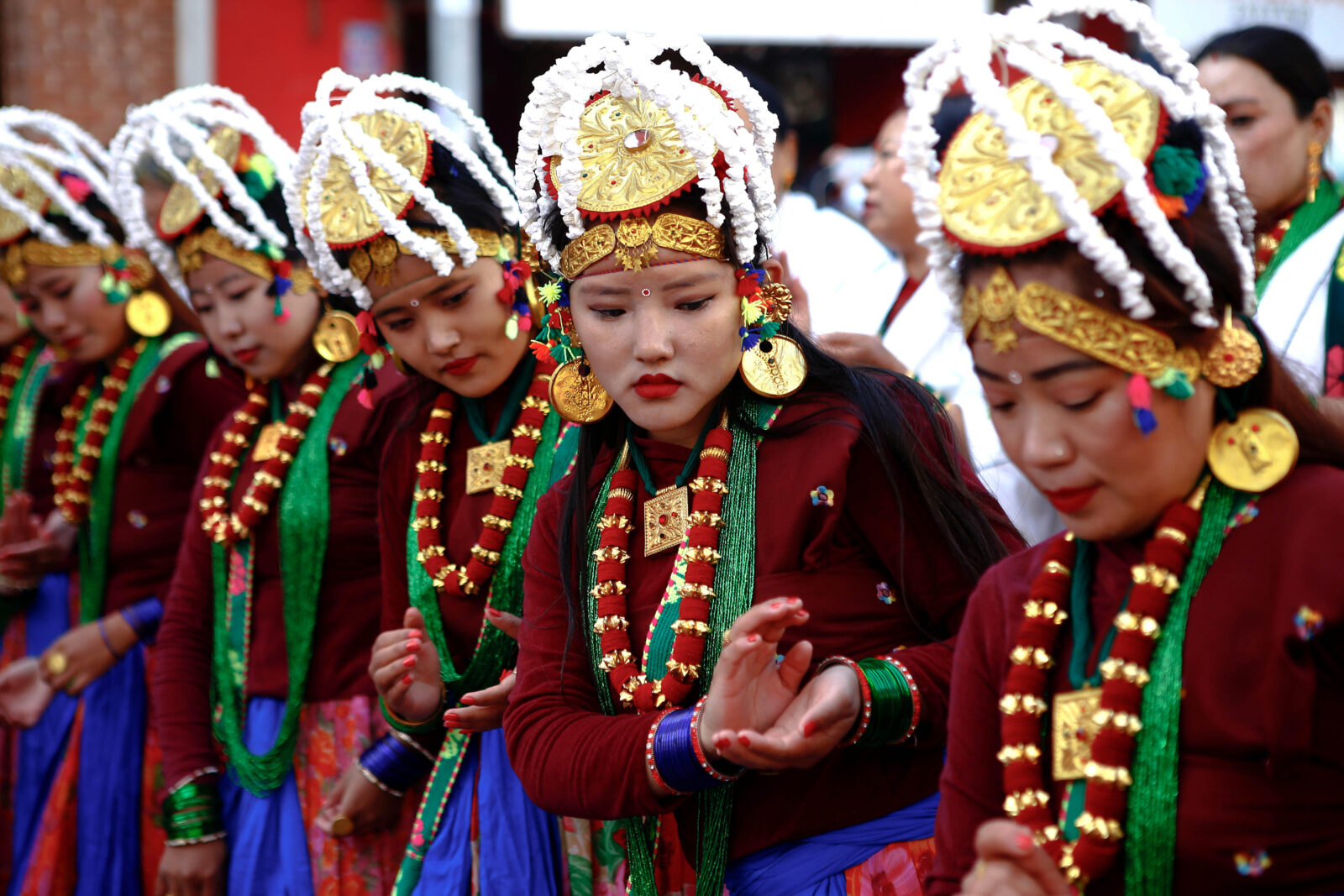
Women from the Gurung community, in traditional attire, dance during Tamu Losar. Photograph by ZUMA Press via Alamy
Similar to Tamu Losar is Tol Losar, which falls on December 31, 2025. However, whereas Tamu Losar is celebrated by the Gurung people who occupy the Himalayan foothills, Tol Losar is primarily observed in Nepal’s alpine northwestern regions of Humla, Jumla, Dolpa, Mugu, and Manang. There is some historical evidence to suggest that Tol Losar preserves the most ancient reckoning system, often coinciding with the winter solstice and the barley harvest—a staple crop vital across the entire Tibetan Plateau.
In this way, Tol Losar offers a window into the ways that Losar combines astrological and agricultural notions of renewal and rebirth. A rite of thanksgiving celebrated across all major Himalayan Losar traditions emphasizes this agricultural dimension. This rite involves throwing pinches of roasted barley flower, known as tsampa, into the air while reciting prayers for an auspicious new year.
Next in the sequence is Sonam Losar, falling on January 19, 2026, which is observed primarily by the Tamang and Hyolmo communities. Whereas most Losars follow Tibetan lunisolar calendrical systems, the calculation of Sonam Losar is more lunar and often relies more on South Asian calendrical systems than Tibetan ones. Accordingly, Sonam Losar falls on the second new moon after the winter solstice, placing it in close proximity to other Nepalese and Indian post-solstice festivals like Maghe Sankranti, which is celebrated across South Asia and occurs on January 14, 2026.
Being a Tibetic holiday based on an Indic calendar, Sonam Losar reflects the ethno-cultural hybridity that defines much of the Himalayas, with Central Asian (Tibetan, Mongolian, Chinese) influences from the north mixing with South Asian (Nepalese, Indian, Persian) currents to the south.
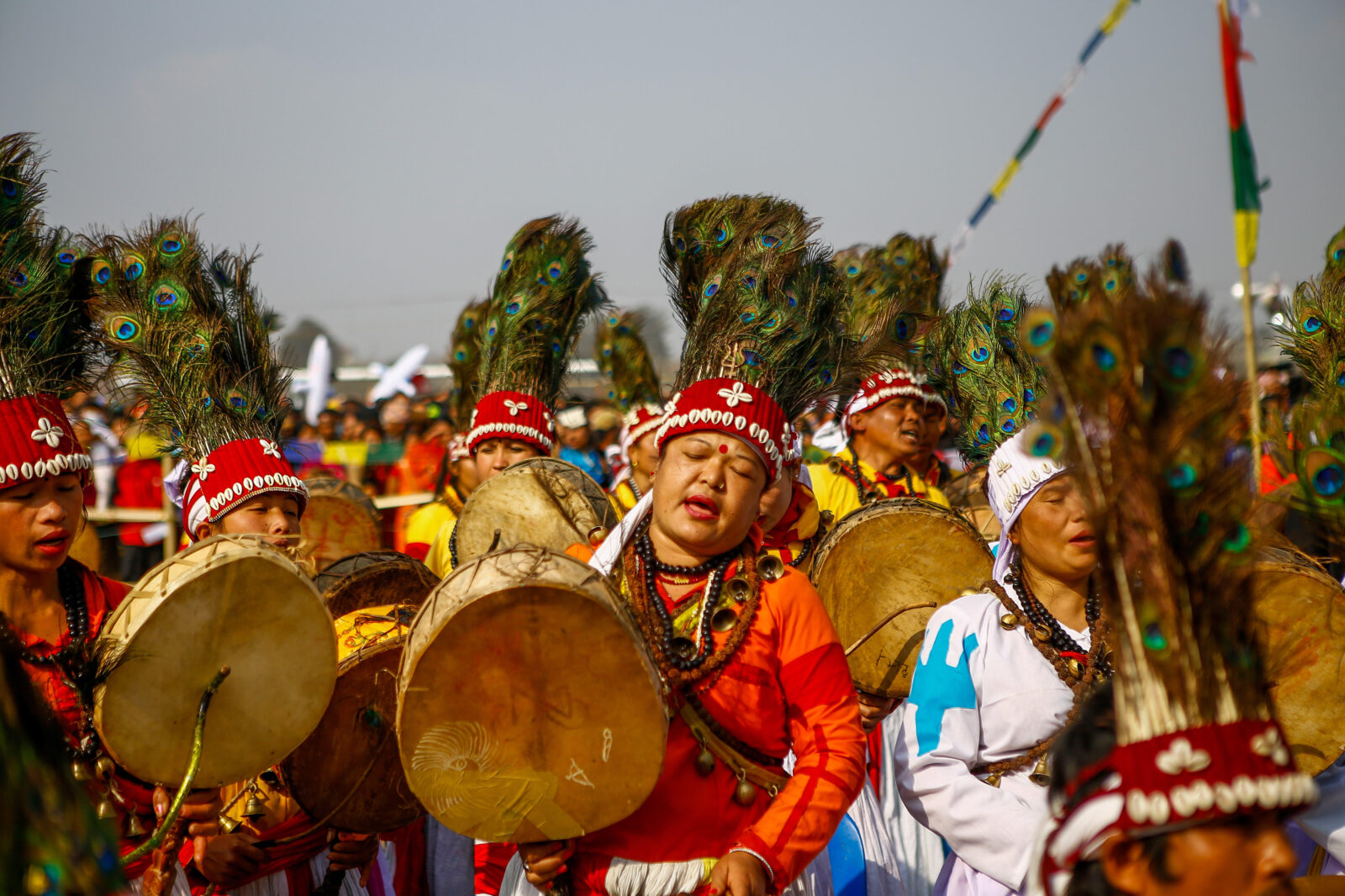
Tamang ritual specialists or shamans, known as jhakri, gather on Sonam Losar. Photograph by SOPA Images via Alamy
The last Losar celebration in the chronological sequence is Gyalpo Losar, or the Royal Losar, observed by Tibetan and Sherpa communities. In 2026, it falls on February 18. Gyalpo Losar is the most widely observed version of Losar and its royal namesake emphasizes its intersection with institutional articulations of power. Tibetan political and religious institutions across the Himalayas hold spectacular festivities of cleansing and renewal. Monasteries bring in the new year with a clean karmic slate by conducting elaborate meditation and worship retreats devoted to visualizing wrathful deities, like Vajrakila or “Diamond Nail,” believed to vanquish misdeeds and nonvirtuous habitual patterns accrued over the previous year.
Concurrently, households, villages, and largely political institutions host festivities to make offerings of thanksgiving, confession, and absolution. Many of these rites focus on purifying human relationships with elemental and environmental beings—like subterranean serpent spirits called naga or lu who control water, wealth, and disease, or mountain spirits who control weather, fertility, and blessings.
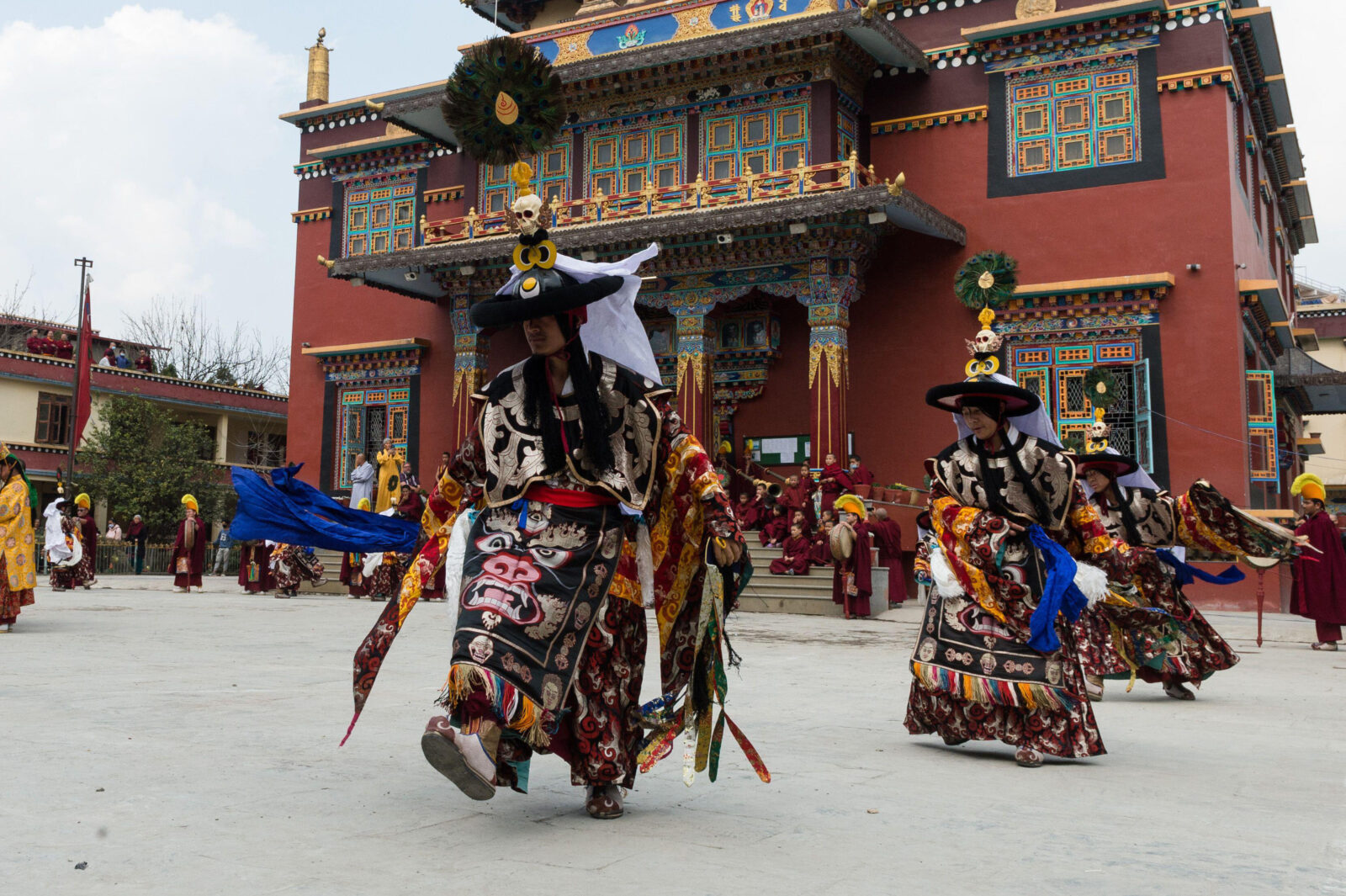
Lamas of Shechen Monastery performing the cham dance on Gyalpo Losar to clear obstacles and welcome the new year with a clean karmic slate. Photograph by WIktor Szymanowicz via Alamy
Seen this way, Losar is not a singular holiday but a family of Himalayan new year festivals, each articulating what renewal means across social, ecological, and ritual worlds. And yet, across their diversity, these celebrations share a common purpose: to give thanks, to purify past missteps, to reaffirm relationships (with family, community, environment, and unseen forces), and to begin again with intention.

Westin Harris is the resident scholar in Himalayan cultures at the Rubin Museum of Himalayan Art.
Get the latest news and stories from the Rubin, plus occasional information on how to support our work.