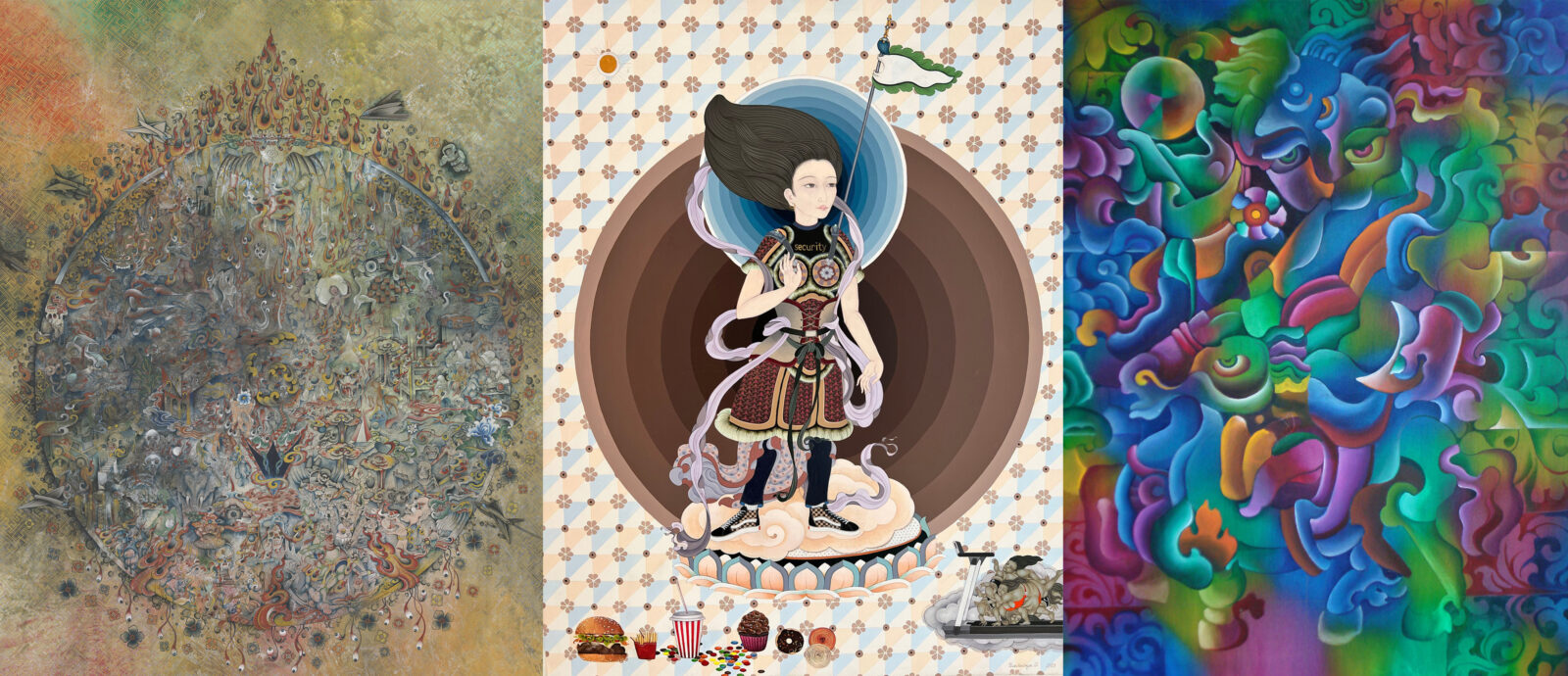
From left to right: Ripples, Dedicated to Women Migrants: Security II, Untitled

From left to right: Gyempo Wangchuk; Ripples; 2025; natural color on canvas; courtesy of the Rubin Museum of Himalayan Art | Uuriintuya Dagvasambuu; Dedicated to Women Migrants: Security II; 2023; acrylic on canvas; courtesy of the Rubin Museum of Himalayan Art | Sodhon; Untitled; 2007; oil on canvas; courtesy of the Rubin Museum of Himalayan Art

The Rubin Museum of Himalayan Art has acquired nine paintings from seven contemporary artists including Uuriintuya Dagvasambuu, Tserang Dhundrup, Tsering Nyandak, Ang Sang, Sodhon, Tsewang Tashi, and Gyempo Wangchuk.

The acquisitions reflect the Rubin’s commitment as a global museum to expanding its collection, broadening understanding of Himalayan art, and supporting and giving visibility to living artists. The acquisitions build on recent initiatives, including the Rubin Museum Himalayan Art Prize and Rubin Grants, aimed at nurturing the next generation of artists and promoting the rich cultural legacy and living traditions of Himalayan regions.

“It is great to have the works of these diverse artists, some of whom represent the earlier rich developments in Tibetan contemporary art in Lhasa that pioneered and inspired subsequent artists working today,” says Elena Pakhoutova, senior curator of the Rubin Museum of Himalayan Art. “It is important for us to collect art by contemporary artists whose creative productions reflect cultural sensibilities expressed in contemporary forms that speak to and are accessible to all.”

Artworks from Uuriintuya Dagvasambuu and Gyempo Wangchuk will join the Rubin’s traveling exhibition Gateway to Himalayan Art, which serves as an introduction to the forms, symbols, and iconography of Himalayan art and is touring nationally to university museums through 2030.

Read more in the press release.
Uuriintuya Dagvasambuu (b. 1979) is based in Ulaanbaatar, Mongolia, and is known as a contemporary master of the Mongol Zurag painting and is widely respected for her innovations in this style. Mongol Zurag, which has its roots in the Cold War period, was a reaction to the socialist government’s erasure of Buddhist iconography in favor of Socialist Realism. Dagvasambuu integrates traditional Mongolian and Buddhist motifs with contemporary themes, as she chronicles the lives of women and daily, mundane life across the seasons in her post-nomadic homeland. Dagvasambuu graduated from the Institute of Fine Arts, Mongolian University of Arts and Culture, and has exhibited internationally. Her work is in the collections of the Dallas Museum of Art, Allen Memorial Art Museum at Oberlin College, Smith College Museum of Art, Johnson Museum of Art at Cornell University, Hood Museum of Art at Dartmouth, Queensland Art Museum in Australia, Fukuoka Asian Art Museum in Japan, and the Ruth and Elmer Wellin Museum of Art.

Tserang Dhundrup is a contemporary artist and designer born in Labrang, Gansu.  Dhundrup graduated in 1987 with a major in oil painting from the Art Department of Northwest Institute for Nationalities in Lanzhou. He later studied stage design at the Academy of Drama. He is a member of the Tibet Artists Association and Chinese Institute of Stage Design, and he is vice chairman of the Tibet Oil Painting Society and cofounder of the Tibet Gendun Chopel Artists Group. Has been invited to participate in art exhibitions, artist residency programs, and art exchange activities in the United States, Canada, Germany, Italy, Macau, and other countries.

Ang Sang (b. 1962) is a Lhasa-born artist who originally studied dance at the Central Institute of Nationalities in Beijing and became a professional dancer. In 1983, he enrolled at Tibet University to study thangka painting under Danba Raoban. His paintings show unintentional emotions and reflect his faith and devotion while finding a common ground between ancient Tibetan traditional art, folk art, and Western avant-garde art. From 1985 to 1987, he organized three exhibitions for the Sweet Tea House gallery. His work has been exhibited widely in domestic and international exhibitions, and has won numerous awards. Ang Sang became a member of the Gendun Chopel Group in 2013 and currently serves as the chairman of the Lhasa Artists Association.

Tsering Nyandak (b. 1974) is a contemporary Tibetan artist based in Lhasa and a founding member of the Gedun Choephel Artists’ Guild. Largely self-taught, his art today centers around sensual expression and the affinity we feel as human beings on the common ground of dukkha, the Buddhist concept of the truth of suffering. His works are shown and collected locally and internationally.

Sodhon (b.1971) is a self-taught Tibetan contemporary artist currently based in New York. His love for art combined with his artistic talents at a young age led him to work on numerous Tibetan decorative arts and crafts while also working with a group of highly talented artisans on a mural restoration project for one of the most important monasteries in Tibet, all of which laid the foundation for his later works. He moved to Dharamsala, India, in 1988 where he taught art at a Tibetan school for several years and later devoted himself to Tibetan children’s book illustrations and comics, which serve as a critical medium to impart and conserve Tibetan language and culture for younger generations. While working on his art, he continued to serve as the chief illustrator and cartoonist for various Tibetan journals and magazines before moving to New York in 2008. His work has been exhibited internationally at reputable galleries and museums.

Tsewang Tashi (b. 1963) graduated from the Fine Arts Department of Minzu University of China in Beijing in 1984. He also later earned an MA in visual art from the National College of Art and Design in Norway and a PhD in modern Tibetan art from the Norwegian University of Science and Technology. A founding member of the Gedun Choephel Artists’ Guild, he is currently a professor at the School of Arts, Tibet University, Lhasa. He has published papers on Tibetan art education and painting, and organized conferences and curated exhibitions on modern and contemporary Tibetan art. His works have been exhibited at international museums and galleries in Europe and Asia.

Gyempo Wangchuk (b. 1987) is a painter who lives and works in Thimphu, Bhutan. After giving up an education at an early age, he studied Buddhism at Rigsum Goenpa Monastery, where he found his calling as a painter and artist. He later studied traditional painting (Lhadri) at the National Institute Zorig Chusum (Thirteen Arts and Crafts) and joined Voluntary Artist Studio Thimphu (VAST), a nonprofit organization of artists that provides Bhutanese youth with opportunities through art and community service. Wangchuk uses locally sourced mineral colors on canvas to create paintings that blend traditional Himalayan techniques and symbolic images with contemporary ideas. Wangchuk created the cover art for the 2022 issue of the Rubin Museum’s Spiral magazine, and one of his artworks accompanied an article in the 2021 issue.

Published December 19, 2025

Sign up for our emails

Get the latest news and stories from the Rubin, plus occasional information on how to support our work.

Discover artworks, articles, and more by typing a search term above, selecting a term below, or exploring common concepts in Himalayan art.