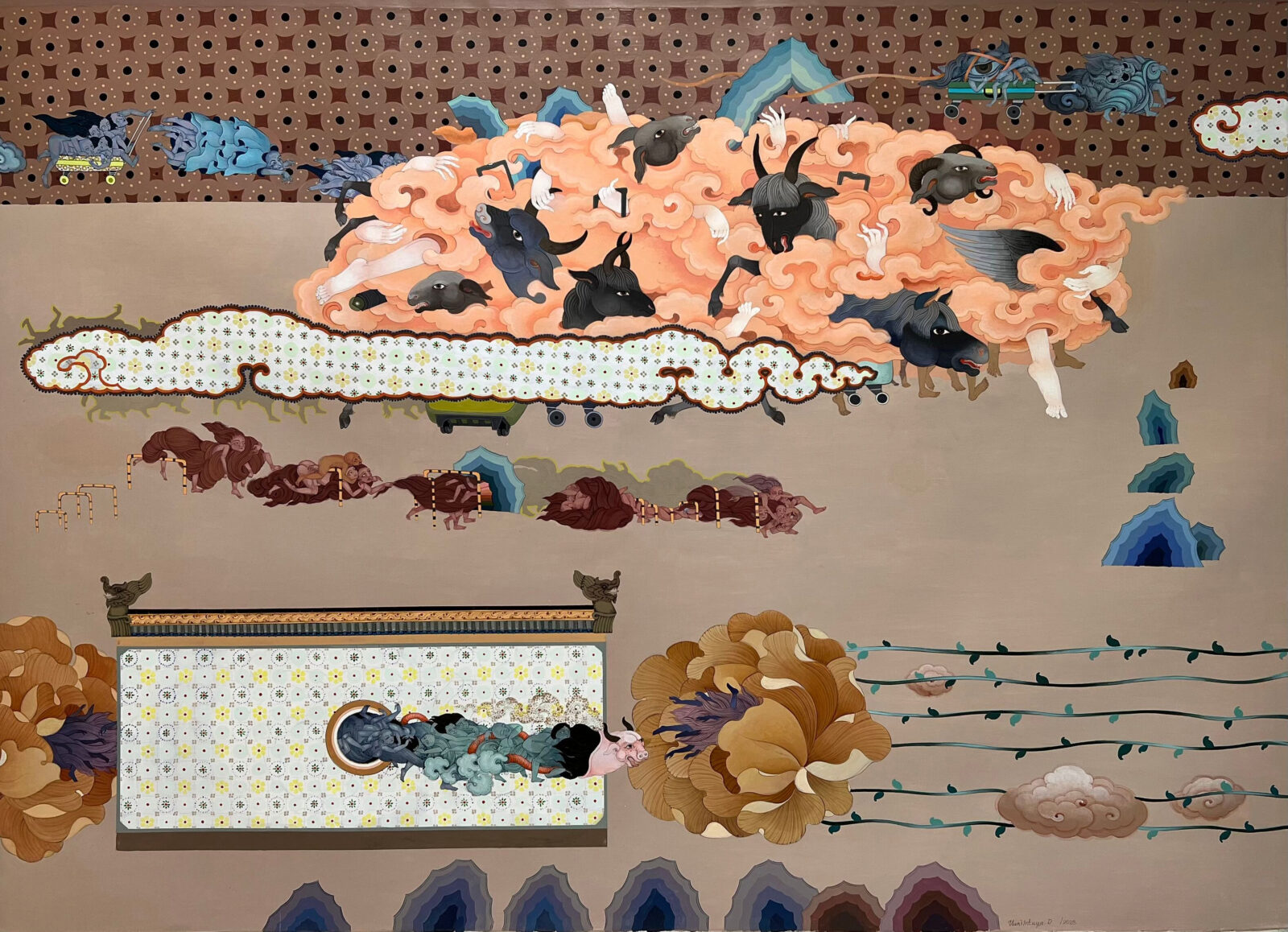
Uuriintuya Dagvasambuu; Floating World; 2023; acrylic on canvas; courtesy of Sapar Contemporary
Uuriintuya Dagvasambuu; Floating World; 2023; acrylic on canvas; courtesy of Sapar Contemporary
Uuriintuya Dagvasambuu is a contemporary artist based in Ulaanbaatar, Mongolia, who specializes in Mongol Zurag painting. This art form came out of the Cold War period as a reaction to the socialist government’s erasure of Buddhist iconography in favor of Socialist Realism. Dagvasambuu integrates traditional Mongolian and Buddhist motifs with contemporary themes, as she chronicles the lives of women and daily, mundane life across the seasons in her post-nomadic homeland.
Her art is featured in the Oglethorpe University Museum of Art (OUMA) exhibition Oneself and Cherished Traditions, alongside select objects from the Rubin Museum of Himalayan Art, Sapar Contemporary, and OUMA. The Rubin recently acquired Dagvasambuu’s painting, Dedicated to Women Migrants: Security II, and her work has also appeared in the Museum’s publication Spiral.
Color and rhythm. Sometimes color precedes words and imagery, carrying on its own. Music also helps me sense and express these feelings. I listen to music when I am painting. Life without music feels empty and without rhythm. Color is both an inspiration and a powerful expressive tool.
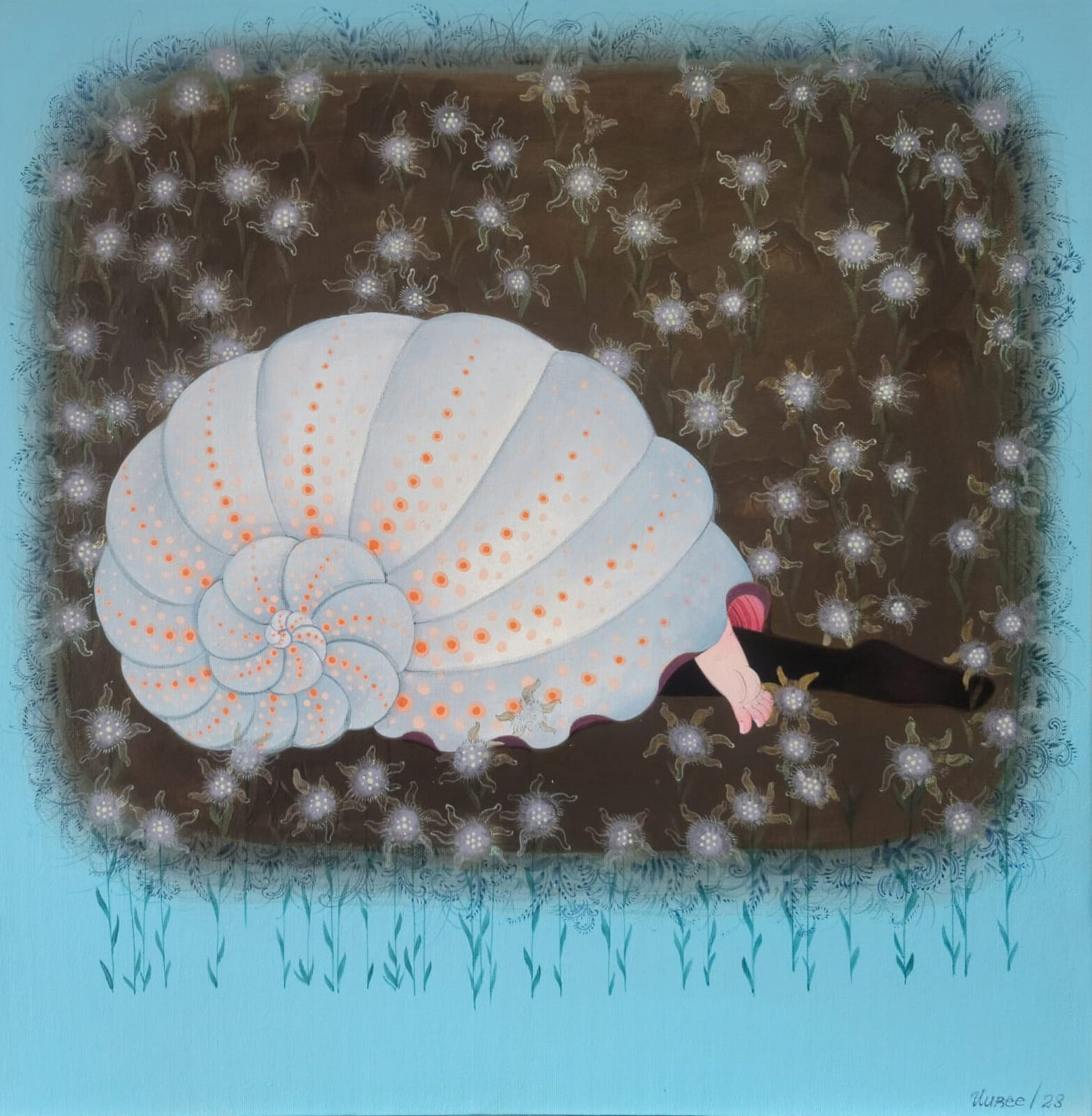
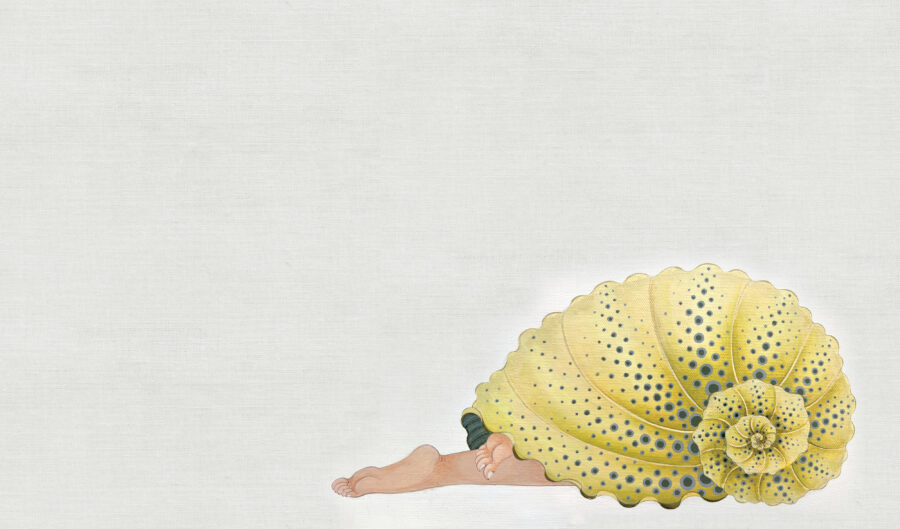
Uuriintuya Dagvasambuu; Vignette: Snail Black Stocking; 2023; acrylic on canvas; courtesy of Sapar Contemporary
There are many. I am deeply drawn to Himalayan and Tibetan art, as well as Western Surrealist artists.
I believe it has changed significantly. I feel content knowing that my work has gradually evolved alongside the times, moving forward with the rhythm of the contemporary world.
Yes. As a child, unlike many other girls, I didn’t have beautiful dolls—perhaps because I never asked my parents for them. Instead, my parents encouraged my creativity in wonderful ways. My mother, who was a librarian, would often bring home books filled with fascinating images, while my father gave me sculpting clay with which I created figures from my imagination. Looking back now, it feels insufficient to describe this process simply as “play.”
As a conscious artistic practice, however, my first true artworks were created much later, for my first exhibition in 2006.
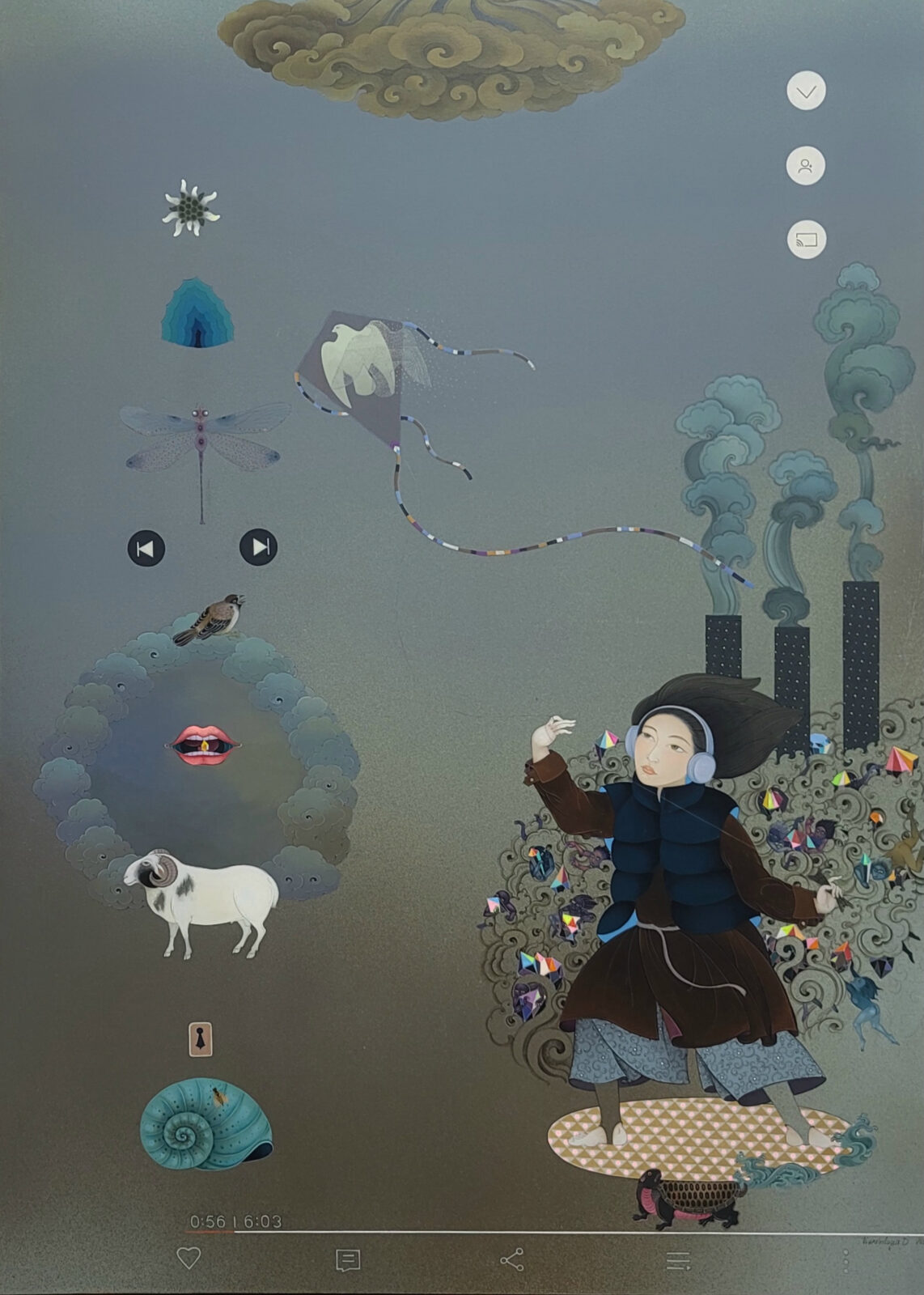
Uuriintuya Dagvasambuu; Woman in Ulaanbaatar: Dreams Carried by Wind; 2025; acrylic on canvas; courtesy of Sapar Contemporary
The process of making art is, for me, a way of sharing my inner emotions with others. I welcome and encourage each viewer to interpret the work in their own way. The symbols within my paintings are not meant to impose a single, fixed meaning; rather, they are open signs that intersect with the viewer’s own memories, experiences, and emotions. I hope my work begins with my feelings but then continues to live on as a multilayered simulation through the interpretations of its viewers.
Although my work often focuses on personal experiences—particularly the condition of women from an Asian and Eastern cultural perspective—these personal narratives are always rooted in broader, collective social issues.
Choosing to study Mongol Zurag initially felt almost accidental, but in retrospect, I realize it was the right decision. At first, traditional styles seemed outdated and monotonous to me. Over time, however, I became deeply interested in how tradition could be meaningfully connected to the present moment. I believe Mongol Zurag is a form that can transform endlessly. However, being called a “master” makes me feel quietly shy and modest.
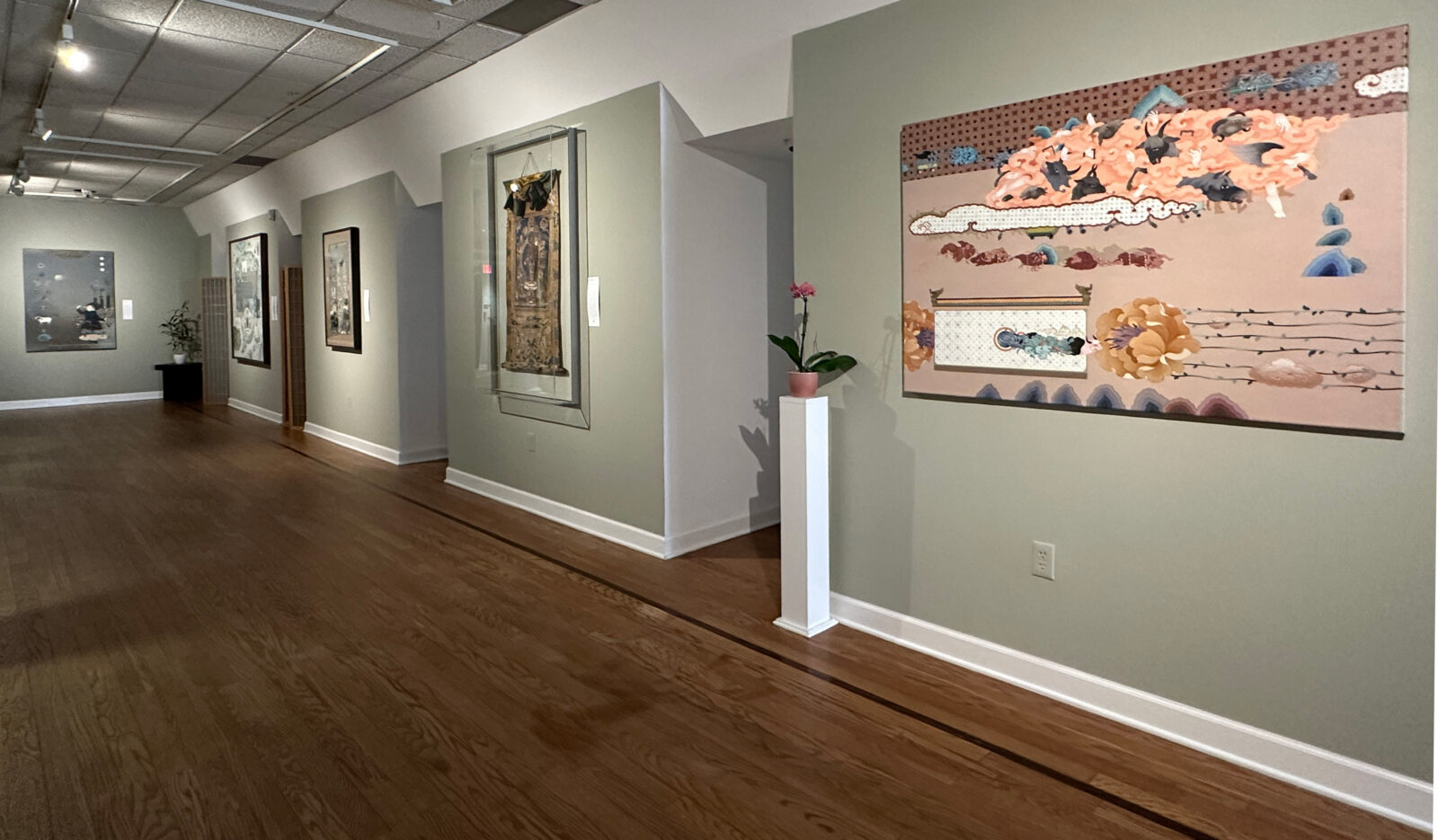
Installation view of Oneself and Cherished Traditions at the Oglethorpe University Museum of Art
As I mentioned, I am a devoted admirer of Himalayan art and thangka paintings. To have my work exhibited alongside these extraordinary pieces, sharing the same space within a single exhibition, is truly an honor for me.
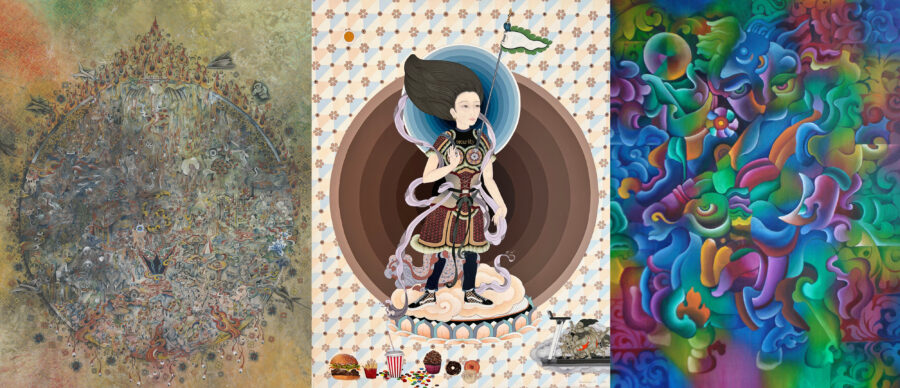
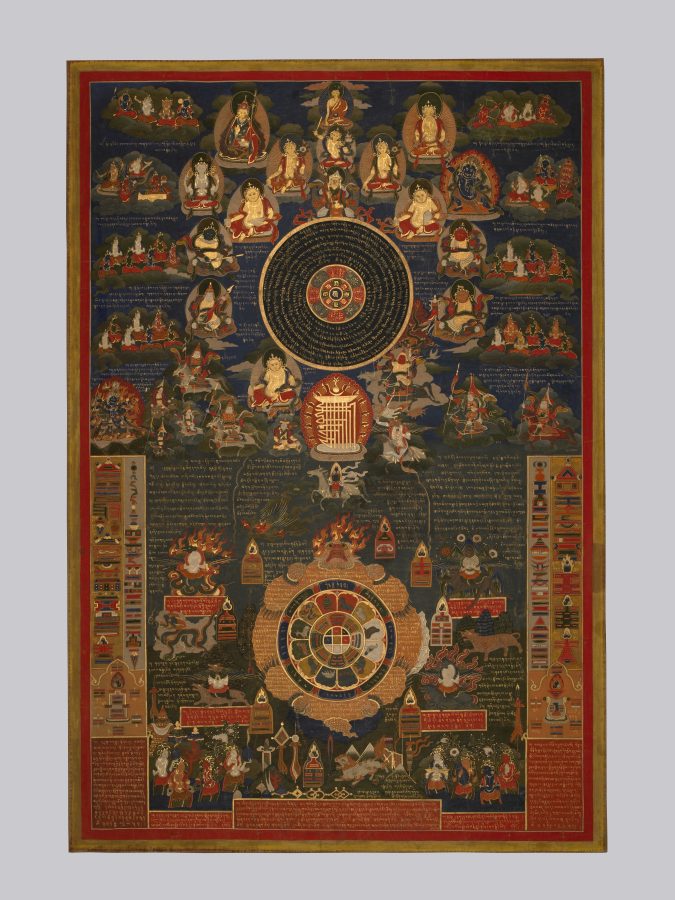
There are two works that absolutely fascinate me: an 18th-century Tibetan astrological scroll and a Tibetan protective astrological chart. At first glance, their compositional solutions stand out as somewhat different from the others, which immediately captured my attention. Upon closer observation and after reading the descriptions, I became even more intrigued by the symbolic imagery related to astrology and the cosmos.
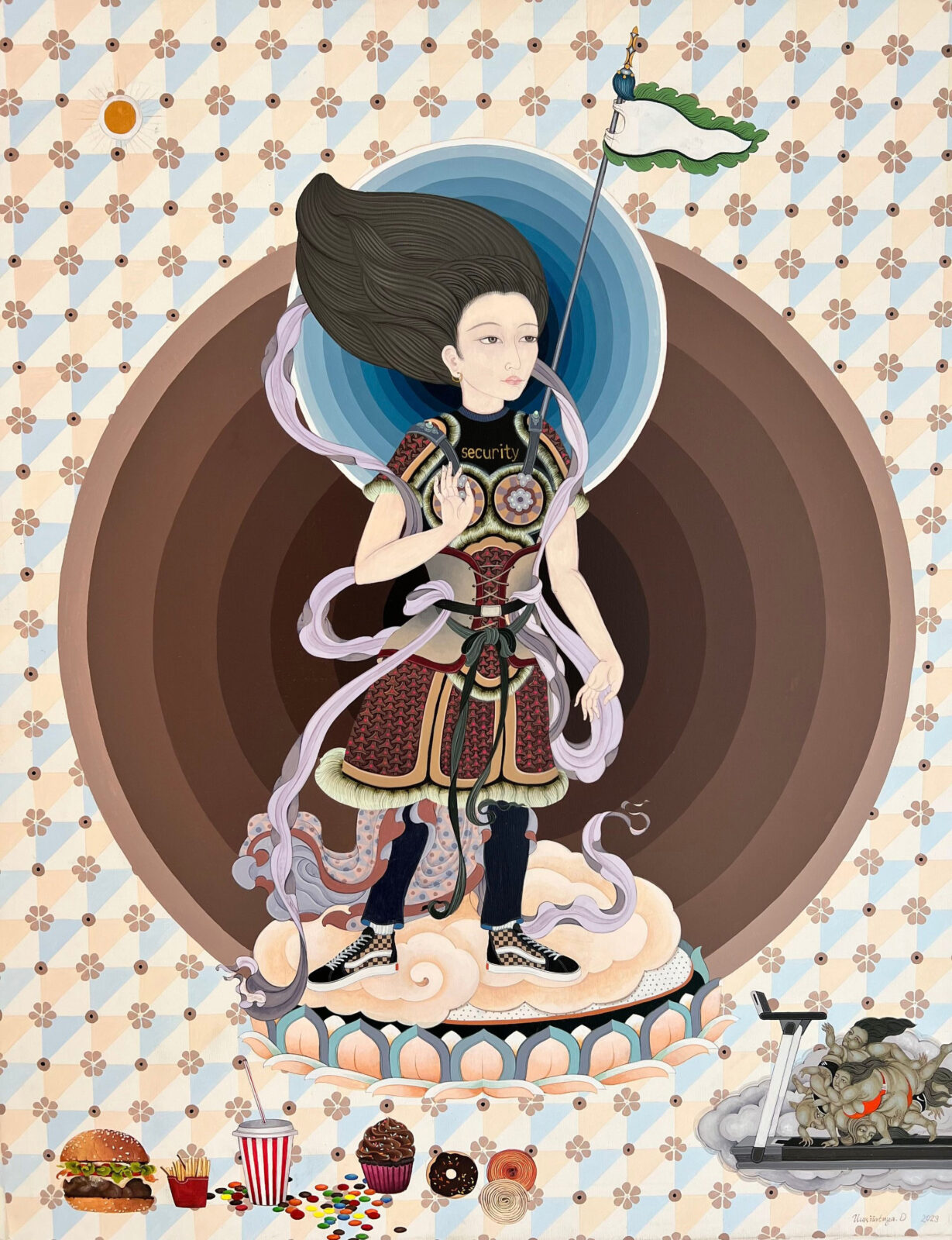
Uuriintuya Dagvasambuu; Dedicated to Women Migrants: Security II; 2023; acrylic on canvas; courtesy of the Rubin Museum of Himalayan Art
Many monasteries once existed in Mongolia, but most were destroyed during the political purges of 1937 by the communist regime. Fortunately, one temple remained in Ulaanbaatar, and today it stands preserved as a museum. While visiting this museum, I encountered the four Buddhist heavenly kings figures, and in that moment, I felt inspired to reimagine them in female form. It was then that I deeply realized that the power to protect, to guard, to stand watch, and to uphold does not have to be expressed solely through male figures.
The archetype of the guardian transcends the boundaries of gender—it is a symbol that exists on a level of consciousness. Thus, my female representations of the guardians are not merely a visual transformation but a philosophical reflection on the possibility of strength and compassion coexisting, and on the inner and outer guardian qualities inherent in women.
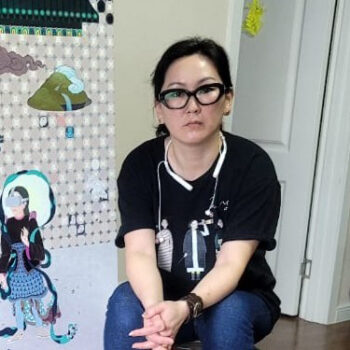
Uuriintuya Dagvasambuu (b. 1979) is based in Ulaanbaatar, Mongolia, and is known as a contemporary master of the Mongol Zurag painting and is widely respected for her innovations in this style. Mongol Zurag, which has its roots in the Cold War period, was a reaction to the socialist government’s erasure of Buddhist iconography in favor of Socialist Realism. Dagvasambuu integrates traditional Mongolian and Buddhist motifs with contemporary themes, as she chronicles the lives of women and daily, mundane life across the seasons in her post-nomadic homeland. Dagvasambuu graduated from the Institute of Fine Arts, Mongolian University of Arts and Culture, and has exhibited internationally. Her work is in the collections of the Dallas Museum of Art, Allen Memorial Art Museum at Oberlin College, Smith College Museum of Art, Johnson Museum of Art at Cornell University, Hood Museum of Art at Dartmouth, Queensland Art Museum in Australia, Fukuoka Asian Art Museum in Japan, and the Ruth and Elmer Wellin Museum of Art.

Christina Watson is the digital editor at the Rubin Museum of Himalayan Art.

Get the latest news and stories from the Rubin, plus occasional information on how to support our work.