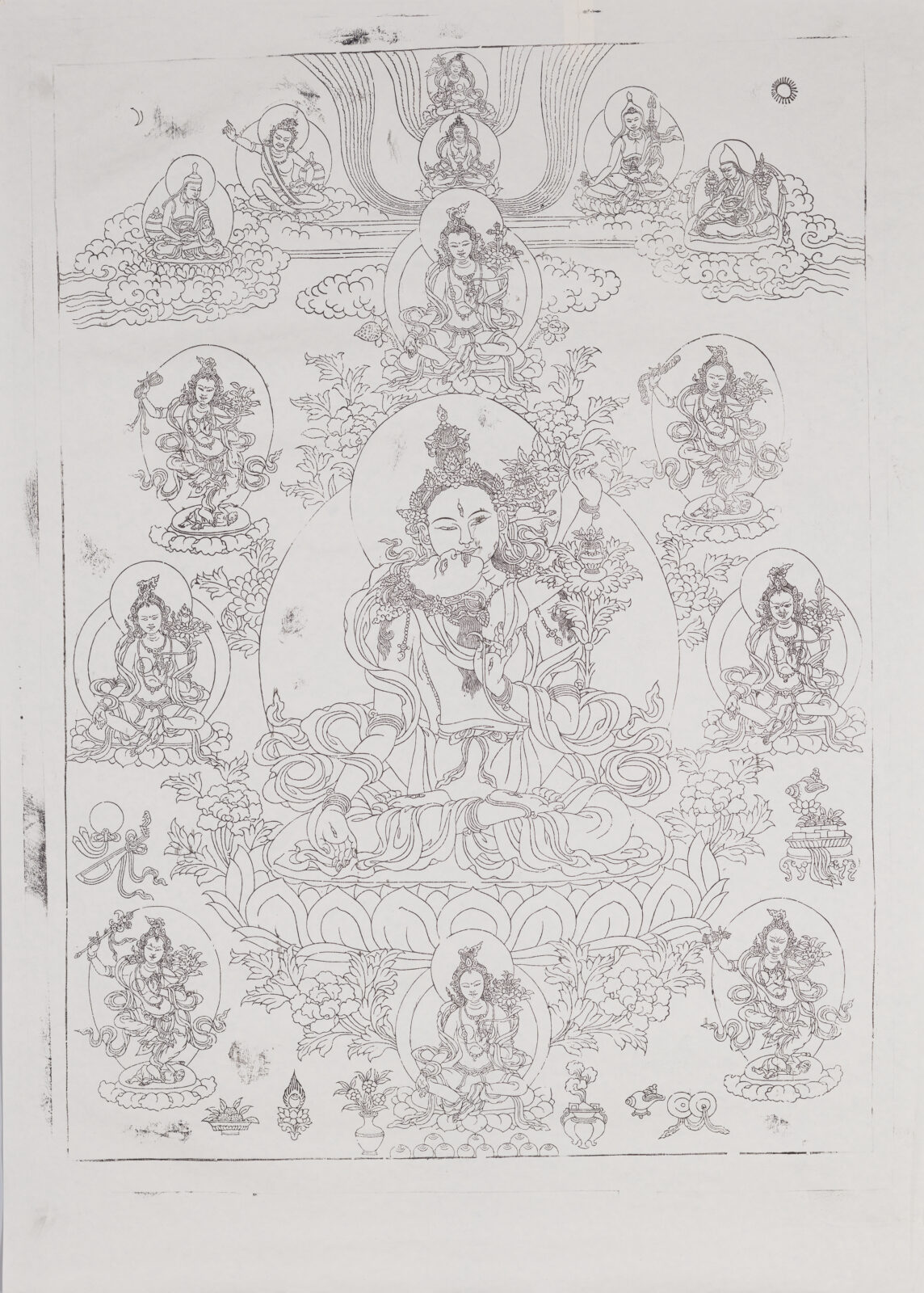
White Tara and Consort. Derge Printing House, Derge, Kham Region, Eastern Tibet; 2000. Xylograph, ink on paper. Rubin Museum of Himalayan Art, Gift of Jane M. Farmer. SC2023.1.59
White Tara and Consort. Derge Printing House, Derge, Kham Region, Eastern Tibet; 2000. Xylograph, ink on paper. Rubin Museum of Himalayan Art, Gift of Jane M. Farmer. SC2023.1.59
Three hundred woodblock prints in the Rubin’s collection are from the same Tibetan printing house
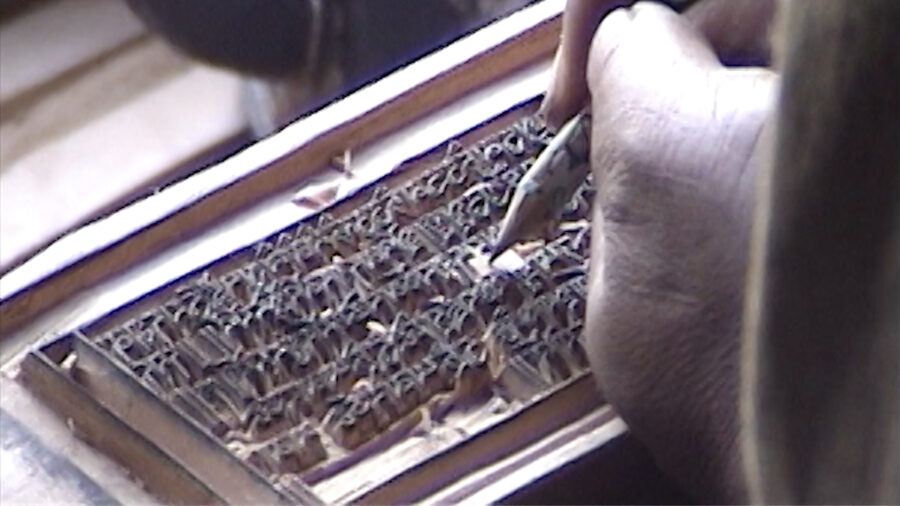
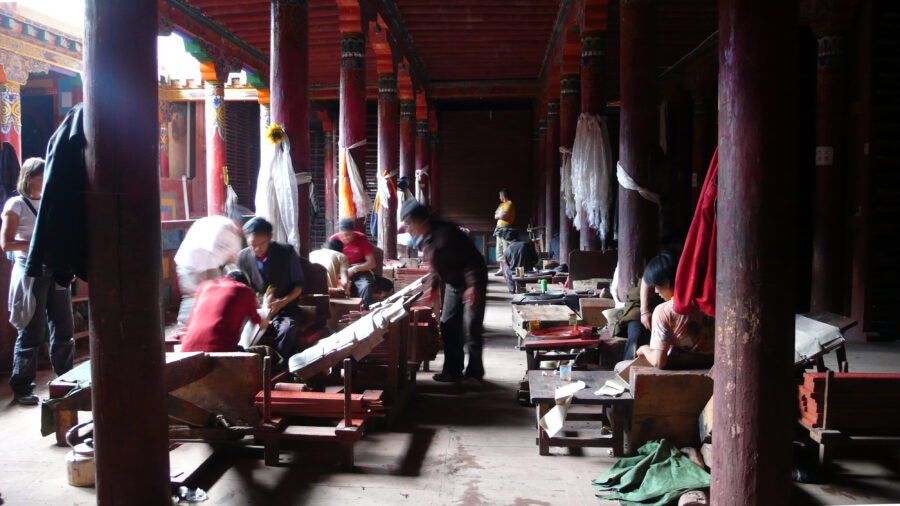
The study of Tibetan, Himalayan, and Inner Asian art is a young and developing field, and new visual and textual evidence can change how we understand objects from these regions. For instance, 300 of the woodblock prints in the Rubin Museum’s collection come from the same location, the famous Derge Printing House (Derge Parkhang), in the Kham region of southeastern Tibet, which is still an active site of cultural production today.
During one of Senior Curator Karl Debreczeny’s visits to this printing house, he acquired an extensive bilingual Tibetan-Chinese book that Derge copublished. According to Dr. Debreczeny, “This book was important for the identification of the prints’ source, subject matter, figures depicted, and inscription content. It even attributes compositions and sets to specific artists, information often lost for objects removed from their original contexts. It is quite an unusual boon to have such extensive documentation from an object’s source of creation that one can draw on in its study.”
This book proved essential during the Rubin’s recent assessment of the woodblock prints in the collection. Museums regularly conduct assessments to evaluate the objects in their collections. Begun in 2016, the Rubin’s collection assessment is an ongoing multiyear collaboration between the collections management and curatorial departments, with the goal of making the Museum’s entire collection of nearly 4,000 objects from the greater Himalayan region accessible online.
Below are some exquisite examples of woodblock prints that were examined during the collection assessment and are now available to the public through the Rubin’s online collection.
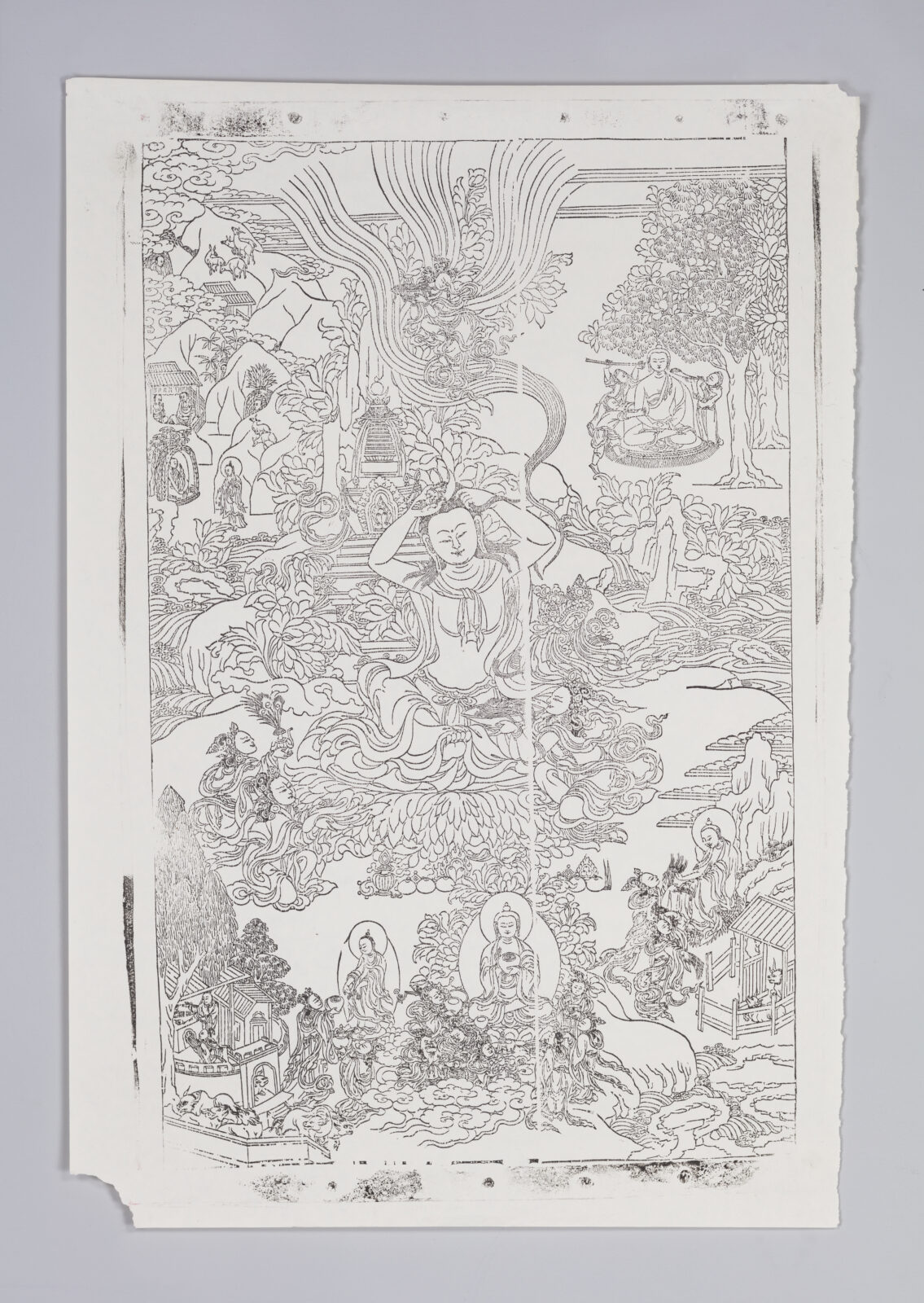
Renunciation and Asceticism; Derge Printing House, Derge, Kham Region, Eastern Tibet; ca. 1979; Xylograph, ink on paper; Rubin Museum of Himalayan Art, Gift of William Hinman; C2001.4.4
This is the third composition from a set of nine depicting key scenes from the life story of Buddha Shakyamuni, known as the Twelve Deeds of the Buddha. This image depicts the sixth and seventh deeds—Renunciation and Asceticism/Austerities—signified by the cutting of his hair. At the foot of the Immaculate Stupa, the Buddha removed his ornaments and cut his hair. Indra, seen floating in rainbow light above the Buddha, gathered the hair and took it to Trayastrimsha Heaven where it was placed in a stupa to be worshiped by the gods.
The Rubin also has a painting based on this print.
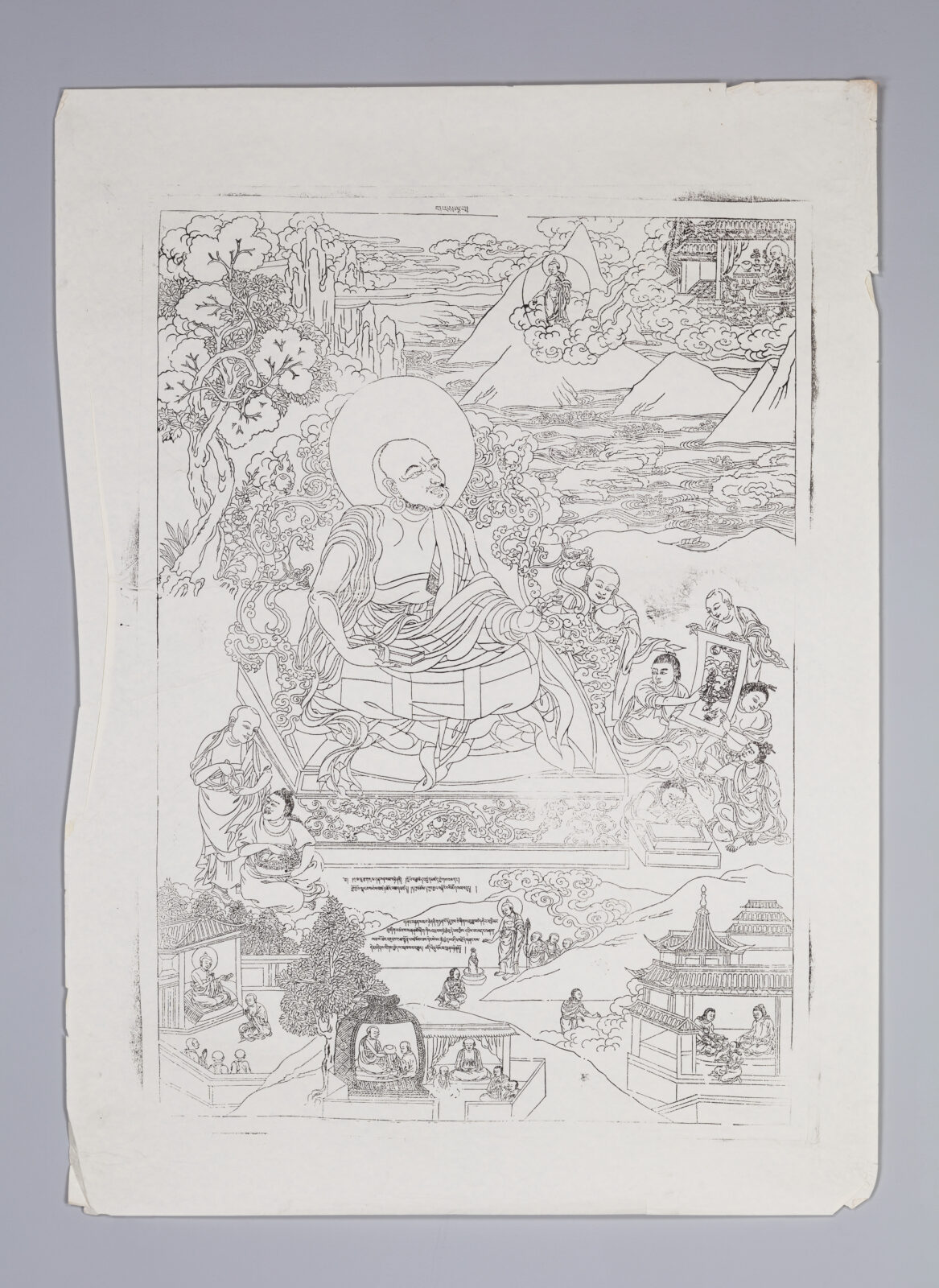
The Arhat Pantaka; Derge Printing House, Derge, Kham Region, Eastern Tibet; ca. 1979; Xylograph, ink on paper; Rubin Museum of Himalayan Art, Gift of William Hinman; C2001.4.18
This is the ninth composition from a set of 23 images depicting 16 arhats, the principal disciples of Buddha Shakyamuni. It depicts Pantaka, the thirteenth of the 16 arhats, who is said to live in the Heavens of the 33 Gods. He can be recognized by the book he holds and the teaching gesture he makes. In the Tibetan tradition, arhats usually appear together as a group of 16, flanking a central Buddha figure, as well as an attendant, patron, and four guardian kings, as seen in this set. As a genre, arhat painting often carries with it aspects of Chinese artistic and material culture.
An interesting detail at mid-right shows attendants displaying a painting—art depicted within art.
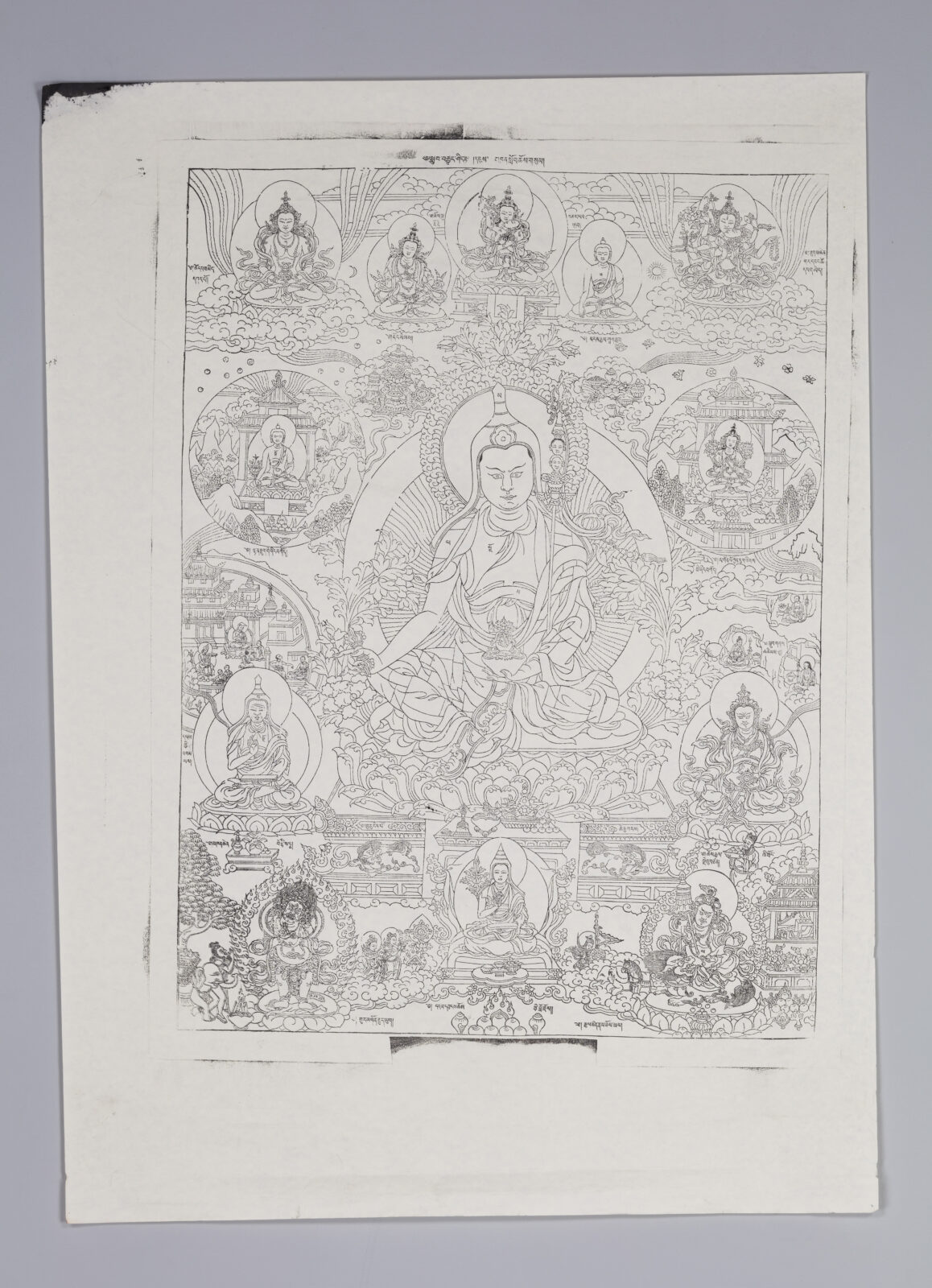
The Abbot, the Master, and the Dharma King: Shantarakshita, Padmasambhava, Tri Songdetsen (742-796) and the Nyingma Tradition; Derge Printing House, Derge, Kham Region, Eastern Tibet; ca. 1979; Xylograph, ink on paper; Rubin Museum of Himalayan Art, Gift of William Hinman; C2001.4.105
This print is from a set of nine compositions of the Eight Chariots of the Practice Lineage, which describe the eight schools of Buddhism that flourished in Tibet according to the classification system of the famous Derge scholar Jamgon Kongtrul (1813–1899). This is the central composition of the set, depicting the founding figures of Buddhism in Tibet as the root on the Nyingma tradition: the Abbot, the Master (Acharya), and the Dharma King—Shantarakshita, Padmasambhava, and King Tri Songdetsen (742–796). A detail at left shows Samye, Tibet’s first monastery, established in 779 by the three figures depicted here, a seminal moment in the establishment of Buddhism in Tibet.
Color notations, indicating what colors to use when painting the composition, can be seen throughout the image, such as “ma” for marpo (red) in the central figure’s hat.
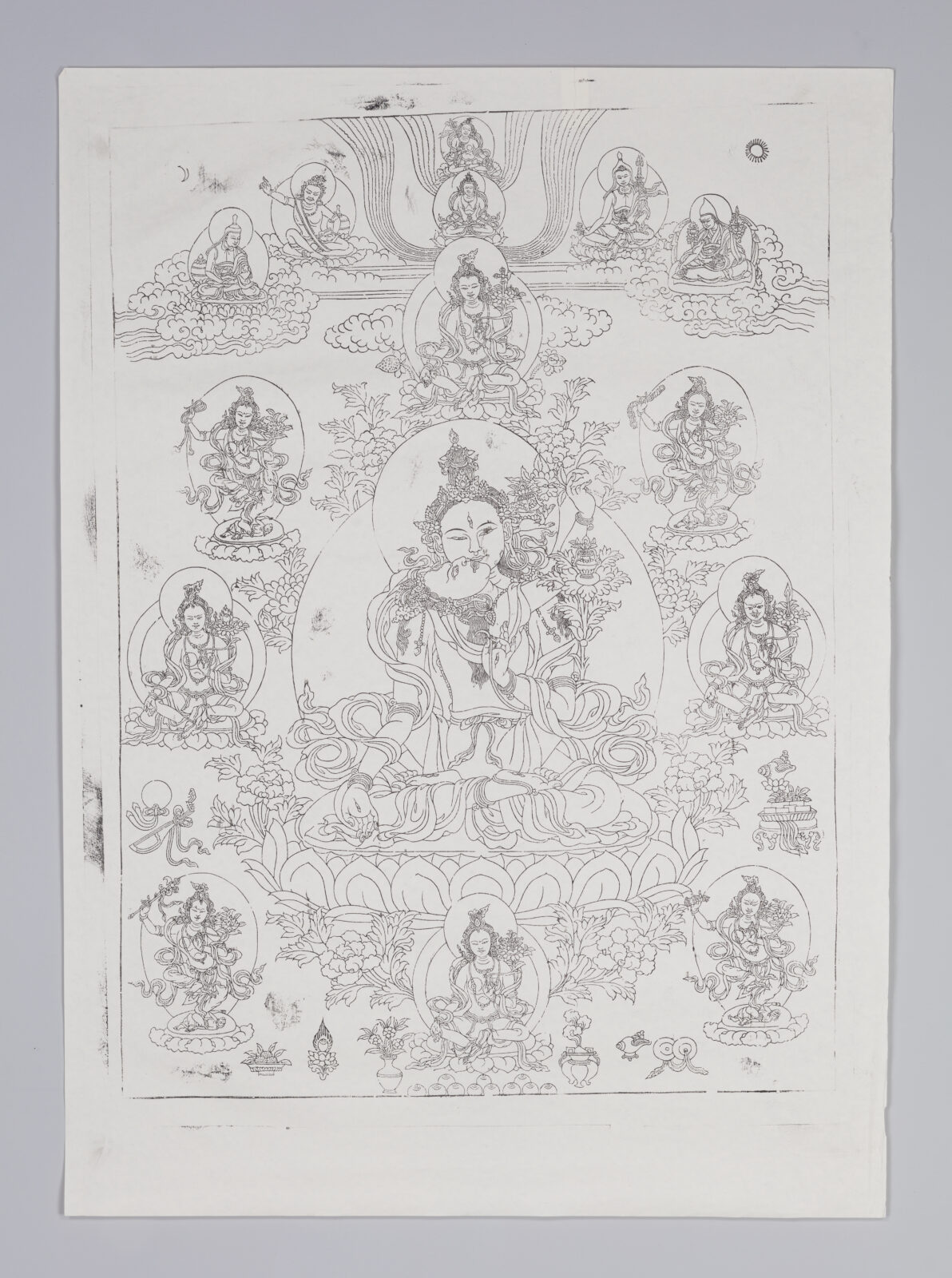
White Tara and Consort; Derge Printing House, Derge, Kham Region, Eastern Tibet; 2000; Xylograph, ink on paper; Rubin Museum of Himalayan Art, Gift of Jane M. Farmer; SC2023.1.59
Longevity goddess White Tara is shown here in union with her consort. In this print the female deity is dominant, a rare occurrence in Buddhist art. The model for this composition is attributed to the painter Tangla Tsewang (1902–1989), a Karma Gardri painting master and scholar from nearby Pelpung Monastery, as well as scribe and court painter to the eleventh Situ incarnation.
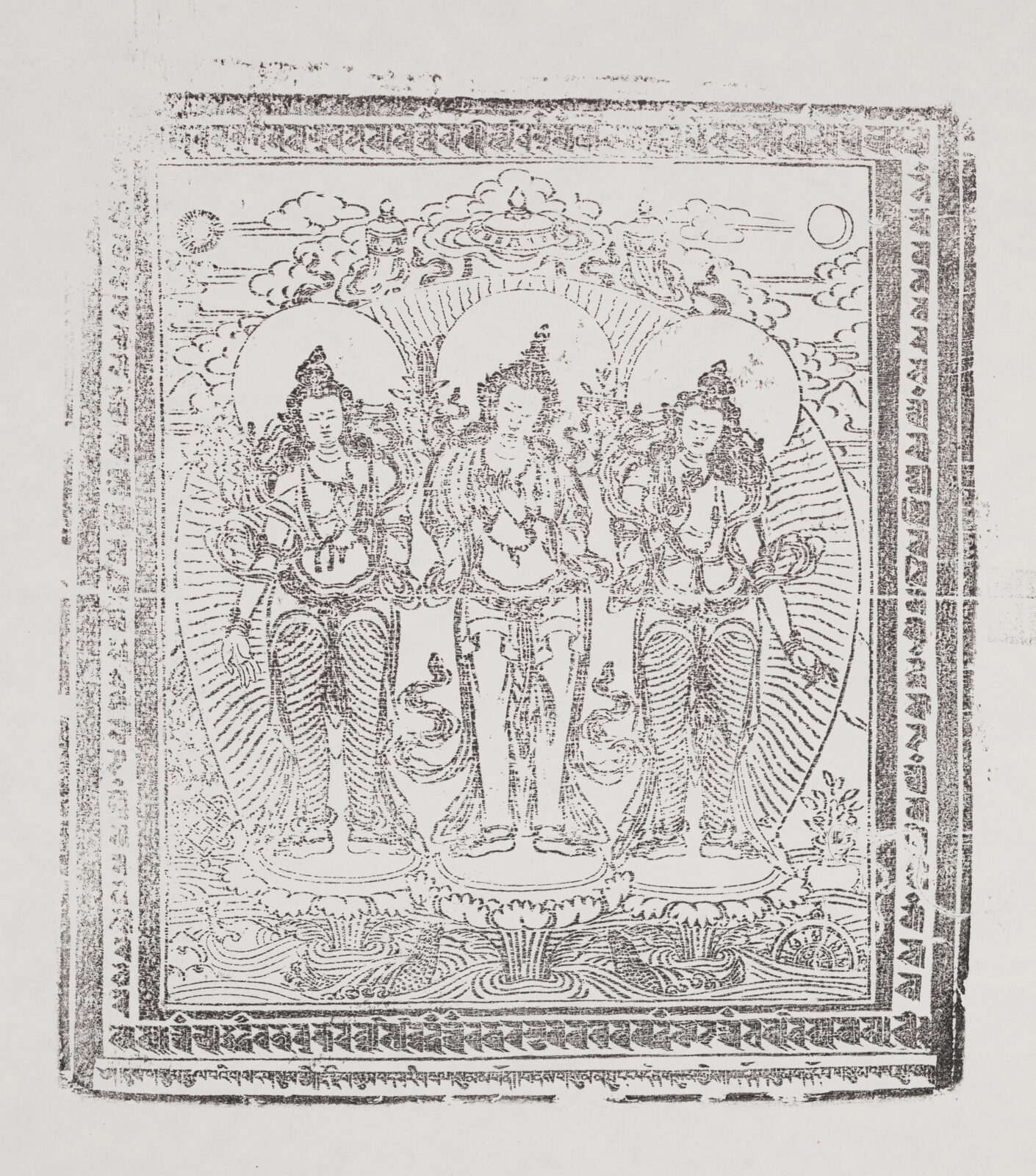
Lords of the Three Families: Manjushri, Avalokiteshvara, and Vajrapani; Derge Printing House, Derge, Kham Region, Eastern Tibet; 20th century; Xylograph, ink on paper; Rubin Museum of Himalayan Art, Gift of William Hinman; C2001.4.58
This print depicts the Lords of the Three Families, also known as the Three Lords of the World. The three enlightened families are the Buddha Family, represented by Manjushri who embodies wisdom; the Lotus Family, represented by Avalokiteshvara who symbolizes compassion; and the Vajra Family, represented by Vajrapani who signifies power.
The places where the image is not printed clearly indicates the wear of the block and suggests this image was printed from one of the older surviving woodblocks at the Derge Printing House still in use.
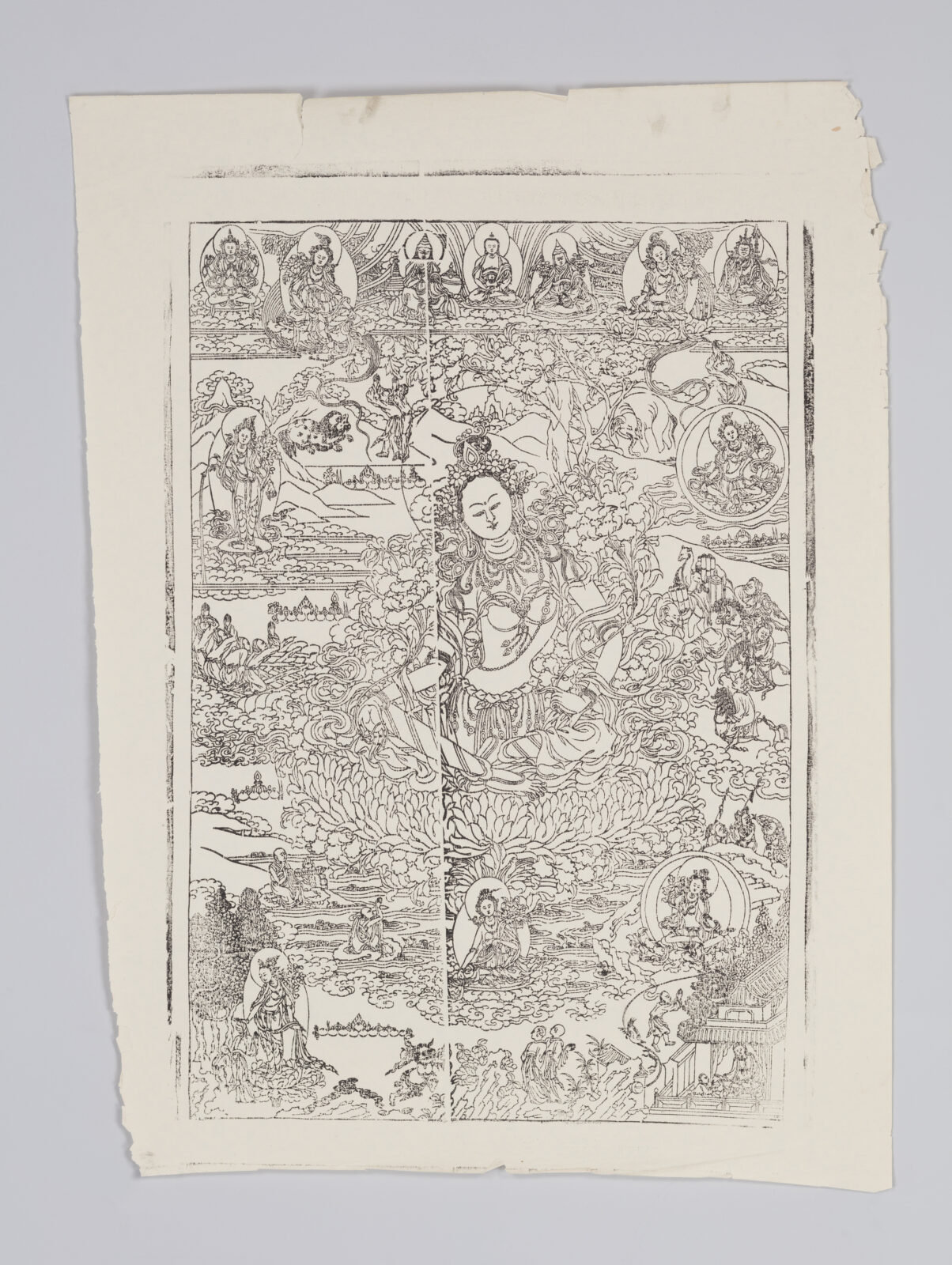
Green Tara as Savioress from the Eight Fears; Derge Printing House, Derge, Kham Region, Eastern Tibet; ca. 1979; Xylograph, ink on paper; Rubin Museum of Himalayan Art, Gift of William Hinman; C2001.4.71
Tara is one of the most popular female deities in Tibetan culture. She is particularly associated with providing protection from a group of dangers known as the eight fears, depicted here in the scenes surrounding her: ghosts/sickness (bottom center), drowning (center), fire (mid-left), false imprisonment (bottom right), bandits (mid-right), wild elephants (top right), snakes (bottom left), and lions (top left). Although these dangers center on the worries of secular life, they also have more esoteric meanings, namely associations with inner obstacles that prevent spiritual progress.
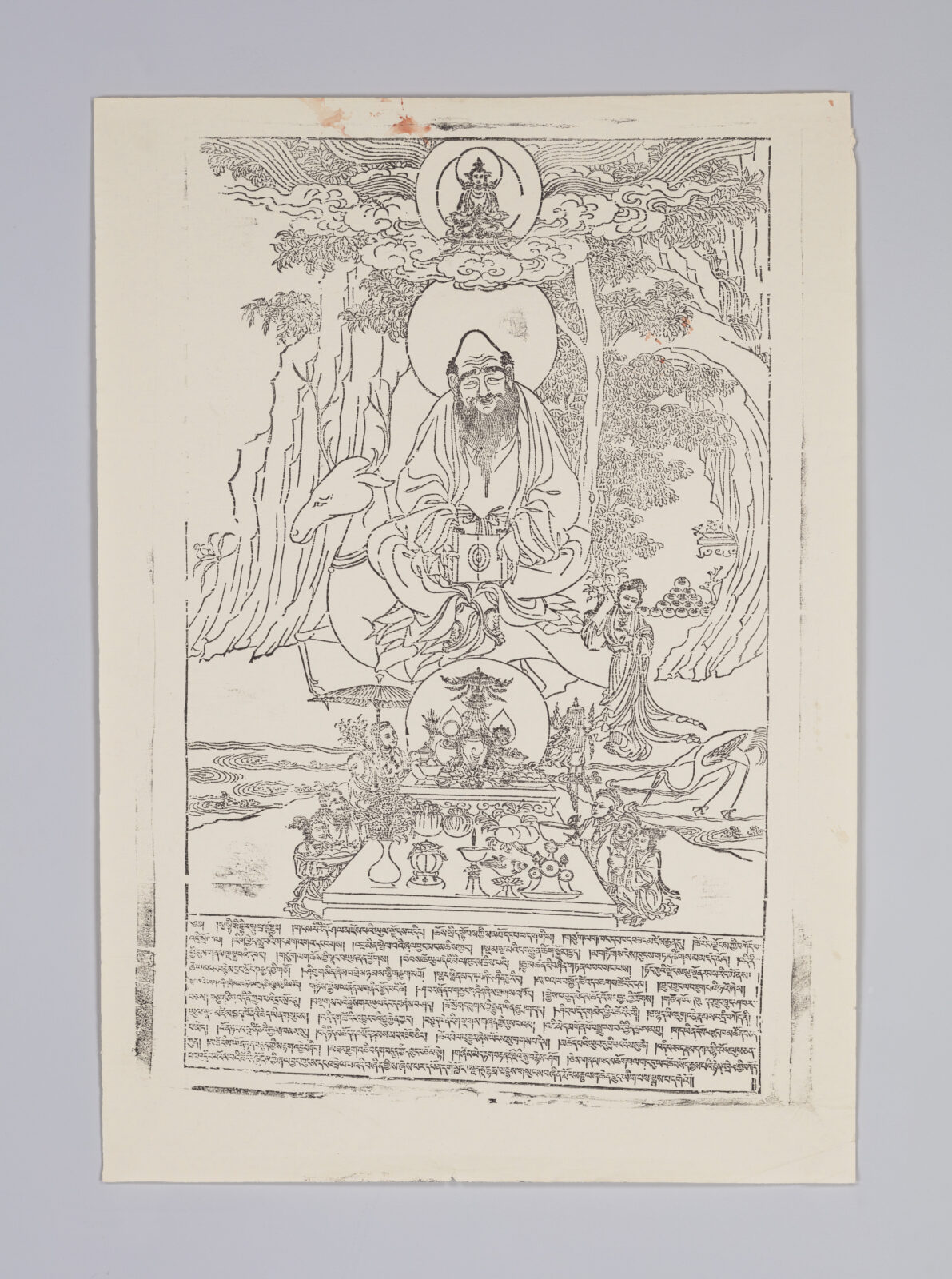
Six Symbols of Long Life; Derge Printing House, Derge, Kham Region, Eastern Tibet; ca. 1979; Xylograph, ink on paper; Rubin Museum of Himalayan Art, Gift of William Hinman; C2001.4.87
This depiction of the Six Symbols of Long Life is based on Chinese Daoist immortal imagery. The central figure, the Sage of Long Life, is seated on the antelope of long life, framed behind by the tree of long life and the rock of long life. At front is the water of long life, with the bird of long life, typically depicted as a white crane or pair of cranes. The Buddha of Infinite Life Amitayus floats above him.
According to the Derge Printing House, the original composition this print is based on was made following the instructions of Zhuchen Tsultrim Rinchen (1697–1774), a famous editor and designer of paintings, who became heavily involved in the publishing activities of the newly founded Derge Printing House (where this print was produced) in the 1730s under the patronage of the King of Derge.
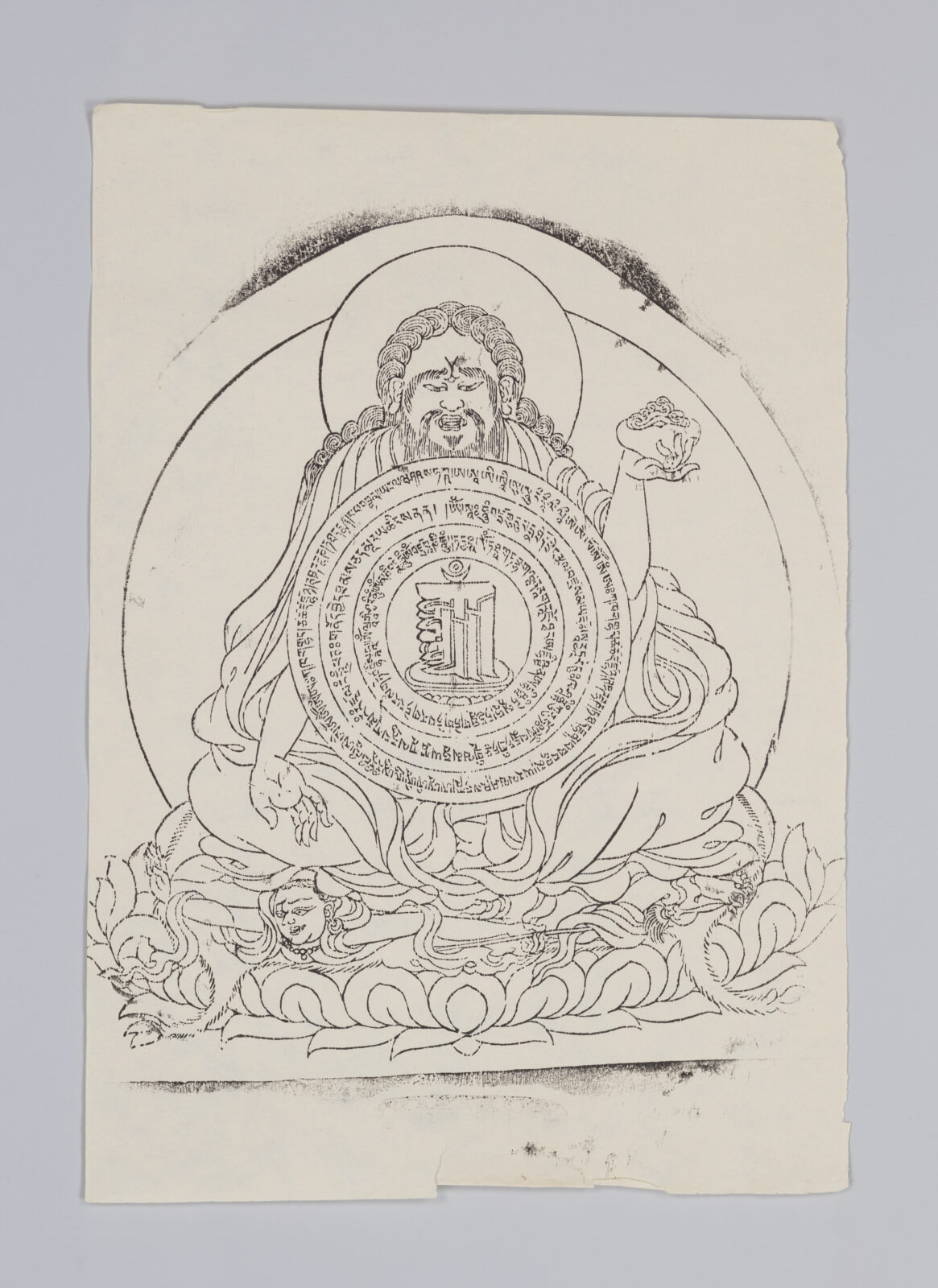
Tangtong Gyelpo Protection Against Earthquake Yantra; Derge Printing House, Derge, Kham Region, Eastern Tibet; ca. 1979; Xylograph, ink on paper; Rubin Museum of Himalayan Art, Gift of William Hinman; C2001.4.151
Tangtong Gyelpo (1361–1485) is a Tibetan cultural hero renowned for engineering, medicine, and geomancy. His protective circle (yantra) serves as protection against earthquakes.
Learn more about the practice of woodblock printing in Project Himalayan Art.
Karl Debreczeny is senior curator, collections and research, at the Rubin Museum of Himalayan Art. His research focuses on artistic, religious, and political exchanges between the Tibetan and Chinese traditions. His publications include The Black Hat Eccentric: Artistic Visions of the Tenth Karmapa (2012) and the coedited The Tenth Karmapa and Tibet’s Turbulent Seventeenth Century (2016). More →

Christina Watson is the digital editor at the Rubin Museum of Himalayan Art.
Get the latest news and stories from the Rubin, plus occasional information on how to support our work.