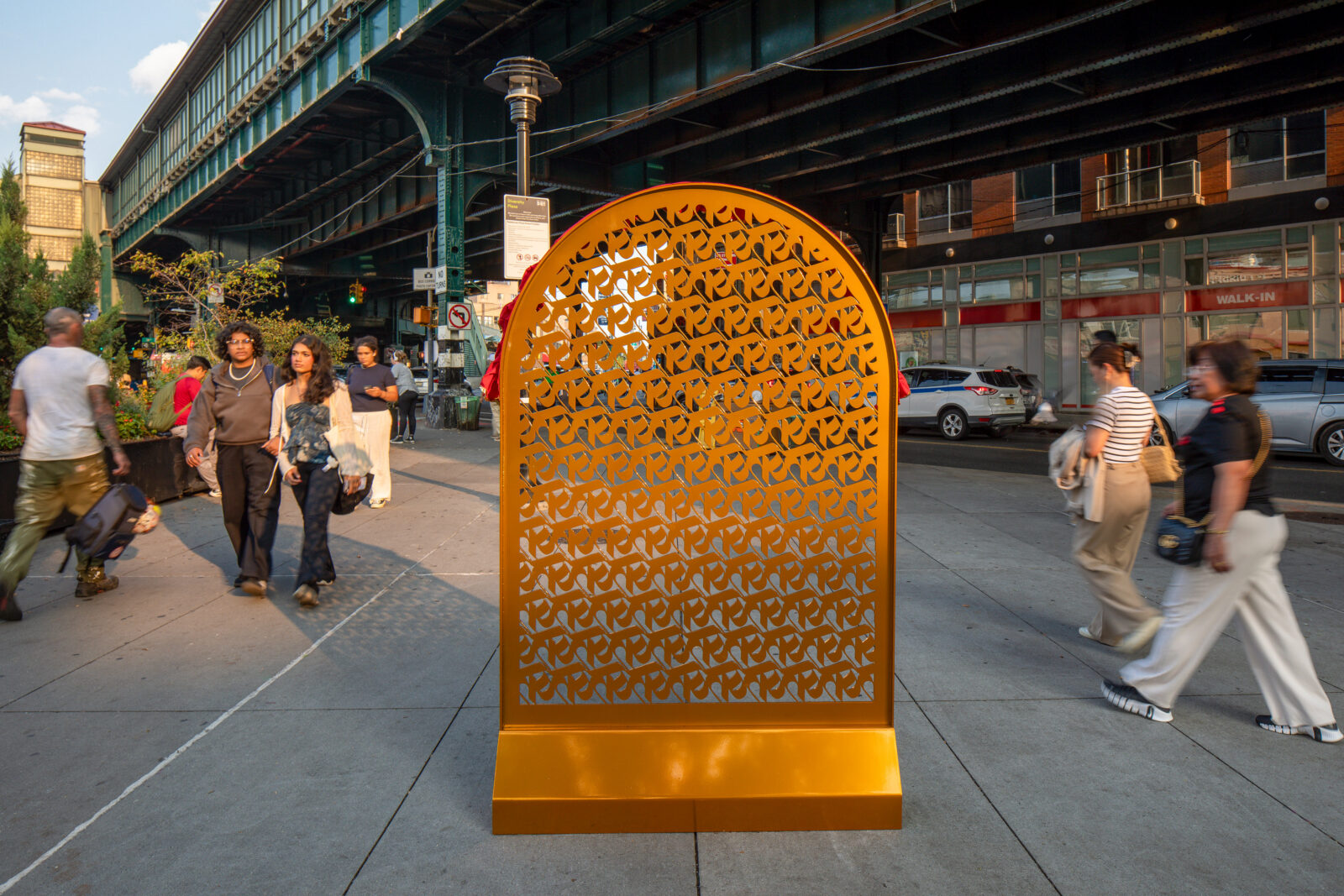
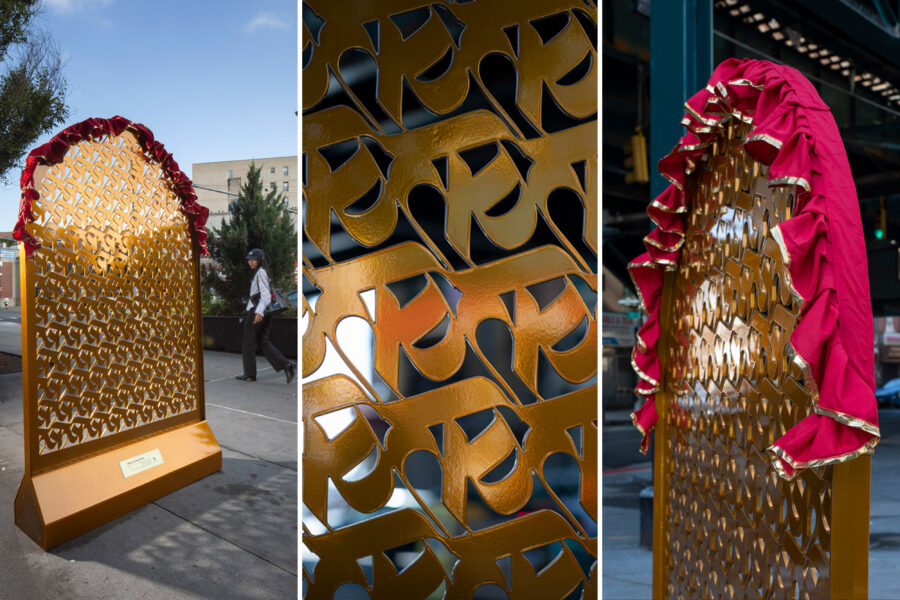
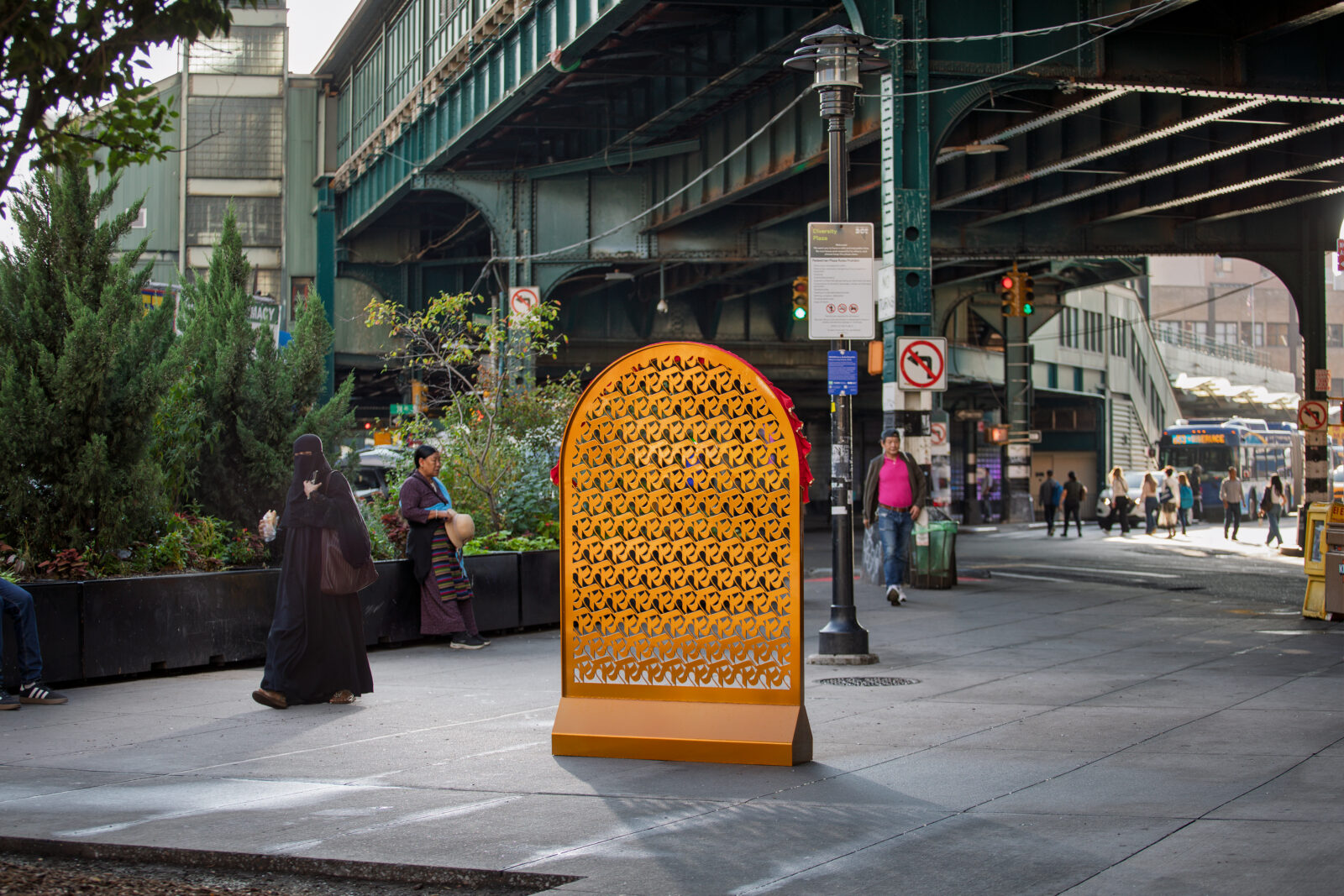
A gold arch made of repeating rows of ka, the first letter of the Nepali alphabet, near a green bridge with pedestrians walking nearby

IMAGINE (a.k.a. Sneha Shrestha) (b. 1987, Kathmandu, Nepal); About a Living Culture; powder coated steel and fabric; 2025; Diversity Plaza, Queens, New York City; courtesy of the artist, presented by the Rubin Museum of Himalayan Art and New York City Department of Transportation; fabricated in collaboration with Black Cat Labs; photo by Nicholas Knight

Nepali artist IMAGINE’s first public art sculpture offers an intimate moment within a bustling New York City neighborhood

For her first public art sculpture, Nepali artist IMAGINE created About a Living Culture, an installation in the shape of an arch made of repeating rows of ka, the first letter of the Nepali alphabet. IMAGINE’s sculpture invites New Yorkers into a space of reflection and belonging as they travel through Diversity Plaza, a bustling social, cultural, commercial, and transit hub located in Jackson Heights, Queens—one of New York City’s most diverse and densely populated neighborhoods and home to large Himalayan diaspora communities.

About a Living Culture is a NYC DOT (Department of Transportation) Art Community Commission in partnership with the Rubin. Community Commissions is a signature initiative in which the agency collaborates with community-based organizations to commission artists to design and install temporary public art on NYC DOT infrastructure citywide.

Michelle Bennett Simorella: Could you tell us about your art practice?

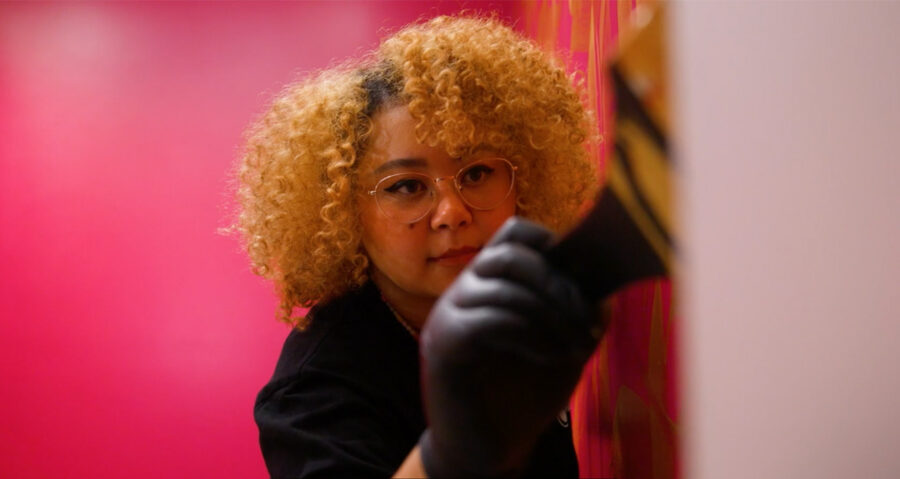
IMAGINE (a.k.a. Sneha Shrestha): I’ve enjoyed painting all my life. But once I moved to Boston, I was introduced to graffiti, this movement started by young people out of rebellion and this idea of looking at letters as images. My mind was blown. Over time, my mentor, Rob “Problak” Gibbs, taught me how to spray paint and more about the art form, and I would paint some walls here and there.

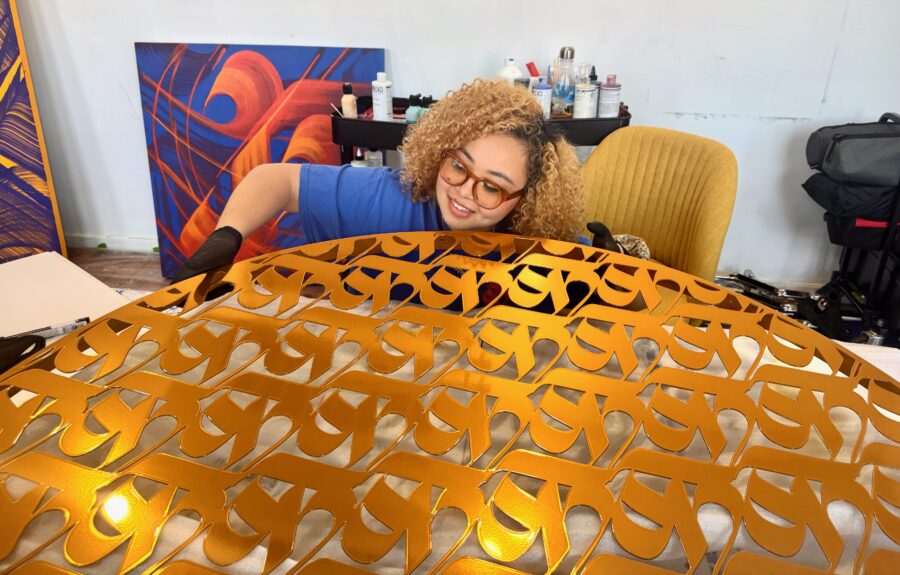
But over the years, I thought, where’s my voice in this? I really want to connect this back to my culture. It led me down this rabbit hole of doing research on 14th-century Nepali manuscripts. I started taking a lot of inspiration and mixing graffiti hand styles with traditional manuscript scripts. Now my paintings are a fusion of both of these worlds and a metaphor for my life coming together from Nepal and being in the United States.

Recently my practice has extended into sculptures. I have done public art before—really large murals—but I haven’t done public art sculptures, which is a whole different sort of experience.
I wanted to create something that would speak to the living culture of the Himalayan diaspora and speak to the resilience of the culture as well.

It was so exciting to have your first public sculpture be a collaboration with Rubin and the DOT. It makes such a statement in Diversity Plaza.

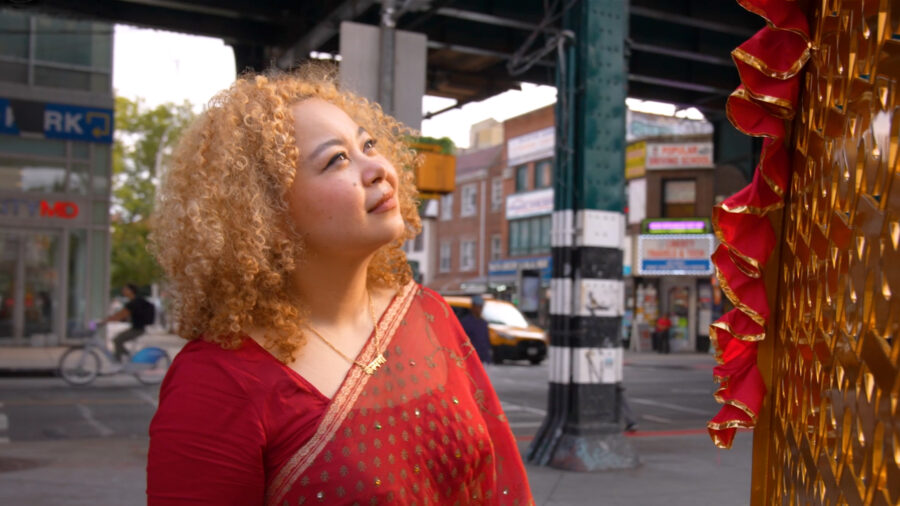
I really wanted to create something that had a presence but also a welcoming presence. I hoped that when people from the Himalayan diaspora and various minority cultures saw it, they would see a part of their home in it. Not literally, but the feeling—maybe it’s the color, maybe it will remind them of the architecture, maybe it will be the fluttering jhallar that is a familiar sight in so many Himalayan cultures.

I wanted to create something that would speak to the living culture of the Himalayan diaspora and speak to the resilience of the culture as well. This culture lives beyond museums. It lives in our everyday lives and evolves with us.

We’re living, breathing people who practice this culture on a daily basis. And this is what it looks like now. That’s what I want to share at the heart of this. I think it’s an important message to share, not just to the Himalayan diaspora but to people in general, that cultures all over the world are resilient and evolving in different ways. There are contemporary practices that have basis in centuries-old traditions. And through that we find our community too.

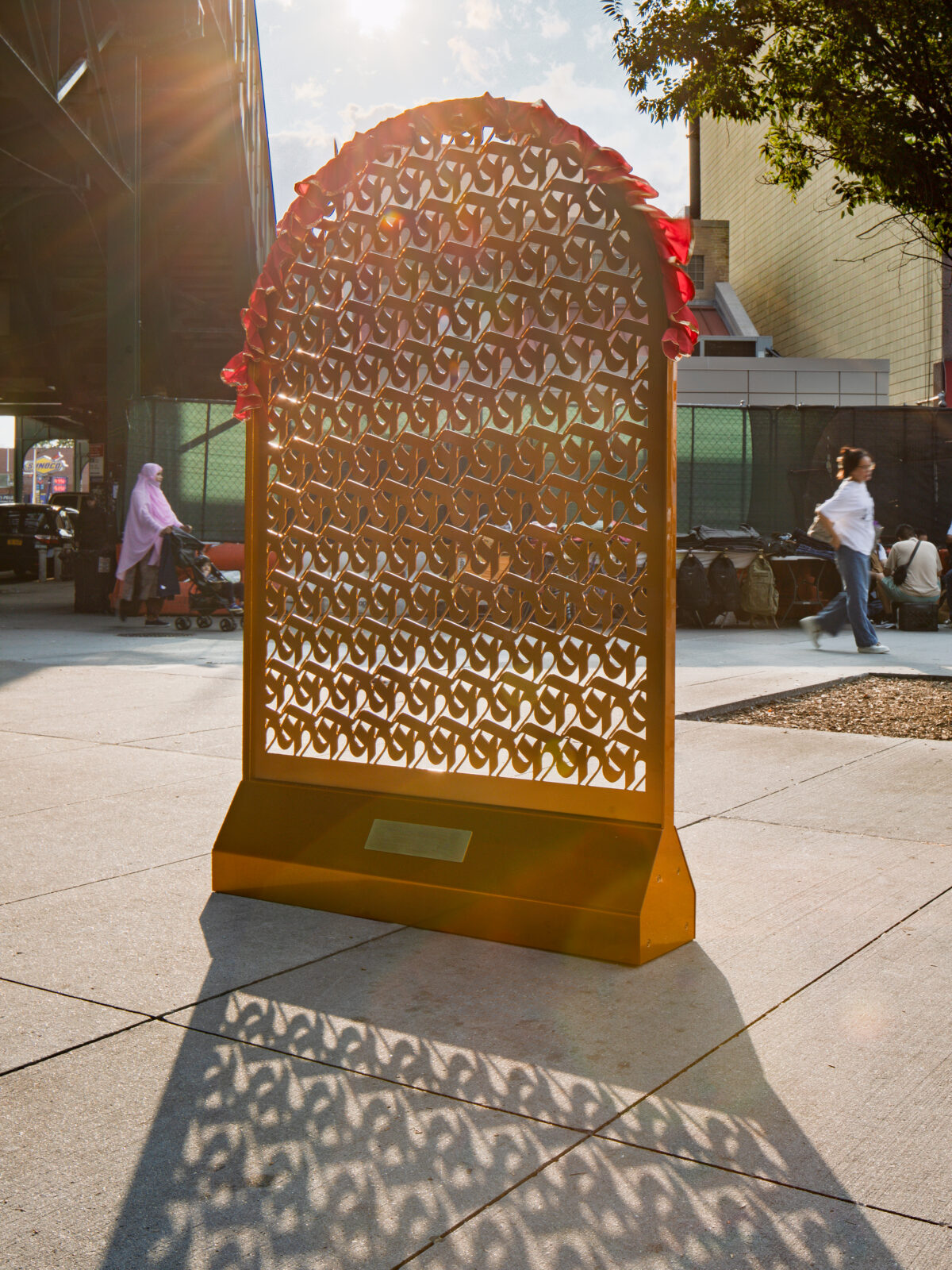
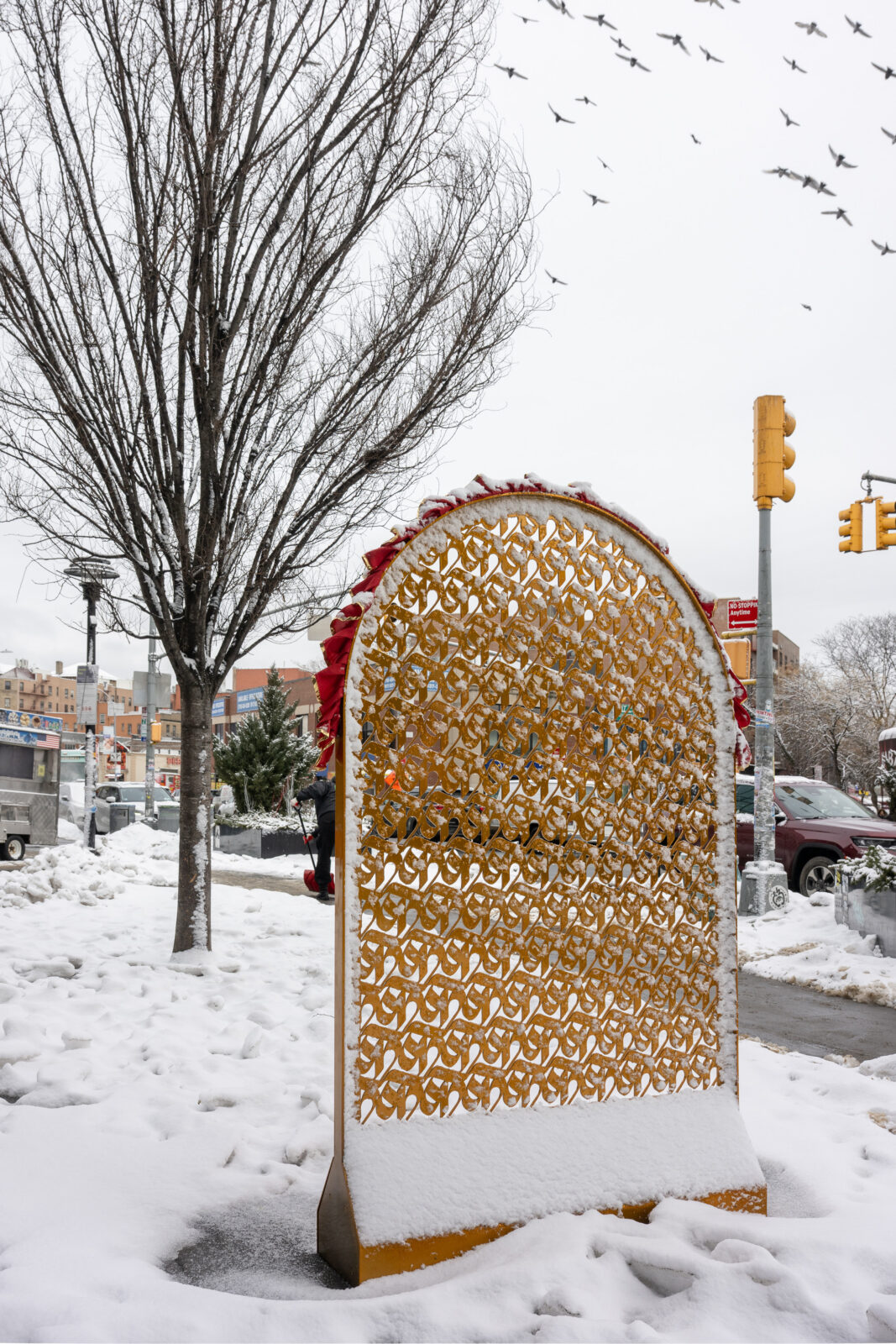
A gold arch made of repeating rows of ka, the first letter of the Nepali alphabet, in the wintertime with snow on the ground and the sculpture

IMAGINE (a.k.a. Sneha Shrestha) (b. 1987, Kathmandu, Nepal); About a Living Culture; powder coated steel and fabric; 2025; Diversity Plaza, Queens, New York City; courtesy of the artist, presented by the Rubin Museum of Himalayan Art and New York City Department of Transportation; fabricated in collaboration with Black Cat Labs; photo by Filip Wolak

Tell me about the form that the sculpture takes and what meaning it has for you and other people from the Himalayas?

I wanted to create something that spoke to the vernacular architecture of Kathmandu, where you see a lot of these lattice windows in ancient temples or older buildings. My dad grew up in one of these buildings.

I remember watching watching jatras or parades and processions through that window as a child. All my sculptures have this arch form and a lattice element to it.

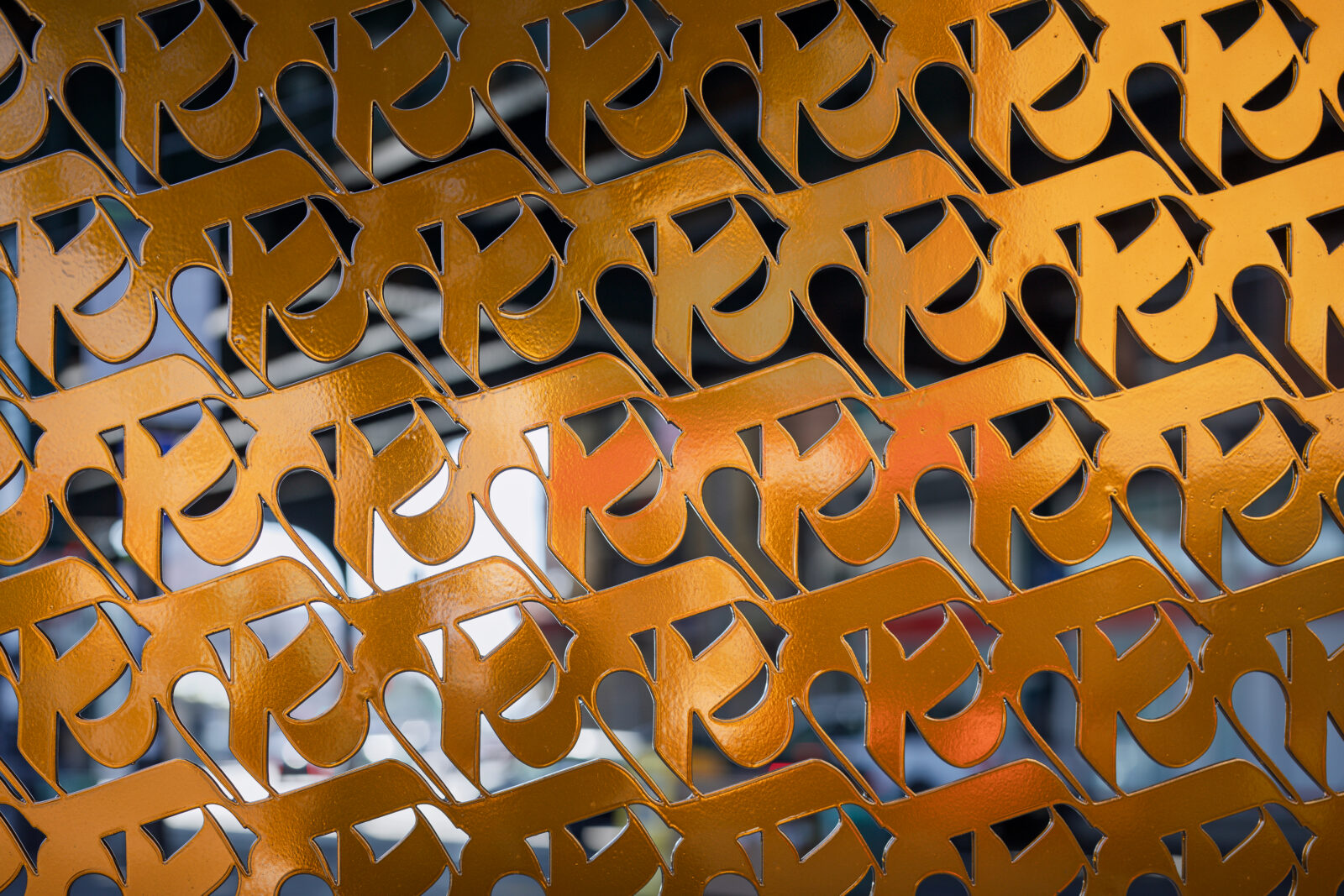
The lattice in my sculptures is a repetition of the letter ka. It’s a visual form of meditation. Meditation is essentially breathing in certain patterns repeatedly. Ka also signifies beginnings. It’s like the letter A. It’s the first letter that you grew up writing, so you can write it with your eyes closed. It is a sort of comfort. Having that comfort of familiarity is what home is.

The most important part is the golden color. Gold is this universal color that is used in very important structures to show their value and importance.

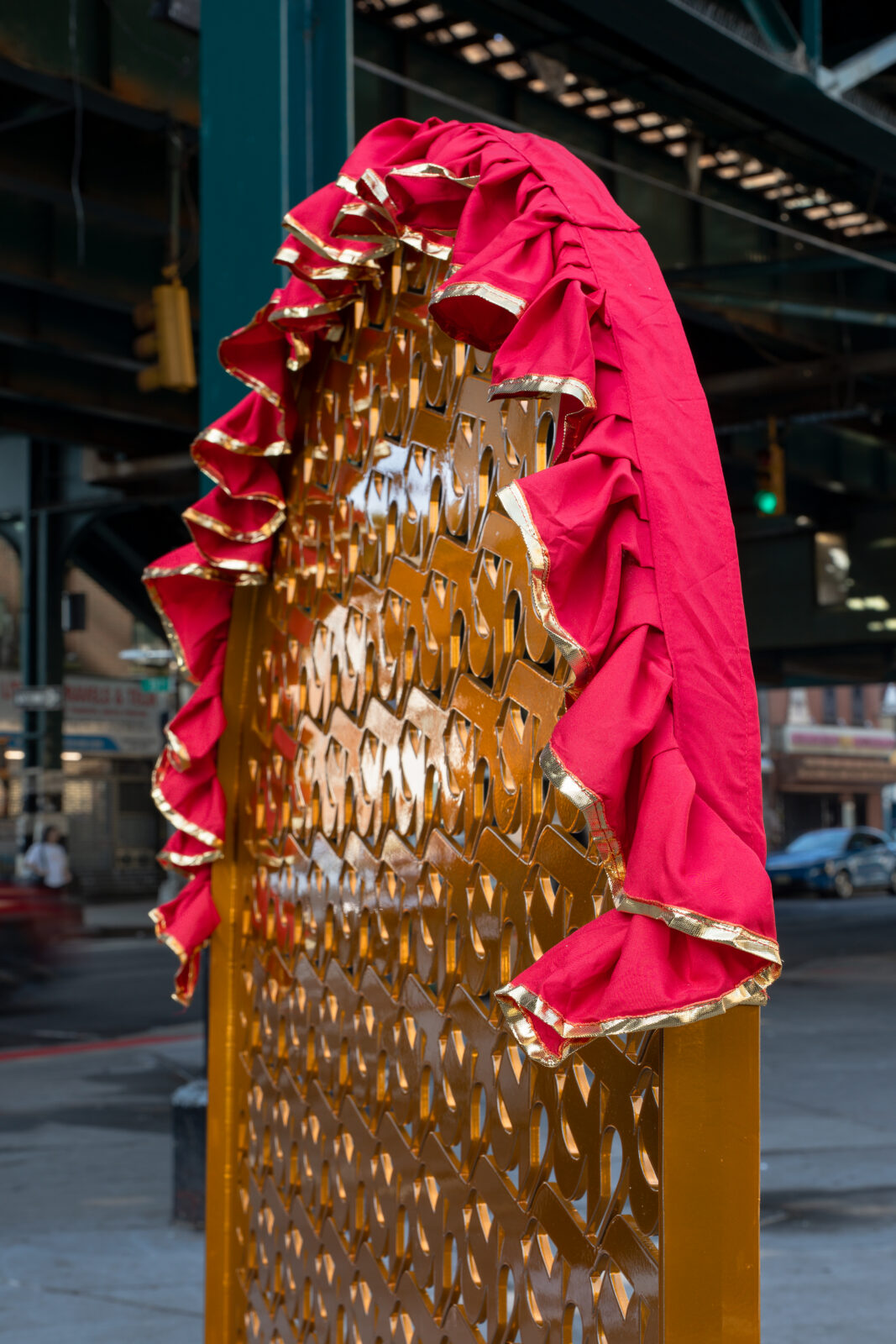
Then on the head of the sculpture is this red fabric. It’s the jhallar, which we use to decorate important sacred structures in Kathmandu. You’ll see it on the edges of roofs of temples. You’ll see it in parade umbrellas where they’re protecting the deity from various elements. The jhallar also moves with the wind. I really wanted that living element to the sculpture, because it’s a sculpture made of steel. But I wanted something that changes over time. The fabric will probably fade. She moves with the wind. All of these elements are important to think of as part of a living culture, the living part of the elements.

Close up of IMAGINE's (a.k.a. Sneha Shrestha) sculpture, About a Living Culture, focusing on the gold rows of ka, the first letter of the Nepali alphabet

IMAGINE (a.k.a. Sneha Shrestha) (b. 1987, Kathmandu, Nepal); About a Living Culture; powder coated steel and fabric; 2025; Diversity Plaza, Queens, New York City; courtesy of the artist, presented by the Rubin Museum of Himalayan Art and New York City Department of Transportation; fabricated in collaboration with Black Cat Labs; photo by Nicholas Knight

Close up of IMAGINE's (a.k.a. Sneha Shrestha) sculpture, About a Living Culture, focusing on the red fabric at the top of the golden arch

IMAGINE (a.k.a. Sneha Shrestha) (b. 1987, Kathmandu, Nepal); About a Living Culture; powder coated steel and fabric; 2025; Diversity Plaza, Queens, New York City; courtesy of the artist, presented by the Rubin Museum of Himalayan Art and New York City Department of Transportation; fabricated in collaboration with Black Cat Labs; photo by Nicholas Knight

How has the experience of creating this artwork changed or evolved your art practice?

This is my first public art sculpture, and it’s so different than creating sculptures for a gallery or indoor spaces because there’s so much to think about. I love that so many people can experience the work without going into a space, so it makes it accessible to a wider public. I’ve learned public sculpture is also very challenging, not just because the sculpture has to withstand elements, but because the scope of collaboration expands. We have to trust in all of the stakeholders involved to make it happen, from art handlers to the fabricator Black Cat Labs to NYC DOT in terms of letting us know what city limitations are and whatnot. It was a learning experience for us.

It’s been exciting to learn everything that goes into public art. I had little idea of all the different regulations and different things that you have to take into account, especially when the public is going to interact with the piece, in terms of safety and risk management. We always think about that in museums, but it’s a lot easier to control in a museum environment. Now I feel like I have a better base of knowledge of what to expect and what to ask.

Diversity Plaza is a hub for Himalayan communities and where they meet up to talk. Between the commuters and the tourists that come to Jackson Heights, there are millions of people that go through this space each year. Can you talk about the size and the scale of the sculpture and how you thought about the interaction that people might have with it?

I wanted to create something that would draw people in, as opposed to murals where you sort of take a step back and look at it. After I visited Diversity Plaza, I knew I wanted to make something intimate because Diversity Plaza is such a major crossing. I wanted to create an intimate moment that invited you in, slowed you down. The sculpture is only about seven feet tall like a doorway. It’s big enough that you can see through it, but not so big that you can see through it clearly. So you look at it closely.

We’ve also placed it so that people can walk around it and experience it from all directions. The elevated train is right above the sculpture, sort of towering over it. Many industrial structures surround Diversity Plaza. To create and put something there that felt like an intimate moment—it felt special to do that.

A gold arch made of repeating rows of ka, the first letter of the Nepali alphabet, near a green bridge with pedestrians walking nearby

IMAGINE (a.k.a. Sneha Shrestha) (b. 1987, Kathmandu, Nepal); About a Living Culture; powder coated steel and fabric; 2025; Diversity Plaza, Queens, New York City; courtesy of the artist, presented by the Rubin Museum of Himalayan Art and New York City Department of Transportation; fabricated in collaboration with Black Cat Labs; photo by Nicholas Knight

I saw so many people go up to it and want to touch it, which is great because usually in a museum setting you’re not touching things. They were so drawn to it, this piece of beauty in this urban landscape.

Today there were uncles hanging out in a corner. There were some BMX bikers who were parked there doing tricks. There were didis who were selling hats and stuff. There were children coming back from school, walking through. I felt like it was part of that everyday . . .

Community. It’s a piece of your living culture within the living culture of Diversity Plaza.
A gold arch made of repeating rows of ka, the first letter of the Nepali alphabet, with pedestrians walking nearby

IMAGINE (a.k.a. Sneha Shrestha) (b. 1987, Kathmandu, Nepal); About a Living Culture; powder coated steel and fabric; 2025; Diversity Plaza, Queens, New York City; courtesy of the artist, presented by the Rubin Museum of Himalayan Art and New York City Department of Transportation; fabricated in collaboration with Black Cat Labs; photo by Nicholas Knight

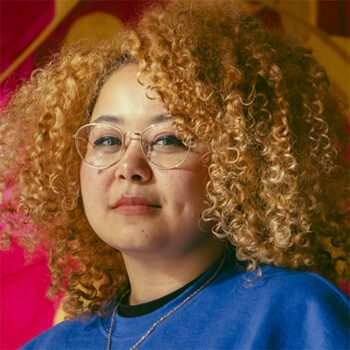
IMAGINE (a.k.a. Sneha Shrestha) is a Nepali artist who incorporates her native language and the aesthetics of Sanskrit scriptures into her work. Her art has been featured in several exhibitions, and her public walls appear across the world from Kathmandu to Boston. The Museum of Fine Arts, Boston, acquired her painting Home416, making her the first contemporary Nepali artist to be part of the museum’s collection. She is a recipient of the 2025 James and Audrey Foster Prize and her work will be presented at the Institute of Contemporary Art, Boston, beginning August 25, 2025. Sneha Shrestha received her master’s degree from Harvard University.

Michelle Simorella headshot

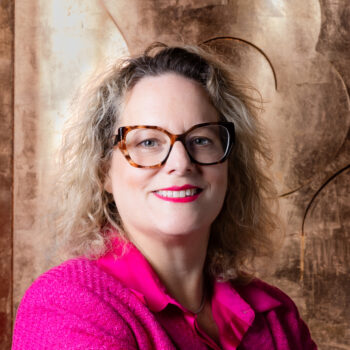
Michelle Bennett Simorella is director of global projects and collections at the Rubin Museum, bringing two decades of museum experience and leading collaborative projects. Working in Kathmandu, Nepal, for several years expanded her knowledge of art and practices in the region. Michelle has degrees in art history and nonprofit management.

Published August 14, 2026
InterviewsContemporary Art FormsContemporary Himalayan Life

Sign up for our emails

Get the latest news and stories from the Rubin, plus occasional information on how to support our work.

Discover artworks, articles, and more by typing a search term above, selecting a term below, or exploring common concepts in Himalayan art.