India
2023
India
2023
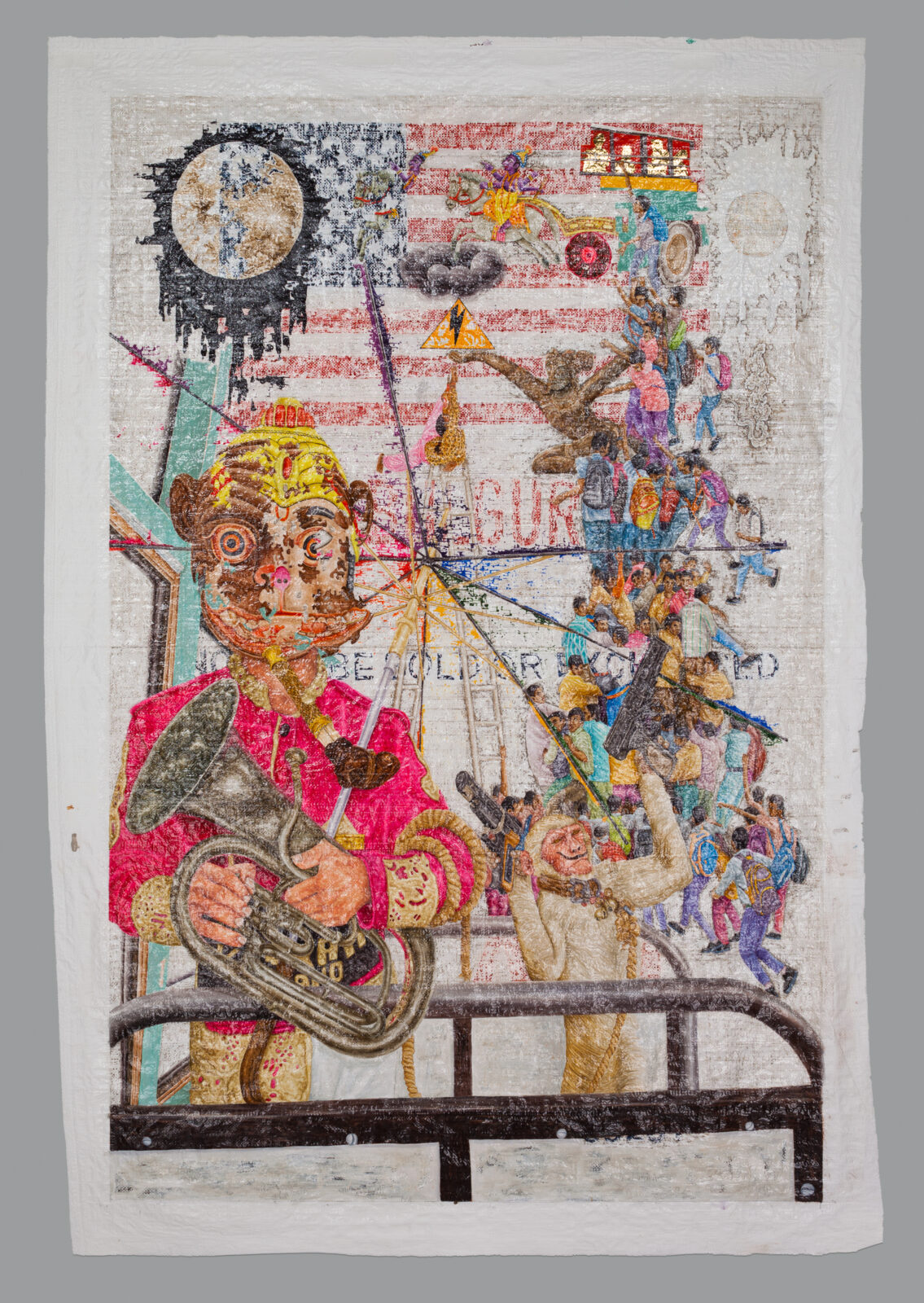
This painting is created on tarp, one of the distinguishing materials in Tenzin Gyurmey Dorjee’s artistic practice. The tarp serves as the canvas of this painting and references the Tibetan refugee situation, as the material was used for bags containing aid supplies when the artist was growing up in India. Tenzin Gyurmey Dorjee’s family, friends, and people he encounters daily are the main subjects in his work. This painting focuses on a local bus stand in New Delhi whose characters became familiar to the artist, along with the experience of being on a crowded bus. Traditional Tibetan and Bhutanese objects—a bone trumpet and mask—reflect the artist’s familiarity with Tibetan Buddhist cultural practices and his awareness of his own restless mind. The artist suggests that without recognizing one another’s humanity, we remain lonely and narrow-minded. Our differences shouldn’t be our cages.
The idea that everything is interconnected and arises from both conscious and unconscious interactions and relationships. Thus happiness and suffering are interlinked, dependent, and relative.
Buddhists believe identity is not fixed but is variable and dependent on causes and conditions. It is a temporary, transitional, and ever-changing interplay of mental and physical elements.
A vehicle for the preservation and transmission of knowledge. The Buddha’s teachings were originally passed down through oral transmission and storytelling, and stories of the Buddha’s past lives are considered an important source of inspiration and guidance.
As the cradle of Buddhism, northeastern India was and remains today a region abundant in sacred Buddhist sites. Through the late 13th century, India was the epicenter for the production of Buddhist material and visual culture, with teachers, monks, traders, and pilgrims bringing objects back home to Tibet, western Himalayan regions, Nepal, and beyond.
Get the latest news and stories from the Rubin, plus occasional information on how to support our work.