Sodhon
Lhasa, Tibet Autonomous Region, China
2007
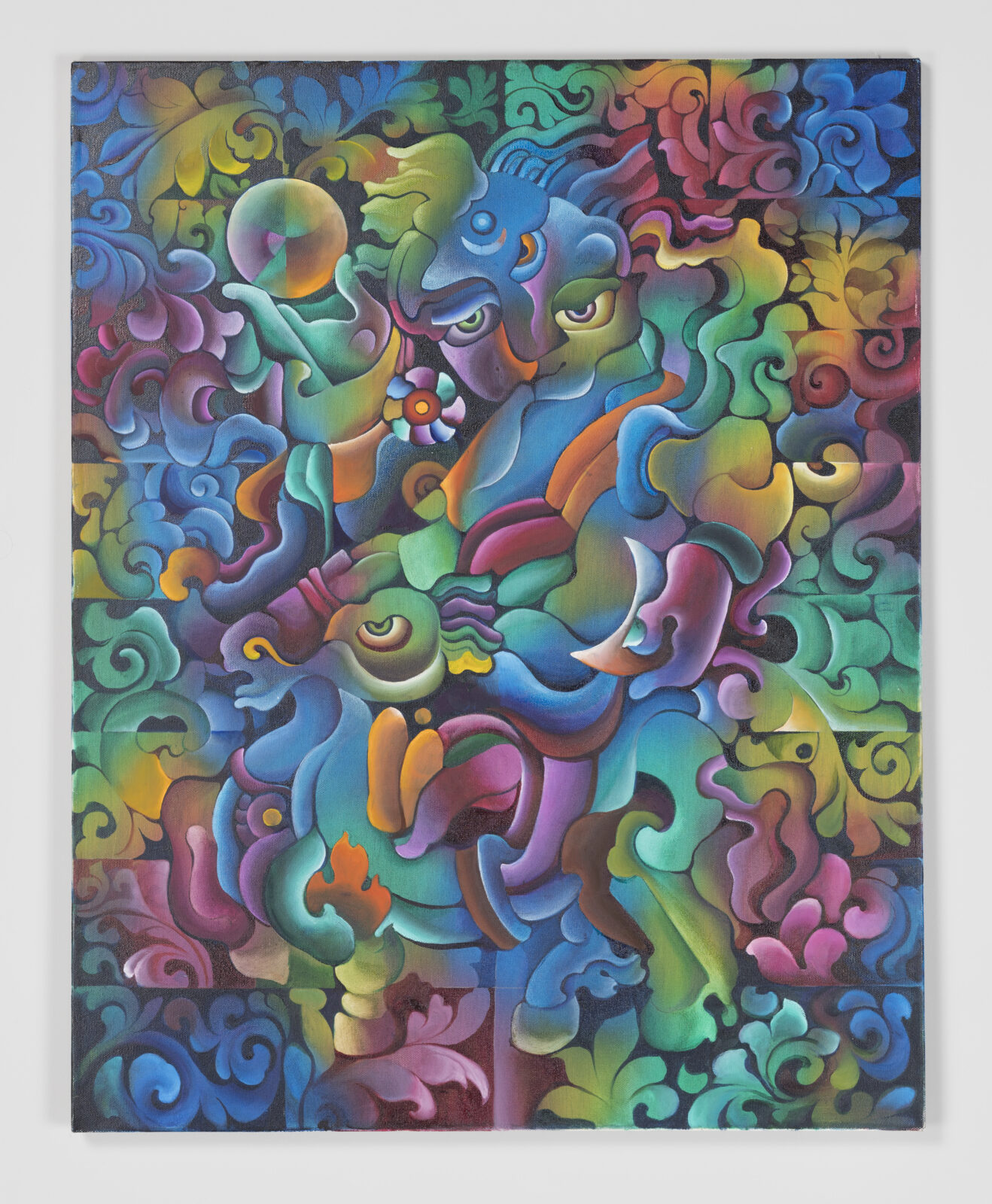
This colorful painting shows an abstracted and imaginary deity riding a horse or a mule (?) while holding in their hands what appears to be the Sun disk and the Moon crescent. The three eyes of the deity are quite prominent, while the symbol of the Sun above a crescent Moon is also visible above their eyes. The figure is completely surrounded by abstracted floral details which are carefully depicted within clearly distinct rectangles that appear as a grid around the figure. These elements recall decorative scrolling features as well as the compositional structure of traditional Tibetan thangka paintings.
The bright colors used throughout the painting, in the deconstructed central figure and the floral scrolling details, make it harder to distinguish the figure from the background. However, the eyes draw the viewer in. Likewise, the horse/mule’s eye is clearly recognizable, and the image slowly becomes legible. Despite the painting being untitled, it suggests an image of a deity one with nature or representing nature itself, in some aspect. Many mountains in Tibetan culture are considered the abodes of the deities, or the deities themselves, just as other remarkable natural sites invite reverence and respect from the people who dwell on the land.
Today, Tibetans primarily inhabit the Tibetan Plateau, situated between the Himalayan mountain range and the Indian subcontinent to the west, Chinese cultural regions to the east, and Mongolian cultural regions to the northeast. During the 7th to 9th century, Tibetan rulers expanded their empire across Central Asia, and established Buddhism as the state religion.
Get the latest news and stories from the Rubin, plus occasional information on how to support our work.