
Illustration by Noma Bar
Illustration by Noma Bar
Wrath, grief, violence, and Buddhist ethics in the popular anime series
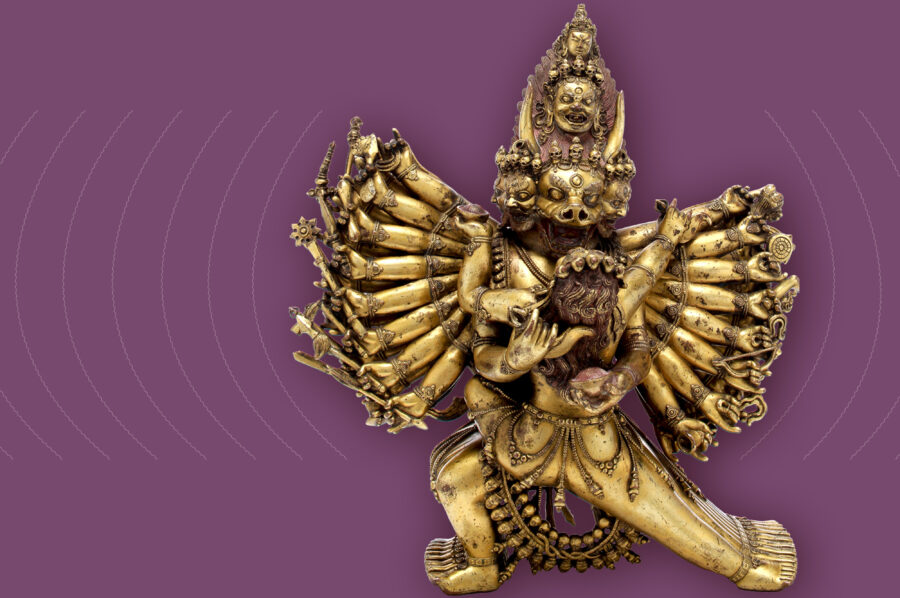
In many religious and philosophical traditions, wrath is synonymous with rage, destruction, and moral failure. But in Buddhist thought, particularly in the Mahayana and Vajrayana traditions, wrath can be understood differently, as a form of compassionate energy. Wrathful figures such as Vajrapani and Achala wield weapons to cut through ignorance and protect practitioners from their own cravings. Far from representing uncontrolled anger, such wrath is used with skillful intention, removing obstacles to liberation. This redefinition opens a powerful ethical question: Can violence be compassionate?
One of the most striking and morally complex illustrations of this question appears outside of traditional Buddhist texts in contemporary Japanese popular culture. Demon Slayer: Kimetsu no Yaiba, a manga and anime series written and illustrated by Koyoharu Gotōge, debuted in 2016 and quickly rose to international prominence for its compelling storytelling, evocative art, and emotional weight. It has become a cultural powerhouse, lavished with awards for revitalizing the manga industry. The 2020 film installment, Demon Slayer: Mugen Train, became the highest-grossing anime film as well as the highest-grossing Japanese film of any kind of all time, surpassing Hayao Miyazaki’s Spirited Away, which had held the record since 2001.
Set in the Taishō era (1912–1926), the series follows Tanjiro Kamado, a kind-hearted boy whose family is slaughtered by demons. In Demon Slayer, demons are former humans who have become predators with supernatural powers and who survive by consuming human energy. Among Tanjiro’s family, only his sister Nezuko survives the attack, but she is transformed into a demon. Tanjiro joins the Demon Slayer Corps to avenge his family and to save both Nezuko and humanity, beginning a journey shaped by moral complexity, loyalty, and self-sacrifice.
Among the ensemble cast, Gyōmei Himejima, the Stone Hashira, stands apart. A blind monk with unmatched strength, Gyōmei channels Buddhist discipline, grief, and spiritual clarity in his role as a protector. As one of the Hashira, the elite corps of Demon Slayers entrusted with the most dangerous battles, his story raises one of the central ethical questions of both Buddhism and Demon Slayer: What does it mean to destroy with compassion?
Introduced early in the series as the towering, silent Stone Hashira, Gyōmei seems at first stoic, even cold. Draped in mala beads, a monk’s robe, and garments inscribed with the nenbutsu—Namu Amida Butsu, the Pure Land invocation of Buddha Amitabha—he embodies a quiet yet unmistakable link to Buddhist ethics. He chants the nenbutsu even in battle and is often shown weeping, mourning both his comrades and those who count themselves his enemies.
What sets Gyōmei apart is that he is both the most physically powerful demon slayer and the most emotionally expressive. While others kill demons with fury or vengeance, Gyōmei cries. He performs violent acts, but with no pleasure and no hatred. Instead, his violence emerges from a well of grief and duty, an expression of compassion so intense it demands action. Even his name means “Island of sorrow who journeys through darkness.”
In one scene, Gyōmei speaks words that recall Buddhist views on rebirth and karmic suffering. Reflecting on Tanjiro’s fate, he laments, “It would have been better if he had not been born,” hinting at the tragedy of karmic entanglement and the difficulty of liberation. His hope is that those bound by suffering might have been reborn into a Pure Land free of demons and violence.
Gyōmei has been compared by some commentators to Avalokiteshvara (known as Kannon in Japanese and Guanyin in Chinese), the bodhisattva of compassion who hears the cries of the world. The connection is more than symbolic.
Gyōmei is blind. Yet he “sees” through sound, using extraordinary hearing to perceive the world, predict movement, and fight. This is more than a representation of superhuman ability; it is narrative symbolism. Avalokiteshvara is said to perceive all suffering through sound. Gyōmei, similarly, hears before he acts. His wrath is never reactive. It is filtered through compassionate attunement.
In this way, Gyōmei echoes the bodhisattva ideal: delaying personal peace or liberation to help others. Just as Avalokiteshvara vows to postpone Buddhahood until all beings are saved, Gyōmei delays rest and healing to continue fighting for those who cannot protect themselves.
Gyōmei’s wrath is born of grief transformed. His traumatic backstory marked by the loss of the orphaned children he once protected and the cruel injustice of being falsely accused of their deaths, leaves him with a sorrow that runs deep. But rather than retreat into despair or vengeance, Gyōmei channels that grief into the protective work of the Demon Slayer Corps.
This transformation of suffering into action has roots in Buddhist psychology. Mahayana ethics teaches that a bodhisattva feels the suffering of others as their own. In Vajrayana Buddhism, wrathful deities wear fearsome faces because their compassion is fierce enough to cut through delusion and danger. Gyōmei’s tears flow from the same source of clarity. Each time he raises his weapon, he does so with sorrow, carrying the burden of violence so that others may be spared.
In Mahayana Buddhism, the doctrine of upaya (skillful means) teaches that enlightened beings may take unconventional or even shocking actions if doing so helps sentient beings move toward awakening. The famous Upayakaushalya Sutra even recounts the story of a bodhisattva, a compassionate being who seeks awakening while helping others awaken, who kills a murderer in order to save a ship’s passengers, acting out of compassion for both the victims and the perpetrator.
Gyōmei’s actions follow this logic. He does not kill demons to exact vengeance but to prevent them from causing further harm. He chants Namu Amida Butsu even while fighting, affirming that his actions are not his own, that he entrusts them to Buddha Amitabha. In this sense, he is acting from entrustment and the vow to save all sentient beings from suffering. His wrath is an instrument of compassion, sharpened by practice and restrained by grief.
As a professor of Buddhist studies and Japanese religion, I have introduced Demon Slayer in the classroom as a tool for exploring Buddhist ethics. The character of Gyōmei often evokes strong responses from students.
After watching scenes in which Gyōmei fights while mourning, one student asked, “If Gyōmei doesn’t hate even the demons, does that mean violence can be compassionate?” Another noted, “His strength doesn’t come from anger but from something greater.”
These reactions echo classical Buddhist dilemmas about force and compassion. They show how anime, like ancient Buddhist stories, can serve as a space for moral imagination, inviting viewers to reflect on what it means to act ethically in a world of suffering. Gyōmei embodies this convergence as a warrior-monk whose actions come from a vow to protect. In him we see that even in a violent world it is possible to act without hatred, to weep while striking, to mourn while protecting, to destroy without cruelty, and to love fiercely even in the fire.

Ronald S. Green is a professor of religious and Asian studies at Coastal Carolina University. His research explores the intersections of Asian philosophical traditions and contemporary culture, especially in film, anime, novels, and lived religious practice. Combining close textual study with immersive fieldwork, he examines how ancient traditions find new expression today. His teaching spans Buddhism, Shinto, meditation traditions, Japanese popular culture, and ethnographic methods for studying African and Asian religious life in South Carolina.

Noma Bar is a graphic designer, illustrator, and artist known for his bold, minimalist style. His work has appeared in Time Out London, BBC, The Economist, and more. He has illustrated over one hundred magazine covers, published over five hundred illustrations, and released three books. Bar has earned multiple awards, including a Gold Clio and a D&AD Yellow Pencil. His Cut It Out exhibition was a London Design Festival highlight and nominated for Design Museum’s Designs of the Year.
This article appears in issue 10 of the print edition of Spiral magazine under the title “Can Violence Be Compassionate?”

Get the latest news and stories from the Rubin, plus occasional information on how to support our work.