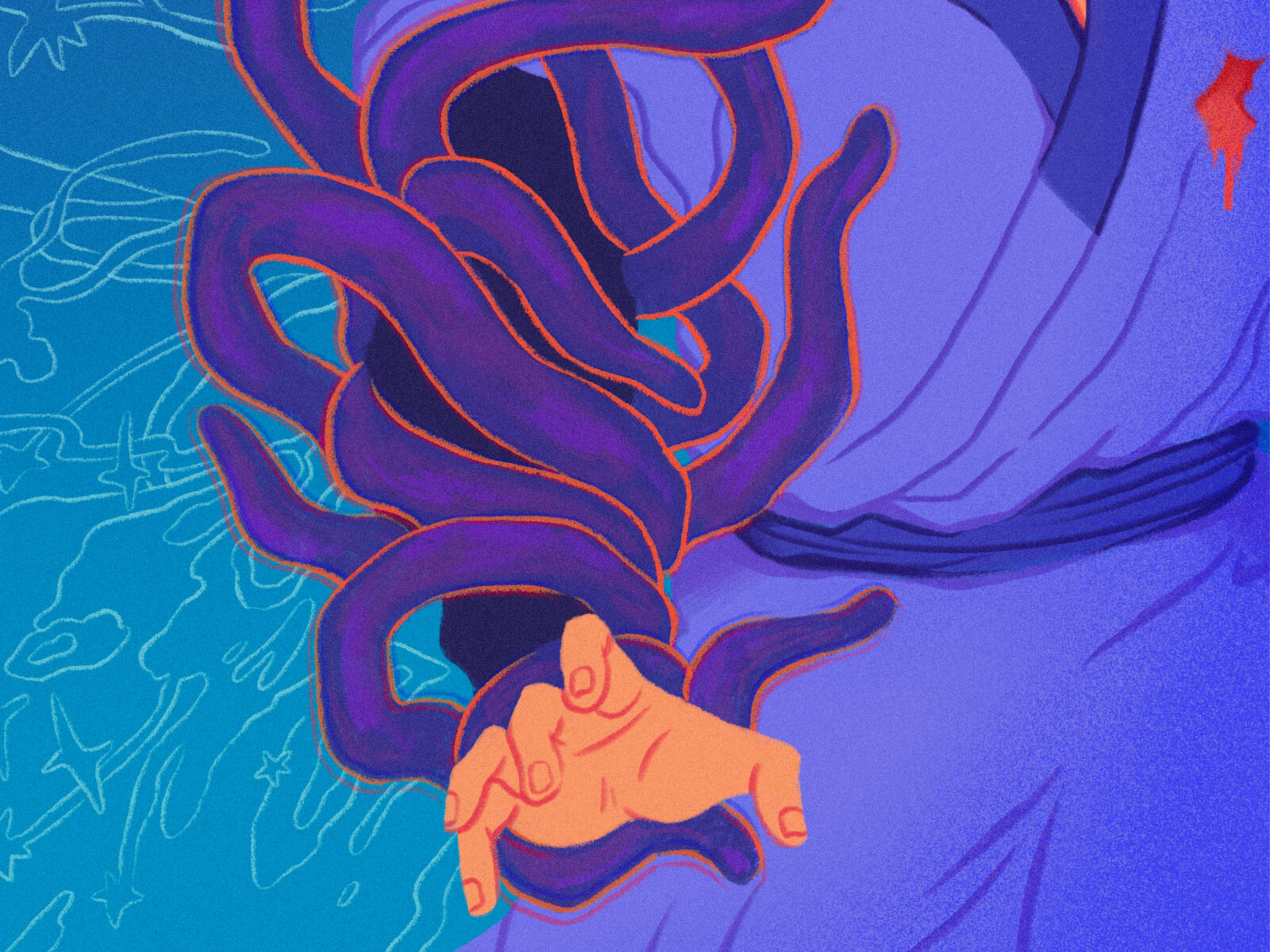
Illustration by Tenzin Tsering
Illustration by Tenzin Tsering
Hayao Miyazaki, co-founder of Studio Ghibli and one of Japan’s most influential filmmakers, has long brought ecological themes, moral complexity, and spiritual imagination into animated worlds. Princess Mononoke (1997), released at the height of his career, became a major cultural event in Japan and the first anime film to receive broad and sustained international critical attention, reshaping global expectations for animated film.
Its reception showed audiences in and beyond Japan that animation could take up war, industrial expansion, environmental threat, and the emotional forces that shape moral judgment with the depth usually reserved for only the most serious live-action films.
Rather than presenting anger as something to suppress or transcend, Princess Mononoke treats it as volatile moral energy.
Within this context, the film introduces a central paradox. In the opening scene, Nago, the Boar kami (nature spirit), charges Ashitaka with a deadly curse. It is not the iron bullet lodged in the kami’s flesh that ultimately drives its fury, but the hatred born from human violence and disregard for the forest. When Ashitaka kills the rampaging spirit, the curse transfers to him, erupting through his arm. Dark patches form on his skin, muscles convulse, and in moments of conflict the limb surges with demonic strength. Its power is devastating.
Arrows shot with the cursed arm slice through armor and sever limbs. Yet this same force becomes the means by which Ashitaka defends the vulnerable and seeks fragile peace. Rather than presenting anger as something to suppress or transcend, Princess Mononoke treats it as volatile moral energy, dangerous when ungoverned, but necessary for compassionate action.
Ashitaka’s first encounter with the curse sets the tone. After slaying the demon-boar that threatens his village, he is instructed by the village shamaness to “see with eyes unclouded by hate.” This is not a command to reject anger wholesale but to refuse its habitual distortion. The cursed arm surges with fury, yet Ashitaka’s moral clarity keeps him from surrendering to it. He leaves his homeland not to enact revenge but to understand the origin of suffering. His anger is reactive, but his journey is investigative, an ethical stance that resonates with Buddhist depictions of wrath that moves toward insight rather than retribution.
Throughout the film, Ashitaka exhibits extraordinary restraint even as the curse tempts him toward deadly excess. When samurai ambush a village, the curse explodes into action. His arrow tears through armor and flesh with impossible strength. The violence is horrifying, but the scene is not framed as failure. Instead, it is a reminder of power that must be stewarded. Ashitaka’s gift, and burden, is the willingness to act decisively in the face of harm while refusing to cultivate hatred.
This moral posture parallels wrathful compassion’s core paradox: the capacity to cut through harm without collapsing into enmity.
This dynamic is clearest in Ashitaka’s relationships with San and Lady Eboshi, who stand on opposite sides of the struggle between the forest spirits and an expanding industrial settlement. San, a human raised by wolf-spirits, fights with ferocity to defend the forest and its spiritual beings, convinced humanity must be resisted. Eboshi, the capable and visionary leader of Iron Town, seeks protection and prosperity for her people, especially outcasts and women, through industry and the clearing of forest land.
Both women are capable of tenderness and devastation. Ashitaka does not passively observe them but steps in hoping to prevent anger from erupting into harm. When San attempts to kill Eboshi, Ashitaka physically removes San from the battlefield, his cursed arm surging to knock aside attackers. The intervention is forceful, almost brutal. Yet he follows violence with compassion. “You’re beautiful,” he tells San, not seeing her as an enemy but as someone wounded by the same world that wounded him.
Later, when Eboshi is nearly killed, Ashitaka risks his life to save her as well. He protects those on both sides of the conflict because he refuses hatred. This moral posture parallels wrathful compassion’s core paradox: the capacity to cut through harm without collapsing into enmity.
Compromise, in Miyazaki’s vision, is not capitulation but shared responsibility won through conflict, not avoidance.
Importantly, the film refuses to sentimentalize anger. The curse spreads whenever Ashitaka lapses toward resentment or violent impulse. Each surge brings agony. Anger is fire: it burns indiscriminately unless shaped by intention. And yet, Princess Mononoke also rejects the idea that peace can be achieved through withdrawal from anger altogether. The forest’s survival depends on decisive resistance to exploitation. Human flourishing depends on the forest’s survival. Compromise, in Miyazaki’s vision, is not capitulation but shared responsibility won through conflict, not avoidance.
The climax crystallizes this ethical tension. After the Forest Spirit’s head is taken, a catastrophic act born of fear and greed, Ashitaka and San race to return it. Here the curse becomes a force for salvation. The arm still convulses with rage, but Ashitaka directs its strength toward restoration. When the head is returned and the curse subsides, he does not receive a reward of heroic elevation or spiritual purity. Instead, he chooses to live and work alongside Lady Eboshi’s people, rebuilding a world scarred by violence. San returns to the forest, still wary of humans but no longer bound to vengeance. In this way, peace comes through shared humility.
The film thus refutes the moral dualisms common in Hollywood fantasies. Good is not the absence of anger; evil is not its presence. The decisive difference lies in intention and discipline. Anger can destroy or protect, corrupt or clarify. What matters is whether fierce energy is tied to compassion. Unbound, it becomes a curse. Guided, it becomes medicine. In this sense, Miyazaki’s film offers an ethics familiar to Buddhist art: compassion sometimes wears a fierce face, and peace may require the steady hand of someone willing to hold the fire without letting it consume them.

Ronald S. Green is a professor of religious and Asian studies at Coastal Carolina University. His research explores the intersections of Asian philosophical traditions and contemporary culture, especially in film, anime, novels, and lived religious practice. Combining close textual study with immersive fieldwork, he examines how ancient traditions find new expression today. His teaching spans Buddhism, Shinto, meditation traditions, Japanese popular culture, and ethnographic methods for studying African and Asian religious life in South Carolina.

Tenzin Tsering is a Tibetan Filipino illustrator and 2D artist based in Toronto, Canada, known for her vibrant use of color and dynamic storytelling through visual art. Drawing from her rich South East Asian cultural heritage and the whimsical world of comics, she creates immersive artworks in many creative fields such as mural painting, editorial art, book covers, comic illustrations, and character design.

Get the latest news and stories from the Rubin, plus occasional information on how to support our work.