
Installation view of Shezad Dawood’s Wrathful Activity, Fierce Energy as part of the 2018 exhibition A Lost Future at the Rubin Museum. Photo by Filip Wolak
Installation view of Shezad Dawood’s Wrathful Activity, Fierce Energy as part of the 2018 exhibition A Lost Future at the Rubin Museum. Photo by Filip Wolak
Shezad Dawood is a multidisciplinary artist based in London whose work interweaves story, symbolism, alternative realities and futures, ecologies, and other cultural and philosophical explorations. His neon artwork Wrathful Activity, Fierce Energy is in the collection of the Rubin Museum of Himalayan Art. It was commissioned for the 2018 exhibition A Lost Future, which also featured his virtual reality work, Kalimpong.
Shezad Dawood: For me, it was something I always struggled with. In Western or Abrahamic culture, guilt and shame play a large part—wrath is one of the seven deadly sins. I wondered why this stuff [these emotions] kept coming up, leading me to feel ashamed of my reactions.
I think wrath is what I would term an excess reaction. It’s often not commensurate with the events that have proceeded or precipitated it. It’s usually an overcompensation. But what does it reveal about ourselves to ourselves?
I’ve practiced several disciplines in my life. I come from a Muslim culture from South Asia, but I’ve done deep dives at different points into Taoism and Tibetan Buddhism. Still, with a number of practices I’ve spent time with, there was this [feeling of], “Oh, you’re playing whack-a-mole with your own wrath. Ooh, I shouldn’t feel this. Or, ooh, my spiritual or meditative practice isn’t up to scratch. I need to meditate longer. Mea Culpa, I feel I am angry. Oh my God, what do I do with all this anger?”
It was a wonderful shift for me as I encountered and spent more time with the wrathful deities in Tibetan Buddhism. It gave me a whole different kind of understanding and cosmology around wrath, because I’d spent all these years doing various things and it wasn’t going anywhere despite my best effort.
There’s a degree in which each practice has a certain amount of spill over into the other. My practice as an artist, my practice as a human being, my practice as a parent, as a partner, as a colleague—it’s all of those things, isn’t it? Because a spiritual practice is something that should fit into the warp and weft of our lives.
I remember my Tai Chi master telling me how in the old days they practiced in the marketplace, because what was the point of cultivating stillness in a room that was still? He would say, “Try cultivating stillness and the Dao when there are chickens running around underfoot.” And for me, I took those chickens to be everything. When my kids don’t listen, when I burn the food, or when I get a bad review of an exhibition, these are all the chickens of the mind.
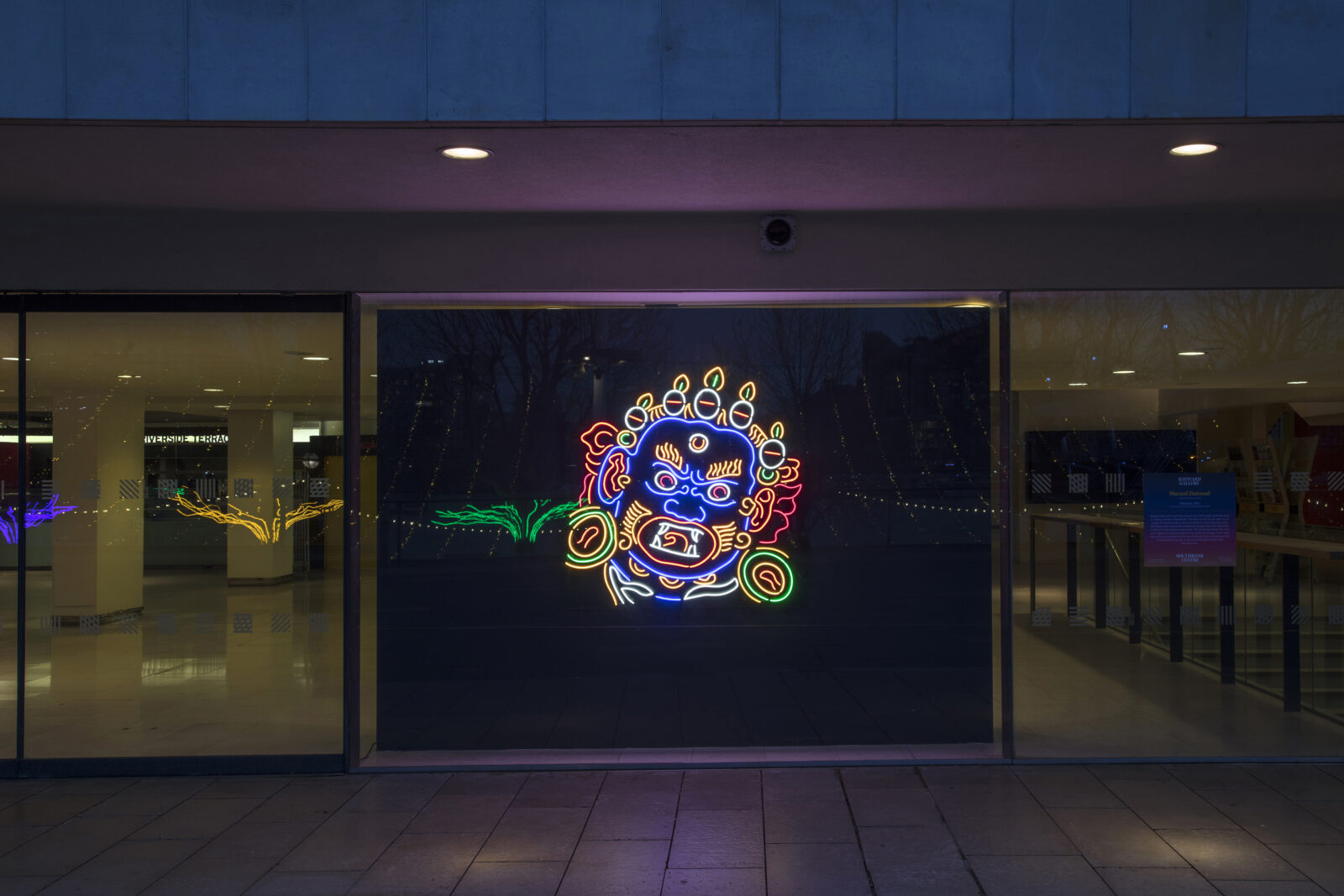
Shezad Dawood; Mahakala; 2020; neon on black, powder-coated aluminium; exhibited as part of Winter Light at Southbank Centre, London, November 20, 2020–February 28, 2021. Photograph © Morley von Sternberg
Tibetan Buddhism took me into perhaps a slightly different place, and it helped me find a different way to negotiate and navigate my own wrath. Once you’ve started to figure out how to negotiate with your own wrath, you can start to look at it systemically as well. And what is overcompensation? Is it your own childhood trauma? Is it generational trauma, a familial trauma? Tibetan Buddhism gave me Mahakala and these big scary deities. But they’re your friends. They’re your protectors.
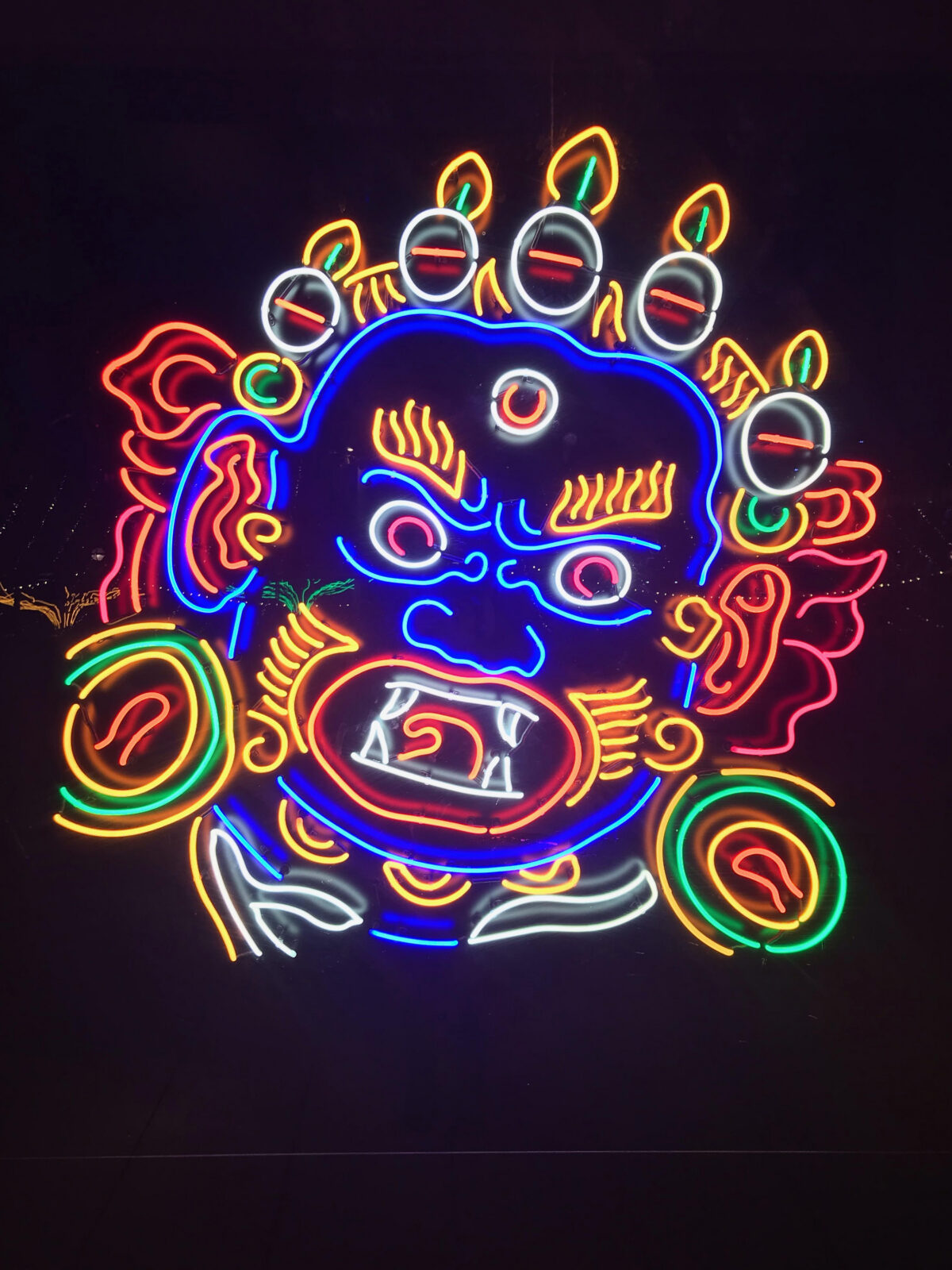
Detail of Shezad Dawood; Mahakala; 2020; neon on black, powder-coated aluminium; exhibited as part of Winter Light at Southbank Centre, London, November 20, 2020–February 28, 2021. Photograph © Morley von Sternberg
There’s an interesting correspondence with Maurice Sendak’s Where the Wild Things Are and the Spike Jonze film of it. What if you make the scary monsters your friends? There’s also something wonderfully transgressive about the wrathful deities. It’s like you’re almost crossing over to the other side of the street and hanging out with the bad kids.
I remember reading about an indigenous spiritual practitioner who decided to make their cancer their totem animal.
If you’re feeling it, rather than shrinking from it or trying to hide it or deny it, how do you recognize what it’s telling you? How can you embody that energy, which is very powerful and can help you break through your own limitations? For example, I’ve done therapy—many people have. It’s taken me sometimes years to have that breakthrough in therapy around something that I was holding onto from my childhood.
But somehow having spent a lot of time with the wrathful deities, particularly in the Mahayana tradition, there’s something about that instant breakthrough that becomes available to you if you go into the acceleration. It’s not for the faint-hearted.

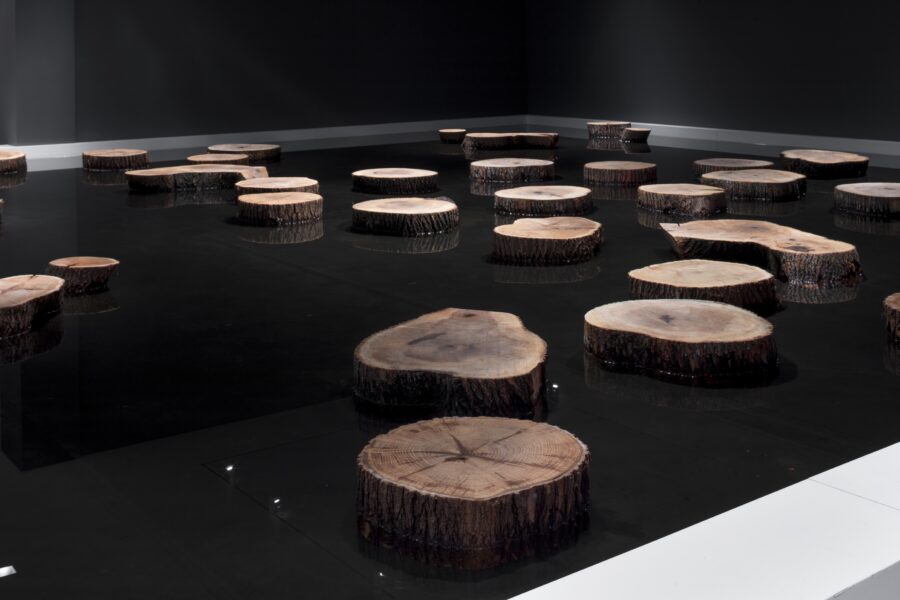
Installation view of Shezad Dawood’s Wrathful Activity, Fierce Energy as part of the 2018 exhibition A Lost Future at the Rubin Museum. Photo by David De Armas
Neon is just one of several media I use. I’m often thinking about the best form the artwork needs to take. With neon, I’m often trying to distill and simplify. If you think of some thangkas, the level of detail is so complex. I didn’t want to lose that. It’s thinking about how you pare something down to its basic essence while not losing anything of that essence. I felt it was essential in representations of wrathful deities to maintain certain motifs that feel vital, whether it’s skulls, eyes, flaming eyebrows, or jewelry.
When I first encountered this imagery, I did not yet have the title Wrathful Activity, Fierce Energy. The power of something visual is that it leads you. I think that’s why I’m a visual artist. Something strikes you in a certain way that’s almost pre-language, that leads into language. That visceral experience of something outside or before language is really important.
I went back to the writings of [Belgian-French explorer and spiritualist] Alexandra David-Néel that I’d been interested in from my teenage days, particularly her book Magic and Mystery in Tibet (1929), where she talks about her meetings with naljorpa sorcerer ascetics who were almost like hermits in caves in the mountain ranges and passes above Kalimpong. Often their practice was chanting the name of Mahakala. The naljorpas were said to be able to withstand the extremes of cold and hunger. It was interesting that you would invoke Mahakala, this sort of terrifying deity to help you overcome such conditions.
Then as I spent more time with it, it made total sense. It’s about engaging with a particular frequency or resonance that helps us break through to potentially another reality—another reality even in our own psyche. I love Tibetan Buddhism kind of pushing me to this next layer. What is this pushing me to break through in my own kind of bullshit? It enabled me to get out of victimhood mode. It gave me permission not to go around being angry, but to think about anger as a waystation to transform negative energy into something generative, into something creative. Whether it’s made me a better person, I can’t say. It certainly made me a better artist. Now if I’m pissed off, I go and paint.
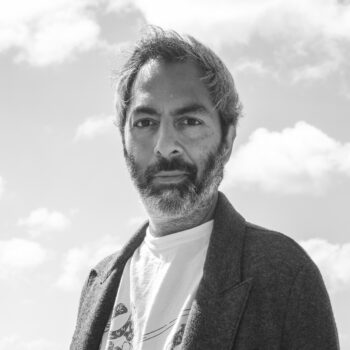
Shezad Dawood works across film, painting, and sculpture to juxtapose discrete systems of image, language, site, and narrative, using the editing process as a method to explore meanings and forms. Dawood trained at Central St Martins and the Royal College of Art before undertaking a PhD at Leeds Metropolitan University. He is a research fellow in experimental media at the University of Westminster.

Howard Kaplan is an editor and writer who helped found Spiral magazine in 2017. He currently works at the Smithsonian and divides his time between Washington, DC, and New York City.
Rubin Museum
150 W. 17th St., NYC
Get the latest news and stories from the Rubin, plus occasional information on how to support our work.