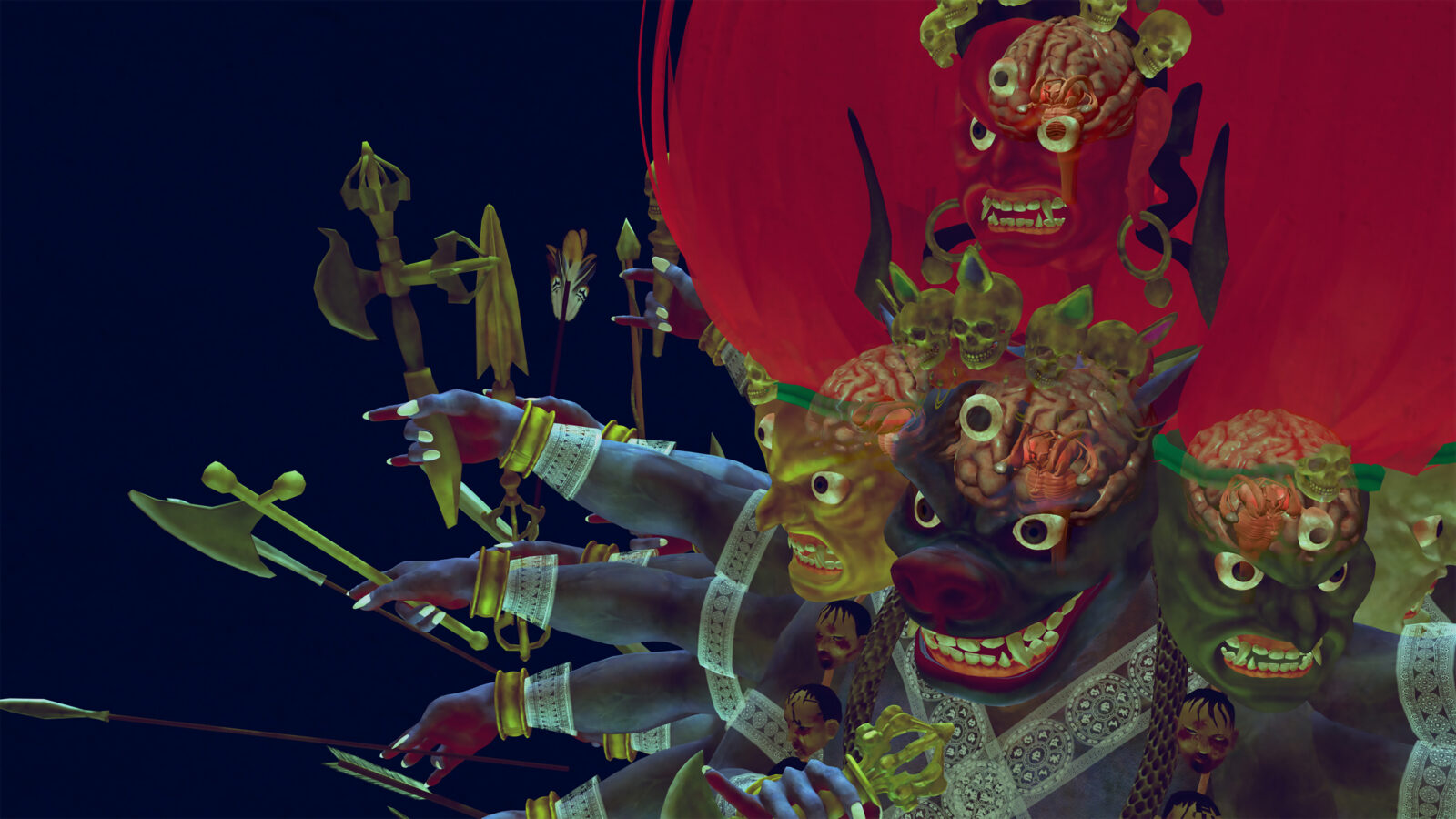
LuYang; Still from Wrathful King Kong Core; 2011; 3D animation; courtesy of the artist
LuYang; Still from Wrathful King Kong Core; 2011; 3D animation; courtesy of the artist
LuYang intertwines new technologies and Tibetan Buddhist philosophies to radically question the perception of reality. They use aspects of anime, science, pop culture, digital art, and music to explore virtual existence and propose multiple identities and realities across time and space. Their work appeared in the Rubin Museum’s exhibition Reimagine: Himalayan Art Now.
In the video Wrathful King Kong Core, LuYang identifies and analyzes the artifacts, accessories, and brain of Yamantaka, a wrathful Tibetan Buddhist deity, in a systematic way to demystify his wrathful appearance. Yamantaka represents the fierce or wrathful aspect of Manjushri, the bodhisattva of wisdom. Manjushri assumes this wrathful appearance to conquer Yama, the god of death, in his quest to defeat the cycle of birth, death, and rebirth known as samsara.
By identifying the sacred objects held by Yamantaka as tools to achieve enlightenment, and further analyzing the neurological response to anger in Yamantaka’s brain, LuYang illustrates the true nature of this protector deity, who aids Buddhist practitioners in conquering anger, hatred, fear of death, and the cycle of suffering.
LuYang: In Buddhist teachings, especially within Vajrayana, wrathful deities represent fierce compassion—they annihilate ignorance and ego clinging. Among the three poisons, anger is often emphasized as a cause of rebirth in the hell realms. From a neuroscientific perspective, anger activates specific neural pathways related to threat and defense. While working on Wrathful King Kong Core, I collaborated with a psychologist to study how these neural mechanisms might visually translate into the inner architecture of wrath. I wanted to contrast the terrifying aesthetics of wrathful deities with their profound inner motivation: compassion.
In particular, the imagery of Yamantaka (Vajrabhairava)—the wrathful manifestation of Manjushri, the bodhisattva of wisdom—guided my thinking. Yamantaka’s terrifying form does not signify malice but wisdom fierce enough to destroy death and delusion.
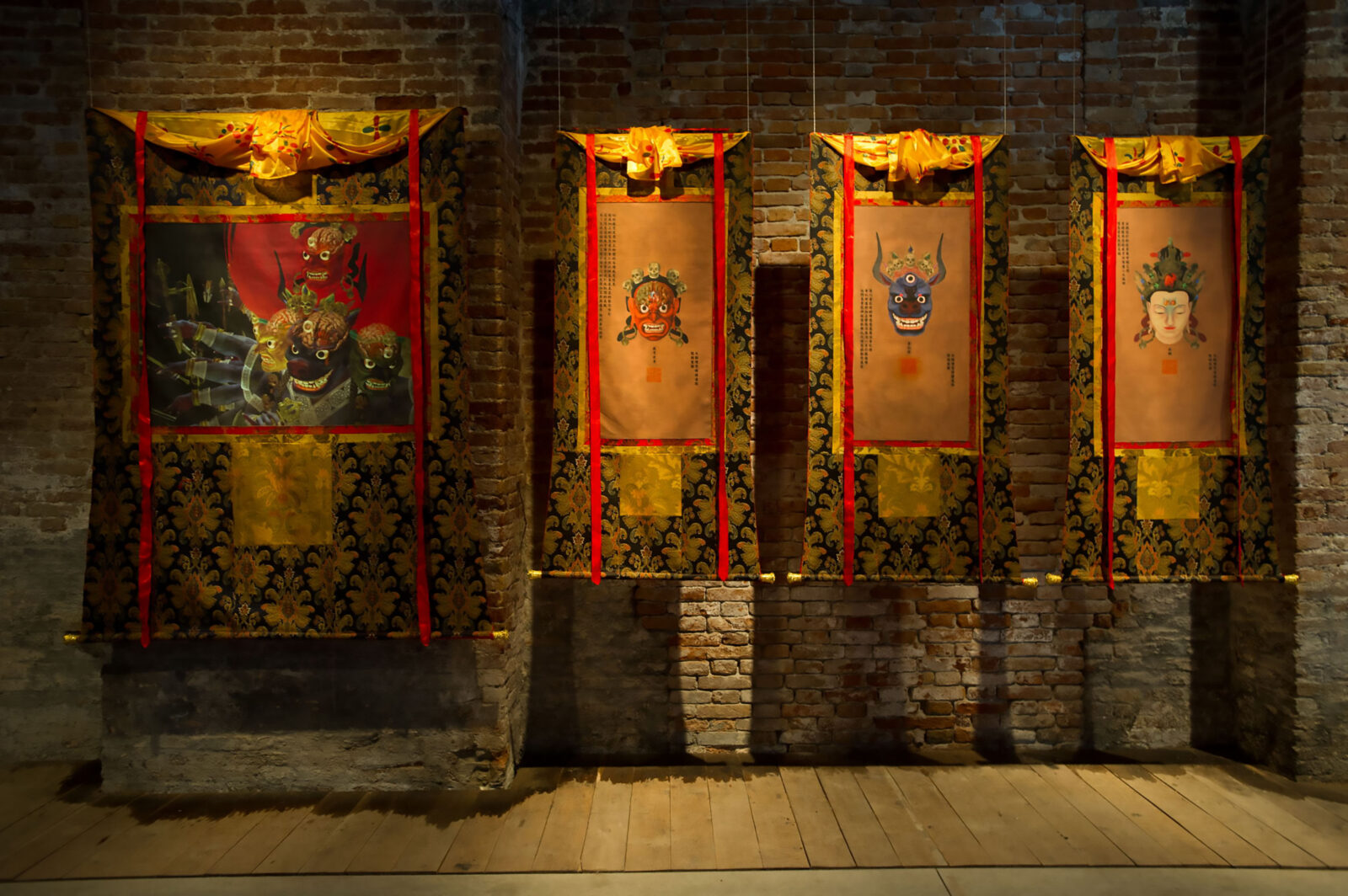
LuYang; Installation view of Wrathful King Kong Core at the 2015 Venice Biennale; courtesy of the artist
Yes. While working on Wrathful King Kong Core, I was deeply immersed in reading various texts on the bardo (intermediate state), especially The Tibetan Book of the Dead as transmitted by Padmasambhava. One passage left a strong impression on me: in the bardo, wrathful deities appear in terrifying forms, but they are in fact compassionate manifestations of our own mind. Recognizing them without fear allows one to attain liberation.
This idea resonates with the core of my work. The visual representation of wrath is not a threat—it is a reflection of unrecognized wisdom. Through this piece, I wanted to explore how something visually violent or terrifying can, in essence, be rooted in the deepest compassion. The contrast between appearance and essence is what fascinates me.
I don’t believe in absolute good or bad. That binary thinking is a trap. In Buddhist Madhyamaka philosophy, all phenomena are dependently originated and empty of inherent nature. Whether technology brings benefit or harm depends on the mind that wields it. The root is always our intention.
So for me, technology is neither savior nor threat—it is a mirror of our own consciousness. It can deepen distraction or accelerate awakening. It all depends on the heart.
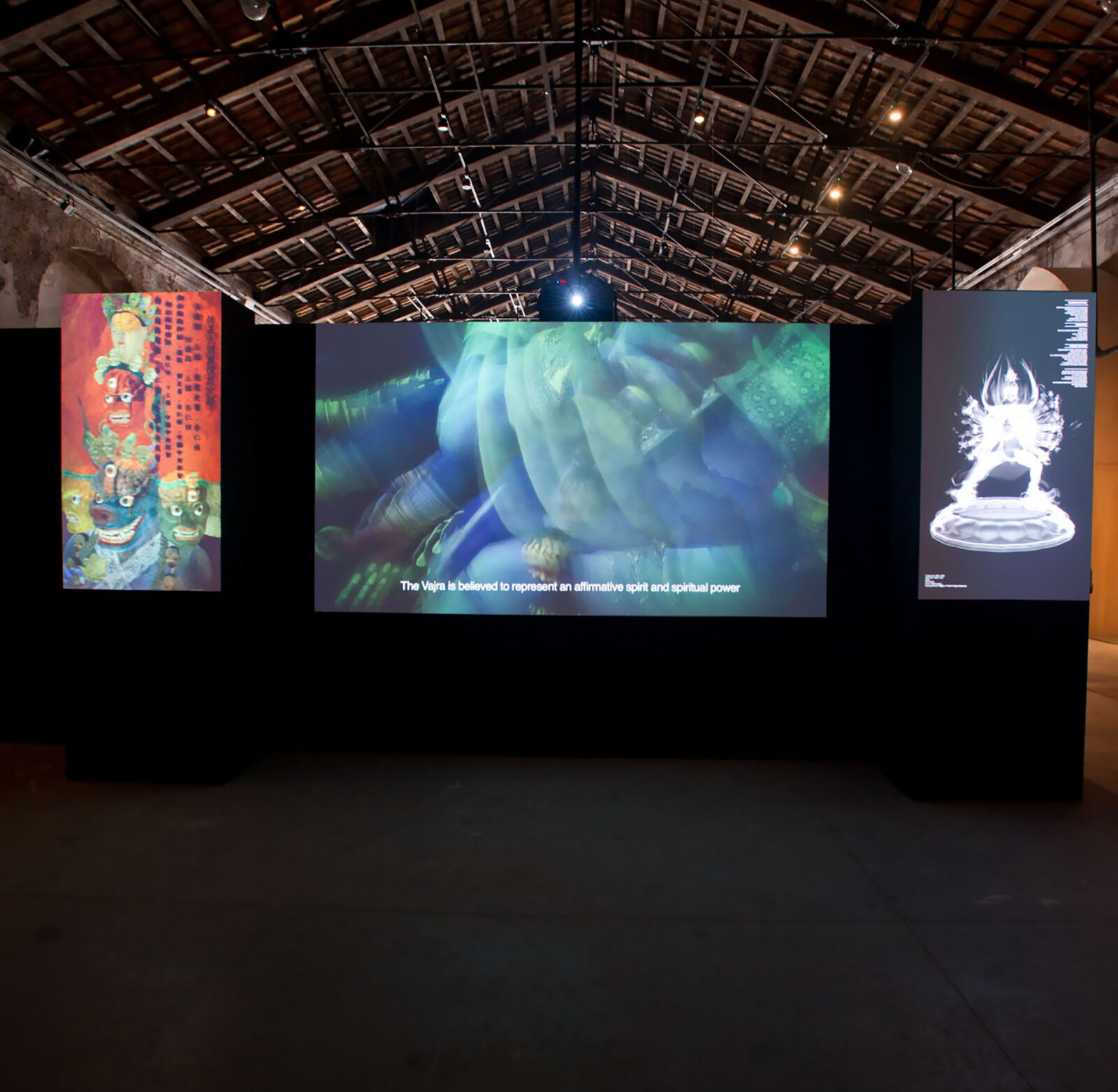
LuYang; Installation view of Wrathful King Kong Core at the 2015 Venice Biennale; courtesy of the artist
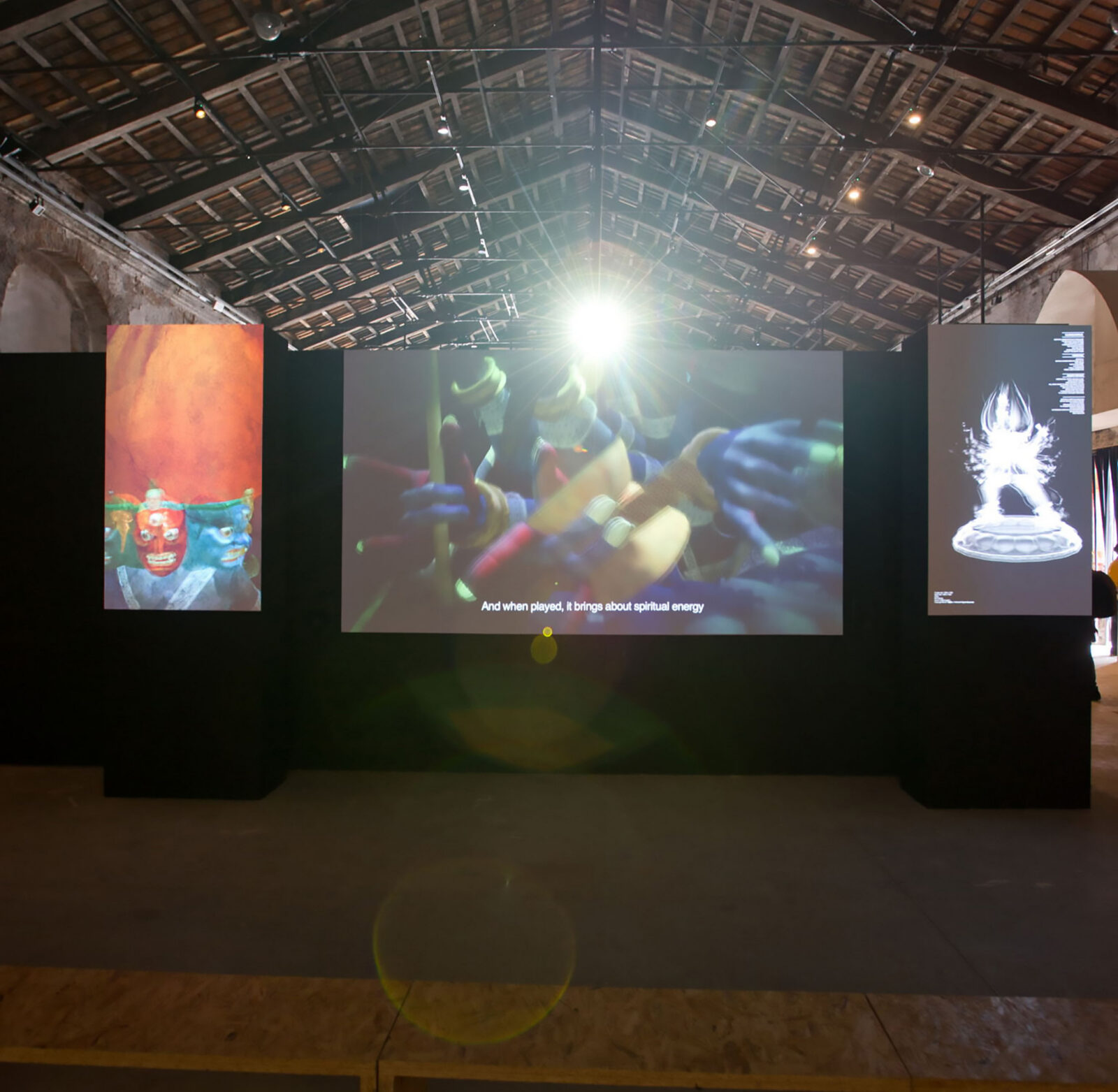
LuYang; Installation view of Wrathful King Kong Core at the 2015 Venice Biennale; courtesy of the artist
This piece is about looking inside the machinery of wrath—its neurological, energetic, and symbolic dimensions. I used AI-assisted visualizations to simulate how anger might travel through a digital brain, juxtaposed with the sacred geometry and iconography of wrathful deities.
But the goal is not to glorify anger. It’s to recognize that wrath, in its purified form, can be a vehicle of compassion. The more terrifying the deity, the more urgent the compassion behind it. I wanted to express the paradox that destruction, when motivated by wisdom, can be liberative.
I never treat tools as subjects. AI is just one of many instruments. The only thing I must carefully guard is my own mind. If I remain grounded in clear intention, I can work with any medium—whether paint, motion capture, or generative models.
AI doesn’t diminish my creativity—it extends it. It allows me to test thoughts faster, visualize contradictions, and bring metaphysical ideas into form. What matters is not the tool, but the clarity and compassion of the artist using it.

LuYang; Installation view of Moving Gods at the 2015 Venice Biennale; courtesy of the artist
I always gravitate toward tools that increase the speed and depth of visualizing complex concepts. I’m currently exploring more generative AI models, neural audio synthesis, and emotion-responsive systems. I don’t fetishize newness, but I’m pragmatic—if a tool helps convey wisdom more directly, I’ll use it.
Yes. In both Buddhist psychology and neuroscience, wrath is energy—it is not inherently evil. In the Abhidharma, anger is a mental affliction that can lead to suffering, but when transformed, it becomes mirror-like wisdom.
The wrathful deities in my work challenge us to see this: that anger, when purified, reveals the power of fierce love. The problem is not wrath itself—but our misperception of it. My art attempts to reframe wrath as a hidden expression of compassion, a shock that wakes us from delusion.

LuYang’s narratives draw heavily from Tibetan Buddhist philosophies and incorporate non-binary, post-human avatars with fluid identities. Intertwining new technologies, science, pop culture, and Buddhist and Hindu belief systems, their work radically questions cultural identity, bodies and gender, human mortality, global destruction, and the perception of reality.
The Shanghai-based artist explores the notion that virtual existence can extend or replace physical existence, creating unlimited possibilities for humanity in the future. They question the idea of an identity anchored in the body, proposing multiple identities and realities across time and space. For LuYang, identity is impermanent with no fixed self, an idea grounded in the Buddhist concept of impermanence.

Michelle Bennett Simorella is director of global projects and collections at the Rubin Museum, bringing two decades of museum experience and leading collaborative projects. Working in Kathmandu, Nepal, for several years expanded her knowledge of art and practices in the region. Michelle has degrees in art history and nonprofit management.

Wrightwood 659
Chicago, IL

Rubin Museum
150 W. 17th St., NYC
Get the latest news and stories from the Rubin, plus occasional information on how to support our work.