Photo by Worawee Meepian via Shutterstock
Photo by Worawee Meepian via Shutterstock
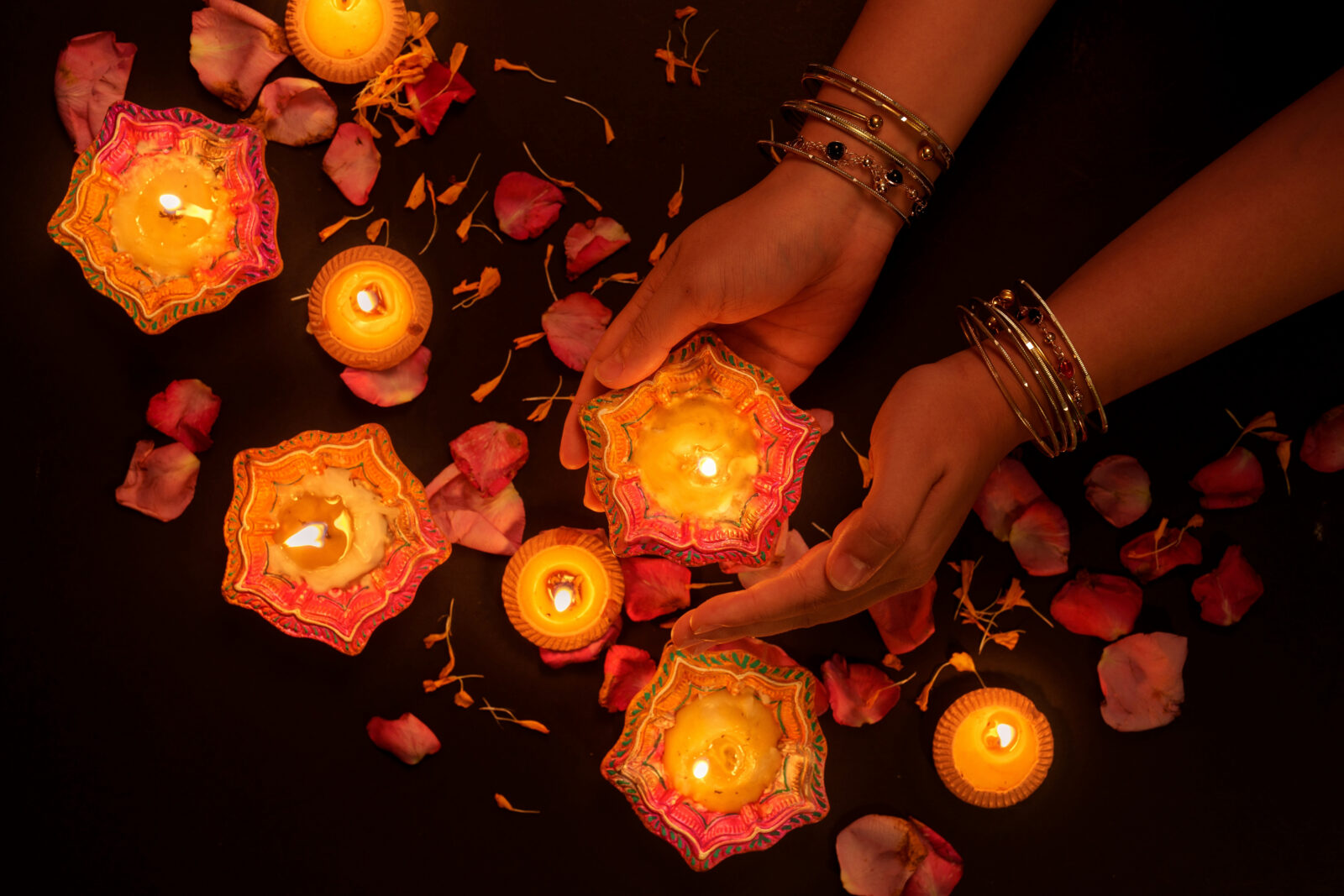
Every autumn, as the monsoon rains recede and the night air grows crisp, homes and temples across South Asia fill with rows of small clay lamps. Their flames flicker against freshly swept courtyards and intricate floor drawings (rangoli) made of colored powder and flower petals. Firecrackers crackle overhead as people gather to feast, exchange sweets, play gambling games, and recite late-night prayers.
Known primarily as Diwali, or the “Garland of Lights,” this festival is often portrayed to general audiences as a single, unified Hindu holiday. Yet this singular framing obscures a far richer reality. Diwali is not a singular holy day but a constellation of festivals celebrated by Hindus, Jains, Sikhs, and Buddhists alike. Each community animates the same rows of light with a different story, different sets of deities or historical figures, and different reasons for celebrating.
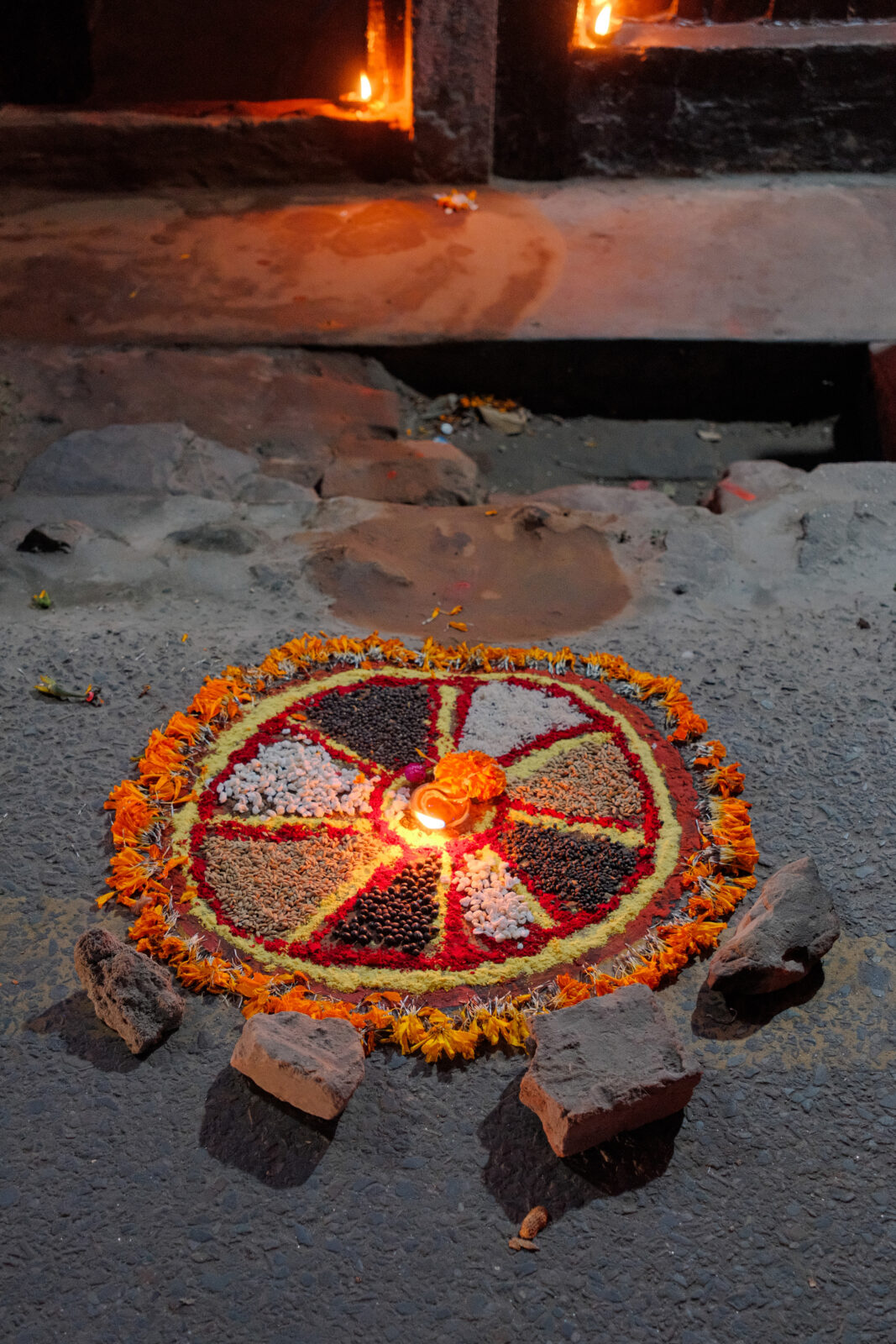
Devotees invite the goddess of abundance, Lakshmi, into their homes by making colored diagrams called rangoli using flowers, colored powders, and lamps. Photo by Sannan Kim via Shutterstock
The word Diwali comes from the Sanskrit Deepavali, a compound of deepa (“lamp”) and avali (“garland, row, series”). It literally means “a garland of lamps.” That etymology alone reveals something important: at its root, this holiday is less about any single deity or myth than about an action, the practice of lighting rows of lamps to mark a threshold, a transformation.
Across traditions, this transformation is consistently framed as the passage from darkness into light, ignorance into knowledge, and despair into hope. What differs, sometimes dramatically, is which story is told to explain that transformation and why.
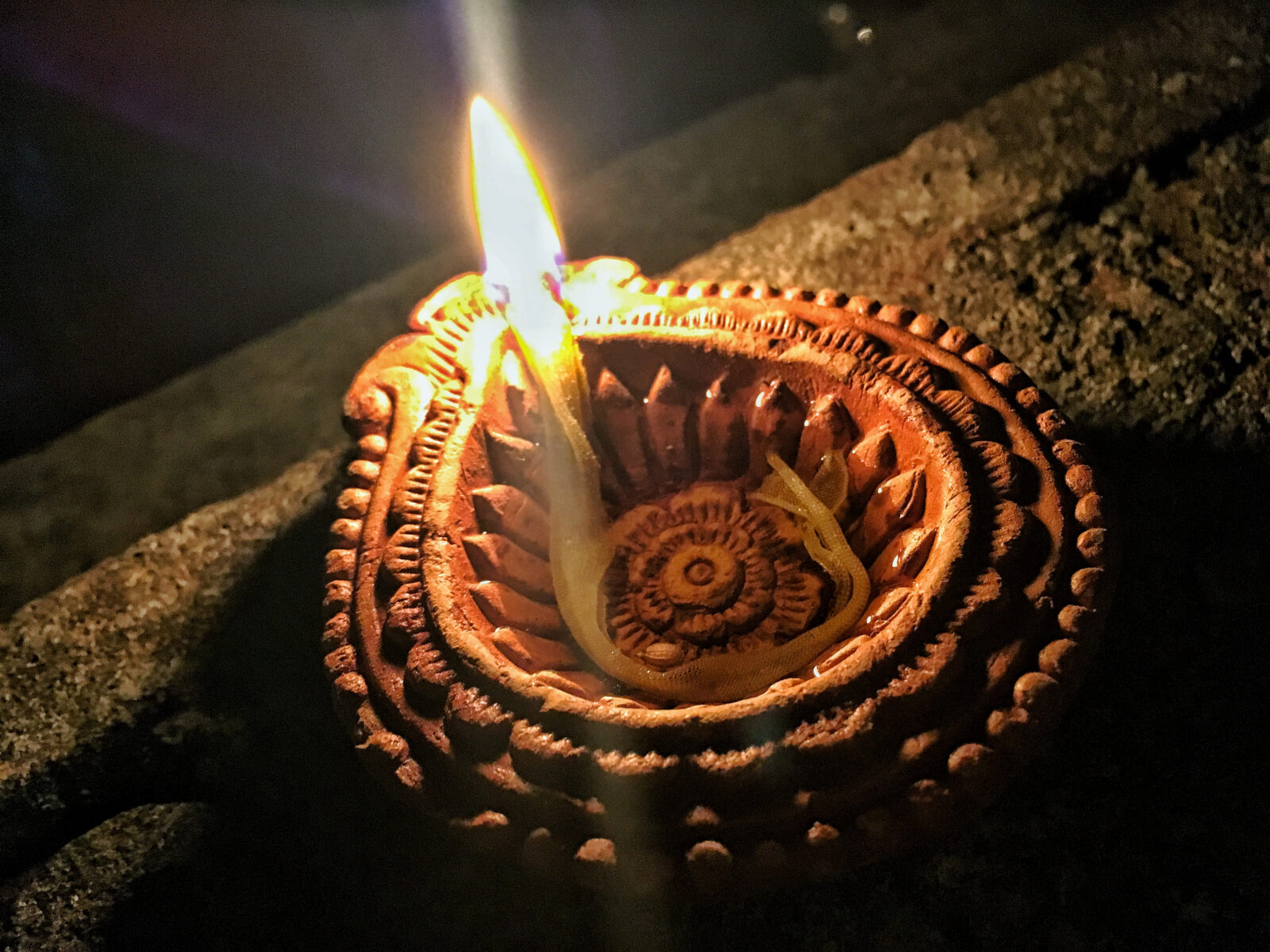
Celebrated in many different forms across South Asia and the Himalayas, the festival of lights gets its name from small clay oil lamps like this, which feature prominently in the public festivities. Photo by Sushant Sharma via Shutterstock
For many Hindus, especially across North India, Diwali commemorates the return of the god-king Rama, a manifestation of the beloved deity Vishnu, to his capital city of Ayodhya after 14 years of exile, as narrated in the epic Ramayana. Having defeated the demon-king Ravana and rescued his wife, Sita, Rama arrives home on a moonless night.
According to tradition, the people of Ayodhya lit oil lamps along the roads to guide him back and to celebrate the restoration of righteous rule. In this telling, Diwali is fundamentally a homecoming story, and the lamps function almost like a beacon: light offered in welcome and in gratitude that justice has prevailed.
Another important observance during Diwali, for both Hindus and Buddhists, is the worship (puja) of Lakshmi, the goddess of abundance, fortune, and wealth. She is also the consort of another manifestation of Vishnu known as Narayana.
On the main night of the festival, households meticulously clean and illuminate their homes, leaving doors and windows open, in the hope that Lakshmi will enter and bless the family with prosperity for the coming year. For many merchant and business communities, this Lakshmi puja also marks the start of a new financial year, complete with the ceremonial opening of fresh account ledgers. Here, the same lamps that guided Rama home double as an invitation and offering to Goddess Lakshmi.
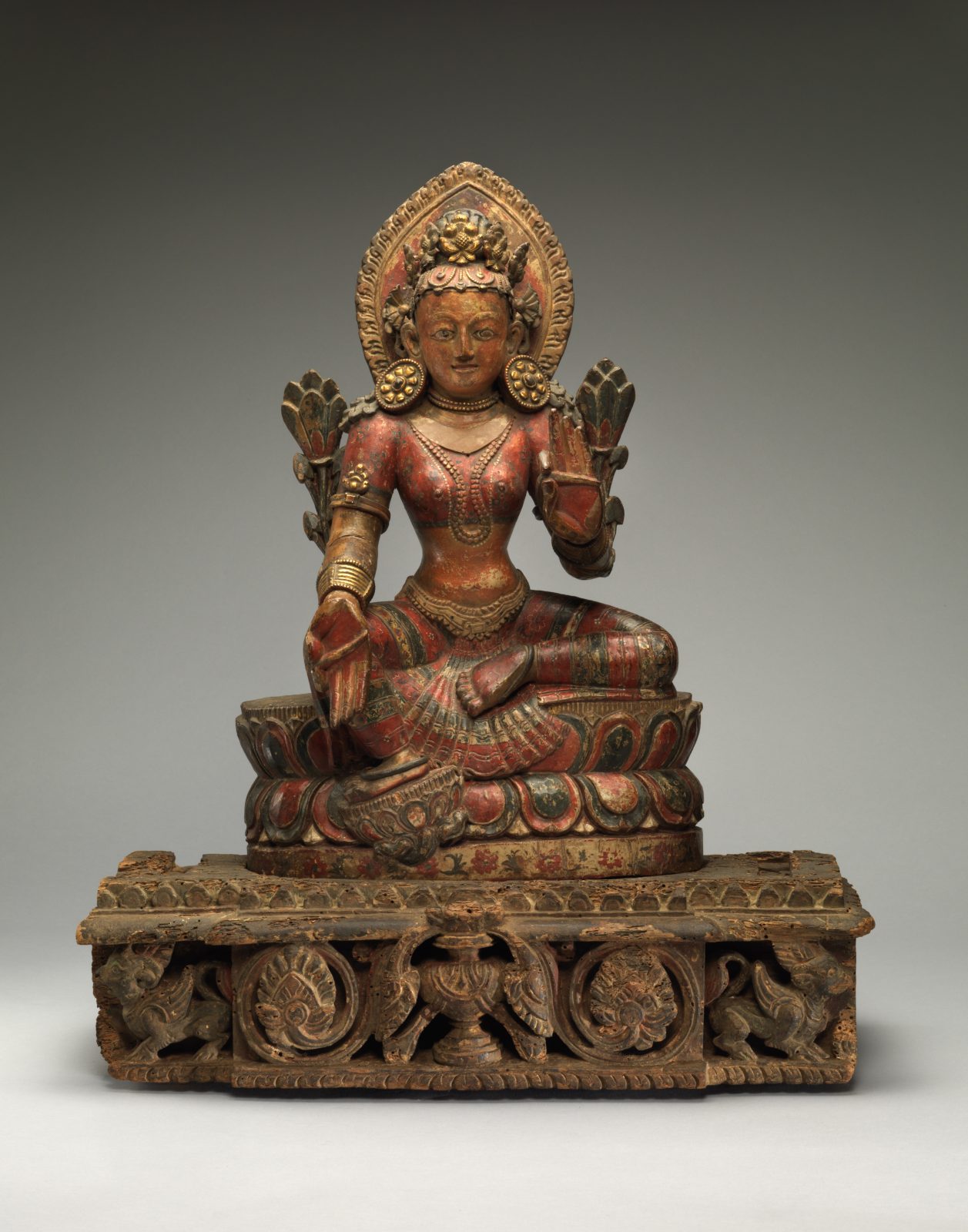
Lotus Goddess, Lakshmi; Nepal; 17th century; Wood with pigments and gilt repoussé; Rubin Museum of Himalayan Art, Formerly of Joe Gelpey Collection; C2008.1a-b
For Jains, the timing of Diwali coincides with an entirely different, and in some ways more solemn, occasion: the anniversary of the moment when Mahavira, the last of the 24 Jain tirthankaras, or enlightened masters, attained final liberation from the cycle of suffering and rebirth.
According to Jain tradition, Mahavira passed into liberation on this very night, and the assembled kings and disciples lit lamps to compensate for the light of his wisdom now departed from the world. For Jain communities, Diwali doubles as both a celebration and a commemoration of loss, and the festival often marks the beginning of a new year.
During this same period, Sikhs observe Bandi Chhor Divas, or “the day of release of detainees.” The holiday commemorates the release of the sixth Sikh Guru (teacher), Guru Hargobind, from imprisonment under the Mughal emperor Jahangir in the early 17th century. According to Sikh tradition, the Guru negotiated the release of 52 Hindu princes imprisoned alongside him by asking that any prisoner able to hold onto his cloak be freed as well. He had a cloak specially made with 52 tassels so that all of them might go free together.
Sikh communities historically illuminated the Golden Temple in the holy city of Amritsar, in North India, to celebrate his return. In this way, Bandi Chhor Divas remains closely tied, in both timing and symbolism, to the broader Diwali season, even as it commemorates an entirely distinct history.
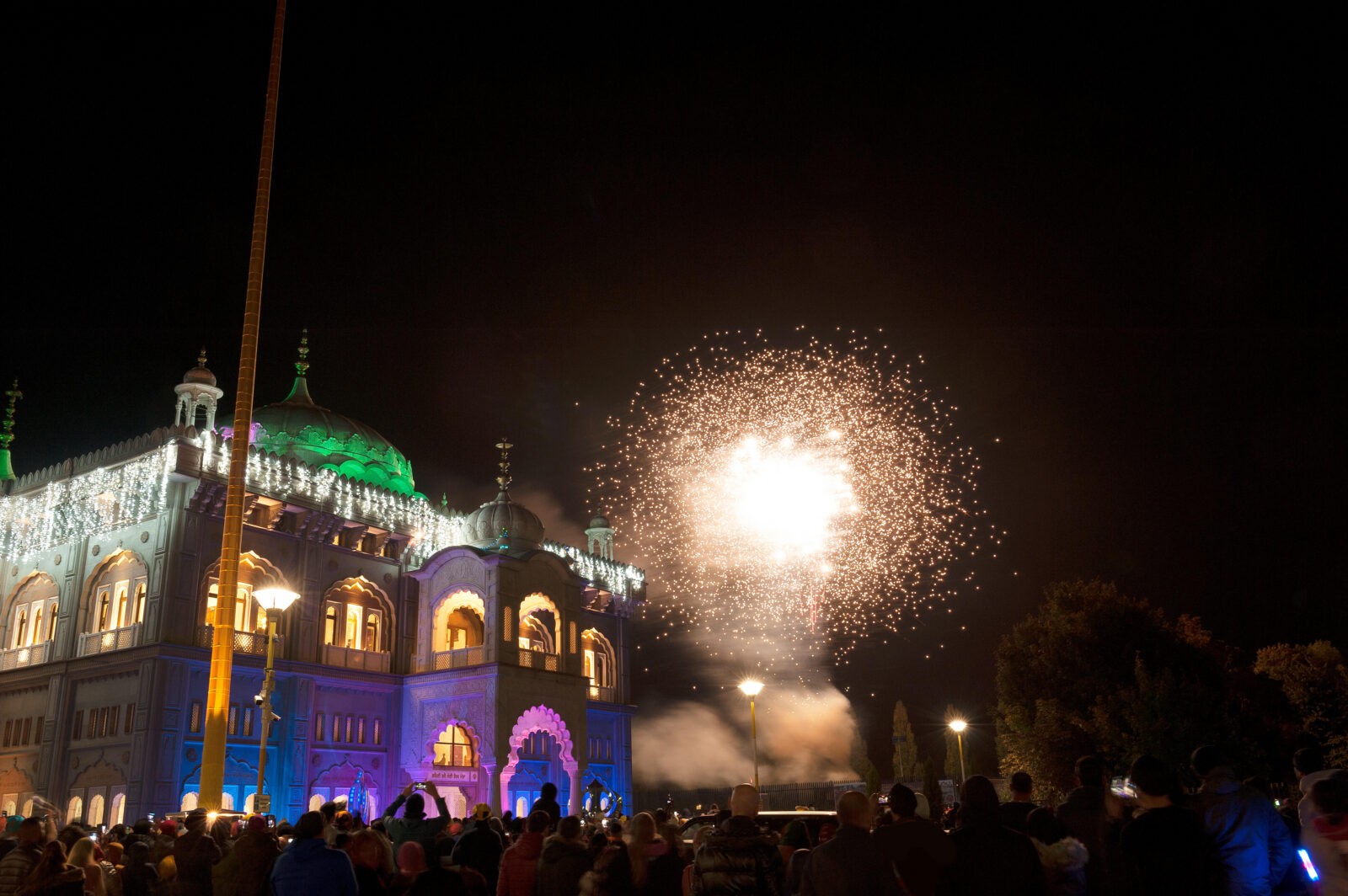
For Sikhs, the festival of lights commemorates the release of the sixth Sikh guru, Guru Hargobind, from imprisonment. Here, Sikhs celebrate with colored lights and fireworks at a Sikh house of worship called a Gurdwara. Photo by Yon Marsh via Alamy
In Nepal’s Kathmandu Valley, this same season is celebrated as Tihar, sometimes called Swanti among the valley’s indigenous Newar communities. It unfolds not as a single night but as a five-day sequence honoring an ever-widening circle of relationships.
On the first day, households offer rice and other foods to crows, messengers of Yama, the god of death, in hopes of warding off ill omens. The second day honors dogs, as devotees adorn them with vermilion powder and floral garlands in gratitude for their loyalty and their role as guardians of the threshold between life and death. The third day belongs to cows, and to Lakshmi herself, with homes illuminated by rows of oil lamps much like in India. Newar communities also observe Mha Puja on this day, a ritual of self-worship marking their own new year, in which practitioners honor their bodies and life force as sacred. The festival closes with Bhai Tika, a day devoted to the bond between brothers and sisters. Sisters apply a multicolored tika, or dot, to their brothers’ foreheads and pray for their long life. In return, brothers offer sweets and gifts.
Taken together, Tihar reveals a vision of renewal that emphasizes the sacred bonds between one’s self, one’s family and community, and the animals and natural world on which one relies—suggesting that no act of illumination is complete until it has touched every relationship that sustains a life.
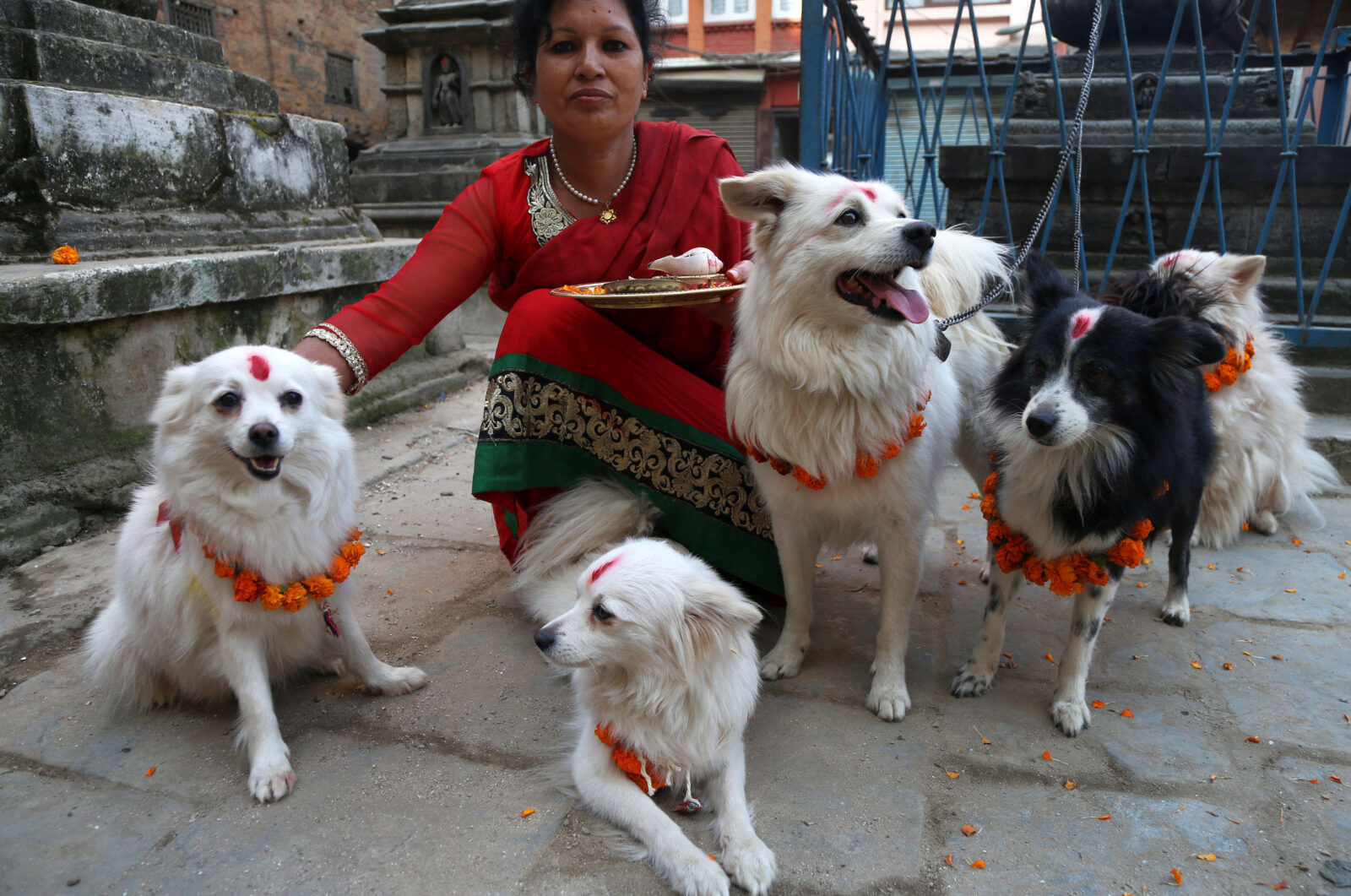
During the Nepalese festival of lights known as Tihar, the second day is reserved for the worship of dogs as an expression of gratitude for their loyalty and protection. Here, devotees anoint dogs with vermillion powder, garland them with flowers, and offer delicious treats. Photo by Pacific Press via Alamy
Seen this way, Diwali is best understood not as a single holiday exported from one tradition to another, but as a shared season of light animated by many different communities, each with its own history and beliefs. A Hindu family welcoming Lakshmi, a Jain family marking Mahavira’s final teaching, a Sikh family commemorating a Guru’s negotiated justice, and a Newar family tying a sacred thread between sister and brother are not performing variations on the same ritual so much as they are independently arriving at a shared conviction: that darkness of all kinds can be dispelled with the communal act of inviting in the light.

Westin Harris is the resident scholar in Himalayan cultures at the Rubin Museum of Himalayan Art.


Get the latest news and stories from the Rubin, plus occasional information on how to support our work.