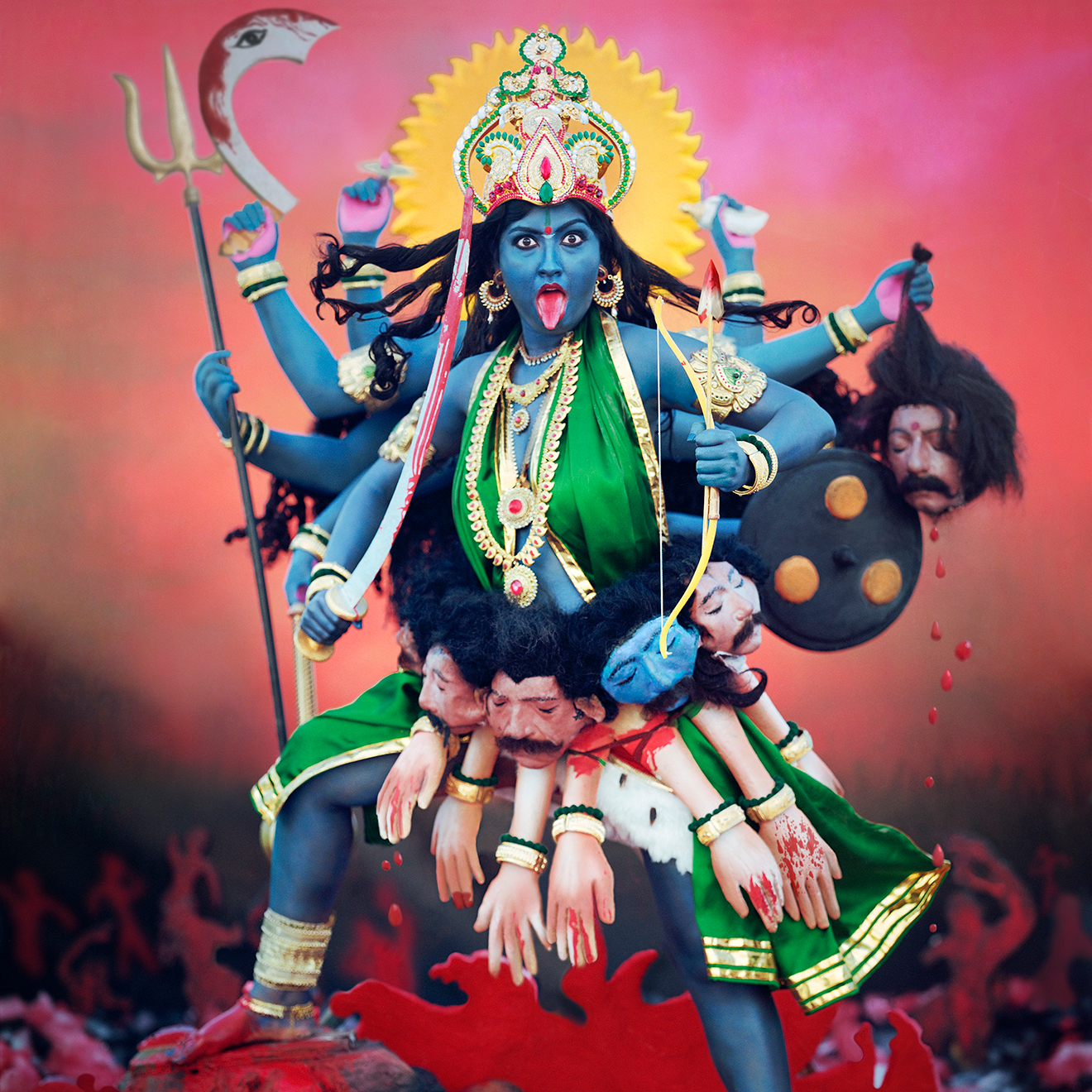
Artwork by Manjari Sharma
Artwork by Manjari Sharma
Kali and Durga possesses transformative powers
In Hinduism, goddesses are understood as manifestations of a single supreme deity—Mahadevi. The myth of Mahadevi became the cornerstone of the Hindu goddess tradition known as Shaktism. She is celebrated in the Devi Mahatmya (ca. 550 CE), which is part of the Markandeya Purana (ca. 250 CE), whose central narrative details her origin story. The text recounts her first appearance as the warrior goddess Durga, who slays the buffalo demon Mahishasura.
In one version of the myth, Mahishasura is granted a boon by Brahma that no male deity could defeat him. Empowered by this protection, he sets out to conquer the universe, including Indra’s celestial realm. In desperation, Indra appeals to Brahma, Shiva, and Vishnu, whose collective fury births a massive force of energy that condenses into the radiant form of Mahadevi. The gods forge replicas of their weapons and offer them to her, urging her to defeat the demon. From Himalaya, the god of the mountains, she receives a tiger (in some versions of the stories and depictions, a lion) named Ambika, and from Kubera, the god of wealth, a cup of wine.
As the newly born goddess lets out a terrible and triumphant laugh, joined by the cries and cheers of the gods, Mahishasura sends his troops to investigate the source of the commotion. His soldiers return describing a vision of an unmarried goddess, dazzlingly beautiful yet terrifying, embodying a fusion of opposites—affection and ferocity, gentleness and wrath. Captivated, the demon proposes marriage. With thunderous defiance, she refuses. Even when he assumes a handsome human form, she remains unmoved, declaring her purpose: to uphold dharma, the righteous order of the universe. She challenges him—fight or retreat to hell. Enraged by her rejection, the demon attacks, shifting into various animal forms. The goddess, drinking wine and mounting her tiger, relentlessly pursues him. With a serene and unwavering grace, she tramples him, drives a trident through his chest, and severs his head with a discus.
This myth and its variants starkly contrast with the normative feminine ideal found in the Dharmashastra, a collection of texts outlining codes of law, ethics, and conduct. There, a woman’s essential nature is framed as passive, subordinate, and nonconfrontational. Her identity is confined to roles determined by male authority—wife, mother, caregiver. But in the Devi Mahatmya, this paradigm is overturned. The demon’s immediate impulse to domesticate the goddess through marriage reflects the drive to subordinate feminine power.
Mahadevi resists this entirely. Within her infinite energy (shakti) resides the strength to defy prescribed roles and surpass the combined might of all male deities. Importantly, she defeats the demon without their direct intervention. Their powers merge within her, affirming her as the Supreme Reality, both immanent in the gods and at the same time transcending them.
Once marginal to the brahmanical spiritual order, the goddess became an integral figure in India’s religious landscape. This transition is reflected in the Markandeya Purana and the emergence of a new tantric metaphysics between 300 and 600 CE. Take Kali, for instance: with her wild and defiant identity, she long existed on the margins of conventional religious beliefs. Yet now she is one of most revered deities in Hinduism. Her iconography and mythic identity were shaped in the tantric texts of the seventh and eighth centuries, particularly in the story of her emergence from Durga’s wrath, as told in the Devi Mahatmya.
According to the narrative, the gods promise the demons that the goddess can only defeat them if she appears before them naked. Unaware of this agreement, Devi strides into battle—only to learn of the condition in shock. Enraged by this deception, she transforms into Kali, a monstrous embodiment of fury, and unleashes a rampage that obliterates everything in her path. This myth is central to her identity: whereas Durga destroys evil to restore cosmic order, Kali, born of violated dignity, annihilates all—even good. Her wrath rejects all order, all hierarchy, all kind of control. In this, she becomes the destroyer who answers to no one.
Yet Kali, although it seems paradoxical, is also worshiped as the Divine Mother. Shiva plays a pivotal role in this transformation. As Kali’s fury threatens to annihilate the universe, Shiva lies down in her path. When she unknowingly steps on him, she pauses. Seeing him beneath her feet, a gentle smile tinged with modesty spreads across her face. She recalls her other identity—as the compassionate mother of the cosmos. Significantly, Shiva does not stop her with command, force, or even words. Through passive stillness, he reminds her of who she is. Her restraint is her own choice. In this moment, her fury does not vanish but becomes self-aware.
This is also where the metaphysical relationship between Shiva and Kali reveals its profound significance. In the Jayadratha Yamala, Kali is described as the Supreme Absolute, the primordial reality, the dynamic cosmic womb, the source of all manifestations and the final destination of all dissolution. She is dynamic even in her unmanifest form. Her wrath is not chaos but raw, pre-cosmic energy, shakti—creative, generative, transformative. She is the thunderous embrace of all existence—wrath and radiance alike. Her wrath is a preexistent order, transcendent energy of becoming. It is the generative force through which the unmanifest becomes manifest, and simultaneously, she is the essence into which all things return. But to manifest a structured universe, she requires Shiva: the principle of form and limitation.
In metaphysical terms, Kali’s wrath is an immeasurable force, shakti, but it also mirrors the very structure of reality. In life, there are forces beyond our control we must accept as expressions of a greater cosmic order. This requires a transformation of human ordinary perception, something her devotees strive toward. While Kali is often venerated in temples, her most intimate rites unfold in remote, unsettling spaces, such as crossroads, the wilderness, or dense forests. The Kalikula texts describe night rituals held at cremation grounds, surrounded by ash, fire, and jackals. Like in Buddhist tantras, these liminal spaces serve as arenas for radical inner transformation. Here, the practitioner confronts death directly, transcends fear, and awakens to truth.
These rituals reveal that true awakening demands embracing the full range of experience, even the painful and terrifying. Life is interwoven with joy and suffering, sukha and dukkha, which is also an insight that lies at the very heart of the Hindu worldview. Through devotion, the practitioner reconciles with their own mortality and finds serenity, even amid the goddess’s furious presence. Fire, ever-present in these rites, symbolizes the goddess herself—life-giving and destructive, purifying and consuming.
But these rituals are not merely acts of surrender to the goddess’s unpredictability; they also awaken constructive wrath in human beings as a transformative force that purges impurity and dissolves the ego, which is shrouded in illusion and, due to its attachments, filled with anger (krodha), which causes selfish and harmful actions. Wrath, in this sense, is understood as a rebellion against the ego, a tearing away from its attachments, a thunderous “no” to its weaknesses, and a force through which the strategies of liberation are enacted.
In this transformative dimension, Kali assumes Durga’s role: the annihilator of evil. She dwells within her devotees as eternal fire—a wrath that both destroys and renews, liberating from fear and illusion. When Kali awakens wrath within, it is not a descent into violence but a leap beyond fear. She shatters inertia, reshapes reality, and continually renews life. This wrath is not mindless destruction but the force that ultimately nullifies even itself, finally arriving at a place of deep equanimity.
Whether as Kali or Durga, the goddess penetrates the human core and interrogates it. She challenges normative structures and enables spiritual and social freedom. Her thunderous wrath—a rebellion in defense of justice and truth and transmuting power of change—continues to reverberate across the layered realities of India and beyond. Wrath, in this vision, does not merely destroy the old; it gives rise to the new. Wrath is the fire that purifies and reshapes, the quake that shatters false ground. It protects compassion, restores dignity, and demands courage—not for hatred, but fierce love in defense of truth.
Therefore divine wrath is not the opposite of compassion, but its guardian. It is a feminine answer to the violence of the world—a visceral, sacred impulse that urges us beyond fear and complacency. When Kali steps on Shiva in fury and awakens to her own nature, she reveals this paradox: boundless power joined with mindful restraint. At this intersection lies her divinity—and our own. For in her wrath, the goddess becomes profoundly human, and in turn, the human becomes divine.
Divine wrath in Hindu goddesses is never mindless but ethical; it is a response to injustice, shame, and imbalance—and so it is in the human realm as well. Divine wrath dissolves ordinary anger, which arises from the selfish tendencies of the human ego, and creates space for new ethical and existential paradigms that lead us toward a deeper understanding of our being. At the same time, the goddess’s wrath is a magnificent affirmation of life in all its terrifying splendor. It is an ode to all the facets of existence, to life and death, and to the mystery that transcends them both.

Dr. Nina Petek is a professor in the Department of Philosophy at the Faculty of Arts, University of Ljubljana, Slovenia, where she teaches courses on Hindu and Buddhist philosophical and religious traditions. Her current research centers on the philosophical teachings and meditative practices of Vajrayana Buddhism, including work conducted as part of the research project “Buddhism in the Himalayan Deserts: The Tradition of Yogis and Yoginis in Ladakh,” funded by the Slovenian Research and Innovation Agency.

Manjari Sharma makes art that addresses issues of memory, identity, multiculturalism, and personal mythology. Her work has been featured in the New York Times, Vice, Los Angeles Times, Huffington Post, CNN, and NPR, and her art is in the permanent collections of the Metropolitan Museum of Art, Museum of Fine Arts, Houston, Carlos Museum, and Birmingham Museum of Art. Originally from Mumbai, she now lives in Los Angeles.
This article appears in issue 10 of the print edition of Spiral magazine under the title “Divine Wrath.”

Get the latest news and stories from the Rubin, plus occasional information on how to support our work.