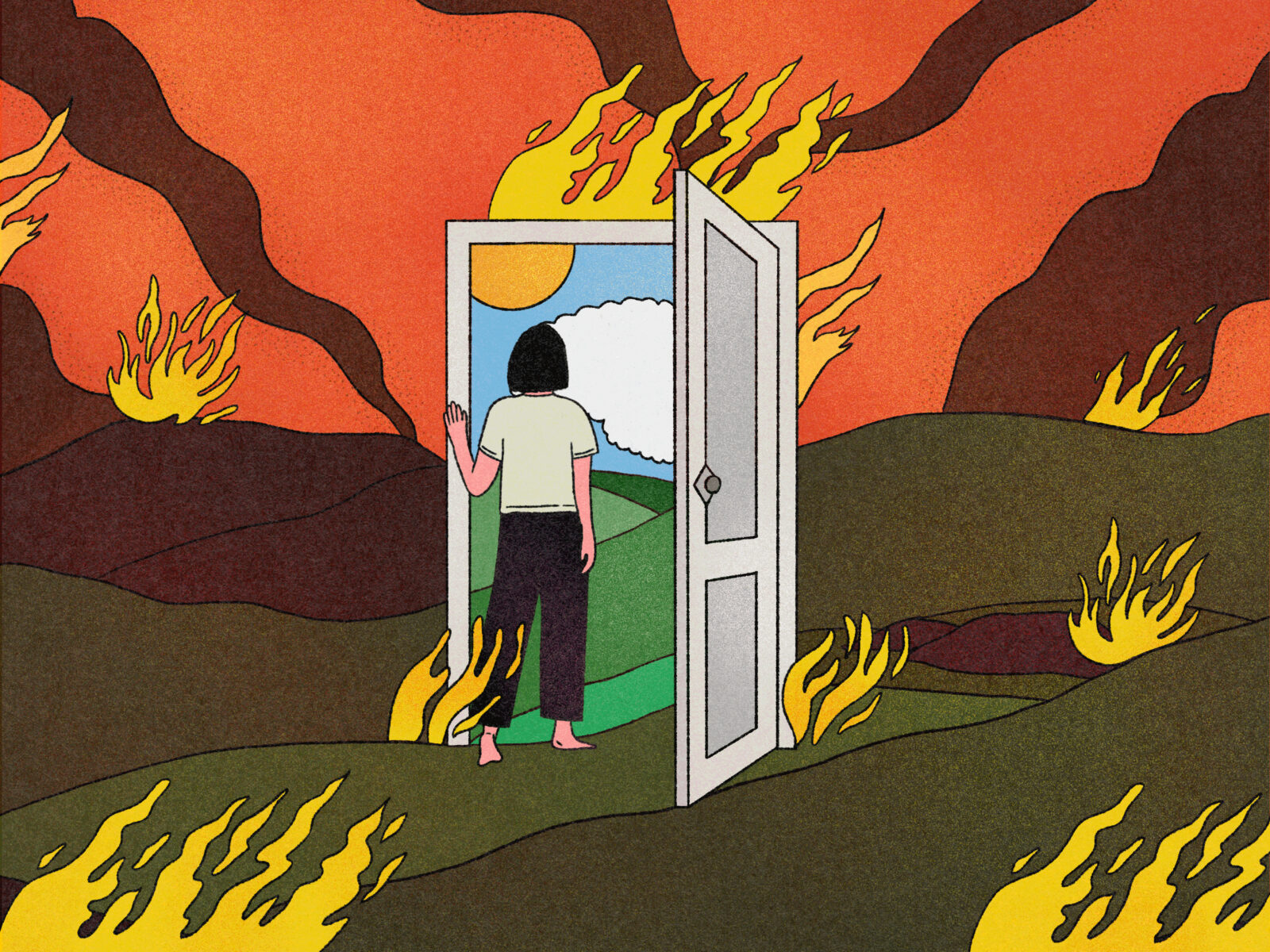
Illustration by Sargam Gupta
Illustration by Sargam Gupta
The first time I had to attend anger management therapy was when I was 15. My parents had sought mental healthcare for me, making it clear I was a “problem child.” Now I knew the problem itself was anger. What I learned was that anger was dangerous, immature, and a thing to be controlled if I wanted to be taken seriously in the world. I quickly internalized that narrative.
But with time, and especially since my autism diagnosis in 2021, I’ve come to realize that anger is, perhaps, the most misunderstood of all emotions.
Rage is one of humanity’s oldest survival tools. Evolutionary psychologists argue that anger evolved as a protective mechanism—mobilizing our bodies to confront injustice, resist harm, and signal when a boundary has been crossed. Anthropologists remind us that in early human societies, collective anger often functioned to restore fairness and curb exploitation. Trauma theorists describe how these somatic responses carry generational wisdom; the body knows when something is unsafe, even before our conscious minds catch up.
If that’s true, then perhaps what I’d been taught to see as my personal flaw—the intensity of my anger—was actually my body enacting self-preservation. Maybe what I had been taught to label as “overreactions” was ancient wisdom reminding me these situations shouldn’t be allowed to continue.
What was really going on was my wrath refusing complicity.
Once upon a time, I used to be a lawyer. My wrath often showed up at work, though at the time, I could only experience it as breakdowns. To give you a quick glimpse of what my life looked like then, I’ll quote myself from an article I wrote in 2019, under a pseudonym: “I narrowly avoid[ed] a major accident with a truck on my way back from work one (mid)night, where my brain’s immediate reaction wasn’t an elated, ‘Phew! What a save! I could’ve died!’ Instead, it was a decidedly dejected, ‘Damn it! Now, I’ll have to go back to work tomorrow.’”
What was really going on was my wrath refusing complicity. The truck incident was my body registering that the violence of overwork had become indistinguishable from any other form of harm.
By the time I quit law, my body was frantically screaming to let go. Every muscle was tight, every nerve frayed, every meeting ending in the same cycle of overstimulation and shutdown. My immunity had collapsed under the weight of stress. And yet, my colleagues somehow managed to soldier on, laughing bitterly about burnout over afterwork drinks, then showing up the next day as though nothing had happened. I couldn’t figure out why I was the one who . . . Just. Couldn’t. Cope.
For years, I mistook my refusal to calm down and accept that this was the life I’d chosen for myself as a weakness. But in hindsight, I see how my wrath was simply refusing to let me normalize harm. It didn’t allow me to disappear into numbness. It was my fire alarm that remained unbearably loud and impossible to ignore. And ultimately, that’s what saved me.
Wrath, in this sense, assumes the form of an embodied truth.
In 2025, a senior former lawyer I met online told me, “I wish I’d also left much sooner, like you did.”
By this time, I had already connected with more autistic lawyers who had quit law, and we bonded over our respective traumatizing experiences of trying to navigate law firms in India’s financial capital. We laughed bitterly at how we’d been accused of being “too sensitive” and “too angry.” But in retrospect, it was precisely that anger that stopped us from internalizing more abuse.
Wrath, in this sense, assumes the form of an embodied truth. For neurodivergent people, rage and shutdowns —often perceived as “overreactions”—are just signs of the nervous system signalling when the environment is unbearable. Sometimes, that very “oversensitivity” that society is quick to mock and pathologize is simply our nervous system picking up on dissonance before anyone else notices. We are wired to register friction—whether it’s sensory chaos, exploitation at work, or hypocrisy in relationships—with an intensity others can afford to tune out. So what looks like volatility from the outside is, from within, a heightened accuracy of perception.
My body hasn’t failed me; what I’d mistaken for breakdowns was, in truth, the clearest boundary I’ve ever drawn.
For those already on the margins, wrath is often the only tool left to name misattunement.
As Lindsey Mackereth, a therapist and writer, notes, “Neurodivergent employees aren’t fragile. They’re just early indicators of dysfunction. We’re the canaries in the coal mine. If something’s confusing, overwhelming, or inefficient, we feel it in our bodies before anyone else. We notice the friction. We point it out. And too often, we get labeled as ‘difficult’ or ‘high maintenance.’”
Anger in marginalized bodies is always suspect—be it the “angry feminist,” the “angry Black woman,” or the “angry disabled person.” Our wrath threatens the status quo, so it must be delegitimized. Our distress gets medicalized, medicated, and disciplined, rather than being heard.
Workplaces love to weaponize this dynamic and glorify “resilience,” which is usually a euphemism for being forced to endure exploitation without protest, so that when someone burns out, they don’t have to acknowledge it’s the system that’s abusive. Instead, they can get away with blaming it on how the individual wasn’t strong—and, of course, resilient—enough.
We’ve built a work culture where breakdowns don’t warrant introspection into how the system is structured, but rather inspire a workshop on managing one’s emotions better.
When I think back to my conversation with the senior former lawyer, I realize I couldn’t adapt to the long nights and relentless grind, not because I was weak, but because my body refused to comply with what should never have been acceptable in the first place. Where others are conditioned to suppress, neurodivergent rage remains uncontainable. My autism had made me unwilling to endure what no one should ever have to endure.
Historically, wrath has been cast as sin; it’s one of the deadly seven even. But what if that framework says more about preserving hierarchy than about human truth? For those already on the margins, wrath is often the only tool left to name misattunement. What society reads as disorder, then, might actually be a different kind of order, an embodied refusal to accept what is unjust.
Our bodies know what our cultures deny. When we’re willing to listen, the fire of rage can illuminate us, just as it burns away what’s destroying us. And, maybe, what neurodivergent wrath offers the world is a living reminder that what we normalize is not always what we should accept.

Devrupa Rakshit is an award-winning independent journalist, social media consultant, new media artist, and disability rights advocate based in India. Her work—which focuses on the intersections of mental health, gender, and social justice, particularly through the lens of disability and neurodivergence—has appeared in several national and international publications. A former lawyer, Devrupa is also a bilingual poet and regularly performs spoken word poetry on anti-establishment themes directed at challenging exclusionary and unsustainable societal norms.

Sargam Gupta is an Indian artist and creative director whose work blends everyday moments with playful surrealism. Based in New York City, Sargam pushes the boundaries of reality in her art, nudging it ever so slightly to reveal a world where the impossible feels possible. She has collaborated with the New York Times, Vox, Uber, and Apple. See her work at @stopthisgupta
Get the latest news and stories from the Rubin, plus occasional information on how to support our work.