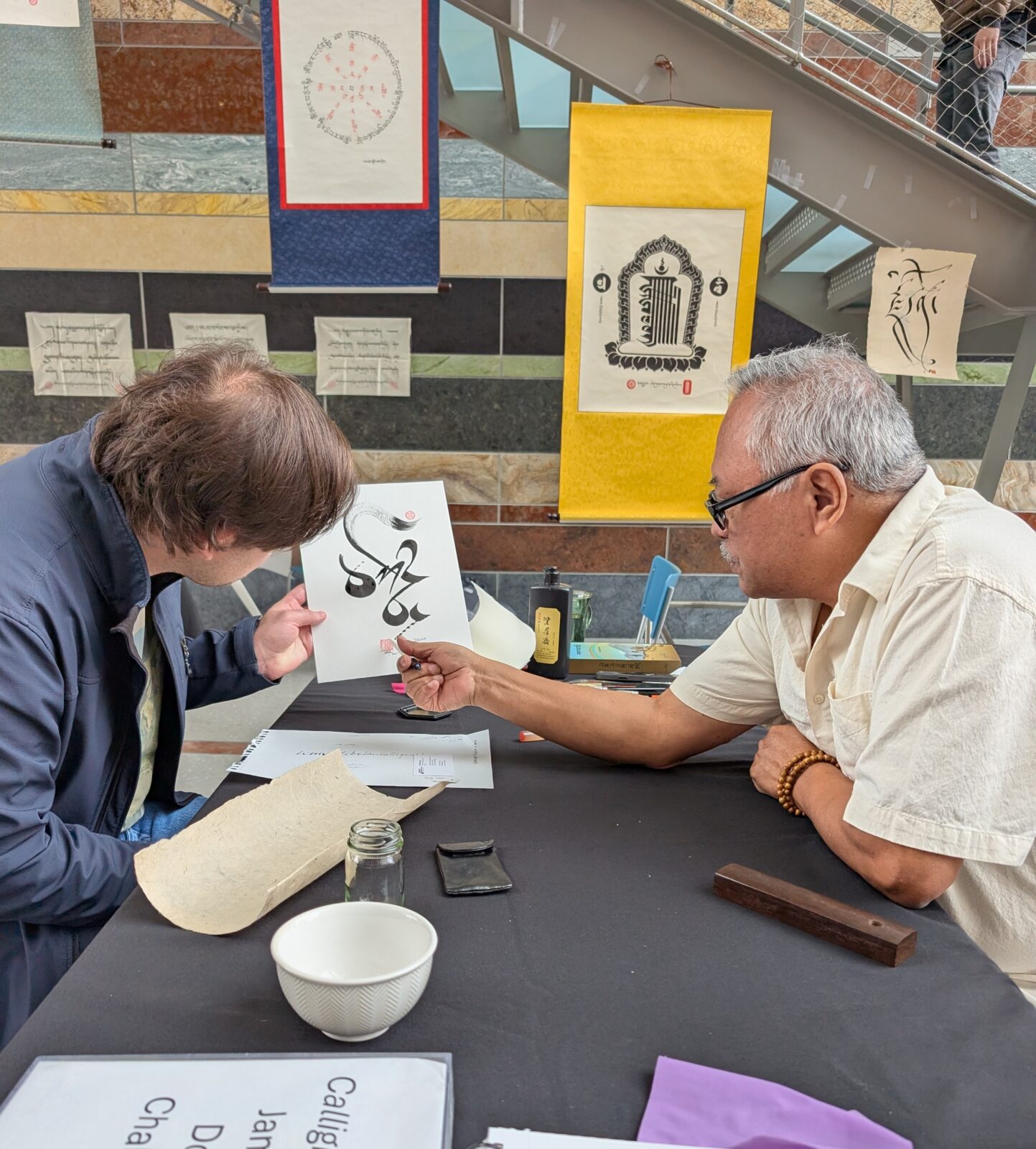
Jamyang Dorjee Chakrishar showing someone their name at Tibetan Calligraphy Day in 2025 at Indiana University; photo by Kristina Dy-Liacco
Jamyang Dorjee Chakrishar showing someone their name at Tibetan Calligraphy Day in 2025 at Indiana University; photo by Kristina Dy-Liacco
“My name is Julia.”
“Could you please write it down?”
Jamyang Dorjee Chakrishar watches as a visitor to the Tibetan Calligraphy Day event in Bloomington, Indiana, jots down her name on a notebook page. The event, organized by The Latse Project and hosted by Indiana University, is lively with students, faculty, and community members, some encountering Tibetan calligraphy for the first time. Jamyang Dorjee is doing live calligraphy demonstrations, creating spontaneous works for visitors who make requests for their name or words, such as compassion or peace, to be rendered in his artistic Tibetan calligraphy style.
Jamyang Dorjee Chakrishar writing script on Tibetan Calligraphy Day in 2025 at Indiana University; video by Kristina Dy-Liacco
He reads Julia’s name aloud to confirm the pronunciation, “Jule-lee-ya?” Then, hand poised midair, he bows his head and gazes at the blank sheet of watercolor paper in a moment of thought and vision. Once he puts brush to paper, his hand moves fluidly and with intention, as Tibetan letters emerge from the empty canvas.
Julia’s face lights up when Jamyang Dorjee presents her with the finished work. Her voice full of wonder, she asks, “That’s my name in Tibetan?” She is beaming as she beholds the paper, handling it carefully to not smudge the still-wet ink, and thanks Jamyang Dorjee for this small work of art that is inextricably hers.
Jamyang Dorjee Chakrishar is one of the foremost Tibetan calligraphers of our age, celebrated for his calligraphy mastery, artistic expression, and commitment to promoting Tibetan calligraphy within Tibetan communities and beyond. For Jamyang Dorjee, the act of writing is also a vital part of his Buddhist practice.
Jamyang Dorjee is from Sikkim, a Himalayan state in present-day India. As a young child, he spent some time in the monastery as a monk, an experience that rooted in him a deep interest in Buddhist studies that has endured throughout his life. Later, Jamyang Dorjee’s parents enrolled him in the Tibetan school in Shimla, one of the three Tibetan schools established by His Holiness the Dalai Lama after coming into exile in India in 1959.
In 1960, his family left Tibet for Sikkim, a Himalayan state in present-day India. Jamyang Dorjee’s parents enrolled him in the Tibetan school in Shimla, one of the three Tibetan schools established by His Holiness the Dalai Lama after coming into exile in India in 1959. “It was very interesting,” recalls Jamyang Dorjee, “for [grades] one, two, three, and four, we had such eminent scholars as our teachers, like Samdhong Rinpoche and Geshe Lobsang Tharchin of Sera Mey. Geshe Lobsang Tharchin, one of the best Geshe Lharampa of Tibet, was my main master for calligraphy. It was through him that I developed a strong foundation in handwriting.”
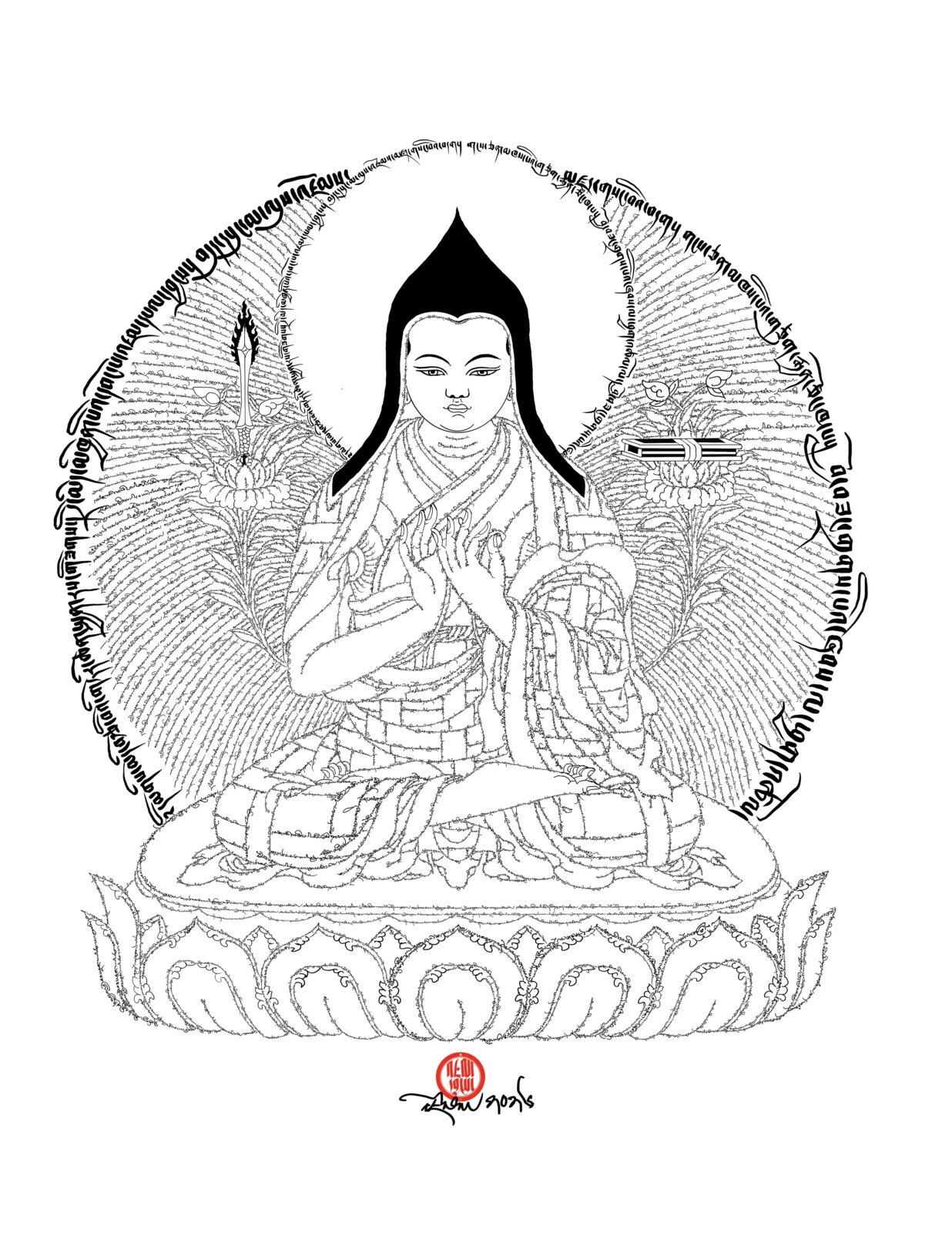
Tsongkhapa, the founder of Gelukpa tradition of Tibetan Buddhism, composed of popular prayers of Tsongkhapa in miniature script. Artwork by Jamyang Dorjee Chakrishar; courtesy of the artist
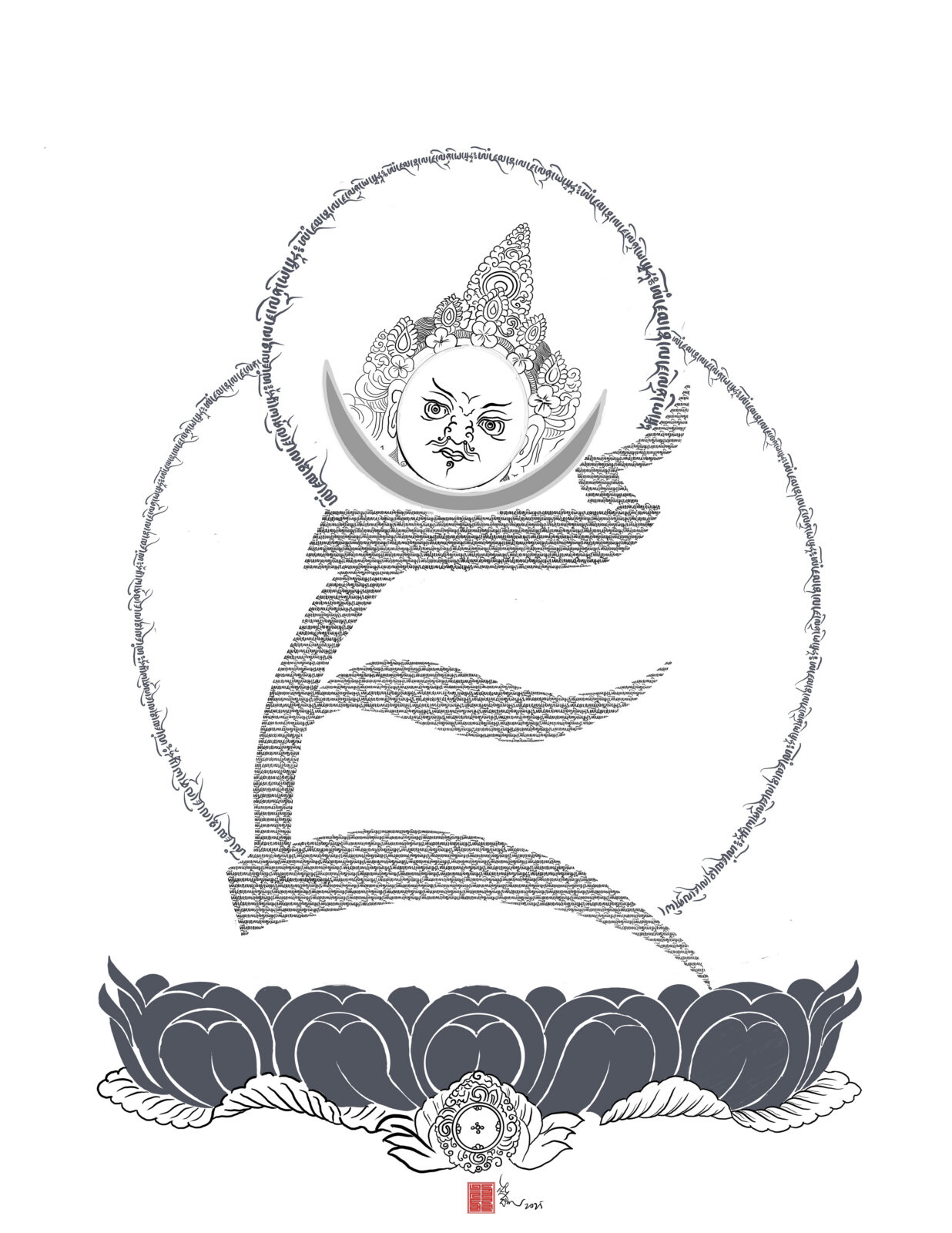
Jambhala, the god of wealth. The letter ZA is the deity’s seed mantra, and is composed of the Jambhala mantra in miniature script. Artwork by Jamyang Dorjee Chakrishar; courtesy of the artist
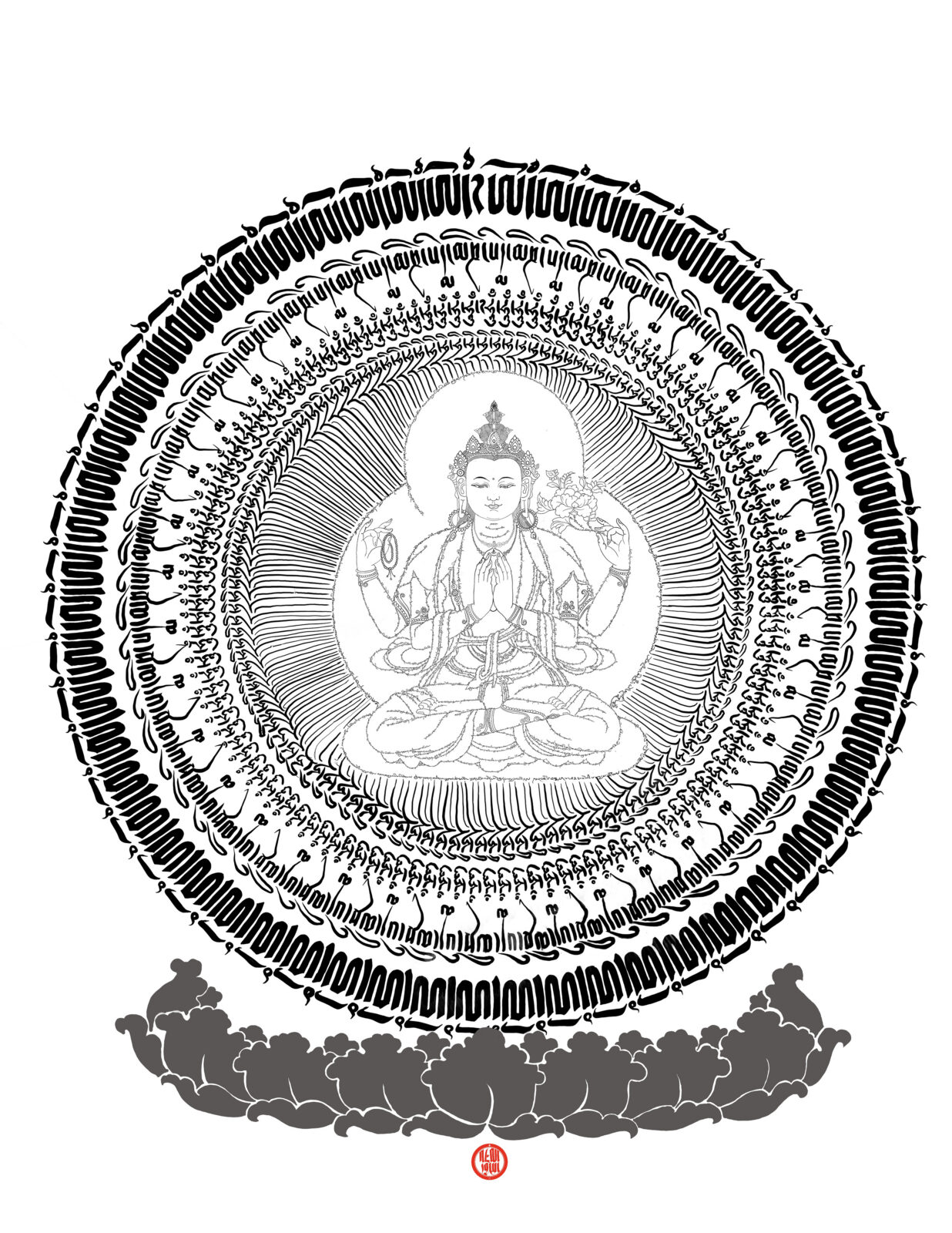
Avalokiteshvara encircled by his mantra: om mani padma hum. The image of Avalokitesvara is composed of his prayers in miniature script. Artwork by Jamyang Dorjee Chakrishar; courtesy of the artist
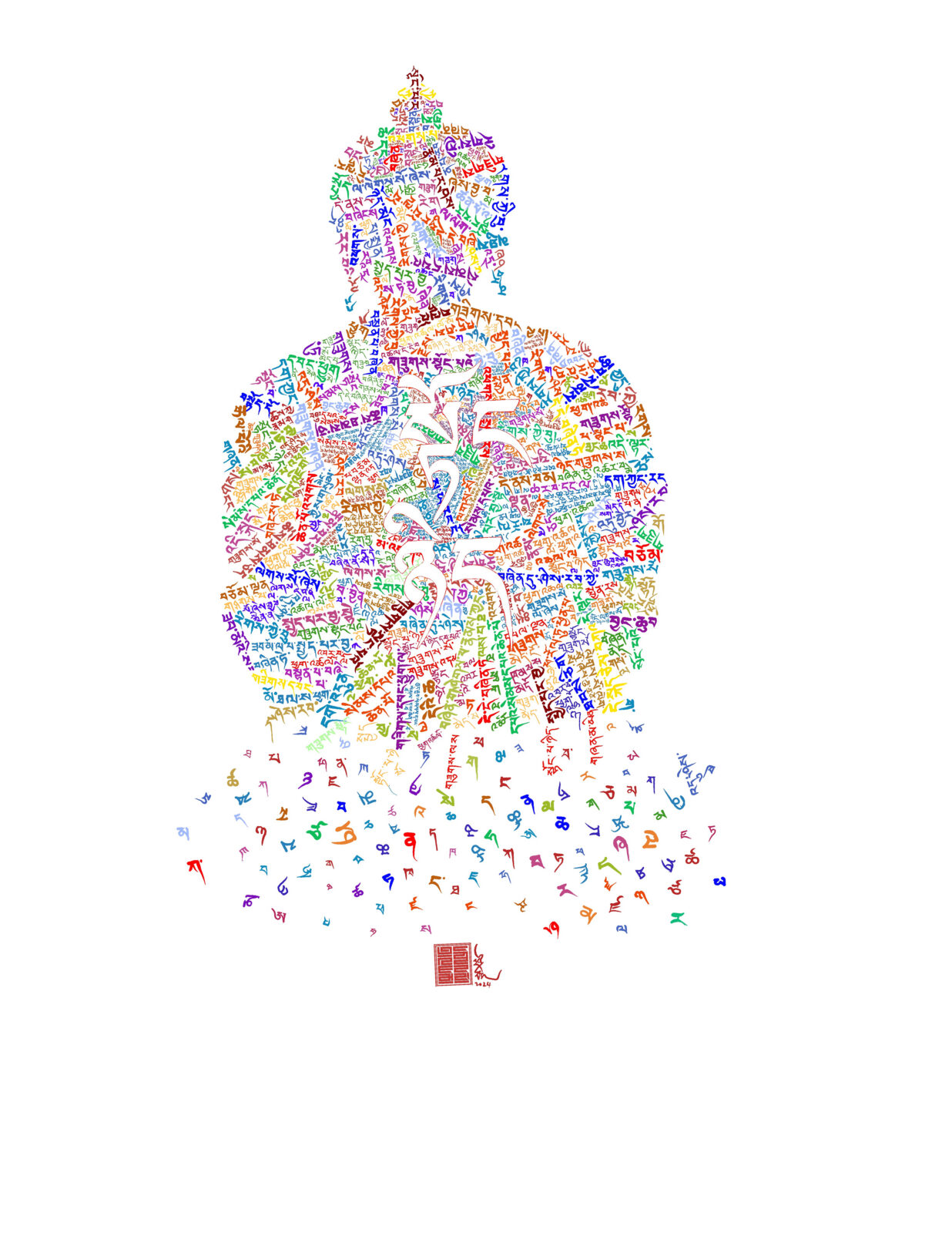
Scattered letters of the Heart Sutra (Sherab nyingpo) form words, describing shunyata (Tongpa nyi), or emptiness. Artwork by Jamyang Dorjee Chakrishar; courtesy of the artist
At school, students developed writing skills in the traditional way, practicing using a jamshing—a wooden board marked with faint rule lines—and a bamboo stylus and ink, which could be washed off the surface for reuse. “We had to make our own inks by burning weeds and mixing it. We wrote on the wooden plank with a bamboo pen,” Jamyang Dorjee explains. “I realize now that when you keep practicing writing in this way, it trains your fingers for writing. It trains your muscles in writing correct, beautiful handwriting.”
This muscle memory remained with him even after he went to an Indian school, and during his career serving the Government of Sikkim, the Tibetan Government in Exile, and later the Tibetan Institute for the Performing Arts as director.
Upon retirement, Jamyang Dorjee found himself drawn back to Tibetan calligraphy. “I finally had enough time to be and to explore my own self, no longer having to serve any government or institution. To discover what I was good at,” he says. “I felt that Tibetan calligraphy was something I was really interested in, and that I wanted to do something with it. I started doing a lot of research on the calligraphy traditions of the world—Chinese, Japanese, Korean, Islamic—and then trying to find out where I was as a Tibetan calligrapher.”
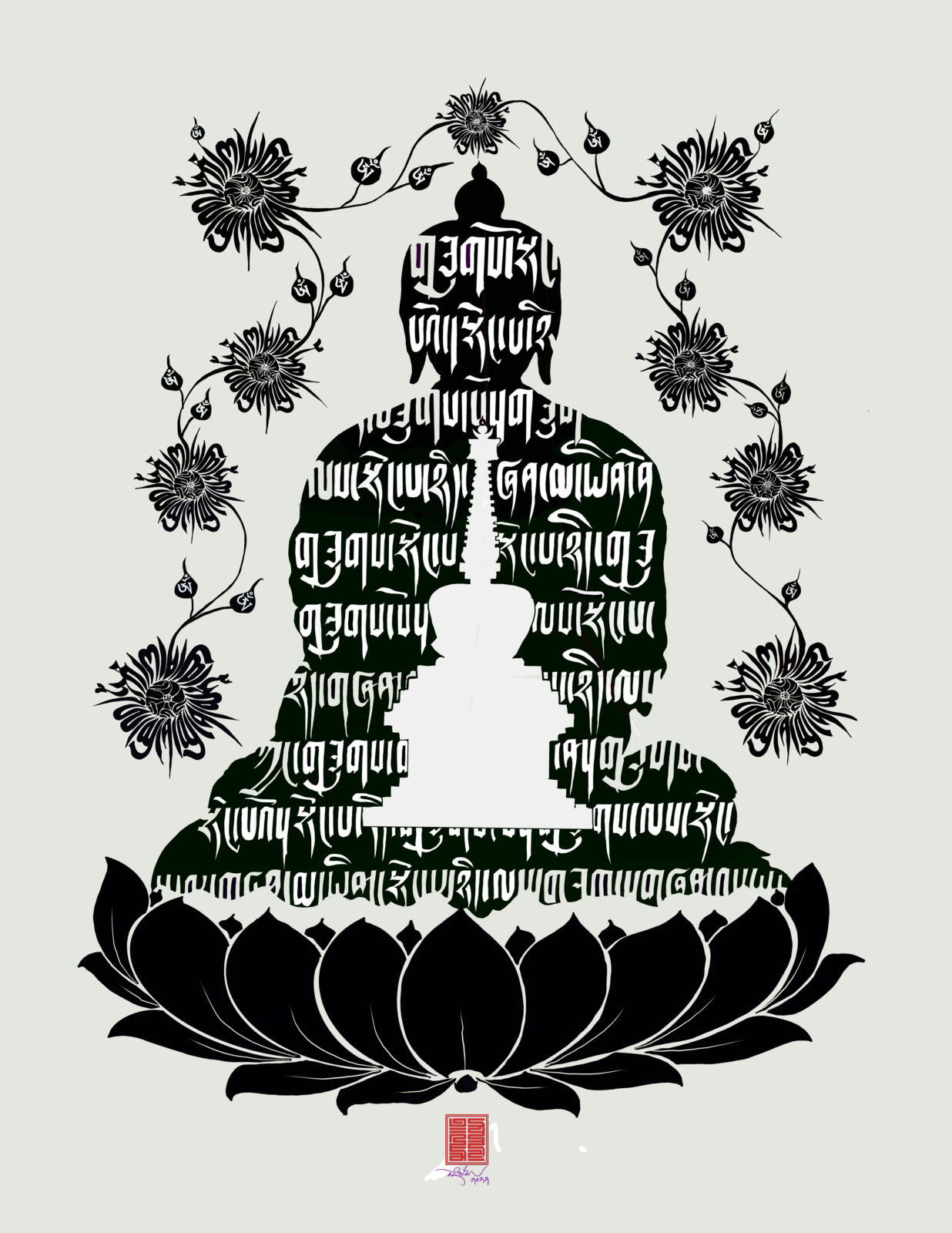
Representation of body, speech, and mind of Buddha (Ku sung thuk). The flowers are letters of Buddha mantra. Artwork by Jamyang Dorjee Chakrishar; courtesy of the artist
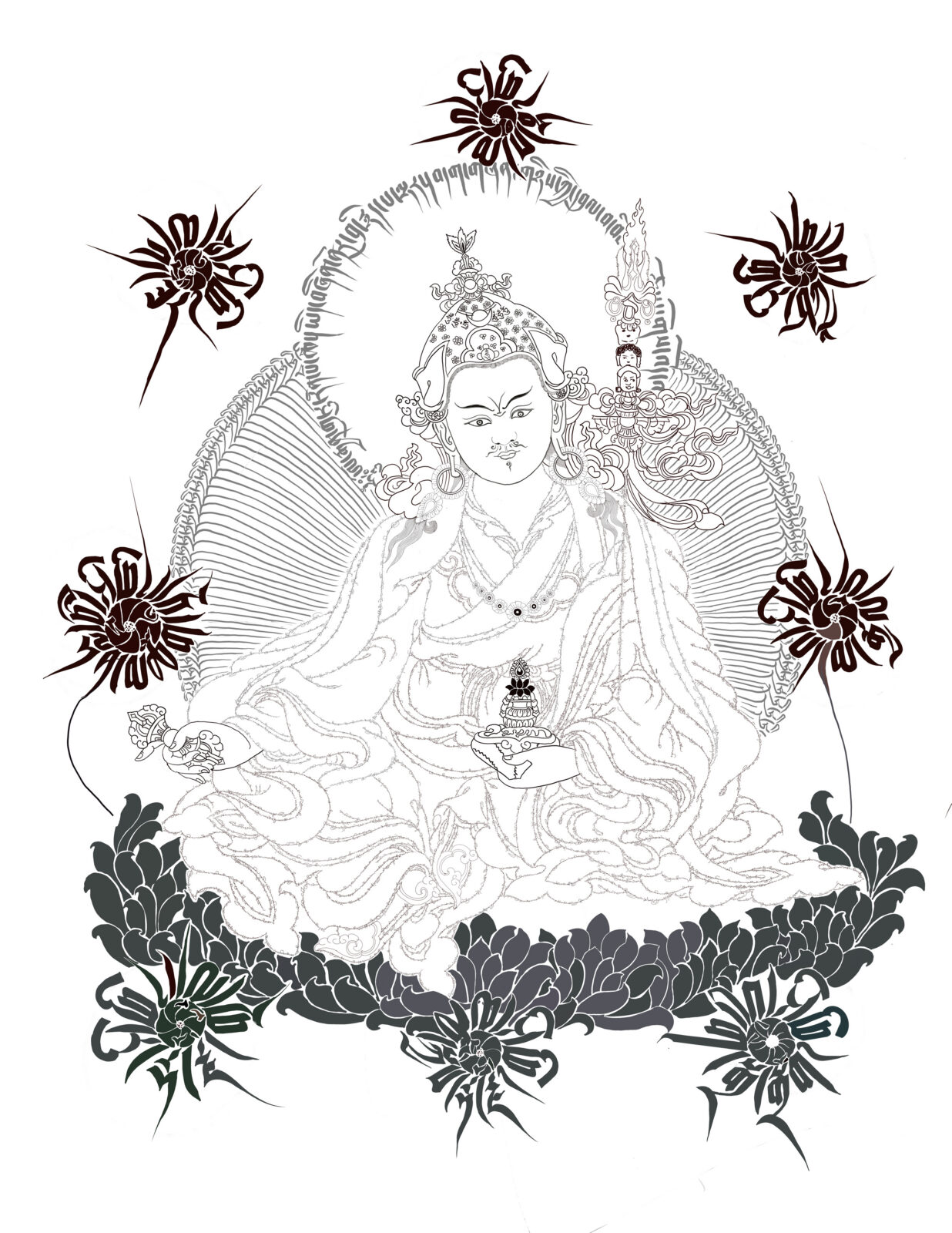
Eight different manifestations of Guru Padmsambhava (Guru Tsengye). Artwork by Jamyang Dorjee Chakrishar; courtesy of the artist
Jamyang Dorjee came to realize that Tibetan calligraphy was nowhere near as prominent in the world as other calligraphic traditions. “Tibetan writing is so beautiful visually, and we have so many varieties of scripts. And then there are the insights contained in the written word, very profound, deep teachings of Buddhadharma, manifested through writing,” he says. “But beyond that, [Tibetans] never ventured out of the standard [styles], we never explored artistic styles of writing. Handwriting was never celebrated as ‘calligraphy,’ and it was never something done as a form of art.” It was from these observations that Jamyang Dorjee felt moved to find a way to promote Tibetan calligraphy to the world through his own artistic expression.
Inspired to put Tibetan calligraphy on the map, Jamyang Dorjee embarked on a project to set a world record for longest calligraphy scroll. He achieved this goal in 2010 with a 163-meter-long work consisting of long-life prayers for His Holiness the Fourteenth Dalai Lama. He then went small, copying word for word the text of the biography of Padmasambhava, the Pema Khatang, to create another long scroll in miniature script. Jamyang Dorjee says at first he didn’t intend to create a work of art. He used the copying activity to better retain the knowledge and insights gained by reading the Pema Khatang. But over time, it became his own way of Buddhist practice.
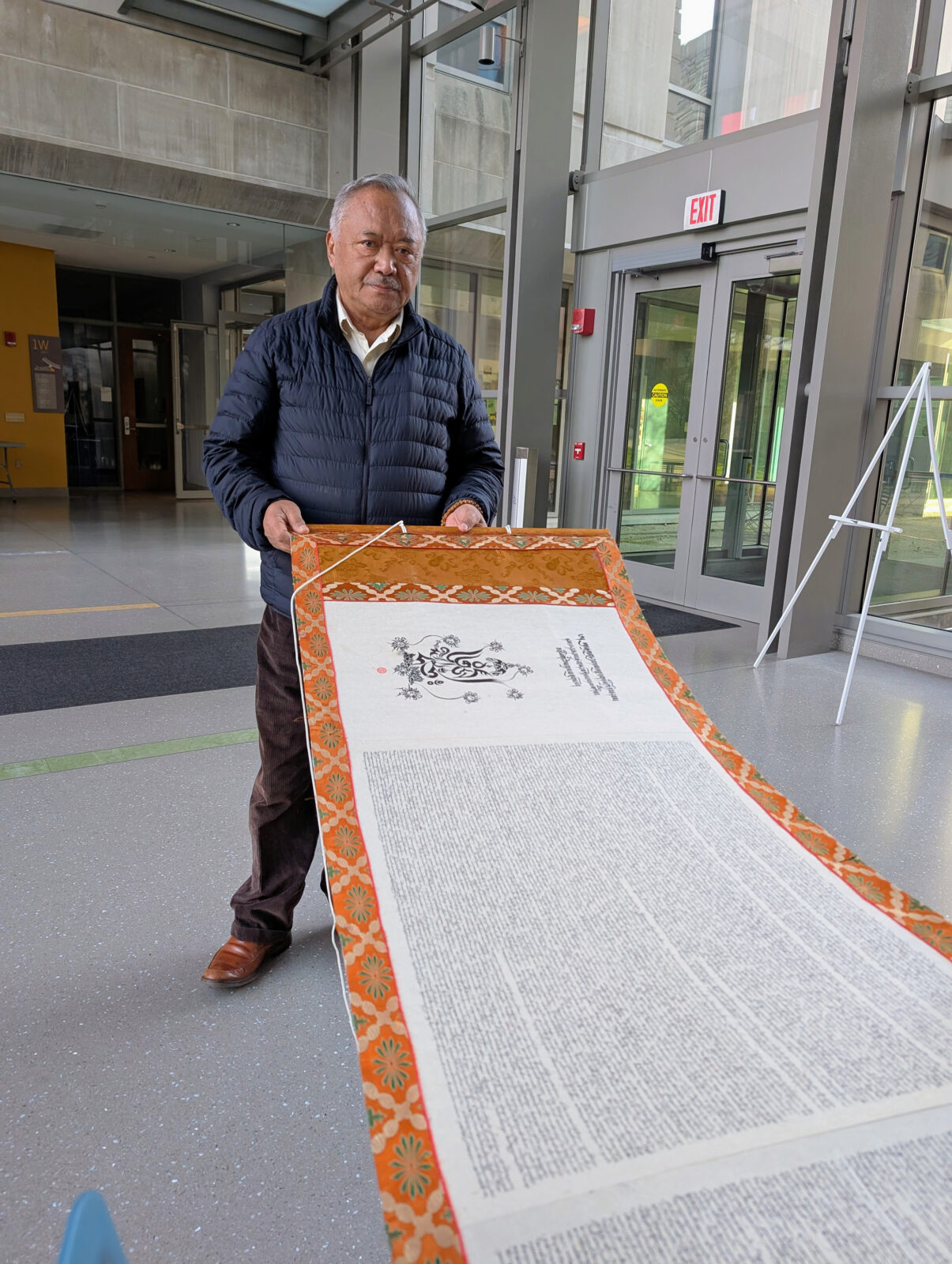
Jamyang Dorjee Chakrishar holding his scroll of the Pema Khatang; photo by Kristina Dy-Liacco
“I would wake up every morning and write out the text of the Pema Khatang, six to seven hours a day, for one year and four months. Practicing Tibetan Buddhism through writing is the best form of meditation I have found. One must be focused on the task at hand, be 100% present. If that focus endures for hours, this long meditative process of concentration and gaining insights into Buddhist narratives, it’s like a yig tsam, a writing retreat. At an exhibit of my art, His Holiness the Dalai Lama asked how I found the time to do all these works. I told him that instead of reciting daily prayers, I write them out instead. This delighted His Holiness.”
Miniature writing has also developed into what the late Lama Zopa Rinpoche described as Jamyang Dorjee’s distinctive “dharma art.” Jamyang Dorjee relates, “I was thinking about our own Tibetan Buddhist tradition. We always have mind, body, and speech of the Buddha represented on our altars. You have a stupa, a statue, a book. I thought, why don’t I combine in writing all three in one? I can draw a figure of the Buddha, which represents body, and then write into it the mantra or prayers related to that Buddha in miniature writing, with the help of a magnifying glass, for speech. Then the gu-so-thuk—body, speech, and mind—are represented there.” His dharma art features buddhas, bodhisattvas, and other deities, all composed of tiny script of mantras and prayers, enriching the religious image with an additional layer of meaning.
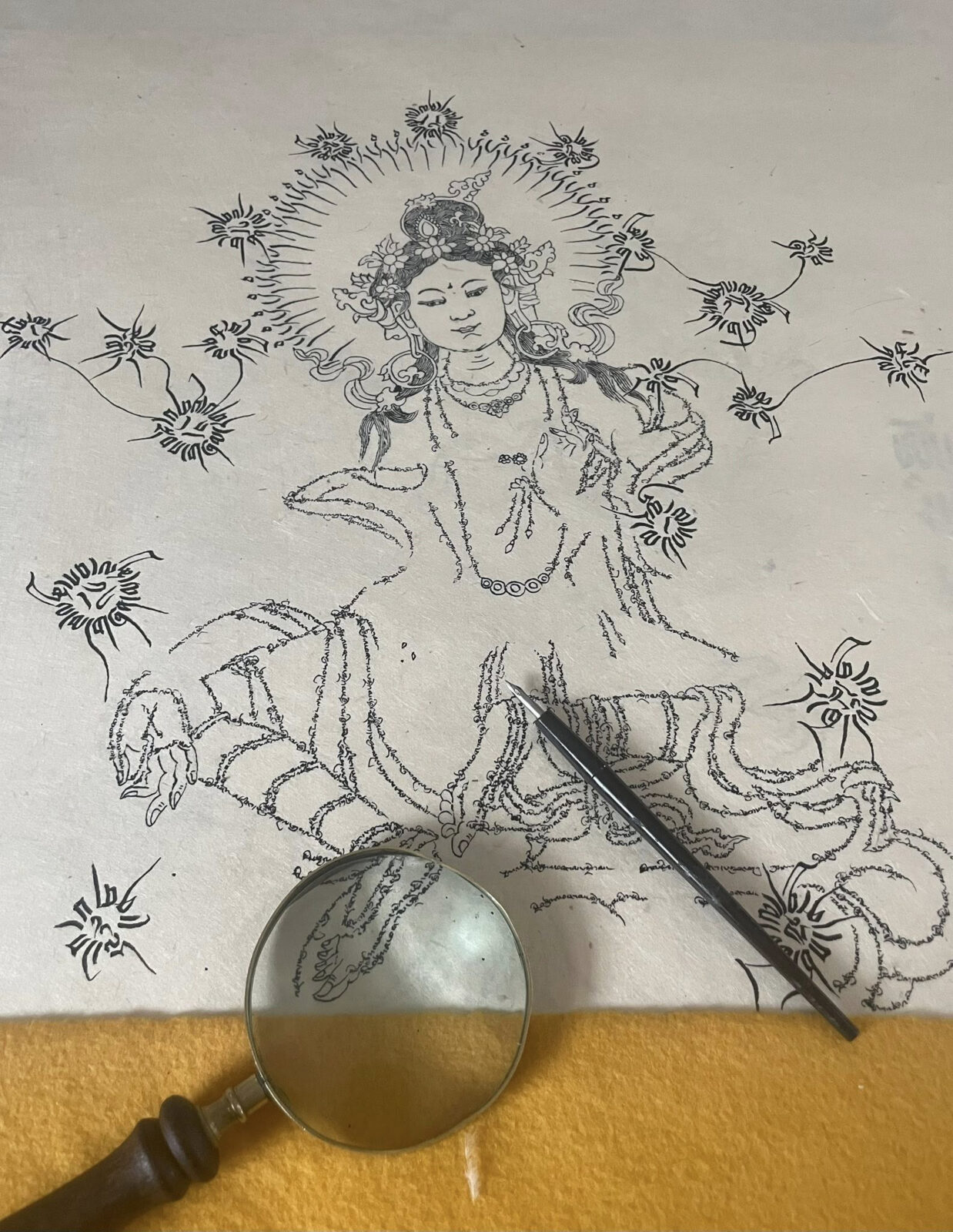
For his miniature calligraphy work, Jamyang Dorjee uses a magnifying glass. Photo courtesy of the artist
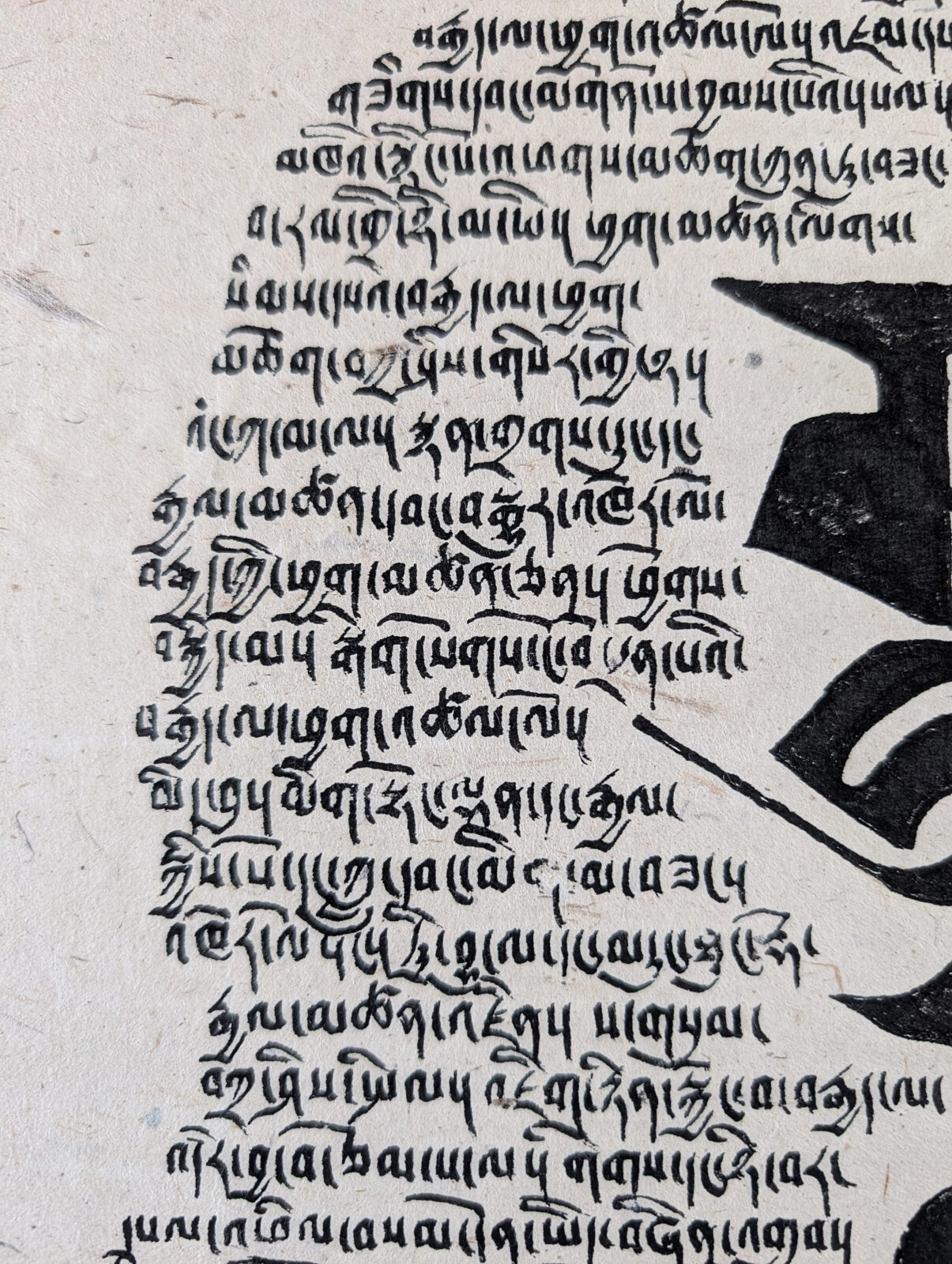
Detail of an artwork by Jamyang Dorjee Chakrishar; courtesy of the artist
Meanwhile, in Tibet since around 2010, new generations have become interested in fine handwriting and in using Tibetan calligraphy for artistic expression. In 2017, Tibetan calligraphy associations from across the plateau met at a conference in Amdo and conceived of a Tibetan Calligraphy Day. The day is intended to celebrate, instruct, and explore the breadth and beauty of Tibetan calligraphy, as well as preserve and promote Tibetan language. They chose April 30, or 4/30, as there are four vowels and thirty letters in the Tibetan alphabet.
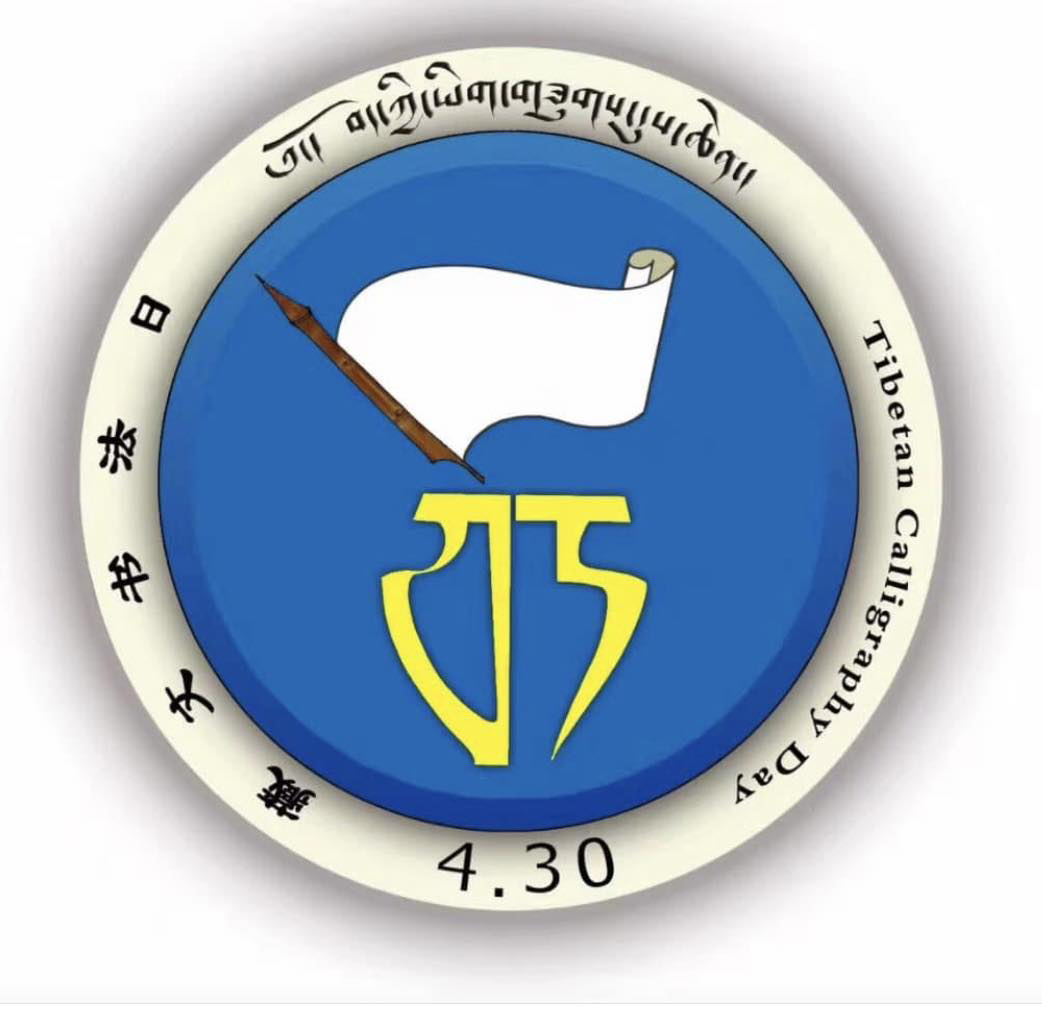
Logo designed for Tibetan Calligraphy Day by Tibetan calligraphy associations in Tibet in 2017
New Jersey–based scholar and writer Pema Bhum, who is himself a skilled calligrapher, notes, “Ever since the founding of Tibetan Calligraphy Day in Tibet, there has been increasing activity by various schools and cultural offices across Tibetan regions to host Tibetan calligraphy demonstrations and exhibits every year on April 30. There is now a growing wave of younger Tibetans who are studying calligraphy in Tibet.” Especially at a time when Tibetan language is under threat from government policies that severely curtail the use of the language in schools and communities, Tibetan Calligraphy Day takes on greater significance in highlighting mother tongue language expression and identity.
In India, Jamyang Dorjee followed the developments in Tibet closely. Eager to contribute his peers’ endeavors for international recognition of Tibetan Calligraphy Day, he called upon his friends in Gangtok, Sikkim, to organize an exhibit of his works. Since then, he has organized an exhibit, talk, or workshop to commemorate Tibetan Calligraphy on April 30 each year, and he has conducted programs in Bhutan, India, and North America to spread awareness.
For Jamyang Dorjee, commemorating Tibetan Calligraphy Day serves to preserve Tibet’s rich cultural heritage. Moreover, “Celebrating this day,” he says, “also represents a powerful symbol of unity among our people on both sides of the Himalayas.”
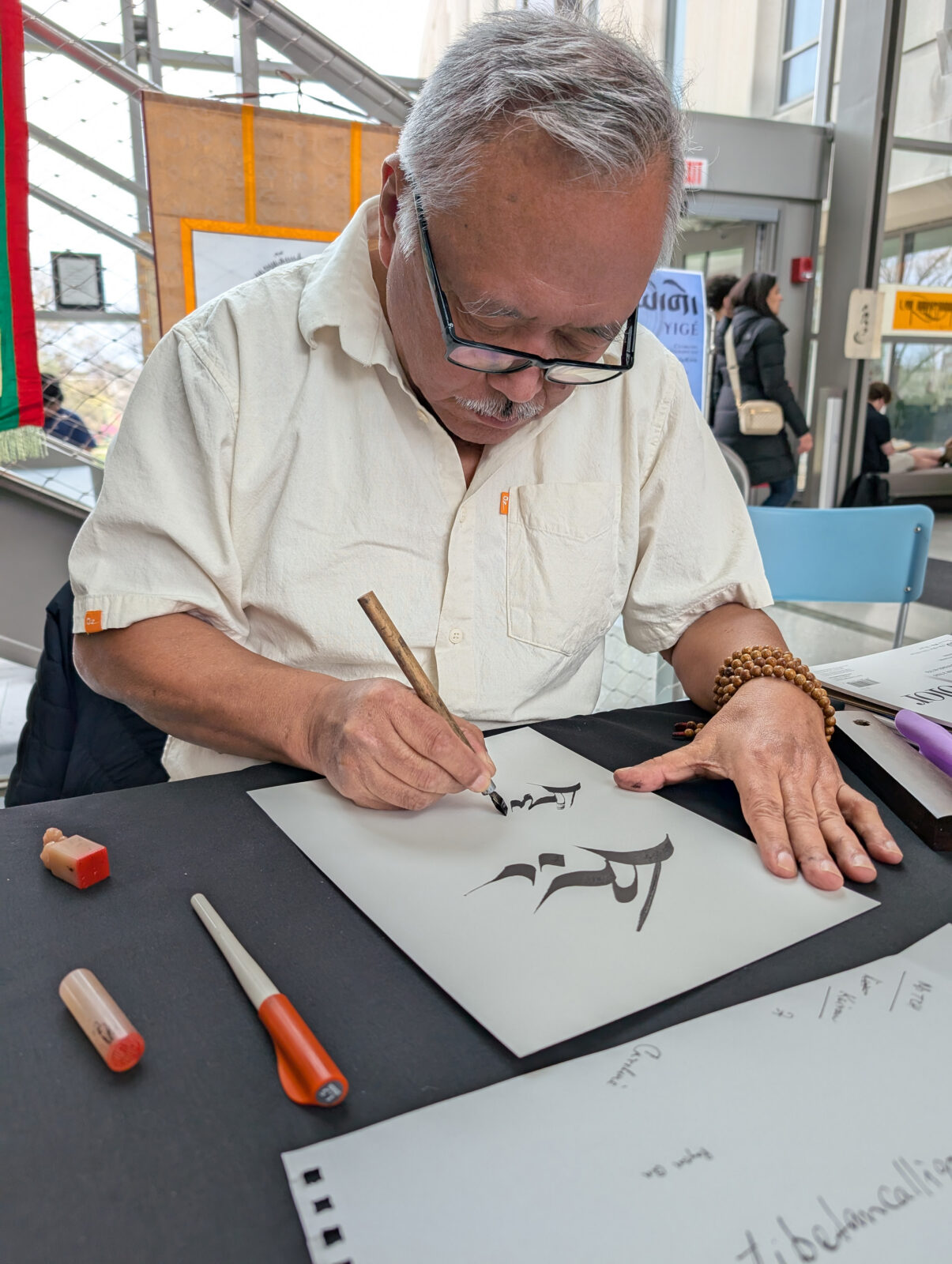
Jamyang Dorjee Chakrishar writing script on Tibetan Calligraphy Day in 2025 at Indiana University; photo by Kristina Dy-Liacco
Learn more about Jamyang Dorjee’s work at tibetancalligraphy.com
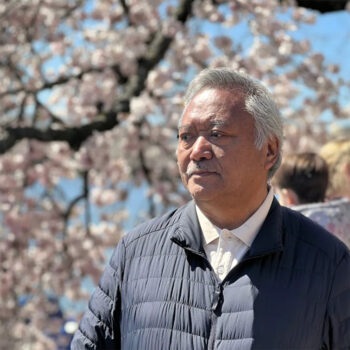
Jamyang Dorjee Chakrishar is a calligrapher based in Gangtok, Sikkim. During his career, he worked for the Government of Sikkim, the Tibetan Government in Exile, and the Tibetan Institute for the Performing Arts. More recently, he served as regional coordinator for the Conservancy for Tibetan Arts and Culture, and he founded the Lhatsun Dharma Centre. Celebrated for his “Dharma Art” and miniature calligraphy in umé, his works have been exhibited internationally, and can be found in private collections worldwide. Learn more about Jamyang Dorjee’s work at tibetancalligraphy.com

Kristina Dy-Liacco is the Tibetan studies librarian at Columbia University’s C.V. Starr East Asian Library and the University of Toronto. She served as librarian at Latse Library for 18 years before its closure in 2020. She is a cofounder of The Latse Project, a NY-NJ-based all-volunteer nonprofit organization promoting Tibetan language use and literacy. They organize events for Tibetan Calligraphy Day across North America every year.
Get the latest news and stories from the Rubin, plus occasional information on how to support our work.