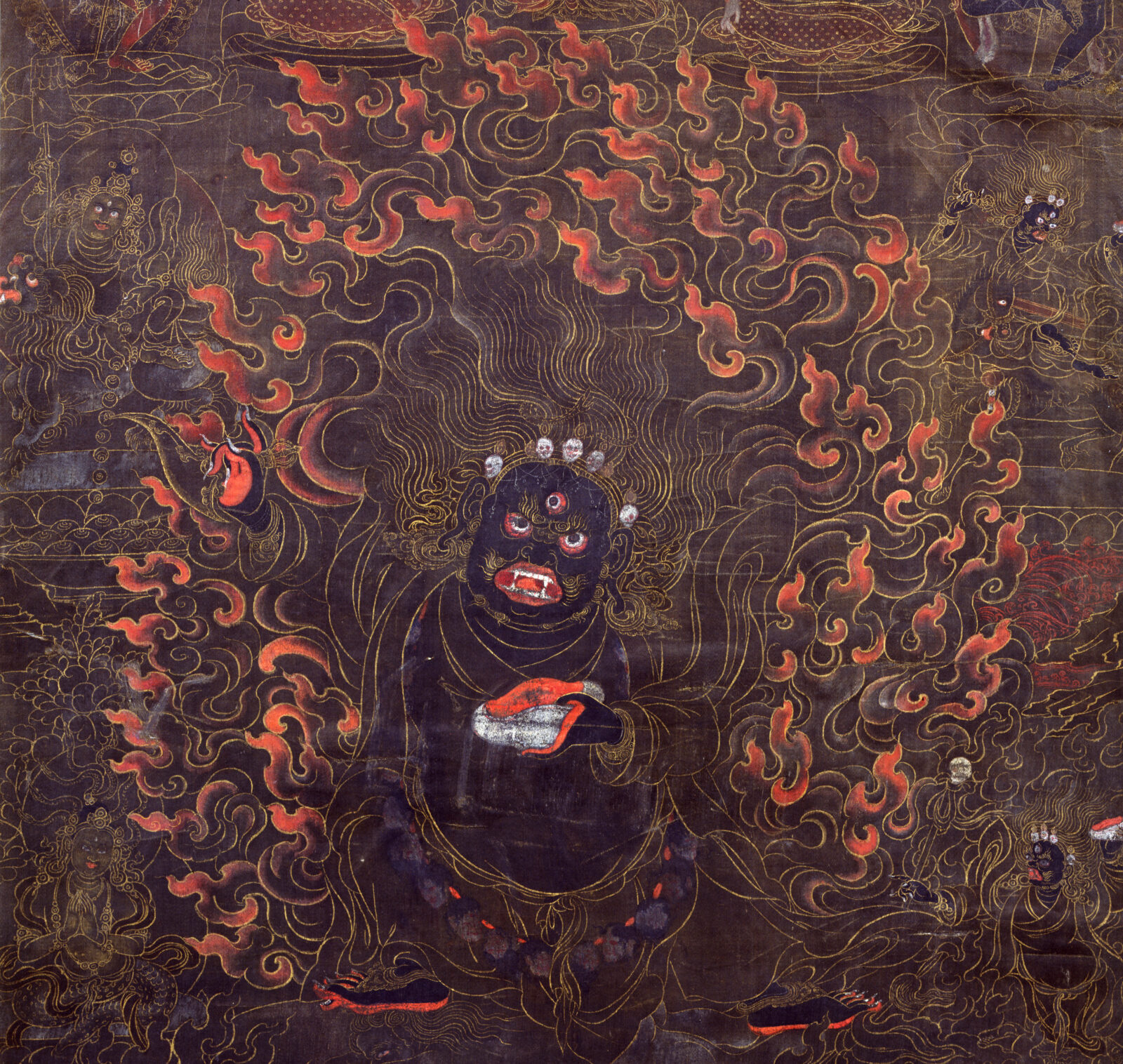
Black Cloak Mahakala; Tibet; 18th century; pigments on cloth; Rubin Museum of Himalayan Art; gift of the Shelley & Donald Rubin Foundation; F1996.32.7
Black Cloak Mahakala; Tibet; 18th century; pigments on cloth; Rubin Museum of Himalayan Art; gift of the Shelley & Donald Rubin Foundation; F1996.32.7
A look at the complex symbolism of wrathful deities
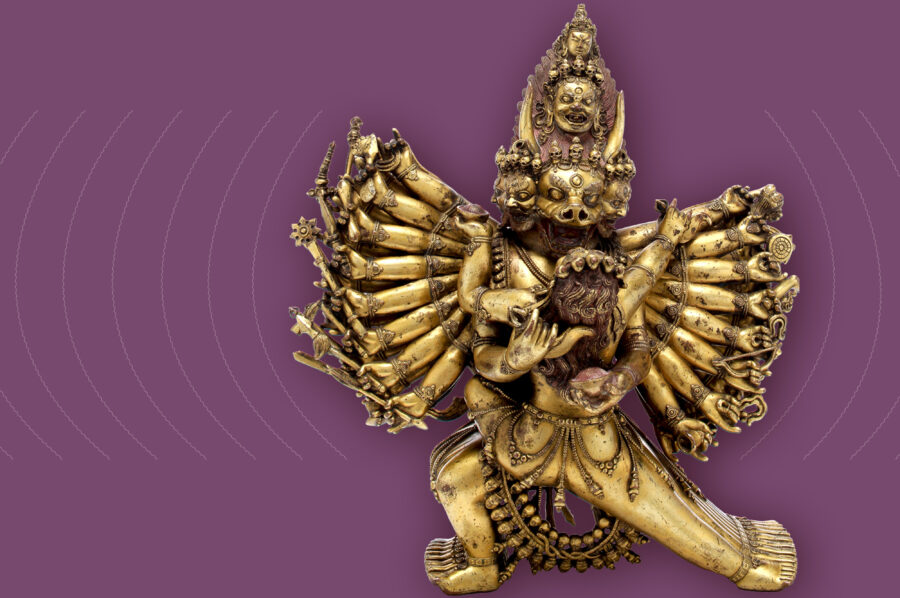
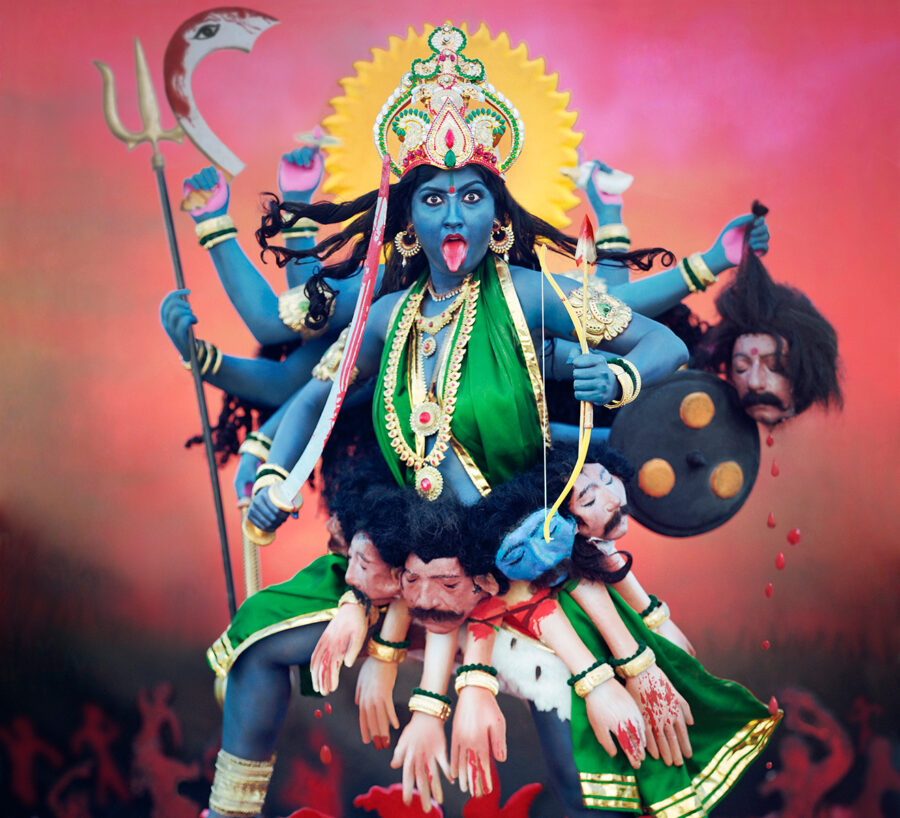
When you look at a wrathful image from Tibetan Buddhist art, like the image of Mahakala here, what do you see? When buddhas, dharma protectors, and other kinds of deities are shown in wrathful mode, they are characterized by bulging eyes, fangs, auras filled with flames, wild animal skins, and ornaments made of skulls and bones. For people experiencing Tibetan and Himalayan art for the first time, this “wrathful” mode of depicting divine figures can be challenging, even startling if you’re not sure what you’re looking at.
And yet, as Tibetan and Himalayan Buddhist and Bon writers explain, the wrathful mode is not necessarily what it seems. From a Tibetan and Himalayan Buddhist perspective, while worldly supernatural beings can appear wrathful because they are associated with activities like war, hunting, or disease, enlightened figures like buddhas and bodhisattvas are understood to manifest in a wrathful mode as part of their compassionate, skillful response to the needs of living beings.
Far from channeling negative energy or menacing the viewer, for an enlightened being like a buddha, the wrathful mode expresses compassion and wisdom, enlightened skillfulness and guardianship. Wrathful figures can serve as mirrors of negativity, transforming or deflecting what is frightening or dangerous away from living beings. Wrathful deities in Tibetan and Himalayan art are thus not angry in the conventional sense. Rather, they wear anger’s costume, repurposing and redirecting qualities we associate with anger and transforming these qualities into protection and help.
To give brief art historical context, we can place Tibetan and Himalayan wrathful imagery in the context of three “moods” or “modes” of Indian Tantric art: peaceful, semi-wrathful, and wrathful. As art historian Jeff Watt explains, these are not unique to the Tibetan religious world but rather draw on earlier Indian artistic systems. These artistic systems have influenced societies across Asia, from India to Southeast Asia, to the Himalayan region, to China, Japan, and Korea.
Wrathful imagery can also represent the absorption or conversion of non-Buddhist figures into Buddhist pantheons, leaving visual traces of cultural and cross-religious encounter. Consider the eighth-century tantric Buddhist figure Padmasambhava, often described as the “Second Buddha” of Tibet. He is said to have tamed local protectors and land deities across the Himalayan region, converting dangerous supernatural beings into oath-bound Dharma protectors. These protectors kept their frightening appearance but began using their fierce qualities to scare away negativity. Here, wrathful imagery reflects ritual histories of propitiating, taming, and transforming dangerous forces into allies.
How might ‘wrath’ be skillful, and how does wrath relate to the toxic way we often experience anger?
Writing about Indian Buddhist literature, scholar Sonam Kachru has described a “therapeutic” dimension within Buddhist philosophy and practice, fundamentally aimed at relieving suffering. As Kachru explains, Buddhists developed a range of artistic and literary techniques for addressing the needs of different audiences. Among Mahayana Buddhists, this therapeutic approach is called “skillful means,” the idea that buddhas and bodhisattvas work to free beings from suffering using whatever methods work best for each individual. Wrathful displays, in this view, are part of a therapeutic and teacherly toolkit that is fundamentally responsive to beings’ diverse hopes and fears.
So what do Tibetan Buddhist writers have in mind when they describe wrathful beings as bringing protection and freedom? How might “wrath” be skillful, and how does wrath relate to the toxic way we often experience anger?
Anger can be terrifying, even dangerous. You may recall a time when another person’s anger hurt you, or regret a time when your anger hurt someone else. Yet you might also remember a moment when anger enabled you to be direct, even fierce, in standing up for what’s right. Maybe in anger you became a force for justice, like a protective older sibling standing up for little kids.
Tibetan Buddhist traditions engage with both these aspects of anger. On the one hand, anger is a poison, with terrifying destructive potential. On the other hand, if ordinary anger is transformed by altruism and wisdom, its liberating qualities like fearlessness and decisive action can emerge. Tibetan and Himalayan art depicting buddhas, deities, and other kinds of beings in wrathful form offers an opportunity to imaginatively explore what this transformation of anger might look like.
Any talk of transformation requires clarity about what is being transformed, so let’s consider ordinary, selfish anger in more depth. In the earliest Indian Buddhist texts, the Buddha himself is described as urgently warning about the risks of anger. Anger puts us in danger of losing our minds, of doing emotional or physical violence to others and ourselves. Anger is sticky—it feeds on itself, fueling spirals of grievance, resentment, retaliation, and cruelty.
The Buddha famously described anger as one of a trio of harmful mental states that give rise to all negative thoughts and actions and produce all the suffering we experience. This trio of mental states, often called the Three Poisons, includes anger, addictive greed, and ignorance, specifically ignorance of how things really exist. While it’s ultimately this ignorance, or mis-cognition of reality, that’s described as the “root” poison leading to all other negative emotions, anger may be the most horrible poison. Buddhist teachers of all traditions urge students to be especially careful of anger, which in an instant can destroy a wealth of good deeds and relationships, and bring oceans of suffering.
All Buddhist practitioners thus first reflect on anger as one of the Three Poisons, confronting it as a terrible source of suffering to be abandoned or overcome. Tibetan and Himalayan Buddhists draw on a rich repertoire of practices and techniques for this crucial inner work, shared with traditions across the Buddhist world.
One important mind-training technique widely practiced by many Buddhist communities is to abandon anger by developing an awareness of its harms. By watching our mind to see how anger arises, and analyzing our experiences of anger and its results, Tibetan Buddhist teachers say we can develop a sincere wish to be free from anger and choose another path. When we realize we do not want anger’s terrible consequences, we can decide not to act on anger, and pause before lashing out, for instance.
Another indispensable Buddhist approach for working with anger is to cultivate positive mental states like love, care, and patience. These provide psychic antidotes to anger and other negative emotions. By cultivating love, patience, and the wish for others to be happy, and by gradually expanding these positive emotions to an ever-larger circle of people and other beings, we can develop what Tibetan and Himalayan Buddhist writers call “wholesome” mental states, those that bring happiness for ourselves and others. By cultivating wholesome mental states and replacing anger with love and patience, there’s less room for anger to return.
An important component of this second set of mind training techniques is participation in communal practices that put positive mental states into action in the context of relationships. Everything from daily prayers, offerings, and confession rituals, to temple services, pilgrimage, and community service projects can be part of this practice-in-action. Over time, communal practices of love, care, and patience can help us feel appreciation for others even if we don’t always like them, and this experience of connection can viscerally counteract our tendency to anger.
An even longer-lasting way to overcome anger is through practices that develop wisdom, in the technical, Buddhist sense of that term. Wisdom that directly realizes the true nature of reality and ourselves is the ultimate antidote to the mental poison of ignorance and all negativities that flow from that ignorance. From the Mahayana perspective of Tibetan and Himalayan Buddhists, when we cultivate perfect wisdom, we realize that all phenomena exist interdependently, rather than separately or in isolation. This interdependence of all phenomena is indivisible from their ultimate emptiness, or freedom, from a permanent, isolated, unchanging self. That is to say, everything and everyone exists relationally, in dynamic interconnection with one another, not in opposition to each other. When we directly perceive this interdependence and emptiness of all phenomena, anger is said to be dissolved at its root, so it will not arise again. After all, how can we hold onto anger at anyone, once we perceive that other beings and their actions are not separate from ourselves, and are ultimately empty of permanent or unchanging existence?
Tibetan Buddhist teachers encourage students to practice using all these Buddhist techniques for addressing anger and negative emotions. From a Tibetan Buddhist perspective, these methods are the essential prerequisites for the advanced practices of the Tibetan Vajrayana Buddhist path of tantric practice, which is described as a Buddhist path of transformation.
We need to cultivate a combination of wisdom and compassion, of insight and self-less altruism, that allows us to metabolize anger and harness its power, freed from cruelty and aggression.
From the Vajrayana Buddhist perspective, every aspect of our experience—from the things we are most proud of to the parts of ourselves we’d rather hide, from our most delightful emotions to our most painful or challenging psychological experiences—all fuel the process of enlightenment. Nothing is left out or left behind. Every aspect of every being is transformed on the path to Buddhahood. This Vajrayana Buddhist framework of transformation thus gives us tools to engage with the concept of wrath in a broader sense, understanding it as the powerful energy of anger transformed into its liberating mirror image, through wisdom and altruism. Philosopher Emily McRae refers to this transformation as “metabolized” anger. Thus transformed, wrath appears as an enlightened display, motivated by compassion, combining protection, clarity, decisiveness, and strength.
In this Vajrayana view, while ordinary anger is deeply destructive, simply repressing anger or ignoring it won’t set us free. Rather, from the perspective of transformation, we need to cultivate a combination of wisdom and compassion, of insight and self-less altruism, that allows us to metabolize anger and harness its power, freed from cruelty and aggression. Wrathful images of buddhas, bodhisattvas, and protector deities display terrifying facets of our own inner and outer experience, but they do so as part of a process of transformation that turns ordinary anger into compassionate activity.
Wrathful enlightened beings are generally depicted standing in an aureole of flames, symbolizing the fire of pristine awareness. Free of delusion, they radiate power and protection for living beings, defending them from harm, shocking them awake from ignorance. This approach of transformation has deep implications for our fractured times. Wrathful images of enlightened beings suggest a path of wakeful attention combining fearlessness with love, and transforming anger into activities of protection and care.

Annabella Pitkin is associate professor of Buddhism and East Asian religions at Lehigh University. Her research focuses on Tibetan Buddhist modernity, Buddhist ideals of renunciation, miracle narratives, and Buddhist biographies. She received her BA from Harvard University and PhD in religion from Columbia University. She is the author of Renunciation and Longing: The Life of a Twentieth-Century Himalayan Buddhist Saint, which explores themes of non-attachment and teacher-student relationship in the life of Khunu Lama Tenzin Gyaltsen. More →
This article appears in issue 10 of the print edition of Spiral magazine under the title “Wearing Anger’s Costume.”
Get the latest news and stories from the Rubin, plus occasional information on how to support our work.