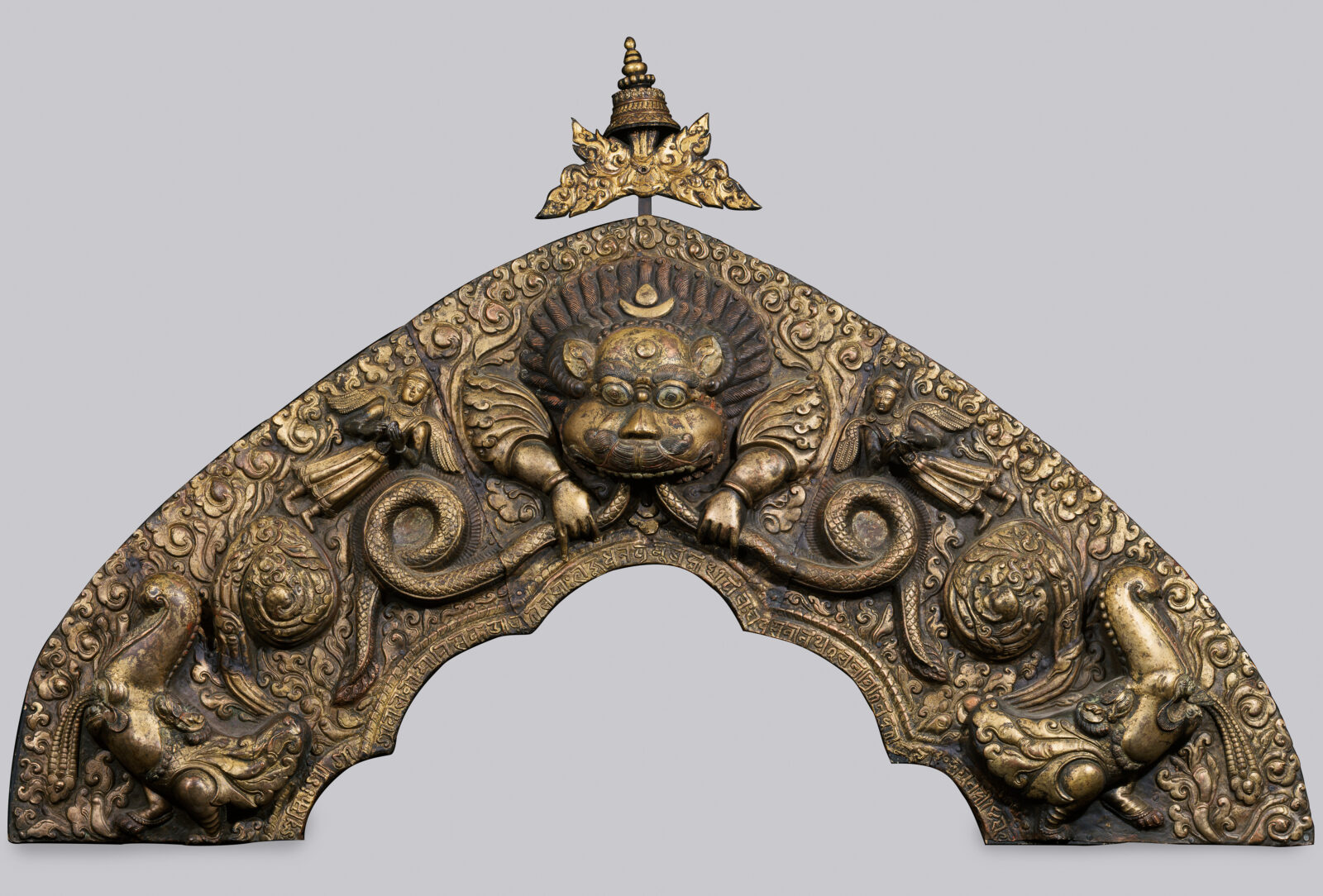
Arched Tympanum; Nepal; dated by inscription to 1810; repoussé copper alloy and wood; 32 × 49 ¾ × 5 5/8 in.; Rubin Museum of Himalayan Art; C2003.21.3 (HAR 65234)
For a year and a half, I had been investigating an inscribed Nepalese tympanum in the Rubin’s collection as part of the Museum’s ongoing provenance research. The inscription on the object had long been read as a dedication to a goddess in Nala, a village some 25 kilometers east of Kathmandu. That reading had guided my research until it stalled for lack of new evidence.
Then in October 2026, Lost Arts of Nepal posted a photograph on social media of the Rubin’s tympanum, alongside an older, black-and-white photograph showing the same object in situ on a monument’s facade, with the caption “BALKUMARI TEMPLE. THIMI, BHAKTAPUR.” The match was unmistakable: the same arch, the same imagery. This sent me back to the inscription, where a single letter turned out to make all the difference.
In the Kathmandu Valley, the doorways of Hindu and Buddhist temples and monasteries are marvels of architectural and sculptural detail. One of their most striking features is the arched tympanum above the horizontal beam spanning the top of a doorway. Known as torana in Sanskrit and tvalam in Newari, the language of the Kathmandu Valley’s Newar people, it is secured to the wall by a chain that allows it to tilt forward at an angle of about 60 degrees. Most toranas are made of carved wood, or wood covered with copper sheets worked in repoussé, a metal-working technique in which an artisan hammers the back side of a sheet of metal, indenting it outward to create an image in relief on the reverse face.
Although a torana may appear to be purely decorative, it marks the threshold to the sacred space beyond, with imagery following a carefully ordered iconographic program. A torana is typically centered on the particular deity enshrined in the sanctuary, surrounded by attendants and other divine figures. The surrounding arch is filled with cloudlike foliage patterns and mythical creatures: a kirtimukha, or “face of glory” at the top; serpent deities called nagas along the arch; and crocodile-like makaras at the base.
Together, these figures evoke the endless circulation of water between sky and earth. The kirtimukha—representing the sky, the sun, and the rain cloud—swallows or disgorges the bodies of the serpents, which stand for water and earth. At the base, the makaras release them as rain. The doorway thus becomes a cosmic gate: an image of time and the cyclicality of the seasons.
The torana in the Rubin’s collection largely follows this iconographic program, with the addition of two celestial musicians playing cymbals (jhyali). The top of the torana is crowned by a multilayered parasol sitting atop a bowtie-like ribbon. The lower portion, along the cinquefoil arch, bears an inscription in Pracalit, a Newar script, written in the Newar language with Sanskrit words.
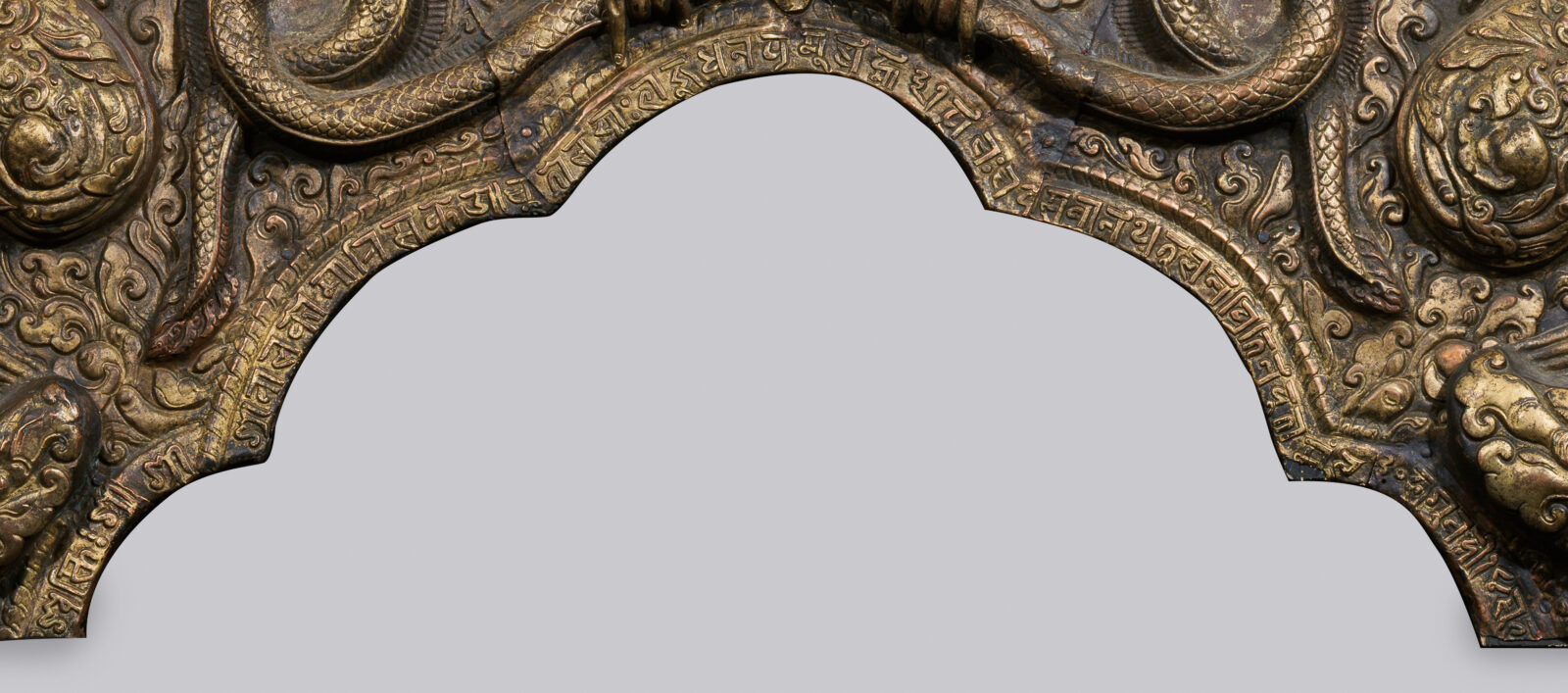
Inscription on the lower part of the torana
Inscriptions can reveal important details about an object’s history; therefore, this torana’s inscription was a key focus of the Rubin’s research into this object. Gautama V. Vajracharya, scholar of South Asian languages, art, and culture, published a first reading in his 2016 book Nepalese Seasons: Rain and Ritual, which accompanied an exhibition he co-curated at the Rubin:
May it be auspicious. In order to please the goddess Kumari of Nala (town), Bhajudhana of (the locality called) Ocutola and thirty-one residents of the town including the five dignitaries commissioned the torana in the year of 930 (1810 CE), on the fourteenth day of the dark half of the Phalguna month.
Following this reading, my research focused on Nala, a village about 25 km east of Kathmandu, where the goddess Kumari is worshiped as devi. The Bhagavati/Ugracandi Temple in Nala seemed a plausible place of origin. Built in 1647, it has three toranas above the colonnade on its south side. The two side toranas are made of carved wood, in a style datable to around the 19th century. The central torana, a copper repoussé work dating to the second half of the 20th century, was probably made to replace an earlier torana. This arrangement seemed to support a possible link to the torana held in the Rubin’s collection.
In addition to the local knowledge held by community members that care for monuments, photographs can provide important clues to provenance research. I was hoping to document the temple’s appearance, including its toranas, at various points in time, but was unable to find any relevant visual documentation. When I visited the temple in October 2024 and again in September 2026, it was undergoing reconstruction work, and the toranas had been taken down. I was unable to find anyone who could give me access to the stored pieces so that I could measure them for comparison. The research appeared to have reached a dead end.
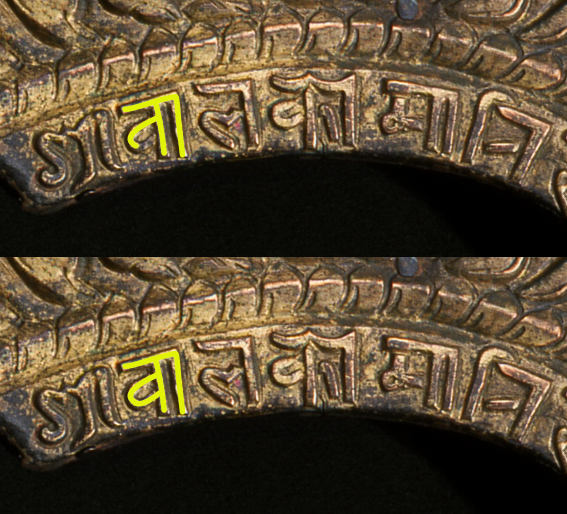
Detail of the inscription with the juxtaposed readings “sri nalakomari” (above) and “sri valakomari.” The character ba is highlighted in yellow.
New evidence emerged on October 13, 2026, when the anonymous account Lost Arts of Nepal published a post on Facebook and Instagram. It identified the Rubin’s torana in a black-and-white photograph that it placed at the Balkumari (or Balakumari) Temple in Thimi, a historic Newar town between Kathmandu and Bhaktapur. The photograph came from a 2019 article by the Russian architect Nikolai Leonidovich Pavlov in a Russian journal on the theory and history of architecture. Alongside the juxtaposition, Lost Arts of Nepal offered a new reading of the inscription, with the translation:
In the year 930 (1810 CE) Falgun 14, this torana was donated by Bhaju Dhana including 31 others of Wochu Tole to the goddess Sri Sri Sri Balkumari.
The post prompted me to investigate the Balkumari Temple in Thimi and reexamine the inscription. Like Lost Arts of Nepal, I read the repoussé text as valakomari, not nalakomari. In Indic scripts, the letters va (pronounced ba) and na can easily be confused, particularly on a worn metal surface or in a photograph. This single letter changes the meaning of the dedication entirely: the torana was not offered to the Kumari of Nala but rather the goddess Balkumari.
My reading differs slightly from that proposed by Lost Arts of Nepal. The translation, prepared with the help of historian Dr. Rajan Khatiwoda of Heidelberg University, reads:
Hail! On the 14th day of the dark fortnight of Phalguna, Nepal Samvat 930 (1810 CE), this torana was offered with devotion to Goddess Sri Sri Sri Balakumari by Bhaju Dhana as the head, along with 31 local elders (pancas) residing in the quarter (tola) of Ocu. May it be auspicious.
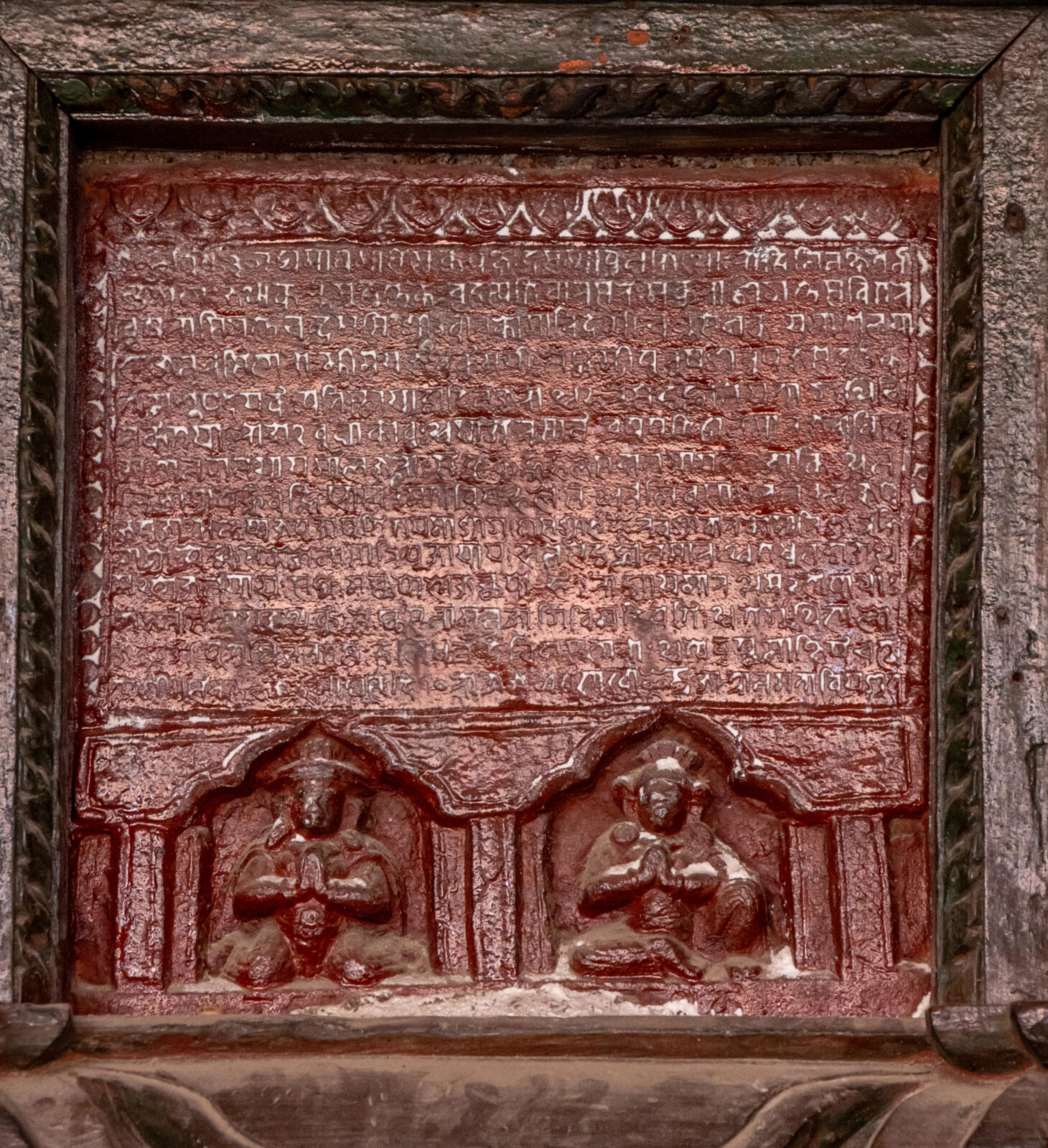
Inscription recording the construction of a rest house by Bhajunarasim Bharo and his wife in 1833 CE. Photo by Prasanna Bajracharya, Nepal Heritage Documentation Project, March 2025. Licensed under CC BY-SA 4.0
There is further evidence linking the name Bhaju Dhana mentioned in the torana to Thimi. Dr. Rajan Khatiwoda drew my attention to an inscription on a traditional Newar public rest house (phalca) near the Balkumari Temple in Thimi. Dated to 1833 CE (Nepal Samvat 953), it records the building’s construction by Bhajunarasim Bharo and his wife. The similarity of the names and the 23-year interval between the inscriptions raise the possibility that the donors were the same man or members of the same family.
The torana inscription mentions a specific neighborhood (tola), Ocu. This is another spelling of Wachhu, an ancient tax district of Thimi. The torana’s dedication suggests that Bhaju Dhana was a local notable with the means to sponsor religious works, playing a leading role in his community. In the Kathmandu Valley, commissioning religious art such as a torana was, and still is, seen as a way of gaining merit (punya). His portrait is seen alongside his wife’s, below the inscription located at the rest house he helped construct.
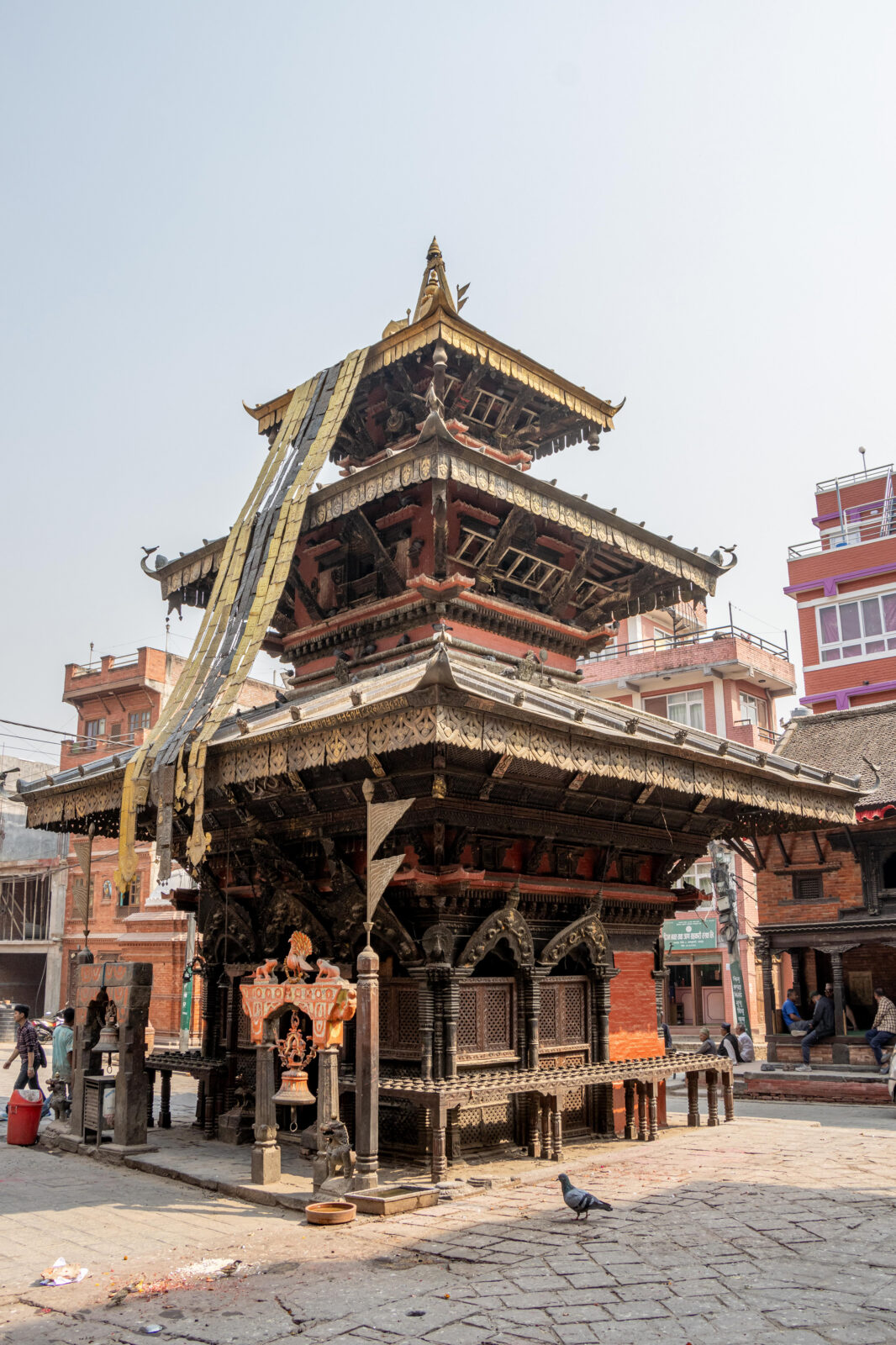
View from the northwest of the Balkumari Temple in Thimi, Kathmandu Valley. Photo by Prasanna Bajracharya, Nepal Heritage Documentation Project, March 2025. Licensed under CC BY-SA 4.0
The Balkumari Temple is documented from the mid-14th century onward and remains central to the religious life of Thimi. Balkumari is the town’s tutelary deity. Such protective deities are attached to specific social units (lineages, households), places (cities, towns, neighborhoods), or ruling dynasties. The temple dedicated to Balkumari is the focal point of Sindur Jatra, the “vermilion festival” (known in Newar as Bhuyu Sinha Jatra), Thimi’s part of the New Year Biska Jatra in mid-April. On the second day of the Nepali year, palanquins carrying the gods of neighboring villages converge on the temple and encircle it.
The temple stands on the historic Kvalakhu square and is a place of daily worship of this form of the mother goddess (matrika) Kumara, or Kaumari. She is the shakti, or female power, of Kumara/Karttikeya, the Hindu god of war, and like him she rides a peacock. In Thimi, the goddess is represented by a metal mask placed beneath a window on the second floor of the temple.
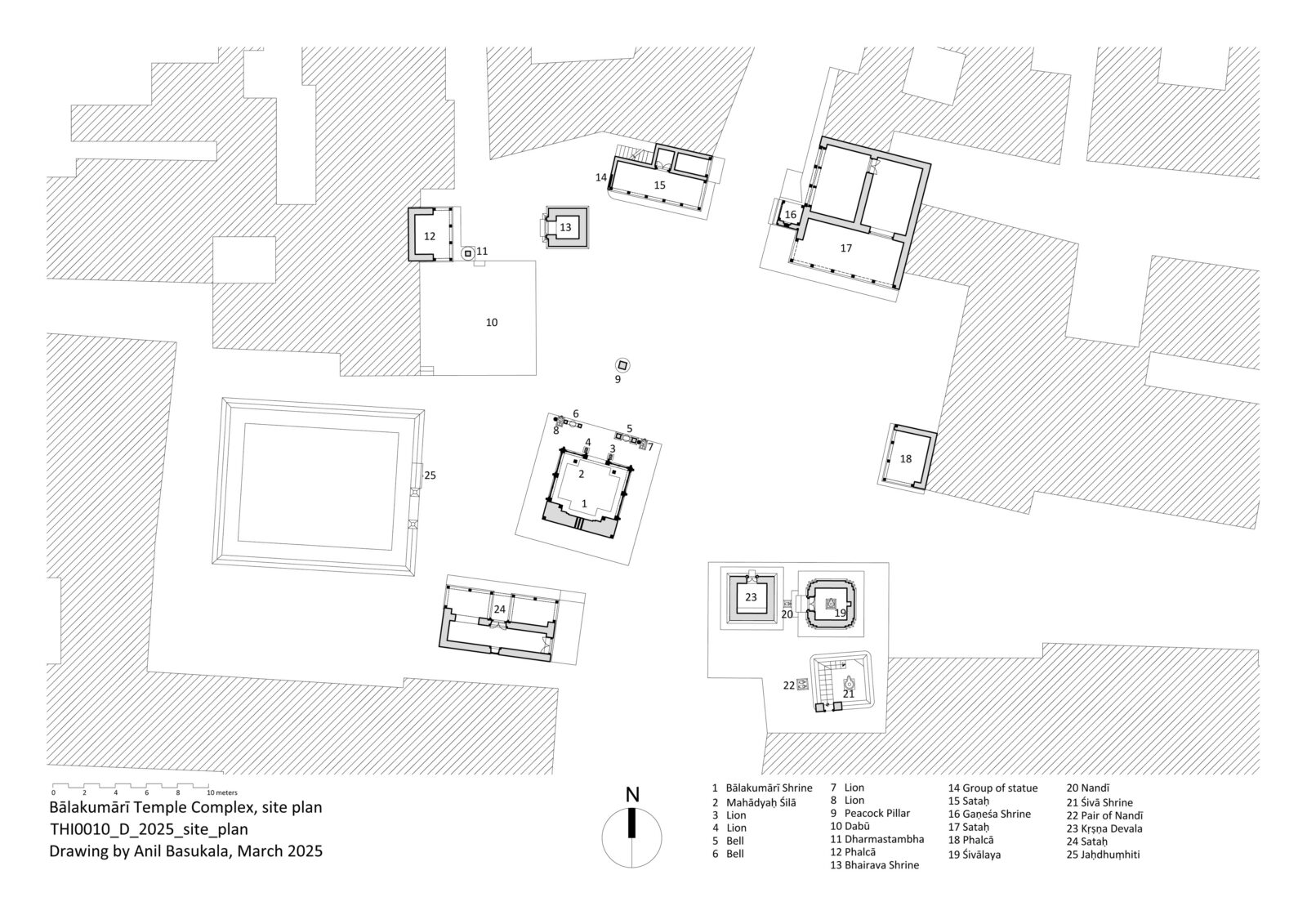
Balkumari Temple Complex. The temple (no. 1 on the plan) is located at the center of the Kvalākhu square. The resthouse built by Bhajunarasim Bharo and his wife in 1833 CE is to the east of the temple (no. 18 on the plan). Site plan by Anil Basukala, Nepal Heritage Documentation Project, March 2025. Licensed under CC BY-SA 4.0
The evidence points firmly to a connection between the Rubin’s torana and the Balkumari Temple, although one question remained. In the photograph posted by Lost Arts of Nepal, the torana’s form and iconography, especially the celestial musicians, confirm that it is the Rubin’s torana. But when was the photograph taken, and did it indeed show the Balkumari Temple?
The image in Pavlov’s article first appeared in his 2001 Russian-language book Altar’. Stupa. Khram (Altar. Stupa. Temple), but neither the caption nor the text identifies the monument—perhaps because Pavlov may not have taken the photograph himself. In the preface, he writes that he was introduced to Nepalese architecture “a quarter of a century” earlier, around 1975, by Vladimir Nikolaevich Yakubenko. After Yakubenko’s death, his widow and daughter gave Pavlov his photographic archive of Nepal, which supplied “a significant portion” of the book’s illustrations. On this basis, the photograph can be attributed to Yakubenko and tentatively dated to the 1970s.
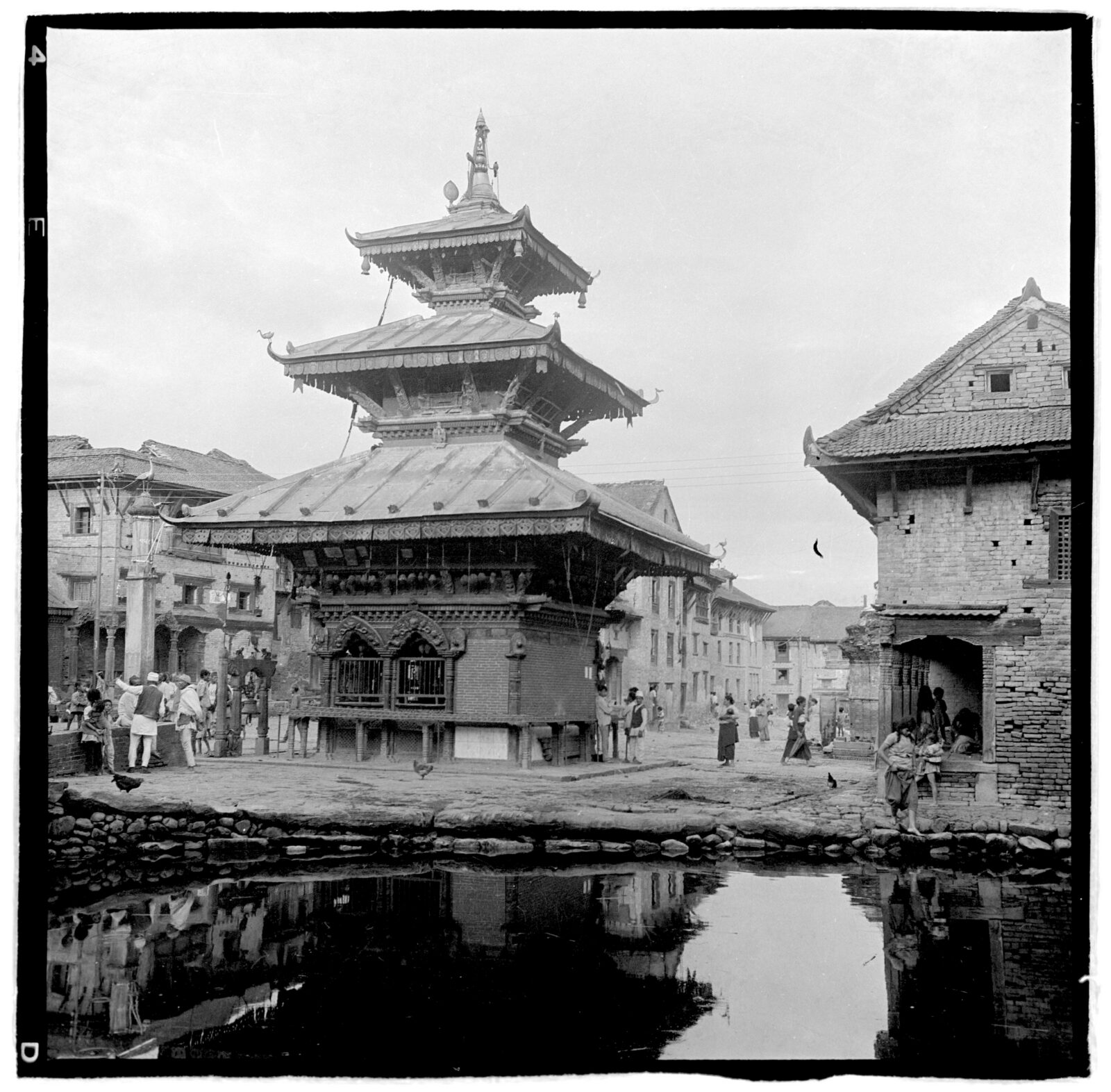
View from the southwest of Balkumari Temple in Thimi, Kathmandu Valley. Photo by Ganesh Man Chitrakar, early 1970s. Photo courtesy of the Dirgha Man and Ganesh Man Chitrakar Art Collection
Confirmation that Yakubenko photographed the Balkumari Temple in Thimi comes from a second image of the temple, taken by Ganesh Man Chitrakar in the early 1970s and published in 1975. Taken from the southwest, it shows two toranas on the left side of the Balkumari Temple’s facade. Close examination identifies the right-hand one as the torana in Yakubenko’s photograph. Several features appear in both images, namely the horizontal band of projecting beams carved with lion faces, wave motifs, and lotus petals behind the torana; a stone statue of a peacock immediately to the right of the torana; objects hanging from the arch; and the outlines of the flying figures on the torana.
Once the torana was traced back to Thimi, the next questions were when it had been removed, under what circumstances, and which hands it passed through before eventually entering the Rubin’s collection. The photo by Yakubenko from the 1970s and the one preserved in the Chitrakar Foundation provide proof the torana was still in situ around 1972 to 1973. I hope further information from community members will shed light on the exact circumstances of its removal.
While not accessible to me at the time of writing, any dedicatory inscription on the newly installed torana could also provide a likely latest possible date for the removal of the Rubin torana dated to 1810. Today a newly commissioned wooden torana hangs in its place, a near replica of the one to its left, which is also a 20th-century work and was already in place in the 1970s.
Currently, no information is available to me on where the torana went after it was removed from its original location. The work does not appear in the auction archives consulted so far, nor have I found additional published references. The earliest transaction documented is its sale by Hardt & Sons, an auction house then based in Santa Barbara, California, to the Shelley and Donald Rubin Cultural Trust on May 29, 2003.
This torana’s story shows that provenance research is rarely the work of one person or one institution. The evidence came from many sources: a reading of the inscription published a decade earlier; an anonymous online account that matched the torana photograph published in a Russian architectural journal without detailed information about the site depicted; a Russian architect’s drawing based on a colleague’s photographic archive; and a historian who knew of an inscription a few steps away from the temple. Each piece of information moved the story closer to Thimi.
While the research conducted identifies the torana’s original location and allows us to correctly understand the dedicatory inscription, many questions remain unanswered. When was the torana removed exactly, for what reason, and by whom? And where was the work held before it entered the Rubin’s collection almost a quarter century ago? We hope that additional research will be able to shed more light on the story of this object.

David C. Andolfatto is a provenance researcher at the Rubin Museum of Himalayan Art, where he studies the cultural contexts and collecting histories of the Museum’s collections. An archaeologist and art historian, he holds a PhD in archaeology from Sorbonne Université, Paris, and is an associate researcher at the Centre de Recherche sur les Civilisations de l’Asie Orientale (CRCAO, CNRS). His research focuses on the medieval art, architecture, and history of Nepal, especially the Khasa Malla kingdom of western Nepal, and on the ritual and material dimensions of Buddhist objects.
From 2015 to 2018 he worked with UNESCO in Kathmandu. There he coordinated heritage protection operations and directed archaeological excavations after the 2015 Gorkha earthquake. He then held postdoctoral positions with Heidelberg University’s Nepal Heritage Documentation Project and the Musée du quai Branly–Jacques Chirac, where he carried out archaeometric analyses of Buddhist clay votive objects. He was scientific advisor for the exhibition Chamanes: Dialogues with the Invisible (2023) at the Musée des Explorations du Monde, Cannes. His book, The Lions of Yatse: Medieval Arts, Architecture and History of the Karnali Basin, Nepal, is forthcoming.
This article is the first in a series exploring the histories of objects in the Rubin’s collection, highlighting the Museum’s ongoing provenance research and the complexities around cultural property.
The research presented above by provenance researcher David C. Andolfatto informed the Rubin’s decision to deaccession the torana and voluntarily return it to Nepal. It is our hope that the torana will eventually be returned to its original location in Thimi.
We have reached out to community members in Thimi, who we hope can help fill existing research gaps, including the circumstances of the torana’s removal from the facade.
The Rubin is working with the Consulate General of Nepal in New York and the Department of Archaeology of Nepal to arrange for the work to be securely transported back to Nepal at a mutually agreed-on time.
Get the latest news and stories from the Rubin, plus occasional information on how to support our work.