
Situ Panchen; Black Cloak Mahakala; Kham Region, Eastern Tibet; 18th century; Pigments on silk; Rubin Museum of Himalayan Art; C2002.8.4
Situ Panchen; Black Cloak Mahakala; Kham Region, Eastern Tibet; 18th century; Pigments on silk; Rubin Museum of Himalayan Art; C2002.8.4
In this simple yet expressive painting, Black Cloak Mahakala seems to emerge out of inky billowing clouds of smoke surrounded by his entourage. I’ve long considered this artwork one of the most interesting in the Rubin’s collection, both for its sophisticated aesthetic and the way it reveals artistic interests and connections across generations of artists. Answering the questions of what inspired this unusual artwork and who painted it requires an assessment of the inscription and iconography as well as visual style, quality, and technique.
Mahakala is one of the eight great wrathful protectors of the Buddhist teachings, a remover of obstacles, both internal and external. He has many forms and is generally depicted as an extremely fierce deity, dark blue or black in color. Here he takes the form of Black Cloak Mahakala, recognizable by his distinctive iconographic attribute, a large black cloak. In this form he is the special protector of the Black Hat Karmapa lamas and their Karma Kagyu tradition of Tibetan Buddhism.
According to Gega Lama (1931–1996), a master Karma Gardri painter in the lineage of artists established by Situ Panchen (to whom this painting is attributed by inscription), Black Cloak Mahakala is an especially terrifying form. Gega Lama wrote that this deity’s iconometric proportions follow a three large unit format (e.g., a short, squat form) with a large head and belly; and according to one system, the head makes up one half of the body height and the mouth one half of the head, which seems to roughly correspond to this painting.
The painting composition depicts Five Deity Mahakala, with the central deity surrounded by the five main members of his retinue. At the lower right is Shi Devi as Rangjung Gyelmo, the consort of Black Cloak Mahakala. She is mounted on a mule, and with her four arms she wields a kila (ritual peg or dagger), noose, katvanga staff, and mirror. The Oath-Bound Blacksmith (Damchen Garwai Nakpo) is on the lower left. He wields a hammer and bellows while riding a goat with entwined horns. These three figures form the primary protectors of the Karma Kagyu tradition and are often depicted together in paintings.
At the top center is a depiction of the head of this tradition, a Karmapa, recognizable by his distinctive black hat, his badge of office. Normally this position in a painting composition is reserved for the root teacher associated with the image. In this case it would be the Second Karmapa, Karma Pakshi (1204–1283). But this Karmapa depiction does not follow Karma Pakshi’s very distinctive iconography. Instead, for reasons outlined below, I believe it is a depiction of another Karmapa.
This painting has a special format with a black background (nak thang), which is traditionally reserved for wrathful deities. Such paintings are often kept in special chapels dedicated to protector deities. However, this painting’s small size (22 ¾ x 13 7/8 in.) suggests it may have been intended for personal use.
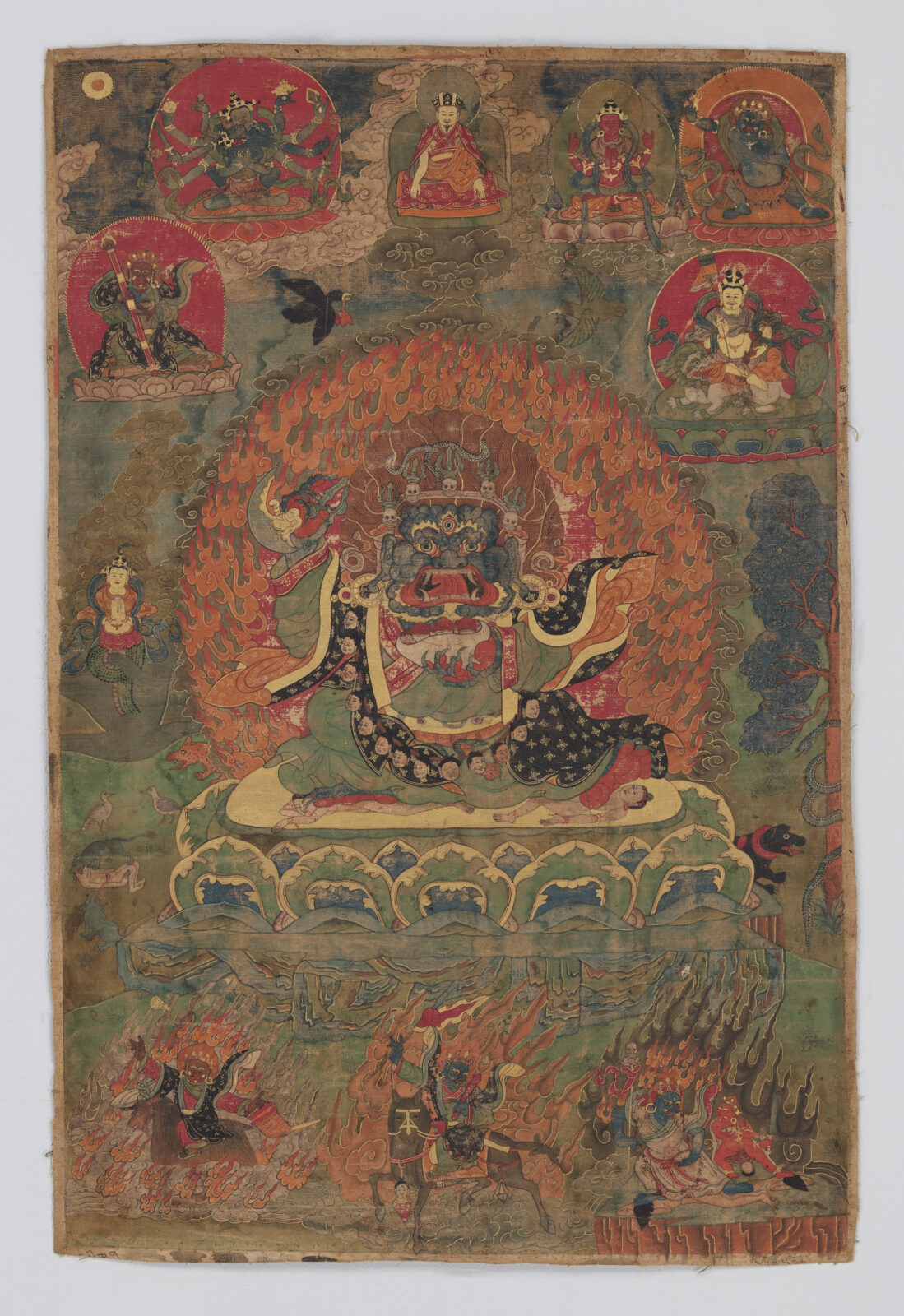
“Cloud Faced” Black Cloak Mahakala; Tibet; 16th-17th century; Pigments on cloth; Rubin Museum of Himalayan Art, Gift of Shelley and Donald Rubin; C2006.66.678
Black background paintings tend to lack solid figural forms or the distinctive green and blue landscape palettes typical of later Tibetan painting. Instead this specialized genre primarily features energetic outlines that emphasize the artist’s brushwork, such as the kind seen in the 18th-century painting of Mahakala below. Some texts describe black-ground paintings as sized with cremation ash and inked with nose blood, but more typically this black effect is achieved with ink made from soot. The gold used to outline the figures and the spare touches of red are typical of this genre. Yet ink on silk is an unusual medium in Tibetan art and is more typical of Chinese painting.
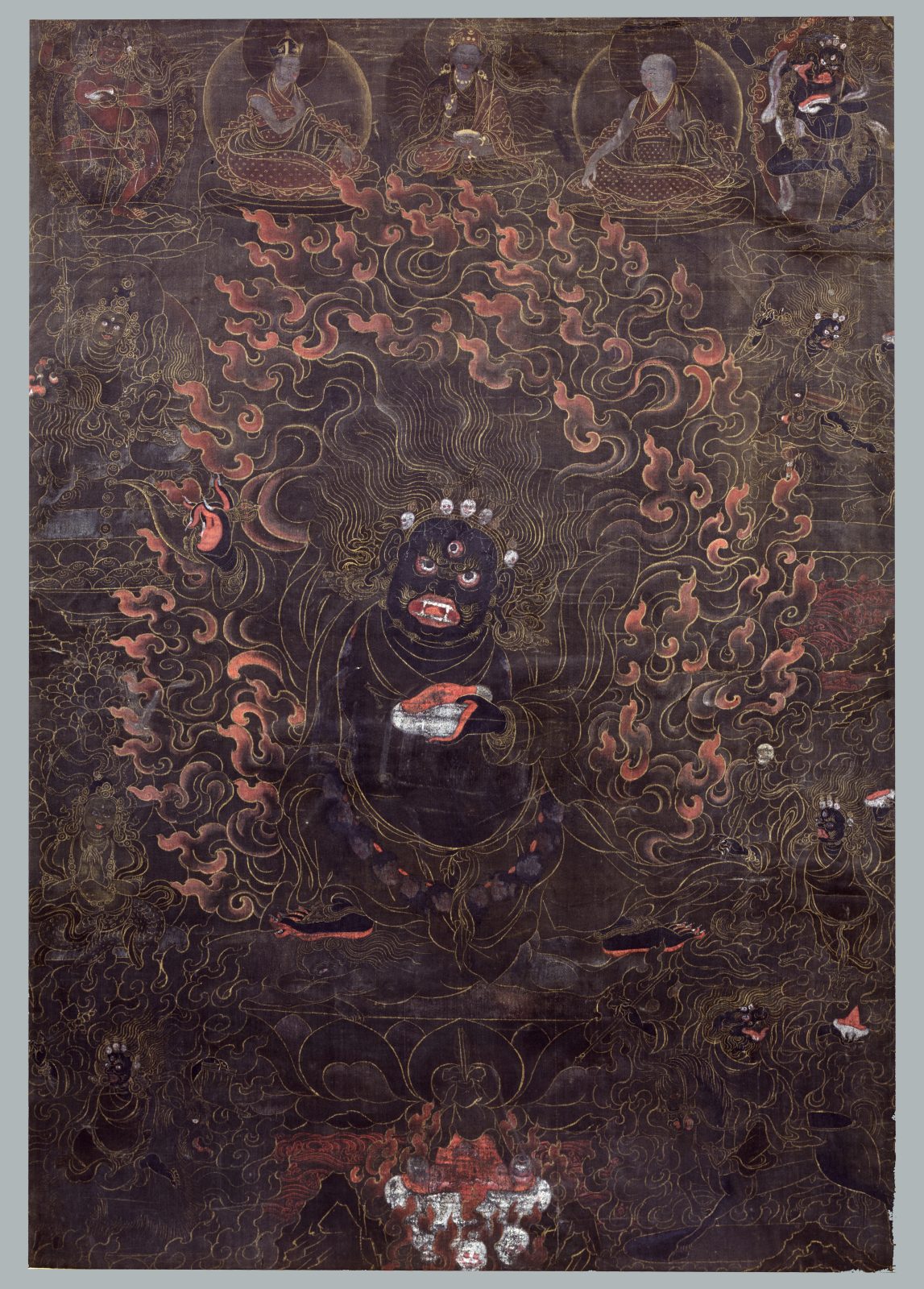
Black Cloak Mahakala; Tibet; 18th century; Pigments on cloth; Rubin Museum of Himalayan Art, gift of the Shelley and Donald Rubin Foundation; F1996.32.7
An inscription in the bottom-right corner reads, “Without error [this] painting of Five Deity [Mahakala] was painted by the hand of Chos ’byung.” This attributes the painting to Situ Panchen Chos [kyi] ’byung [gnas] (1700–1774), an important scholar-artist and polymath of the Kham region in southeastern Tibet. However, the many simple spelling errors, as well as the use of the honorific word for hand (phyag), are clear indications that this inscription could not be by Situ himself, who was famous as a strict grammarian.

Detail of Situ Panchen (1700-1774); From a Palpung set of Masters of the Combined Kagyu Lineages; Kham Region, Eastern Tibet; late 18th century, ca. 1760s; Pigments on cloth; Rubin Museum of Himalayan Art, Purchased from the Collection of Navin Kumar, New York; C2003.29.2
Records show that Situ Panchen painted this theme from early on in his life. For instance, on his first visit to central Tibet (ca. 1714), around the time Situ first took up formal training in image making at the age of 15, the Twelfth Karmapa (1703–1732) asked him to paint Black Cloak Mahakala. As the main protector of his tradition, he would have continued to produce images of this deity repeatedly throughout his career.
Despite the unambiguous inscription, the painting has also been re-attributed to the Tenth Karmapa Choying Dorje (1604–1674). This attribution is due to the painting’s unusual appearance—specifically the sensitive handling of the animals, such as the realistic depiction of the elephant at the bottom center. Also, while a silk ground is unusual for Tibetan painting, it is something the Tenth Karmapa was known to favor. But the handling of the ink clouds here suggests the painter was not familiar with how silk absorbs ink or the techniques for creating layered ink washes—a characteristic technique that the Tenth Karmapa had mastered. Works by the hand of the Tenth Karmapa are distinguished by a combination of strong, quick, expressive lines, or “tremulous brush,” contrasted with soft washes in a “boneless” technique (washes of pigment lacking outlining).

Example of Tenth Karmapa’s brushwork (strong, quick, expressive lines in foliage and soft washes in a boneless technique in the rabbit). Detail from Tenth Karmapa, Choying Dorje (1604–1674); Two Arhats and Heshang with a Woman Washing Daikon (from a set of seven paintings); Lijiang, Yunnan Province, China; dated 1660; ink and pigment on silk; Lijiang Municipal Museum; no. 439.4; photo by the author
In comparison, the quality of the brushwork in this painting of Mahakala is tentative and unexpressive. See for instance the lines in the delineation of the central figure’s proper left hand holding the skull cup. (My own painting teacher once taught me that hands are a telling place to look when evaluating a painting.) This brushwork stands out in this spare format where the lines of the brush are so prominent, as there is no pigmented background to hide or cover mistakes. Yet somehow it does not detract from the elegant simplicity, overall expressive impact, and immediacy of this work.
These qualities are consistent with what we know of Situ Panchen, who was famous as a brilliant polymath, consummate connoisseur, iconographer, and patron of the arts, but not a professional artist. Situ was more famous for the sets he designed and commissioned than works by his own hand. Here in this painting of Mahakala, this sensitivity can be seen in the subtle use of a green wash in the central deity’s tunic. It accentuates the blackness of Mahakala’s cloak on an already black ground, thus foregrounding the characteristic feature of the deity. This reflects a delicate aesthetic sensibility employed in the service of iconographic clarity.
Therefore the unambiguous inscription, combined with these formal qualities, suggests that Situ painted this work following compositions by the Tenth Karmapa, or was at least inspired by that Karmapa’s distinctive style. Specific details supporting this hypothesis are the unusual depictions of the Blacksmith (Damchen) riding the goat to the lower left and Shri Devi on the lower right. Both closely resemble depictions of these two deities in extant paintings inscribed as “painted by the hand of the venerable Choying Dorje”: Damchen, the Oath-Bound Blacksmith and Shri Devi as Rangjung Gyelmo.

Attributed by inscription to the Tenth Karmapa, Choying Dorje (1604–1674); Damchen, the Oath-Bound Protector; Gura Sharkha, Minyak, Kham region, eastern Tibet; dated by inscription 1655; ground mineral pigment on silk; formerly private collection (sold at auction 2025)
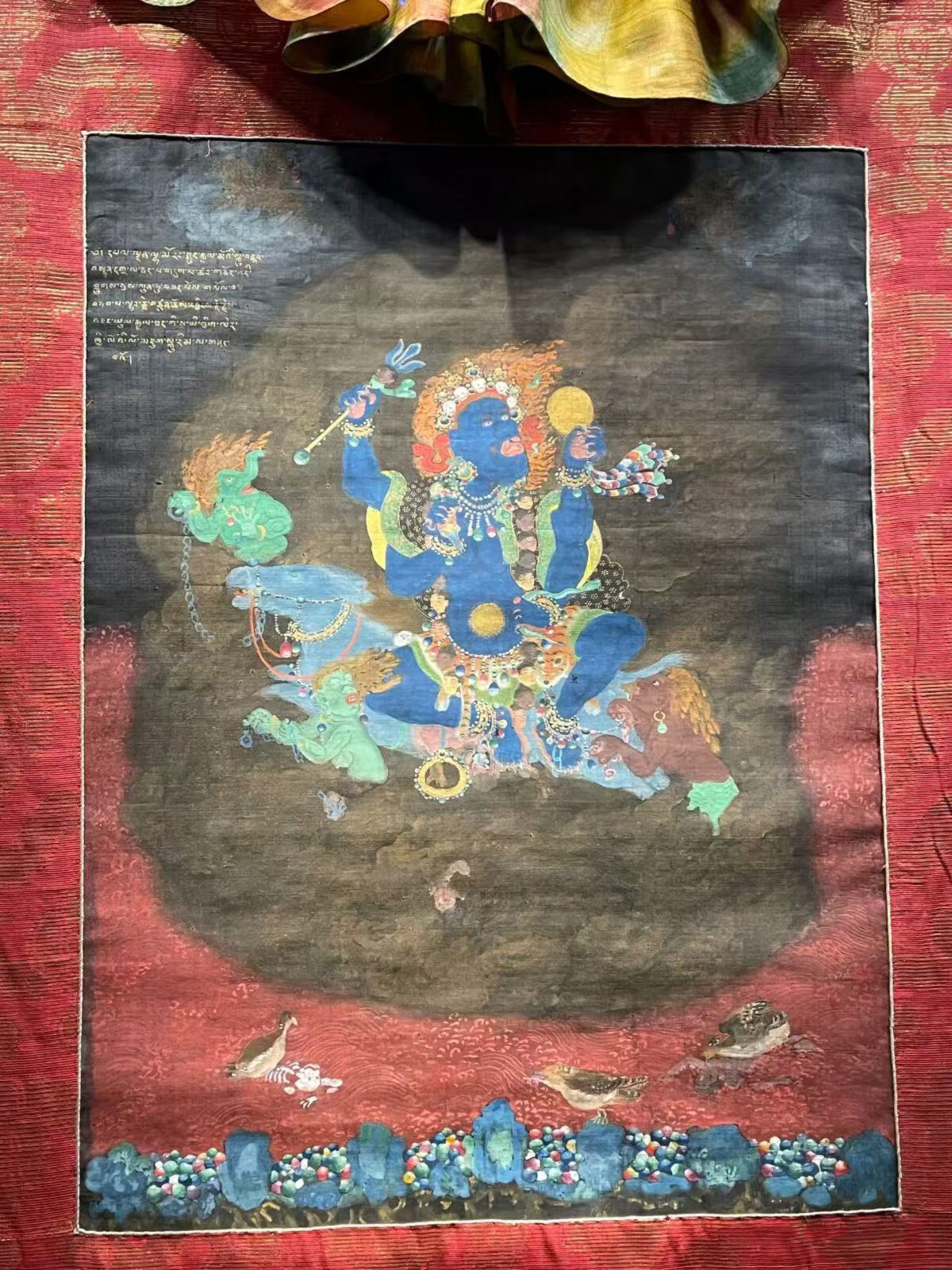
Attributed by inscription to the Tenth Karmapa, Choying Dorje (1604–1674); Pelden Lhamo Rangjung Gyelmo (dpal ldan lha mo rang byung rgyal mo); Gyeltang, Northwestern Yunnan; dated by inscription 1658; ground mineral pigment on silk; Potala Palace Collection; HAR 15640
Interestingly, according to a biography written by Situ Panchen and his student Belo, the Tenth Karmapa also made a painting of Mahakala around the same time (1656), in the same region, and for the same person as the aforementioned paintings of Damchen (dated 1655) and Shri Devi (dated 1658), likely to complete the group of three main Karma Kagyu protectors (ma mgon mgar gsum), presumably in the same style. Clearly Situ was aware of these works which may have served as models for Situ’s painting.
Copying paintings by great masters has long been a basic aspect of training and appreciation across many traditions. Textual evidence confirms that Situ Panchen was particularly interested in the Tenth Karmapa as an artist, and he possessed a number of works attributed to him. Several paintings made by Choying Dorje were even interred with Situ in his burial stupa, suggesting Situ felt a strong affinity to the Tenth Karmapa as an artist.
Thus I believe the Karmapa at the top of this composition could be one of two people. The first is the Tenth Karmapa, who inspired this work. Or, if this is a direct copy of a Choying Dorje composition (as mentioned above), it could be his predecessor, the Ninth Karmapa, Wangchuk Dorje (1556–1601/1603).
The silk brocades of this painting are also in the mounting style of Situ’s seat, Pelpung Monastery, characterized by simple two-tone patterned silk embroidery with minimal flaring at the top and bottom. This is further evidence that helps tie this work to that artistic center and Situ himself.
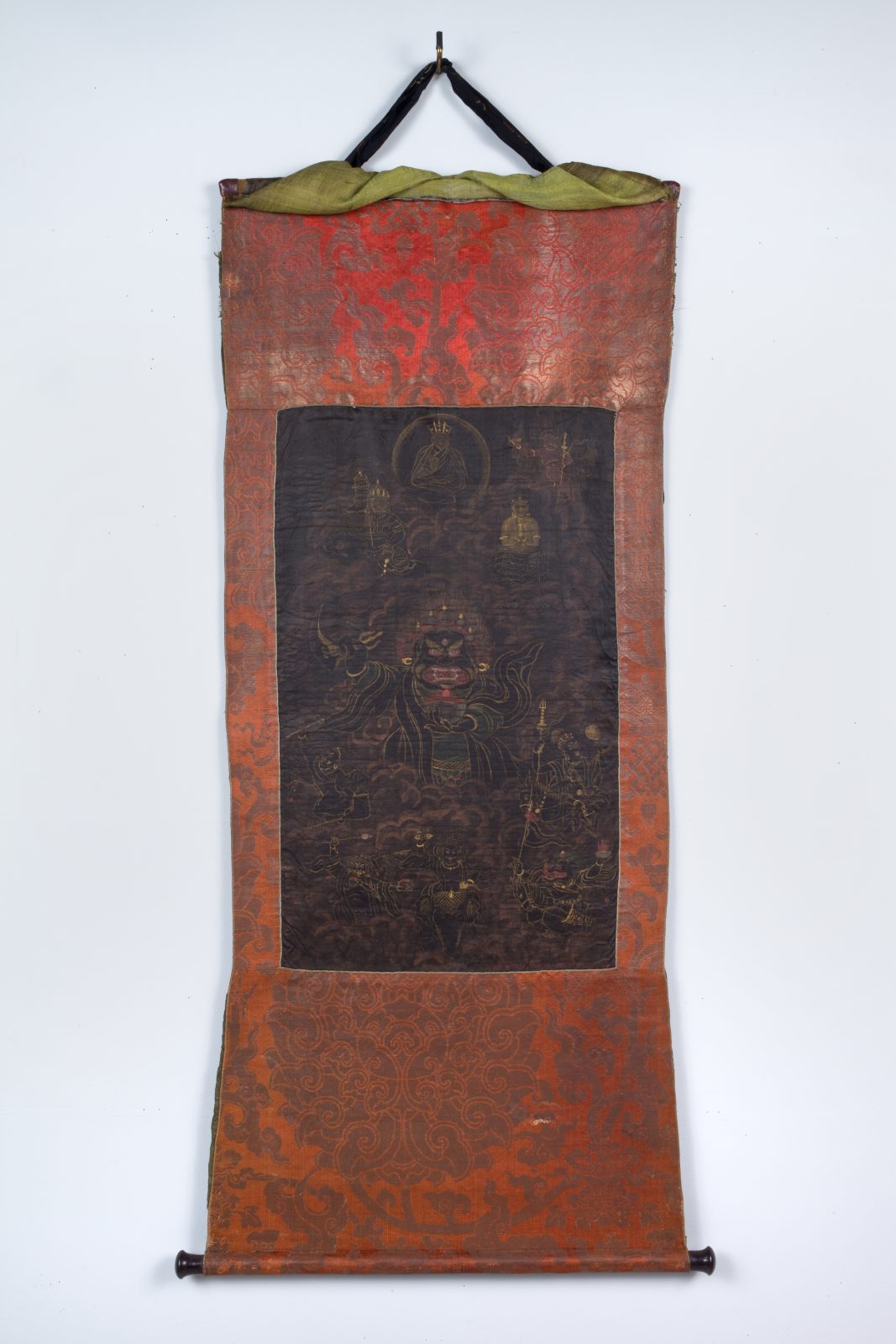
Situ Panchen; Black Cloak Mahakala; Kham Region, Eastern Tibet; 18th century; Pigments on silk; Rubin Museum of Himalayan Art; C2002.8.4

Pelpung Monastery, founded by Situ Panchen in 1729; Kham region, eastern Tibet (modern-day western Sichuan Province, PRC); photo by author
Karl Debreczeny is senior curator, collections and research, at the Rubin Museum of Himalayan Art. His research focuses on artistic, religious, and political exchanges between the Tibetan and Chinese traditions. His publications include The Black Hat Eccentric: Artistic Visions of the Tenth Karmapa (2012) and the coedited The Tenth Karmapa and Tibet’s Turbulent Seventeenth Century (2016). More →
Great Tibetan Patron and Designer of Buddhist Art in KhamPelpung Monastery, Derge, Kham region, eastern Tibet
Get the latest news and stories from the Rubin, plus occasional information on how to support our work.