Tsang region, central Tibet
second half of the 14th century
This is the gesture of the Buddha calling the earth to witness his awakening.
Tsang region, central Tibet
second half of the 14th century
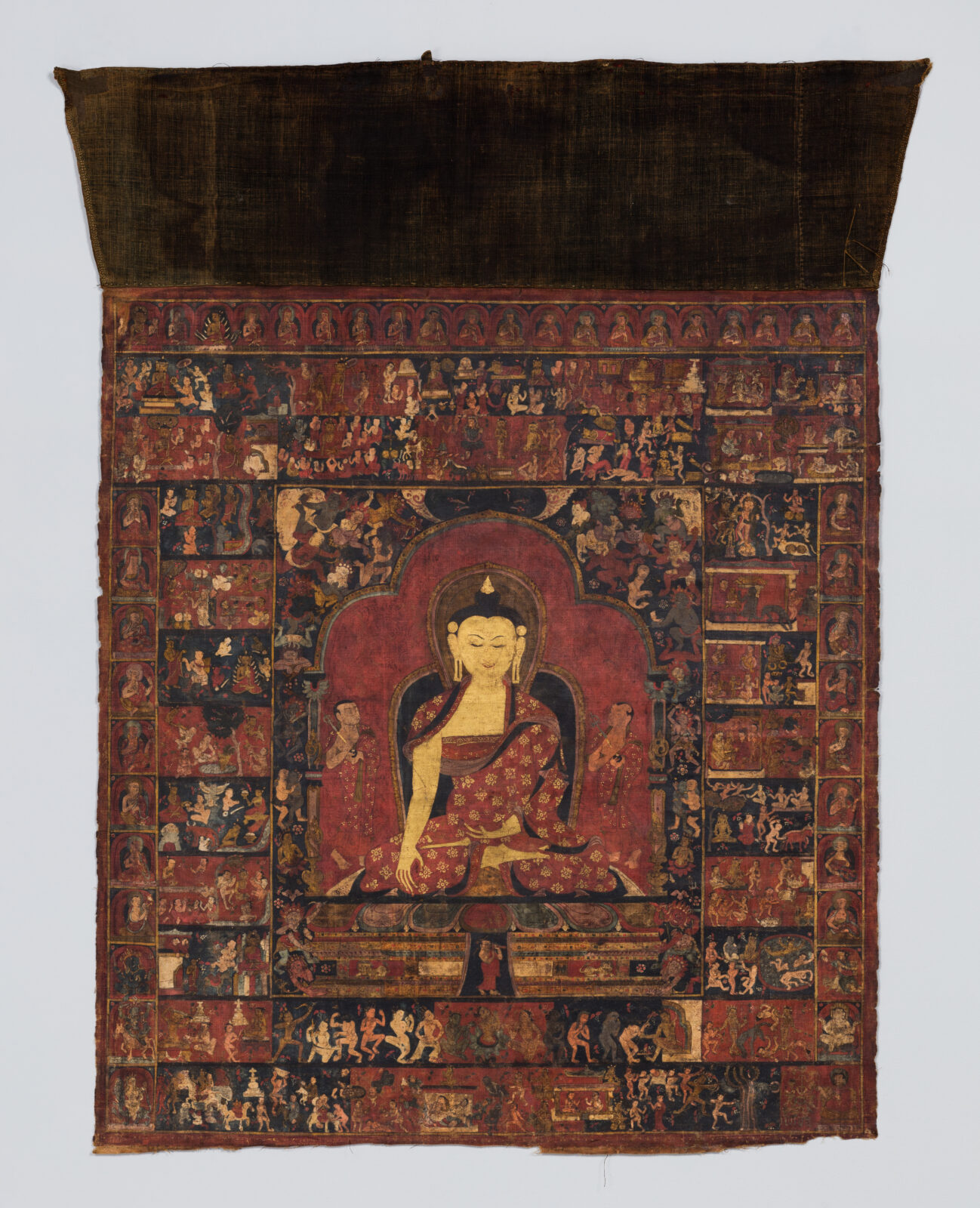
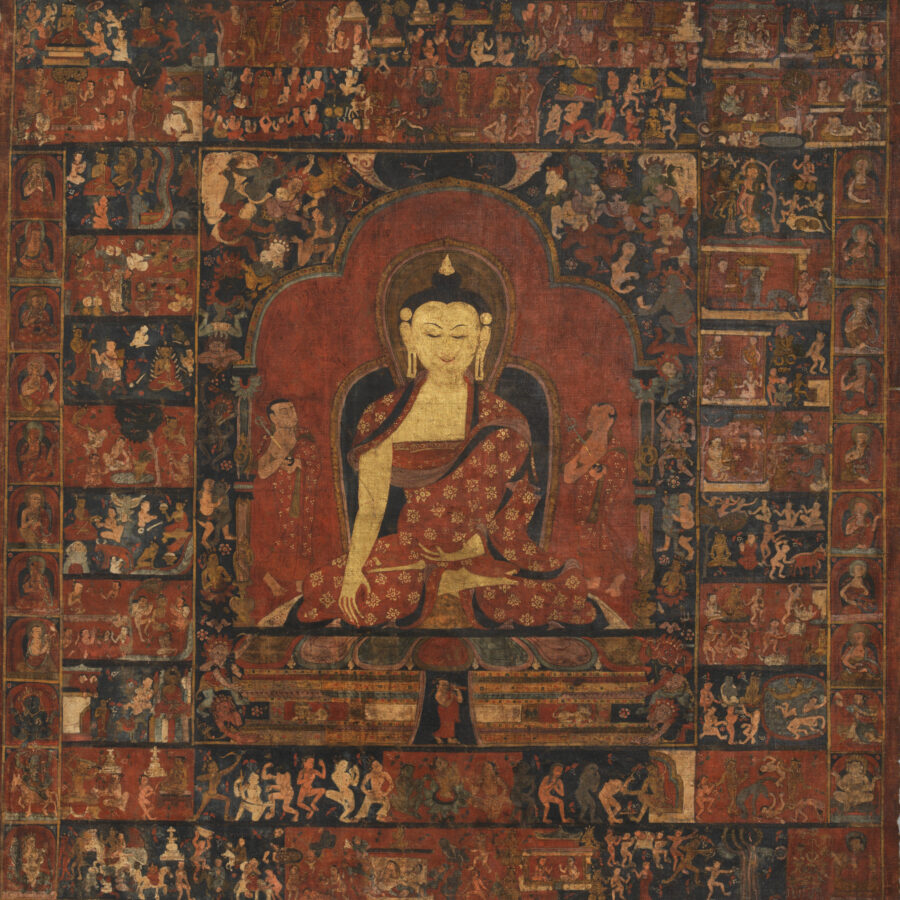
Given its size, this is a surprisingly detailed and finely painted representation of the Buddha’s life. It is closely based on a composition derived from northeastern India. At the center of the painting is a depiction of the Buddha’s awakening, with Mara, a personification of evil, and Mara’s army attempting to stop the Buddha from reaching enlightenment. Other scenes from the Buddha’s life surround this central image, some with fragmentary Tibetan captions in gold ink still visible. The scenes are arranged chronologically starting in the top-right corner and moving in a clockwise direction, ending with the death of the Buddha at top center. One particularly interesting scene at top right shows the creation of a sculpture of a seated Buddha, which seems to refer to the creation of the first Buddha image. Unusually this painting also has an extensive lineage depiction at the top, beginning with Shakyamuni (Śākyamuni) and including Nagarjuna (Nāgārjuna). Although the painting follows early Indic models in many respects, the inclusion of such a lineage marks this as a Tibetan composition. On either side of the central scene are the sixteen arhats, the original disciples of the Buddha, dressed as Indian monks in vertical outer rows (six to the left and seven to the right). One additional figure was added to this group at the bottom of the right column, the attendant Dharmatala (Dharmatāla; zhabs ’bring dhar+ma tā la) who is recognizable by the bundle of books on his back, the fly whisk he holds, and his tiger companion. It seems the patron Hashang’s (hwa shang) inclusion was not standardized by the time of this painting’s execution. The set of eighteen figures became standardized later in the fifteenth and sixteenth centuries. Also unusual for this subject matter are four protective deities in the bottom corners, including Four-Armed Mahakala; Shri Devi as Makzor Gyelmo (mag gzor rgyal mo) “Queen Who Repels Armies” on her mule; four-armed elephant-headed Ganapati (Gaṇapati); and a practitioner or patron wearing Tibetan monastic robes in the bottom-right corner.
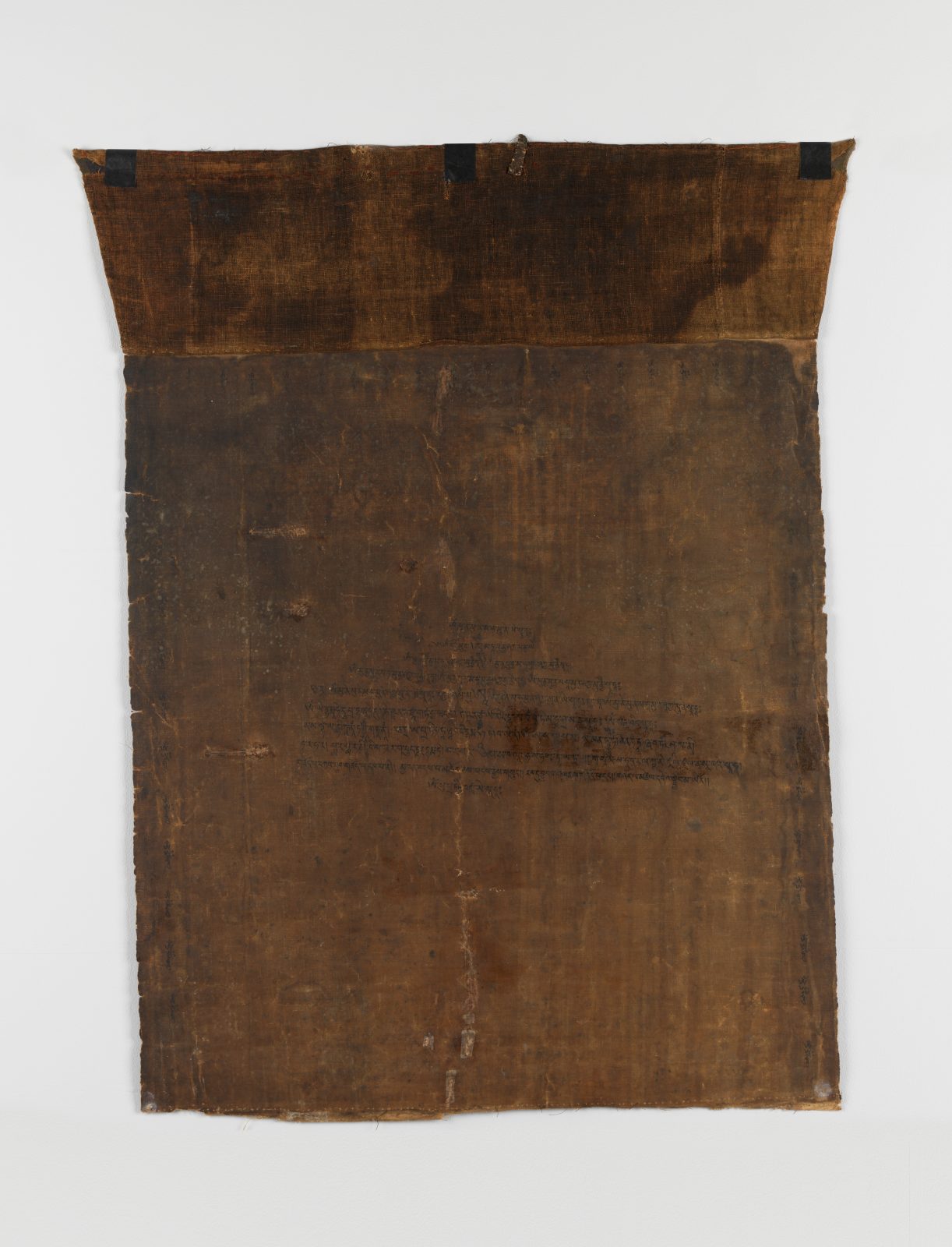
This artwork features other characteristics of early Tibetan painting with close links to Nepalese art found across the Himalayas during the fourteenth and fifteenth centuries. These characteristics include the central Buddha sitting under a three-lobed arch supported by lotus columns; rosettes represented above his ears; his cranial protuberance or ushnisha (uṣṇīṣa) topped by a flame-shaped jewel; the dominant red color; the alternating blue and red backgrounds to differentiate the scenes from his life; and yellow lines defining the main parts of the composition. Many details of this painting can be related to the jataka (jātaka) narrative wall paintings at Zhalu Monastery, including the architectural structures that evoke Newar culture of the Kathmandu Valley. On the back of the painting are ten lines of text, mostly mantras and the Yedharma forbearance verse.

This is the gesture of the Buddha calling the earth to witness his awakening.
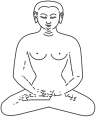
Also known as vajra position, this posture is associated with meditation.
The functioning of cause and effect across time. Buddhists believe that everything we experience is the result of past actions, and everything we initiate has future consequences. Karma encourages actions to bring about positive outcomes and a better future.
A state of “waking up” from illusion and seeing the true nature of reality. Buddha Shakyamuni attained enlightenment while meditating under the bodhi tree. Buddhist teaching explains that the accumulation of merit and wisdom are essential for achieving enlightenment, also known as awakening.
A vehicle for the preservation and transmission of knowledge. The Buddha’s teachings were originally passed down through oral transmission and storytelling, and stories of the Buddha’s past lives are considered an important source of inspiration and guidance.
An awakened being who understands the true nature of reality and is free from the cycle of birth, death, and rebirth. While there are many buddhas, Siddhartha Gautama is the historical Buddha, whose teachings became the foundation of Buddhism.
Today, Tibetans primarily inhabit the Tibetan Plateau, situated between the Himalayan mountain range and the Indian subcontinent to the west, Chinese cultural regions to the east, and Mongolian cultural regions to the northeast. During the 7th to 9th century, Tibetan rulers expanded their empire across Central Asia, and established Buddhism as the state religion.
Get the latest news and stories from the Rubin, plus occasional information on how to support our work.