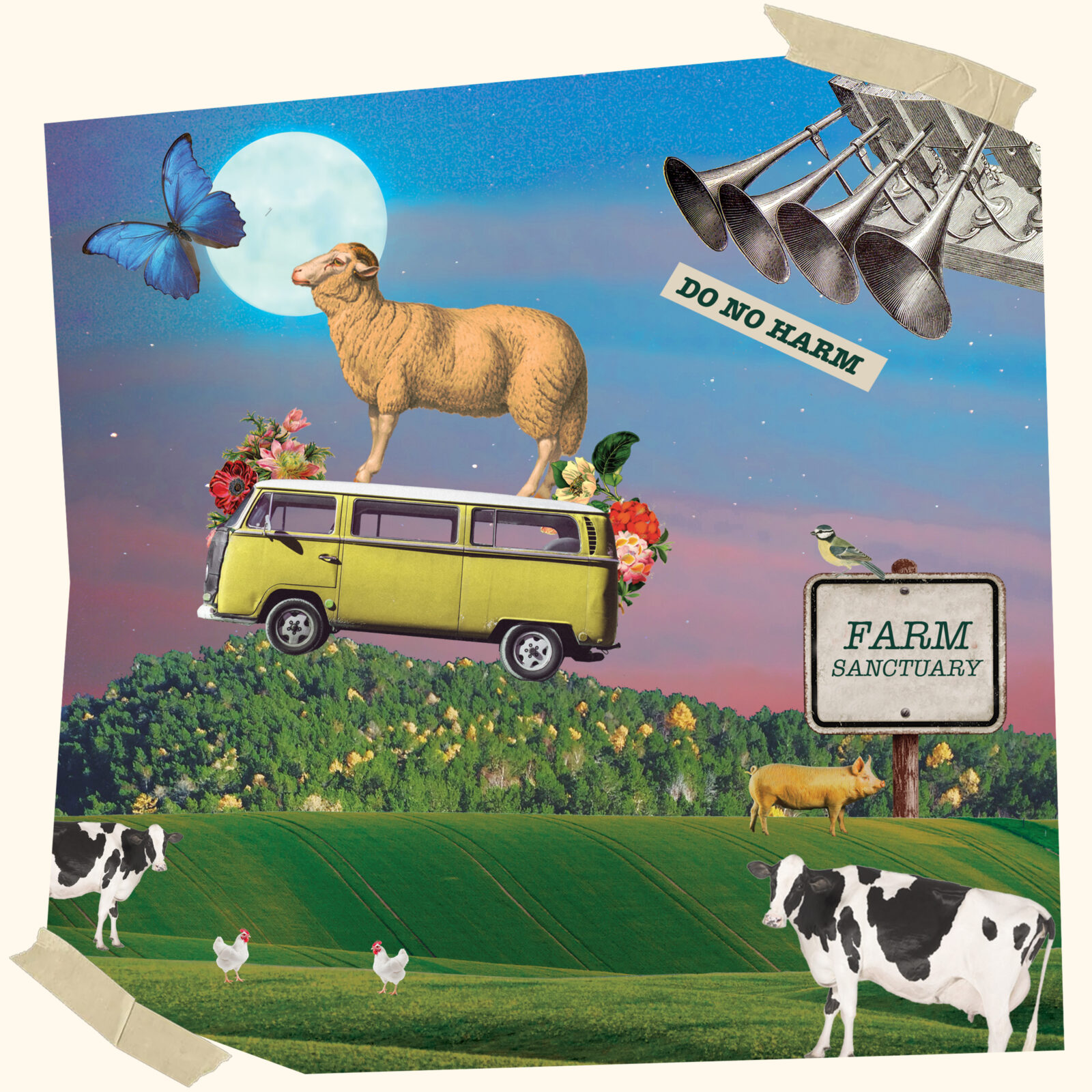
Illustration by Sarah Kaushik
Illustration by Sarah Kaushik
The cofounder of Farm Sanctuary on transforming anger and saving lives
It began with hot dogs, vegan hot dogs, which Gene Baur and his companions sold out of a Volkswagen van at Grateful Dead concerts back in 1986. Their early work also entailed revealing to people the cruelty of animal agriculture and agribusinesses. “We felt that if we showed people what was happening, they would be appalled and stop eating animals, because most people grow up without thinking of the harm they are doing buying these products. That was our initial simplistic thinking. We still think there’s value in showing people, but it’s a lot more complex than that.”
Their first rescue was a sheep named Hilda that Gene and his volunteer team found in a dead pile of cows, pigs, and sheep behind a stockyard in Pennsylvania. When they got closer, the sheep lifted her head. “We were stunned that a living animal would be left here.” They removed her from the dead pile and assumed that she would have to be euthanized. But when they brought her to the veterinarian, she started perking up. “It turns out she probably passed out from heat exhaustion in the truck and was unconscious when the trucker was unloading all the animals. He assumed she was dead and just threw her on the dead pile. She recovered and lived with us for more than ten years and is buried at the sanctuary.”
Gene sees wrath as a force for good that can evoke a reaction to grave injustices and lead to courageous acts. “For me,” Gene describes, “where there’s anger, where there’s pain and injustice, it is upsetting. I take that energy and try to transform it and use that energy towards action. I also think it’s important not to dwell in anger but to transform it into positive forward momentum. Anger can eat us up if we don’t transform it.”
2026 marks the fortieth anniversary of Farm Sanctuary, which has come a long way from the days of the Volkswagen van and has two locations in Watkins Glen, New York, and Los Angeles, California. Though times have changed, and more people have switched to plant-based diets, the ideas of compassion and injustice are as important as ever. Horrific images of what he’s seen in the stockyards and slaughterhouses often come to him, but Gene says, “I don’t focus too much energy on the bad things. I notice and pay attention and record the bad things to be able to educate people.” How does Gene attribute his longevity in the field? “I make a conscious effort to dwell in the things I can do instead of those I cannot.”
Howard Kaplan is an editor and writer who helped found Spiral magazine in 2017. He currently works at the Smithsonian and divides his time between Washington, DC, and New York City.
Gene Baur is a best-selling author, activist, and cofounder and president of Farm Sanctuary, America’s leading farm animal protection organization. Baur was instrumental in passing the first US laws prohibiting inhumane animal confinement and continues working on systemic food industry reforms. Baur has been hailed as “the conscience of the food movement” by Time magazine and named one of Oprah Winfrey’s SuperSoul 100 Givers.
Sarah Kaushik is a Netherlands-based visual artist with Indian roots, whose work reimagines vintage imagery into surreal “worlds” that blur humor, critique and dream. Using found photographs and pop-cultural fragments, she probes the absurdities of modern life with her collages, while also celebrating the strangeness of memory and imagination. Her work invites viewers to look closer—and be looked at in return.
This article appears in issue 10 of the print edition of Spiral magazine under the title “All Creatures Safe and Sound.”

Get the latest news and stories from the Rubin, plus occasional information on how to support our work.