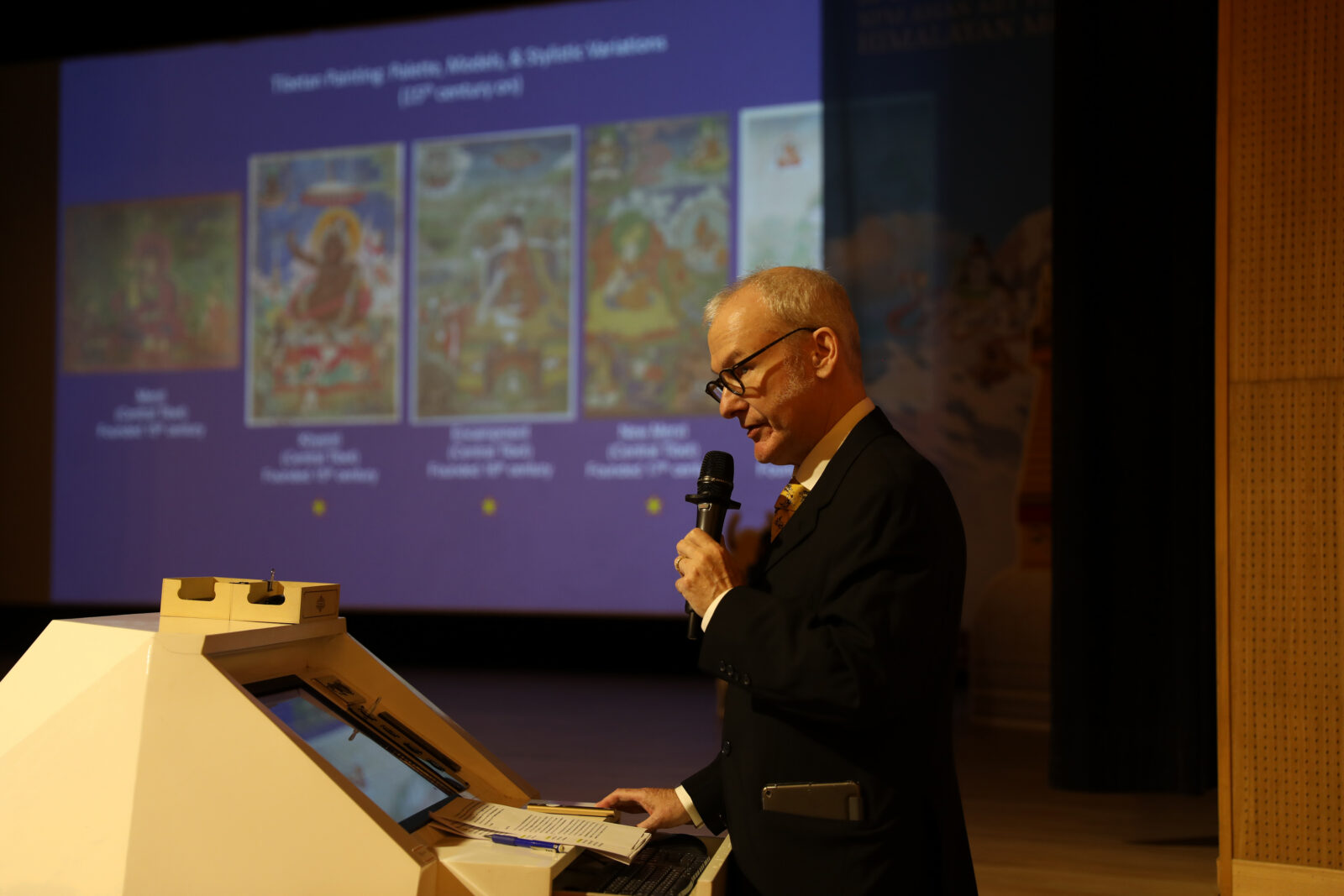
Photo Courtesy of the National Palace Museum
The Rubin’s Senior Curator of Collections and Research Karl Debreczeny was invited to give a talk at the National Palace Museum Southern Branch in Taibao, Taiwan, for the opening events of the new exhibition Crossing the Himalayas: An Artistic Odyssey, which includes 42 objects on loan from the Rubin’s collection and is open through April 6, 2027. “Landscapes of the Divine: Tibetan and Chinese Painting Traditions in Dialogue”—held on October 9, 2026, the day after the exhibition opened—is presented in both English and Mandarin and gives an in-depth look at how traditions in Tibetan painting developed in the 15th and 16th centuries.
True to the exhibition’s theme of cross-cultural exchange in the greater Himalayan region, the talk explores how Tibetan painting moved away from a more Indic-centric aesthetic towards a more Chinese-centered aesthetic, particularly in the depiction of landscapes.
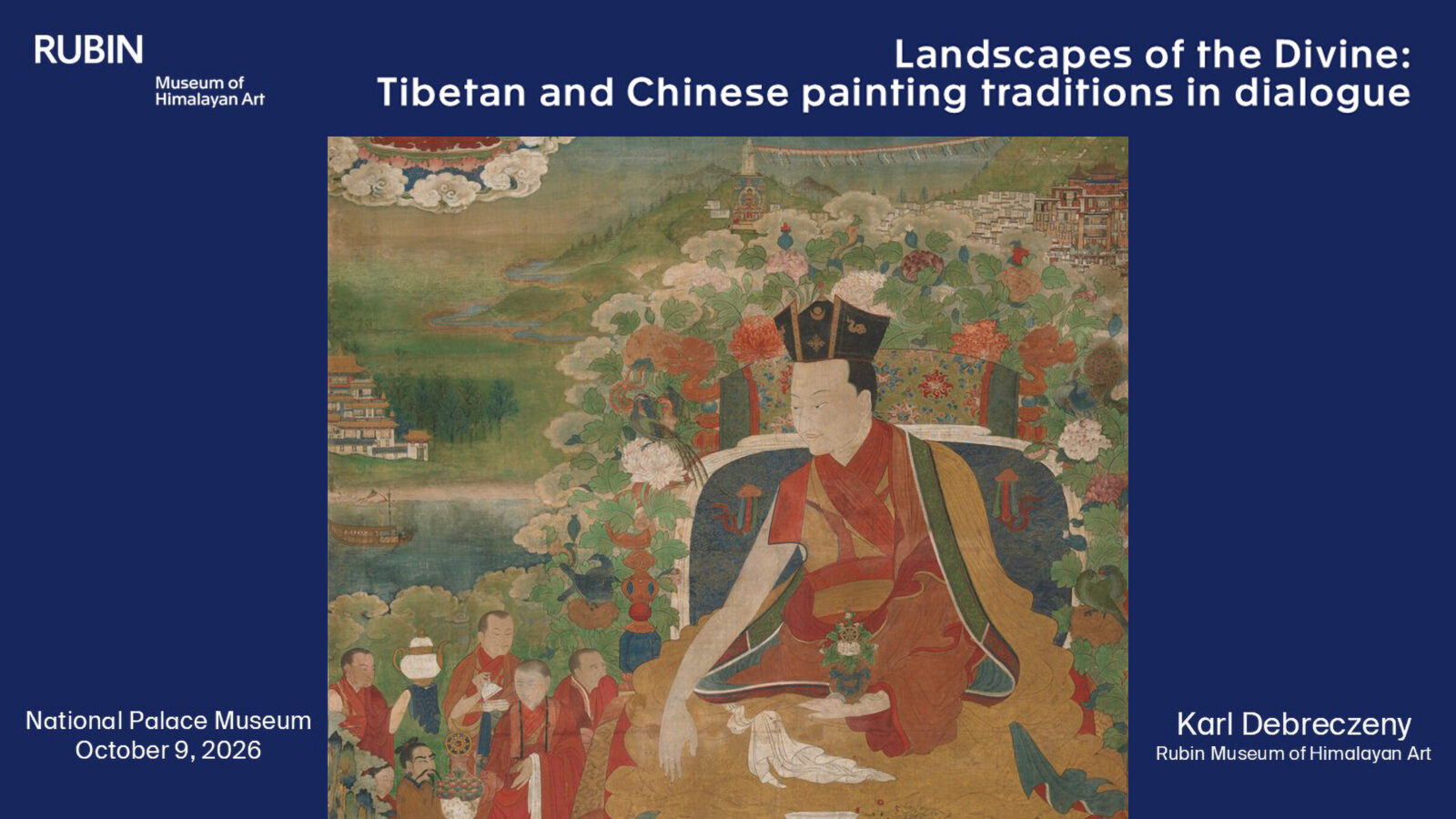
“This is a complex, multifaceted relationship, not a one-way street,” Debreczeny explained. “That’s why I prefer the word ‘dialogue’ to ‘influence.’” For example, Tibetan Buddhist art was created at the imperial workshops of the Ming dynasty.
The artistic and cultural journey illuminated by Debreczeny spans two millennia, from early Sino-Tibetan artistic contact between the 7th and 9th centuries through the 18th-century artistic revival of the Encampment tradition in Tibetan painting. The first half of the talk provides historical and artistic context leading up to these new styles, such as the disappearance of Buddhism in India and the adoption of Tibetan Buddhism by Chinese rulers. It then gives an overview of the new traditions in Tibetan painting that emerged in the 15th to 16th centuries.
The second half of the talk takes a deep dive into the Encampment tradition (Karma Gadri), established in the 16th century and associated with the court of the Karmapas, in which the figures follow Indian Buddhist models while the coloring and shading come from Chinese painting. It then explores the 18th-century “New Encampment” style.
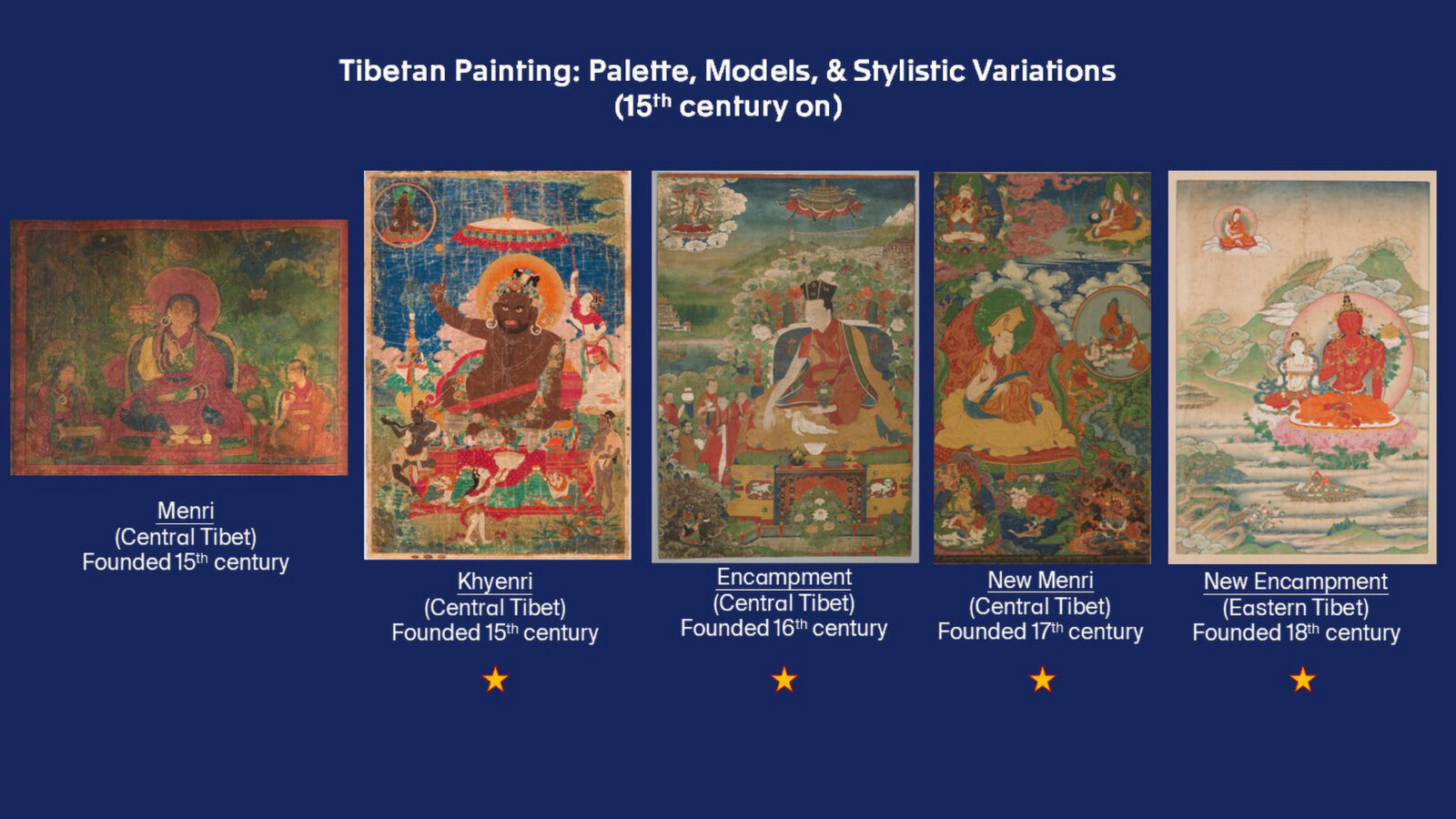
Examples of Tibetan painting traditions. The starred works are on view in Crossing the Himalayas: An Artistic Odyssey.
Many of the works Debreczeny references in the talk are shown in Crossing the Himalayas: An Artistic Odyssey, including several objects loaned by the Rubin. He also uses materials from the Rubin’s Project Himalayan Art digital resources to contextualize the discussion, such as an interactive map tracing the centuries of shifting empires across the greater Himalayan region.
The talk also challenged frequent assumptions about Tibetan art. For instance, Debreczeny said: “Although it is often repeated that Tibetan art is anonymous, this isn’t really the case.” Watch the video of the talk, embedded above and on the Rubin’s YouTube channel, for more insights.
The in-person audience for “Landscapes of the Divine: Tibetan and Chinese Painting Traditions in Dialogue” comprised museum professionals, art enthusiasts, collectors, people interested in Tibetan Buddhism, and faculty and students from several universities in Chiayi and Taipei, including National Chung Cheng University (國立中正大學) and National Chengchi University (國立政治大學). The talk was also livestreamed and posted on the National Palace Museum Southern Branch’s Facebook page, where it reached more than 24,000 views within a few weeks of the opening.
HUANG Hsin-hui (黃馨慧), assistant curator, National Palace Museum Southern Branch, and Dr. Eric CHUNG Tzu-yin (鍾子寅), assistant curator, National Palace Museum Southern Branch and the curator of Crossing the Himalayas, provided opening remarks for “Landscapes of the Divine: Tibetan and Chinese Painting Traditions in Dialogue.” Dr. Teresa YAO Man-ching 姚曼菁 translated the talk into Mandarin.
Get the latest news and stories from the Rubin, plus occasional information on how to support our work.