
Illustration by KJ Bowen
Illustration by KJ Bowen
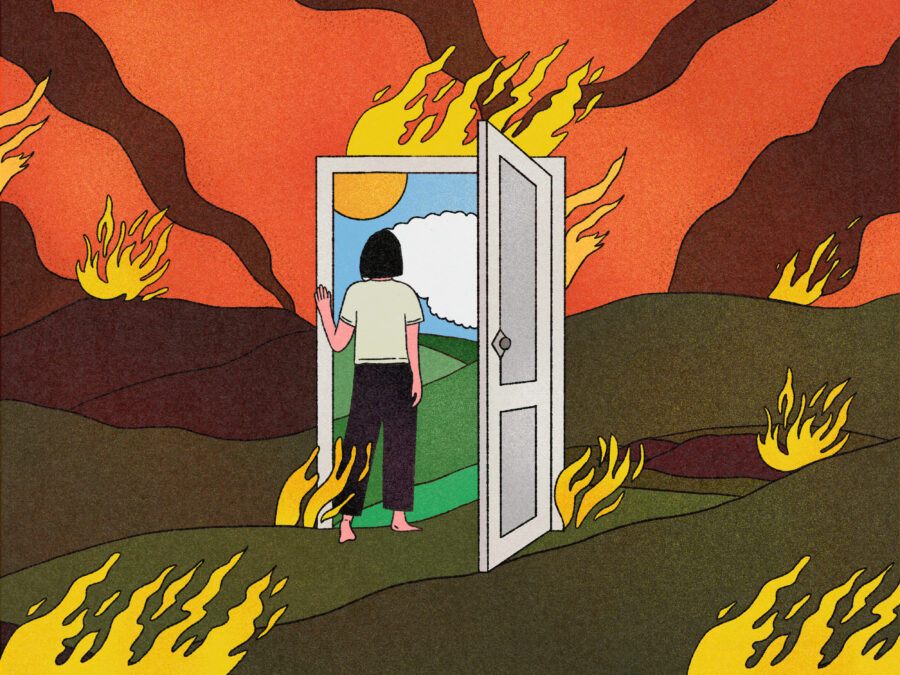
I once imagined healing to feel like a strong but comforting gust of relief, like the feeling of finally exhaling after holding your breath. I imagined letting go of all the trauma my body holds after years of bracing and being in constant fight-or-flight mode. Therapy had, after all, taught me the language of grounding and regulation practices, allowing me to experience fleeting moments—and, on rare occasions, entire afternoons—when my body no longer felt under siege.
So, until it arrived, I didn’t know anger was going to be part of the process too. And this time, it was dressed rather . . . differently.
When the nervous system is busy staying afloat—meeting deadlines, handling relationships, and navigating institutions that feel hostile or unforgiving—rage becomes a liability that eats into the energy we need to survive.
It rose within me without any semblance of urgency or volatility. As it settled into my body with an almost unnerving clarity, I realized it was also astoundingly relieving. I wasn’t reacting to anything in the present—no fresh harm had befallen me, no immediate threat loomed ahead. It was an old, dense kind of fury that could surface only once my nervous system was beginning to unclench.
In somatic psychology, this isn’t unusual. When the body has been organized around survival for long stretches of time, emotions that might interfere with endurance are often suppressed. When the nervous system is busy staying afloat—meeting deadlines, handling relationships, and navigating institutions that feel hostile or unforgiving—rage becomes a liability that eats into the energy we need to survive.
Emotions aren’t necessarily experienced according to when they are earned, but when they are possible, trauma therapists note, explaining how our brains are wired to prioritize what keeps us alive in the moment. The human body’s threat-response systems—specifically the sympathetic nervous system (fight or flight) and the dorsal vagal complex (freeze or shut down)—are designed to ensure immediate survival over higher cognitive functions, including abstract and reflective thinking, since there’s little evolutionary advantage to contemplating emotions during an imminent threat.
Anger disrupts this contract when it insists on naming what others have learned to tolerate and makes visible what everyone else has been trained to survive without question.
Anger especially is rarely met with kindness. And if the angry person is part of a marginalized group, more often than not, anger becomes a diagnosable condition. In women, it is labeled hysteria, bitterness, and emotional instability; in disabled and neurodivergent people, it gets termed as dysregulation, poor coping skills, or a behavioral issue in desperate need of correction. The pathologization serves a purpose, of course. Society demands that we suffer quietly, without making our discomfort visible, because the status quo must never be challenged. Anger disrupts this contract when it insists on naming what others have learned to tolerate and makes visible what everyone else has been trained to survive without question.
So, naturally, it is framed as dangerous, childish, or irrational—anything but truthful. When anger comes from marginalized bodies, it threatens systems that rely on their silence and endurance. The focus must be shifted away from what caused the anger and toward managing the anger itself in the form of medication and mindfulness, resilience workshops, or even mental institutionalization.
Anger, then, is not a failure of healing but a sign of it. It is what emerges when the body finally believes it might survive honesty.
As a result, anger—especially the kind that names injustice or demands change—often has to wait. This is why fury so often arrives after the crisis has passed, when it’s safe enough to feel the anger because the body no longer needs to prioritize survival over truth. It is deferred—not erased—information.
Anger, then, is not a failure of healing but a sign of it. It is what emerges when the body finally believes it might survive honesty. In that sense, wrath is not regression, but delayed clarity.
That is, perhaps, one of the reasons why PTSD (Post-Traumatic Stress Disorder) and Complex-PTSD can manifest long after one experiences a traumatic event. Only when the body senses relative safety does it loosen its grip, allowing buried truths to surface.
I saw this play out in my own body. Years ago, at a time when I was still learning how to inhabit my autism without apology, I stayed with a family member who treated my needs like inconveniences to be endured, my limits like failures of effort, and my disability like something I was doing to them rather than something I was living with. After a few weeks, there was an explosive confrontation. I cried so much I could barely get any words out. Immediately after, my body shut down and I started to function on what felt like autopilot. I was being excessively polite, overly accommodating, and careful not to upset anyone, while I moved through life flattened, compliant, and barely processing what was happening, because survival, in that moment, required docility.
Unlike fear, which asks us to retreat, or grief, which asks us to mourn, wrath asks us to account.
It was only after I left their house—after there was enough distance between us for me to feel emotionally safe—that the anger finally arrived. I started being able to name what had happened and recognize the harm it had caused me. That anger guided me toward establishing and enforcing better boundaries to protect myself. It’s only when I felt angry that I found the courage to decide that they would, henceforth, have limited access to me. The fury did aspire for retribution but remained rooted to the goal of self-preservation above anything else.
Unlike fear, which asks us to retreat, or grief, which asks us to mourn, wrath asks us to account. It demands that we look directly at what happened and stop pretending it was harmless. Anger insists on specificity, names names, and remembers details. For bodies that have survived by enduring—by adapting, appeasing, or dissociating—that level of clarity can feel destabilizing, but destabilizing is not the same as destructive.
I had mistaken calm for the endpoint of my healing journey. What I didn’t know, then, was that an important part of healing is reckoning . . . and that is, usually, brought forth by wrath. To listen to anger is not to act it out or suppress it, but to stay with it long enough to hear what it is pointing toward. When we stop treating anger as an interruption to healing, it often becomes the very thing that makes healing honest.

Devrupa Rakshit is an award-winning independent journalist, social media consultant, new media artist, and disability rights advocate based in India. Her work—which focuses on the intersections of mental health, gender, and social justice, particularly through the lens of disability and neurodivergence—has appeared in several national and international publications. A former lawyer, Devrupa is also a bilingual poet and regularly performs spoken word poetry on anti-establishment themes directed at challenging exclusionary and unsustainable societal norms.


Get the latest news and stories from the Rubin, plus occasional information on how to support our work.