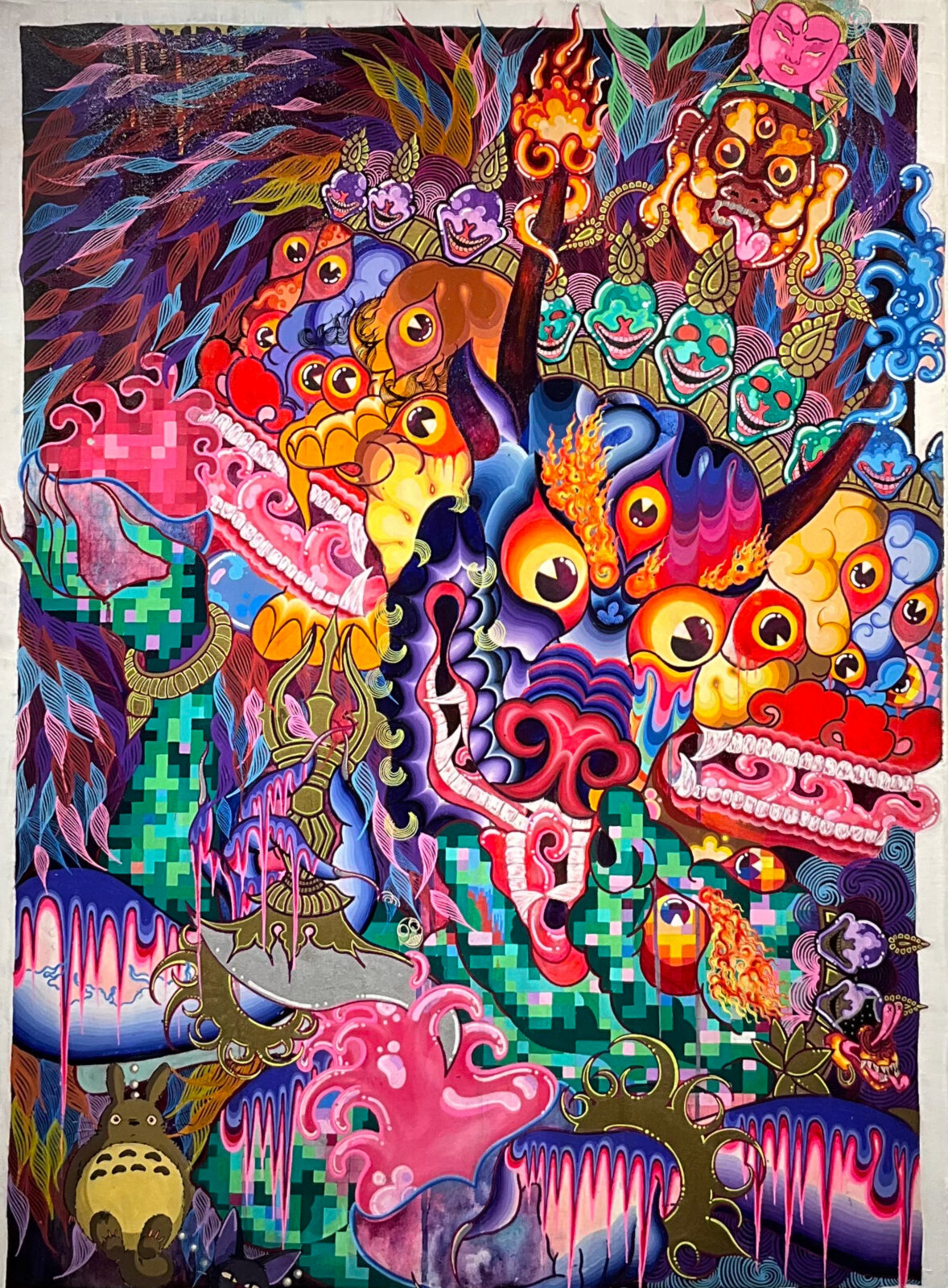
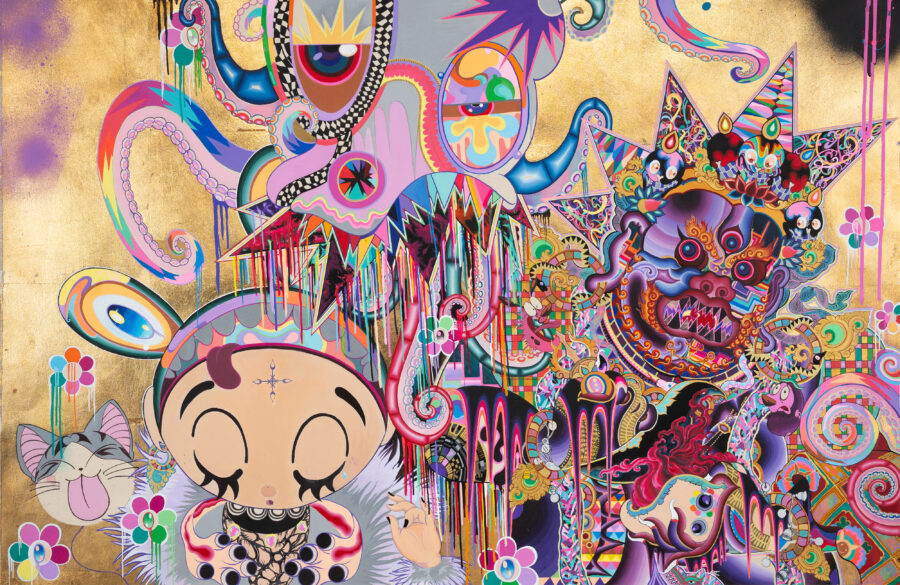
Lujan Rai Dongol; Manifesting Yamantaka; 2024
Lujan Rai Dongol; Manifesting Yamantaka; 2024
Lujan Rai Dongol: I think being human must be the most exhilarating and the most depressing thing to ever exist and be experienced. Many of us felt a lot of emotions growing up and are accustomed to certain emotions through our personal experiences. I grew up in a very uncertain environment where I was a young child who was frequently cast out and rejected. From a young age I felt hints of anxiety, discomfort, and hate. I was exposed to racism and the caste hierarchy that followed.
The constant turmoil that surrounded my environment deeply affected me. My family used to take trips to Lumbini every Dashain, and for me the peace and quiet there truly helped my sanity. I used to sit and look at the murals of every temple that was open. The most sacred and beautiful to me were the depictions of the wrathful deities and protectors that surrounded the monasteries. Even though I could sense the wrath and intimidation on their faces, I couldn’t help but feel seen and noticed. Maybe the way they were portrayed subconsciously reflected the pain, hurt, and anguish I felt inside but couldn’t express—it always had me feeling emotional. I saw them as celestial beings who were frightened and agitated to see me experience a truckload of pain and heavy emotions at such a pivotal age.
For me that relatability was the first and truest form of compassion. Today I actually see that in my heart and in my art.
I want my art to evoke whimsy, joy, irony, and a state of contemplation—vibrant energy and vibes. I also love the part where people question things. As an artist I feel the need to put out clues and messages and let the people be art detectives.
Through my artworks I want people to give themselves the chance to have freedom, whether in their personal lives or creativity. I portray my style as a manifestation of freedom itself, and it’s also about the fact that many traditional forms of art are slowly fading away. I think my art is a reminder to keep things sustainable and alive.
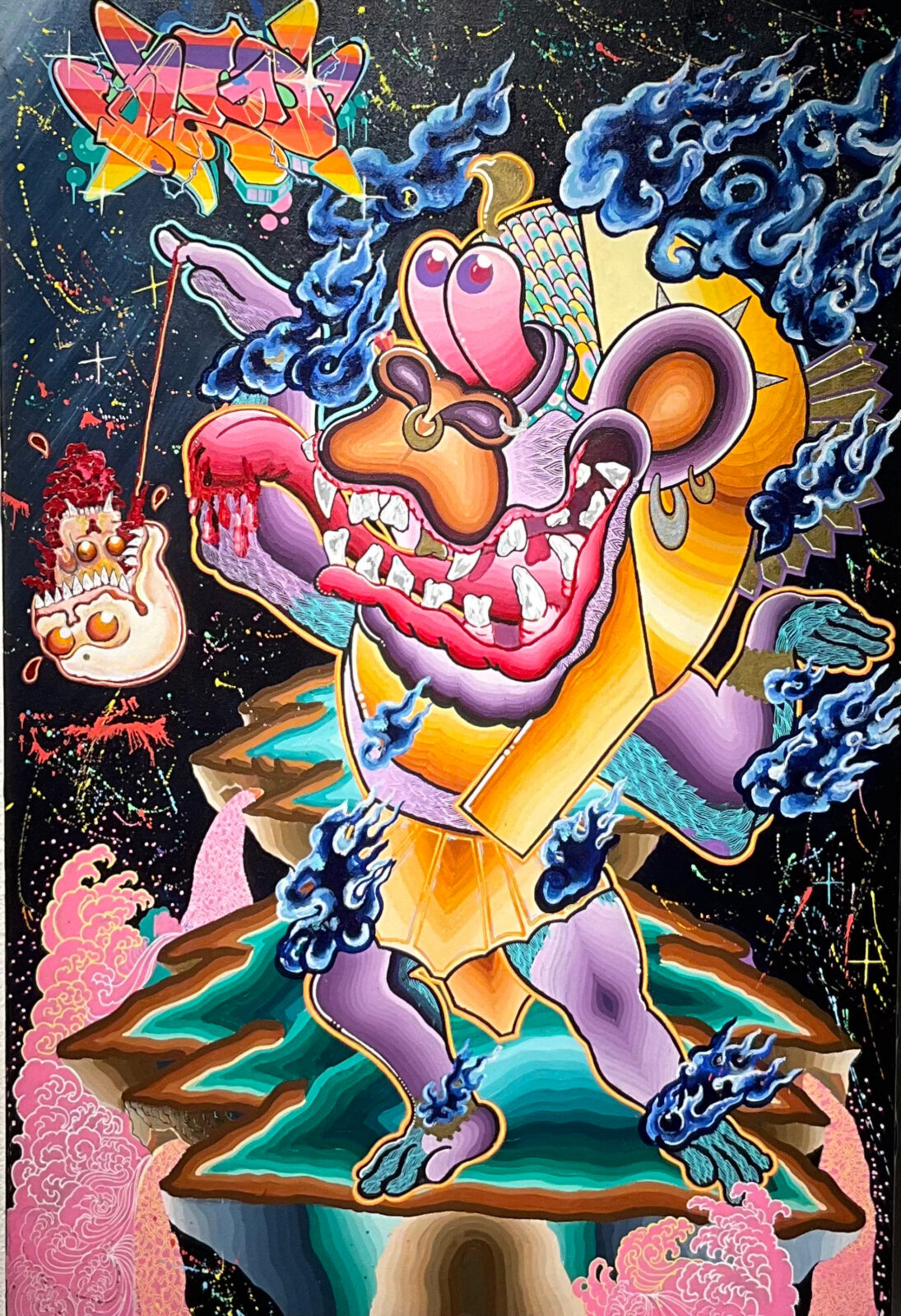
Lujan Rai Dongol; Souvenirs from Time to Time; 2024; Collection of Mr. Paul Pande
In a global sense my art reflects the experience of being a human and the innate need to know what happens beyond life. It also reflects the anxiety we all face in some way or another. Diving deeper, it talks about the dynamics of society and its nature. Lastly, it always reminds us to be free and be true to oneself.
Some artworks are based on my encounters with the deities in my dreams. For example, I dreamed of visiting a shrine of a smiling Vajrapani and the scene of Magzor Gyalmo riding on her mule in the evening sky on the mountain lines. Whenever I create, I always leave things to my subconscious and my primal instincts and taste. I hate to work with a distinct plan—it usually never works out!
My process has always involved a love-hate relationship with my artwork—it’s a constant back and forth between unconditional love and flattery to the gut-wrenching experience of self-criticism. I love working with uncertainty. I don’t know what’s coming next, be it the color, the form, or subconscious instructions on how the deities want to be manifested.
Honestly, creative blocks suck! I often find myself delaying or procrastinating, or maybe I’m lazy sometimes. My go-to methods include going to the monastery (Tharlam) and visiting the Rinpoche (H.E. Dezhung) and hanging out with the cool monks, as well as hanging out with my girlfriend and having a light-hearted conversation that eventually sparks into an intellectual dissection of everything that’s going on in the world. I also believe in having heart-to-heart conversations with my mentors.
I love sleeping until late in the afternoon and playing fetch with my dogs and ending with some boxing. I also love checking out books, but only ones with pictures—I find reading very boring. Some days I drink coffee as the sun goes down, when the birds are in a rush to get back to their nests.
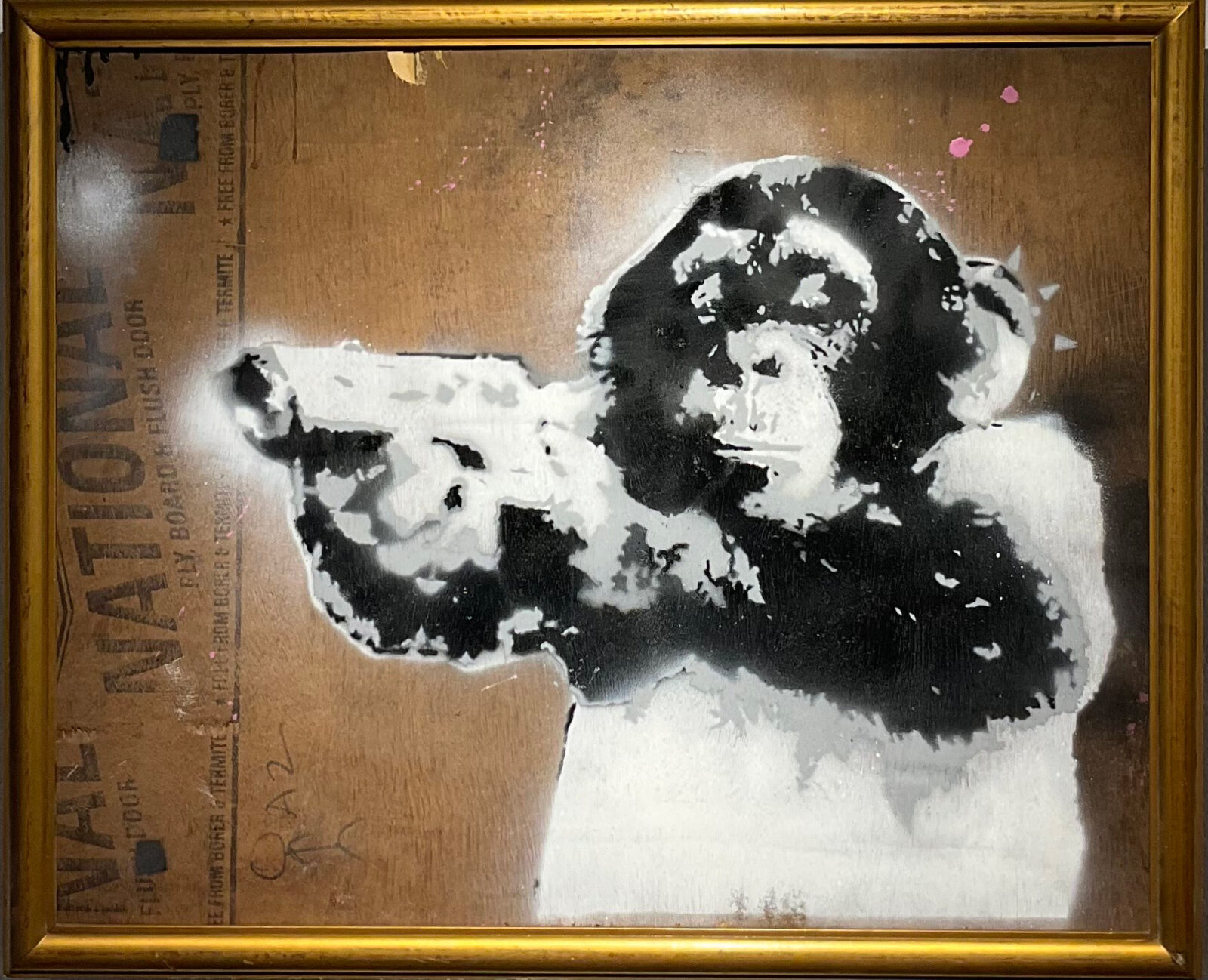
Lujan Rai Dongol; Mero Palo (My Turn); 2024
I think the very first artwork I created was a watercolor painting of Squirtle and Jigglypuff. When I was in first grade I had an obsession with Pokémons.
Before, my art was scrambled—it hinted at something that was in a state of constant incubation, where everything from everywhere was all constantly chatting with everyone. I genuinely enjoyed that, like a child hoarding everything that is cool and shiny all at once. I still love that process and the resonance it has to this day.
My favorite artists include Francis Bacon, Jean-Michel Basquiat, Kurt Cobain, Keith Haring, Takashi Murakami, Andy Warhol, and George Condo.
My art tries its best to reframe and challenge the notion of wrathful deities as being negative. The reason why people tend to stay away is because scary things or wrathful beings are dismissed completely without knowledge of what they actually are trying to convey.
But at the end of the day, they’re just the opposite side of the coin. For example, wrathful beings are here to guide and help us stay on the path to enlightenment. It’s similar to a parent who warns us with a strict tone—not with an intent to hurt us but to signal a warning of the consequences. It comes from a sense of love and compassion.
Whenever I create a piece featuring wrathful deities I always portray them vibrantly with whimsy and funk, because why not? I think my art bridges the two sides of the coin. People have been programmed to see the black and white—my contribution is to show the grey and the mid-section of these philosophies. I try to visually guide people to know the fun, nurturing, and responsible side of our parents, guardians, and protectors. There’s always the good and the bad, but most of the time we forget the middle. So I try to evoke the sense of deeper understanding and compassion that eventually leads to the dissolution of ego and judgment.
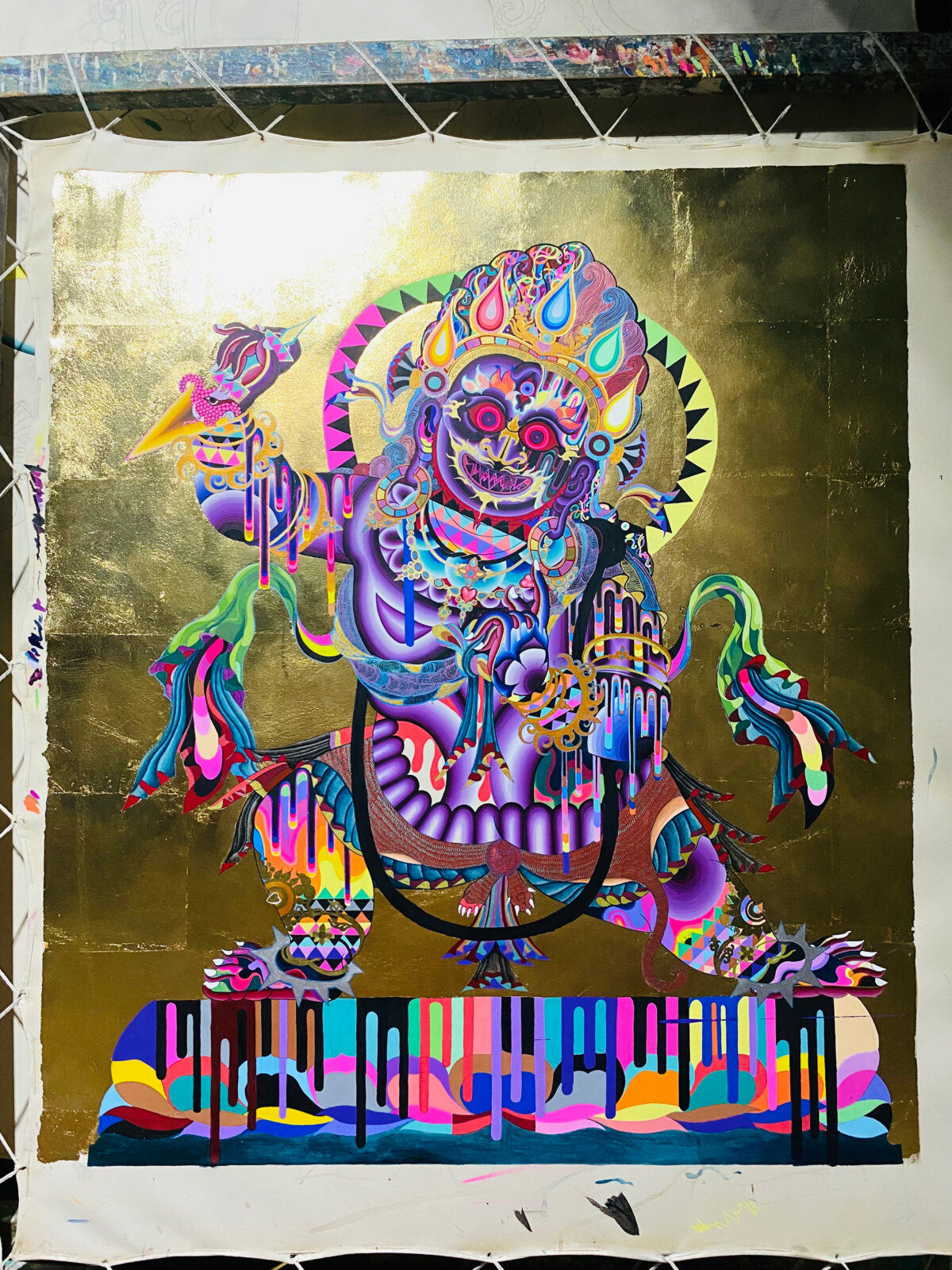
Lujan Rai Dongol, Manifesting Vajrapani; 2025; Collection of Mr. Abhinav Rana
The very basic thing is how even the smallest iconography or symbol carries so much information philosophically, visually, and spiritually. Not only does it provoke the inner curiosity but it also provides the mind with a unique aesthetic of the inner psyche depending on how the individual perceives it.
I’m just not interested in staring at a phone. I think social media is nice if used the right way. But these days there’s so much information, and I find that very overwhelming and overstimulating. Due to the overconsumption of information, I think individuality has become very rare. So I choose not to be online.
Music is such an integral part of my process. Before I started as an artist I was pursuing music, and I think that helped me open up more. When I was making music I only focused on portraying how I felt honestly and brutally. I didn’t care about anyone’s opinion. I’ve always had a problem talking about my emotions, but when I was making music, I just let everything out. Music helped me in being honest with myself and my art as well.
Listening to music while I work is the best feeling—I never know what song is going to come next, and the constant fluctuations of beats, rhythm, and emotions helps in bringing out the best in me.
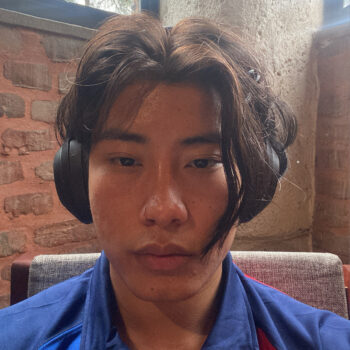
Lujan Rai Dongol is a transdisciplinary artist based in Nepal who weaves Himalayan iconography with contemporary sensibilities. Rooted in thangka philosophy yet unbound by tradition, his practice transforms the sacred into living, evolving forms. Through bold color, intuitive symbolism, and transcultural echoes, he merges the divine with the everyday. Each work is a meditation on identity, impermanence, and collective memory, where ancient deities find new voices and the past and present converge in vibrant, contemplative dialogue.

Christina Watson is the digital editor at the Rubin Museum of Himalayan Art.
Get the latest news and stories from the Rubin, plus occasional information on how to support our work.