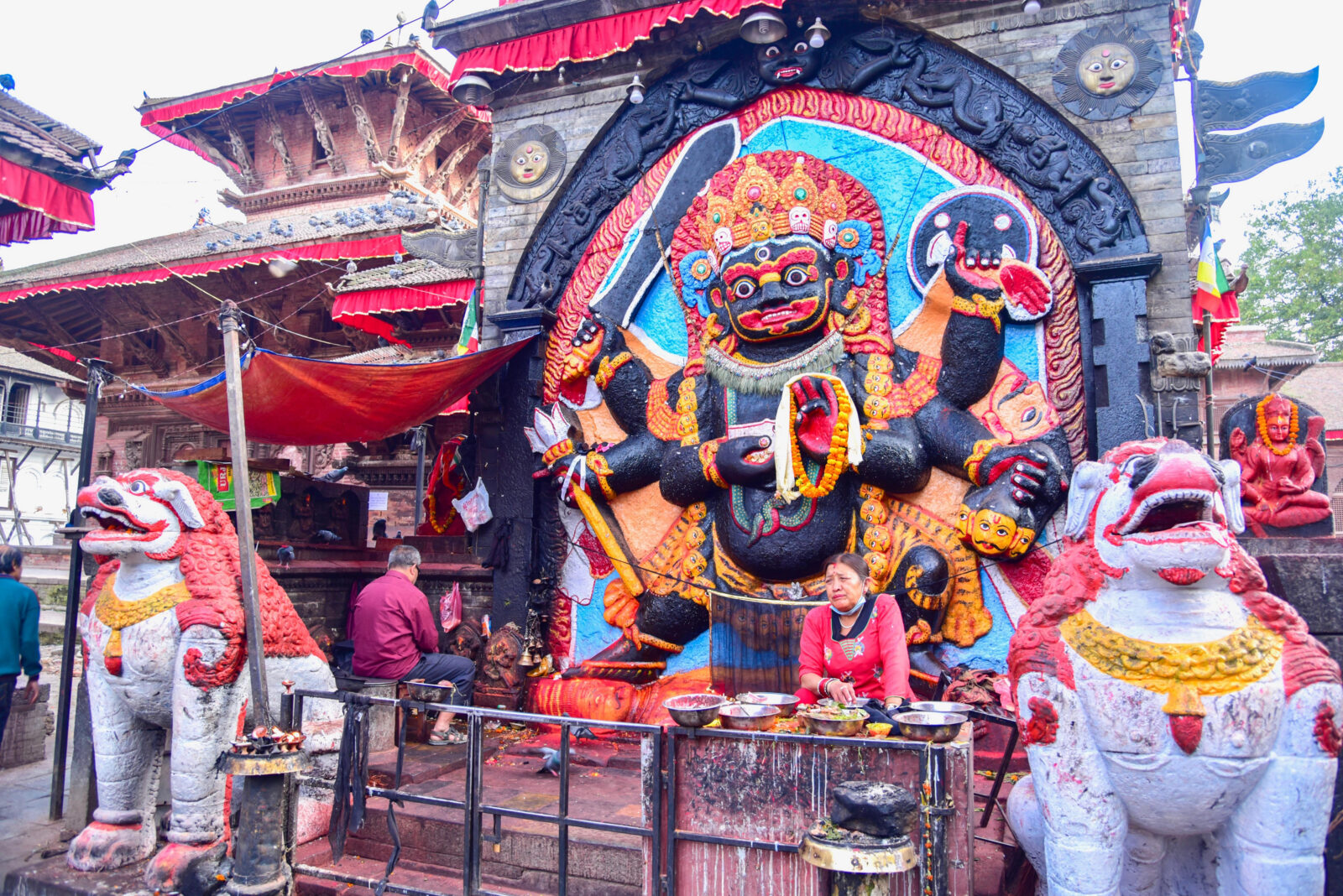
Kaal Bhairava statue in Durbar Square, Kathmandu, Nepal; photo via Alamy
Kaal Bhairava statue in Durbar Square, Kathmandu, Nepal; photo via Alamy
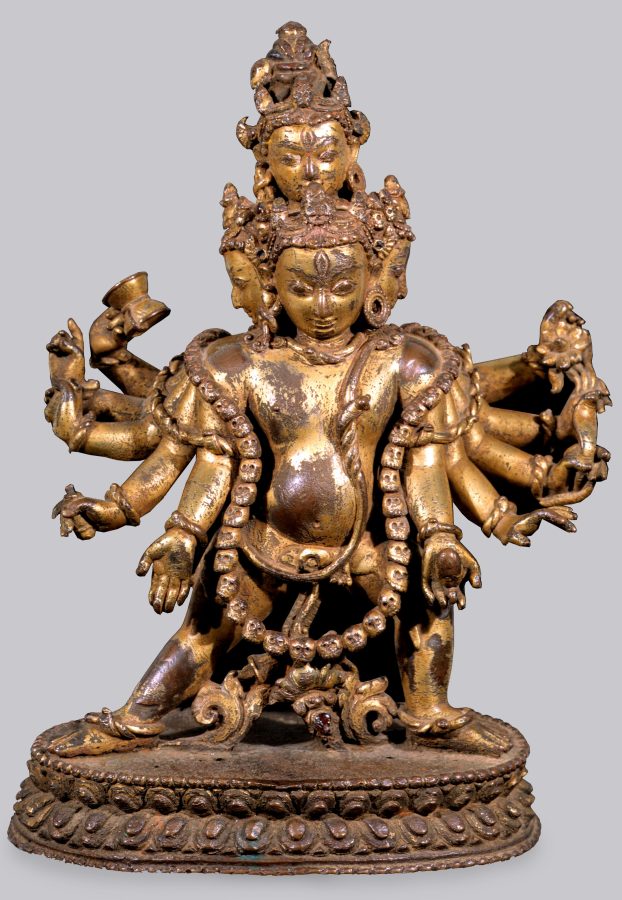
An imposing statue stands in old Kathmandu’s ancient palace square. Carved out of a single block of black stone, this statue of Kaal Bhairava was discovered in a paddy field in the 17th century, but it’s believed to date back to the 5th century BC. About 12 feet tall, Kathmandu’s Kaal Bhairava statue is considered the tallest in the world. He has a fierce expression, wears a crown of skulls, and his six arms hold various weapons. This intimidating portrayal befits his image as the dandapani, the one who holds the danda, or rod, in his hand to punish sinners. Hindus and Buddhists across Asia worship the deity Bhairava’s various forms. And since the Kaal Bhairava statue’s installation in the Kathmandu palace square almost 400 years ago, he has been serving as the city’s guardian deity, our protector.
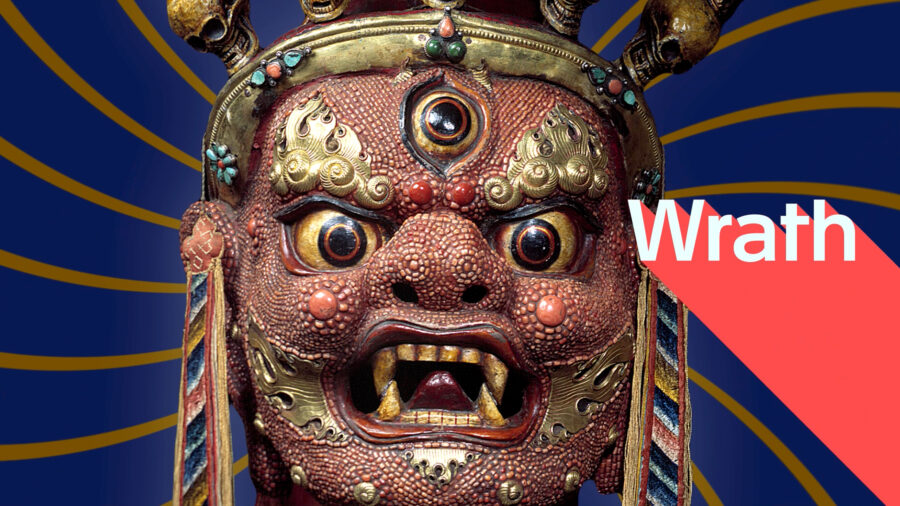
Bhairava appears angry and evokes fear. Bhairava originates from bhiru, which means “fearsome.” One Sunday, as I walked across the palace square, a UNESCO World Heritage Site, I thought of this relationship between fear and anger. It’s a theme I explored in my memoir, in which I wrote about being an angry gay man, afraid to return to Nepal after living in New York.
When I did return, I lived by myself in Lalitpur, and my mother often nudged me to visit the nearby shrine of Batuk Bhairava, the youthful form of Kaal Bhairava. Batuk is also considered a protector. He might even grant further security from the evil eye or “negative energies.”
I dismissed my mother’s advice. In those days, I was learning and writing about the Nepal government’s unjust treatment of different ethnic groups, and I was teaching gender sensitization lessons in high schools. A dozen years have passed since then. I now live with my parents, participate in various festivals, and appreciate the multiethnic rituals and jatras that contribute to Nepal’s dynamic cultural traditions. I’ve also been following several global movements and local sociopolitical issues. As #MeToo unraveled and #BLM exploded—worthy movements fueled by justifiable anger—I’ve wondered, “What is my battle? And what is theirs?”
Kaal Bhairava might have six arms, and some of us might need six different lenses to perceive and process the world around us.
I’ve been studying anticolonial discourses and minding anti-caste movements. Amid all this, after being diagnosed as neurodivergent last year, I’m trying to understand what it means to me to hold this identity in addition to being queer. Kaal Bhairava might have six arms, and some of us might need six different lenses to perceive and process the world around us. Or, maybe we are all like Russian nesting dolls: our truest, innermost self is covered by layers of social conditioning. An authoritarian environment in my childhood home and at boarding school conditioned me to be fearful. It took growing up to realize that it was actually anger masking itself as fear. I am on my own journey, I have my own battles; notwithstanding the fact that in Nepal, I qualify as a privileged man, one with foreign education.
I have also been thoroughly conditioned by a “Western education.” I grew up reading and writing in English, dreaming of Western cities where there was law and order, art and literature. As soon as I could, I escaped my hometown, thinking I would never return. A society gripped by “traditional practices and thinking” would never accept homosexuality! Yet, a few years after my escape, Nepal became the first Asian country to legalize same-sex acts. A group of individuals representing various NGOs filed the petition, presenting “a dissenting view with the prevalent societal structures or norms.” They pointed out that ancient, indigenous, and pre-religious Eastern Tantric societies accepted the notion of more than two genders. Even modern iterations of Hinduism depict male gods wearing colorful, flamboyant, and “feminine” outfits!
Many South Asians—especially those suffering from historic marginalization by the state or dominant society—are rightfully wary of religious practices. Hinduism is plagued by the caste hierarchy and concept of untouchability. And when political groups use organized religion to get votes —the BJP rule in India being a prime example—any association with any kind of traditional, religious, and spiritual practices is considered suspect, if not roundly rejected and ridiculed. But I caution folks against such knee-jerk reactions. “There are millions of Hinduisms,” says renowned Indologist Wendy Doniger speaking on the Himal Southasian podcast. “It’s wonderfully independent and rich—anyone can make it their own.”
In the last few years, I’ve been trying to listen to new voices and new ideas, an attempt to decondition myself. That’s one reason why I began visiting Batuk Bhairava. When the world partially opened up again after the first COVID-19 lockdown, I drove my mother to his temple. During that scary, uncertain time, it seemed like a perfectly good idea to pray for protection from the virus. It also provided a much-needed break from days spent at home. Why not go again? I thought. I began driving to the temple every Sunday afternoon. The ritual I’d been resisting turned into a habit. I began organizing my week around it.
Keeping the image of Bhairava alive in one’s consciousness is tantamount to acknowledging the presence of fear. In other words, it involves surrendering to the notion that there are forces greater than what one human mind might grasp.
This notion of changing one’s habits came up in a conversation between Ariana Reines, Michael Clune, and Jordan Castro at the 2025 METANOIA conference organized by the Cluny Institute. “Transformation is all about what the poet Keats called negative capability, which is the capacity to be open to just seeing something new,” says Clune. Later, he invokes Proust who said that “one of the basic causes of suffering is habit, which is neurobiological. Our sensorium is designed to economize perception. It takes a lot of energy to really see something.”
Art is one way to navigate this problem, the three Cluny speakers agree. Because art allows you to see the world through someone else’s eyes—and the encounter always happens in a matrix of subjectivity—the otherness and the newness enlarge the soul. Reines says this type of encounter “causes me to have empathy with aspects of my own experience that I might not have had a road into.” Doniger, who has spent more than five decades researching and writing about South Asian cultures and traditions, suggests applying this concept not just to art appreciation but to different religious rituals that involve creative thinking connected to mythical narratives: “Stories might tell you something that might matter to you . . . and rituals provide a getaway to understand an aspect of a myth.”
The Kaal Bhairava statue is also an example of ancient artistry. The sculpture is awesome, much like many depictions of Bhairava in paintings and drawings. After visiting the deity that Sunday, I went to Nepal Art Council to check out the Himalayan Art Festival. Sakchhyam Shrestha had constructed a small replica of the same Kaal Bhairava statue using plaster of Paris.
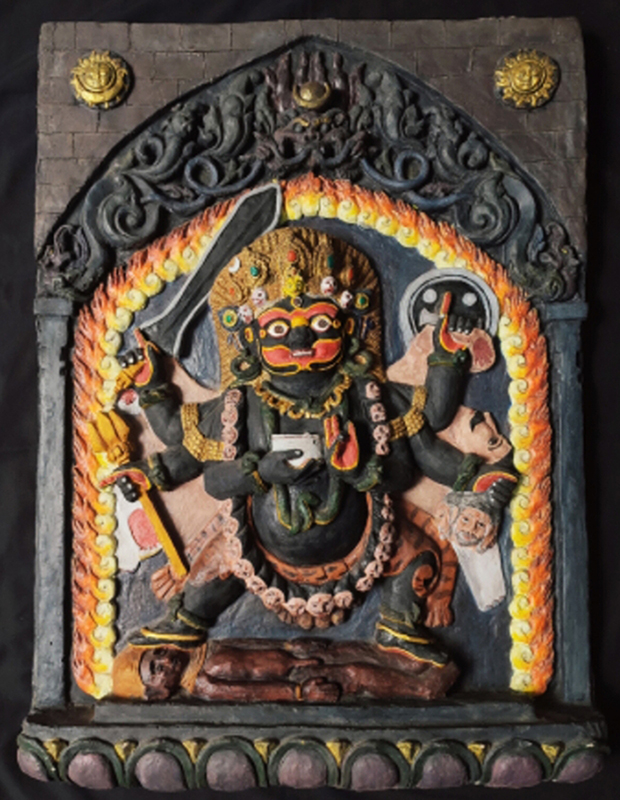
Sakchhyam Shrestha’s Kaal Bhairava statue at the Himalayan Art Festival at Nepal Art Council, 2025
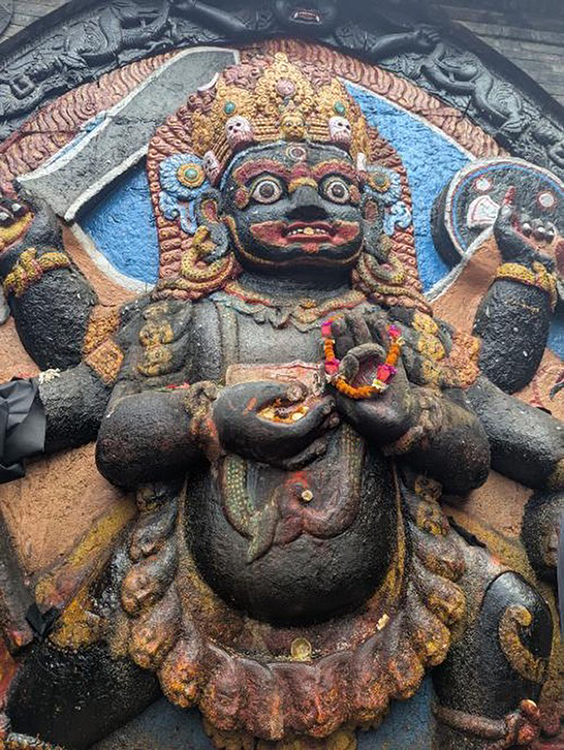
Kaal Bhairava statue in Durbar Square, Kathmandu, Nepal; photo via Alamy
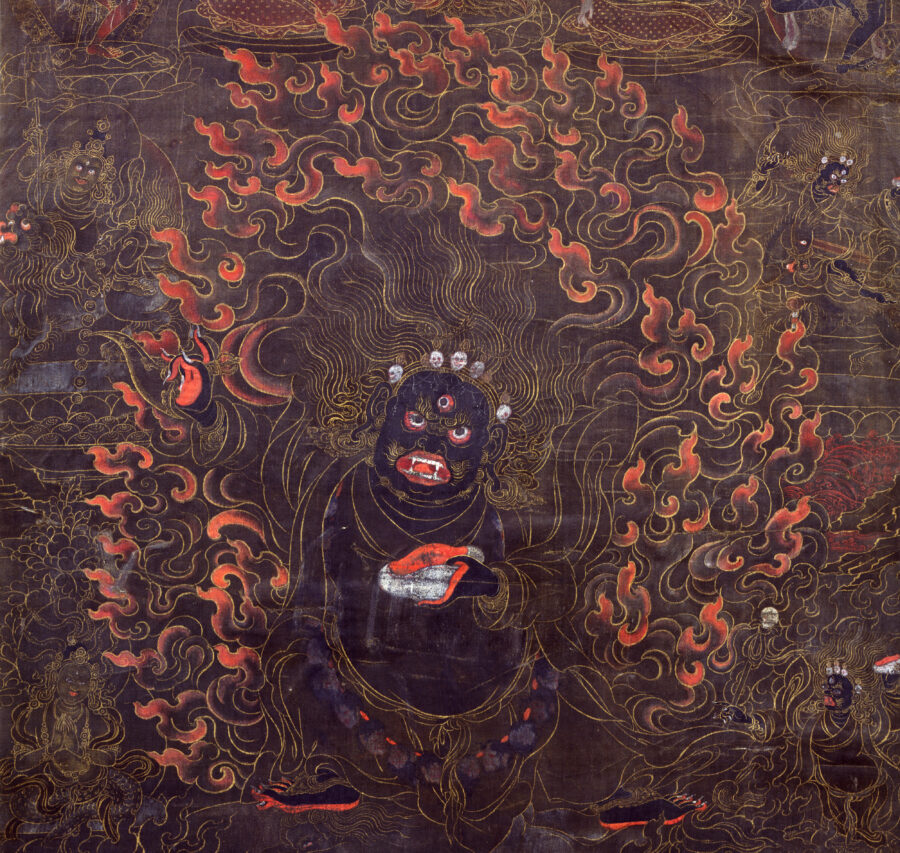
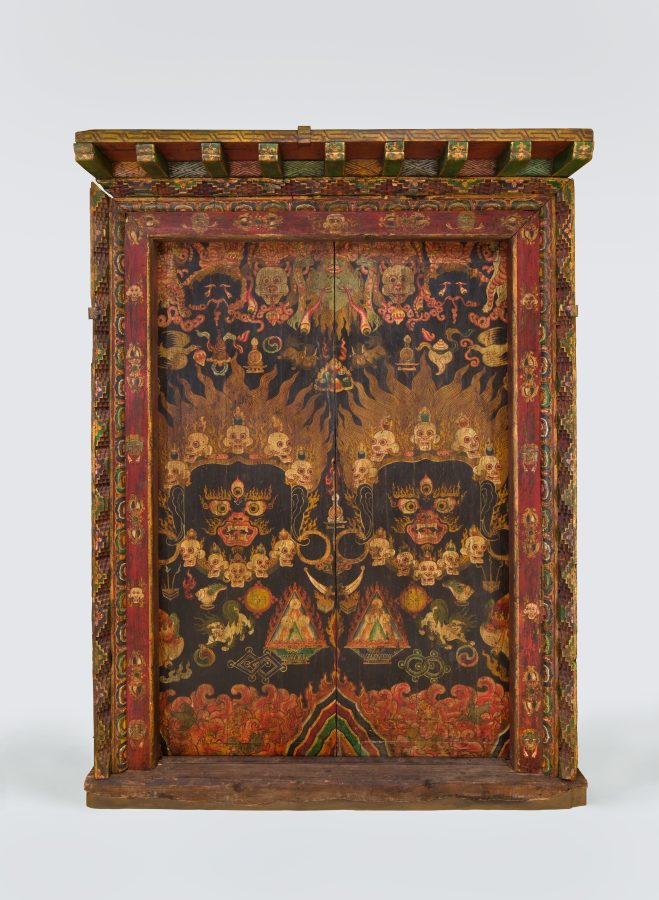
There were other depictions of Bhairava in the exhibition, a reminder that the archetype remains very dynamic and captivating among people in Nepal. Keeping the image of Bhairava alive in one’s consciousness is tantamount to acknowledging the presence of fear. In other words, it involves surrendering to the notion that there are forces greater than what one human mind might grasp. This kind of attitude keeps one humble, also hopeful.
And so, I’ve been going whenever I can, on Sundays, to visit Batuk Bhairava. The shrine is made of three rocks that have reddened over time. Atop each rock are metallic images of the deity, surrounded by a mixture of flowers, colorful powders, and an assortment of grains. Bells ring. Diyas are lit. Amid the sounds and flickering light, amid smoky colors, I present a piece of black cloth, a banana, and more flowers, powders, and grains that I’ve been carrying in a small bowl woven out of dry leaves and twigs. While doing so, I ask Bhairava to protect me.
When we don’t have access to real facts, we rely on memories to construct personal myths. We create stories and rewrite narratives.
What am I doing? I’m simply reminding myself to be mindful, to practice emotional regulation. What about this anger? Maybe I was conditioned by my angry father; maybe it’s a natural response to a patriarchal, heteronormative world. Maybe the intense emotional surges are related to my neurodiversity. When we don’t have access to real facts, we rely on memories to construct personal myths. We create stories and rewrite narratives. This issue becomes dire for many of us in the global south who were either colonized or conditioned by Western culture. We grew up reading other people’s stories, watching other people’s movies, becoming disconnected from our own myths and legends.
When I drive towards Batuk Bhairava on Sunday afternoons, I am clear-headed and committed, even though I don’t understand everything and I don’t need to explain anything. I remember Doniger remarking that it’s not important to define myth but rather “to examine it in action.” And I can share something that I feel in my bones: I’ve noticed my anger dissipating over the years. I feel less anxious, more focused, and more joyful. As Doniger says, “The binary categories of true and false are inadequate for myths.” When we participate in ancient, traditional rituals, we might encounter truth, which “comes at a different angle and a different light.”
Niranjan Kunwar is an educationist whose career includes teaching in primary schools and mentoring teachers in Nepal. His memoir, Between Queens and the Cities, was published by FinePrint in 2020. The chapter book Mijok’s Trip was published by van Doesburg Creative Works in 2025, and his English translation of Seto Dharti, titled A White Life, was launched by FinePrint in 2025.
Get the latest news and stories from the Rubin, plus occasional information on how to support our work.