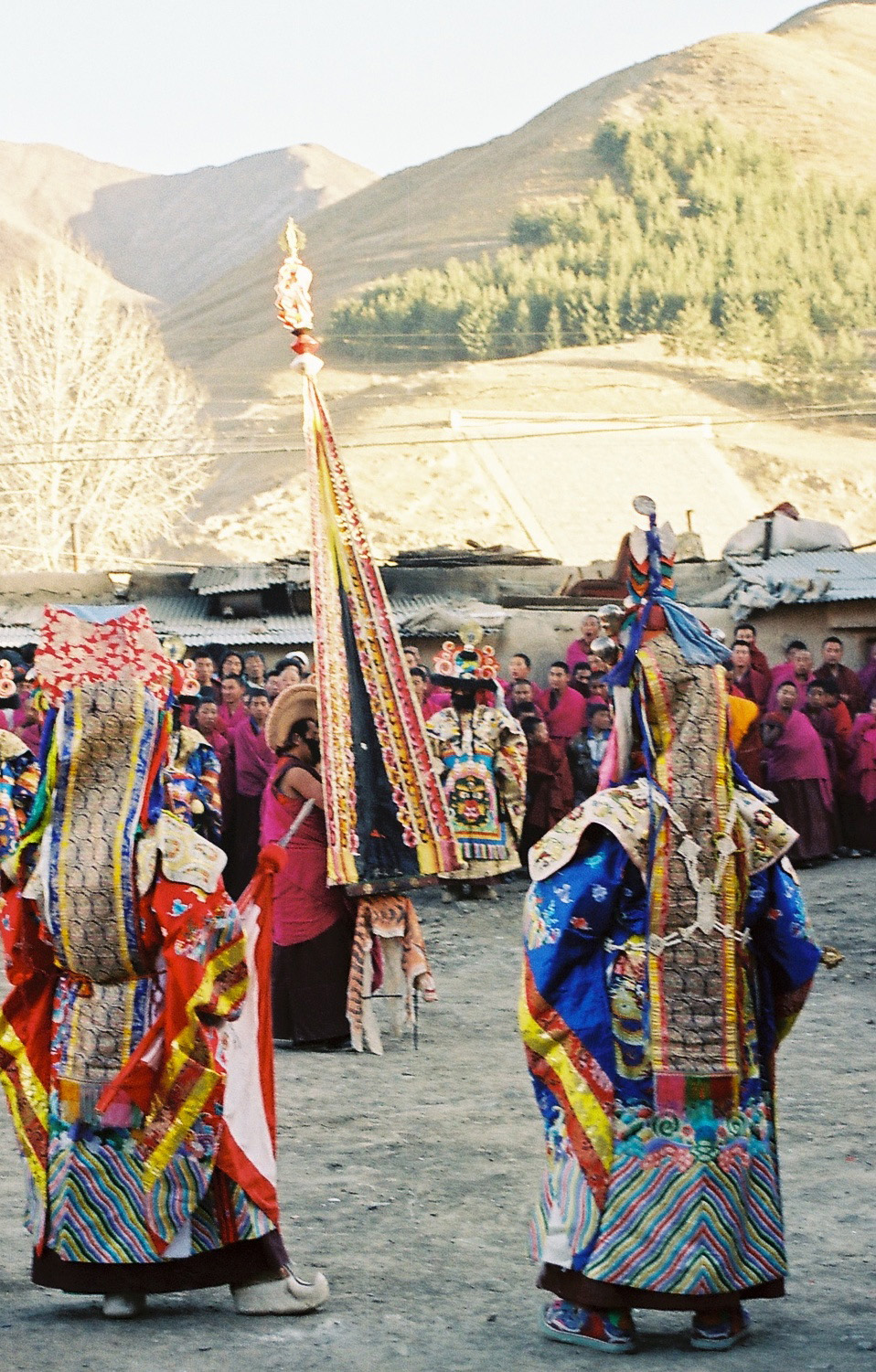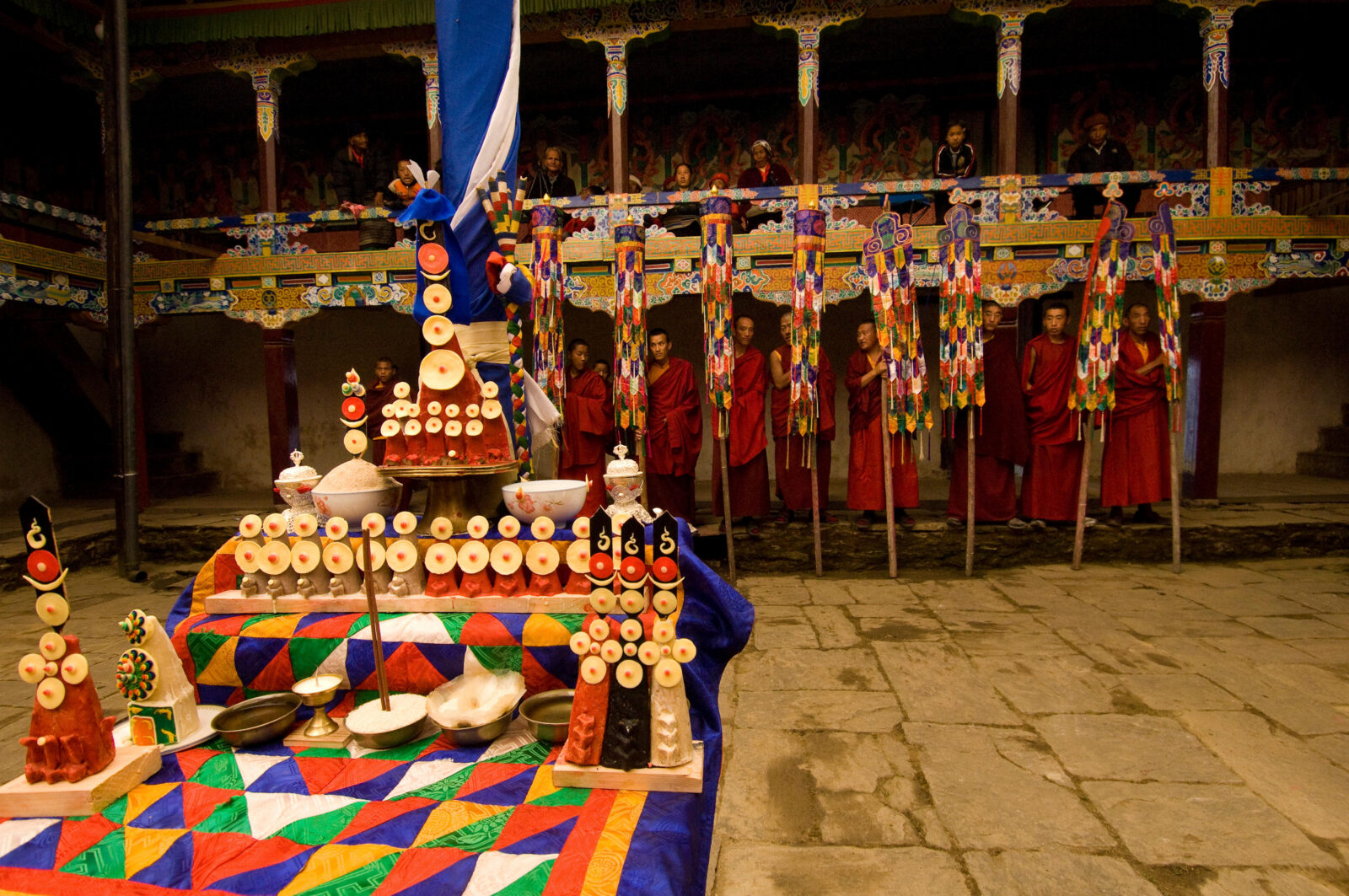
Monks in Nepal consecrate an altar with assorted tormas during the Mani Rimdu festival commemorating the transmission of Buddhism from India to Tibet. Photograph by BOISVIEUX Christophe / hemis.fr via Alamy
Monks in Nepal consecrate an altar with assorted tormas during the Mani Rimdu festival commemorating the transmission of Buddhism from India to Tibet. Photograph by BOISVIEUX Christophe / hemis.fr via Alamy
These ritual objects made of dough are offerings, forms of protection, receptacles for the divine, and more
Anyone who visits a Tibetan Buddhist temple or attends a Tibetan Buddhist worship ceremony will likely notice brightly colored and elaborately adorned dough sculptures known as tormas. Some sit high on the altar near icons of buddhas and enlightened deities, and some rest on offering tables alongside flowers, incense, and lamps. At the end of the ceremony, some tormas are placed outside for wildlife and microorganisms to consume.
To unfamiliar eyes, these objects can be perplexing. Are they food? Sculpture? Receptacles for divine beings? The answer—characteristically, for Tantric Buddhism—is all of the above. Rather than a single ritual object, torma refers to an entire family of edible ritual objects. They mediate devotional exchanges, negotiate with invisible beings, anchor divine presence, and even transmit empowerment. Their diversity reveals how Tibetan Buddhism engages physical matter and beauty as a media through which ethical, social, and cosmological relationships are continually renewed.
The various tormas may fundamentally look similar, but they are more than a singular type of religious object and serve different purposes. Tormas comprise an entire ritual language of exchange, one rooted in Buddhist principles like generosity, kindness, and reciprocity. In other words, tormas help Tibetan Buddhists negotiate their relationship with the world around them, including the seen and unseen forces that inhabit it.
At the most basic level, tormas are food. The word torma is a Tibetan translation of the Sanskrit word bali, which refers to a sacrificial food offering. This culinary connotation is perhaps most directly reflected in the type of torma known as a zhelze—a highly honorific word simply meaning “food.”
Traditionally, Tibetan Buddhist altars have seven bowls and a lamp to represent the seven offerings that a host would provide for an esteemed guest during the Buddha’s lifetime in ancient India: water to drink (Sanskrit: argha), water to wash feet (padya), flowers (pushpa), incense (dhupa), a candle (aloka), scented oils (gandha), food (naividya), and pleasant sounds (shabda). The zhelze torma often resides in the second-to-last bowl, symbolizing the naividya, or food offering.
These food-offering tormas can be peaceful or wrathful in appearance, depending on the Buddha or deity to whom they are dedicated. Peaceful zhelze are typically white and conical in shape, with two circular floral ornaments, or gyen, attached to the front. Wrathful tormas tend to be red and angular in shape, often triangular and adorned with flames.
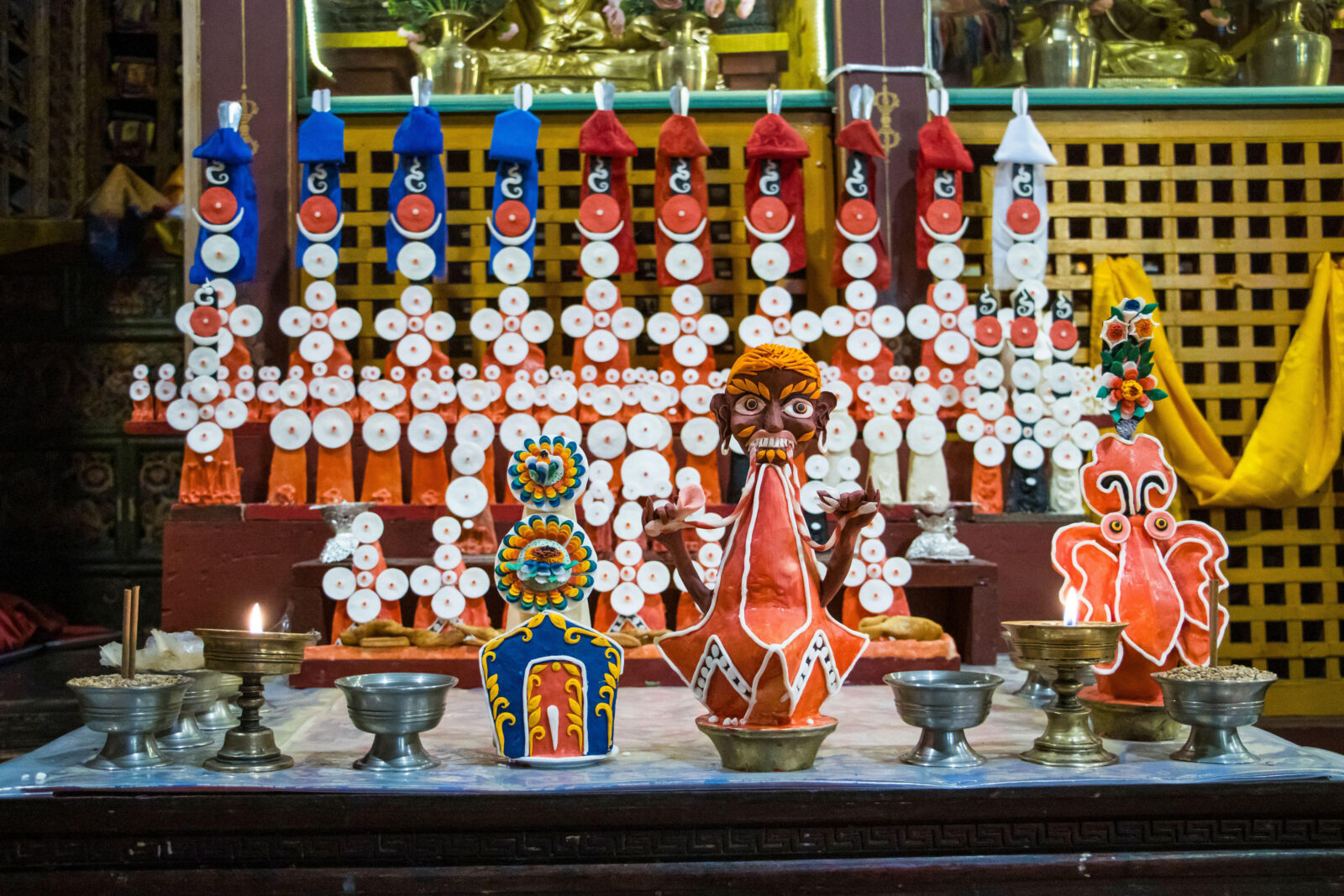
A collection of tormas on a shrine, with peaceful and wrathful zhelze tormas in the center foreground. Photograph via Alamy
In both cases, the act of offering food cultivates generosity while affirming an important Tantric Buddhist principle: ordinary substances, when consecrated through mantra and visualization, can become vehicles of sacred exchange.
The recipients of the zhelze are typically buddhas or other enlightened entities, like meditational deities—collectively known as “upper guests.” Other types of tormas, like the kartor and gektor, are reserved for “lower guests”—unenlightened beings, especially unseen ones like deities of the local landscape as well as obstructing forces and mischievous spirits.
For example, at the beginning of all major Tibetan Buddhist worship rituals, the lama or officiant will offer a white torma (kartor) to local deities and protectors to request their support and permission to conduct the practice on their land. In order to establish a pure perimeter encircling the ritual space, the lama will next offer an obstacle torma (gektor) to ask that interfering spirits and negative beings temporarily depart from the area. Once offered, these tormas are typically carried outside the ritual space and discarded, where they may be eaten by animals or left to decompose.
Another spectacular example is the weapon torma (zortor), which is ritually burned to clear obstacles, especially around the beginning of Losar, the new year. Throughout the ritual, practitioners “feed” the zortor with all their obstacles and mistakes from the previous year. Then, at the climactic conclusion of the ceremony, the zortor is incinerated in a massive bonfire, clearing past troubles and welcoming the new year with a clean karmic slate.
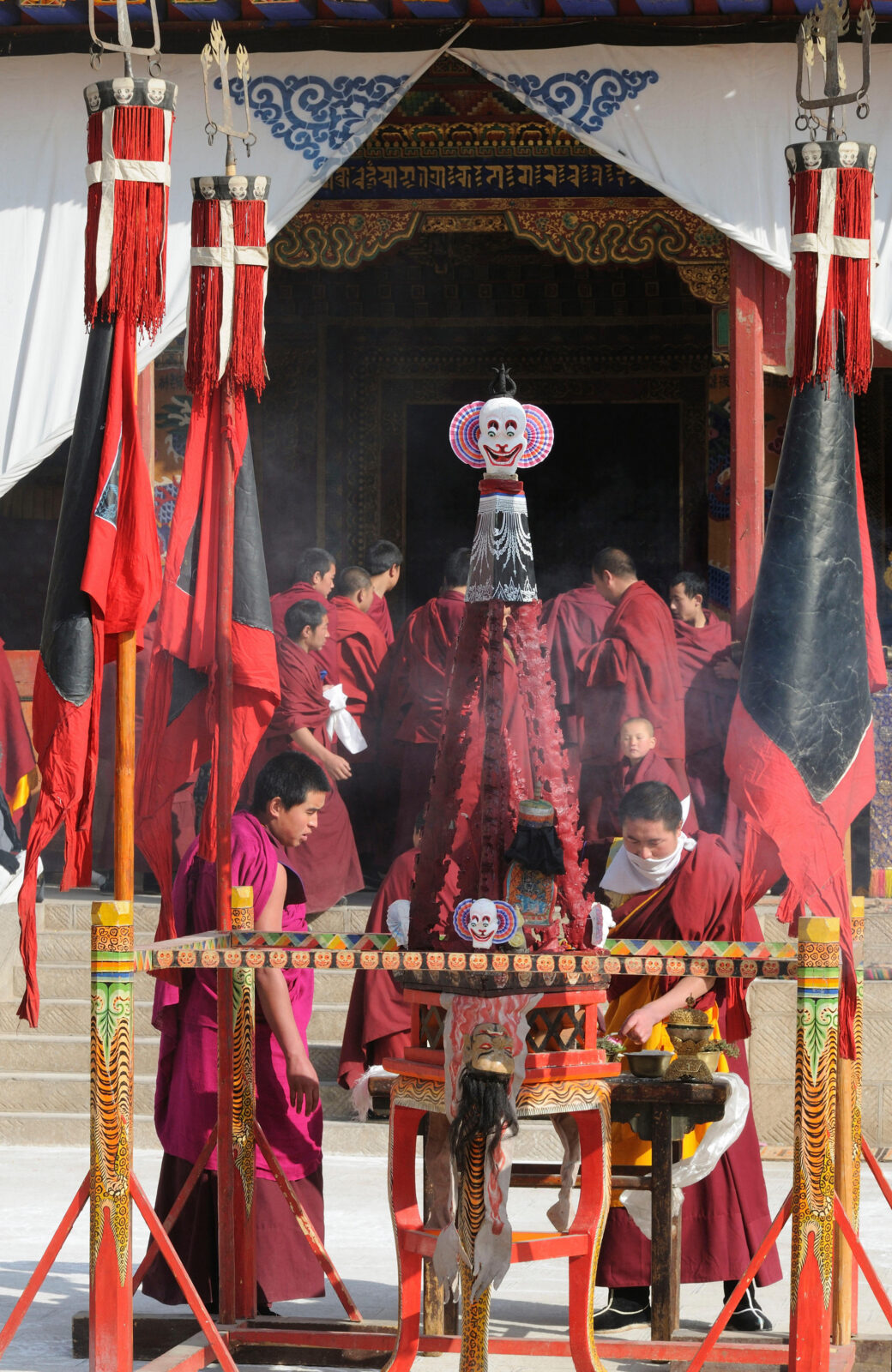
Monks “feed” a colossal zortor with all the obstacles and troubles from the previous year. It will later be incinerated in a climactic bonfire. Photograph by CHARTON Franck / hemis.fr via Alamy
According to Tibetan Buddhist cosmology, a class of guardian beings known as protectors of the teachings (chokyong) occupy the liminal space between the upper and lower guests. Some protectors are regarded as emanations of fully enlightened wisdom deities, while others are said to be worldly deities or demigods who were converted by some past buddha or Buddhist master and asked to swear an oath to protect Buddhism in future generations.
Tibetan Buddhist worship rituals tend to devote elaborate offerings to the protectors, who are typically fierce beings tasked with carrying out the enlightened activity of buddhas and their disciples. Various classes of tormas are used to invoke such reciprocal relationships between practitioners and powerful guardians deities, including red torma (martor), torma for the oathbound ones (damchen chitor), and contract torma (chetho).
The notions of vows and oaths are central to Tibetan Buddhist interactions with the protector deities. Such rituals often include the confession of faults, repair of broken tantric vows (samaya), and reaffirmation of vows. In this way, the offering of the torma symbolizes the practitioner’s effort to restore balance, after which the protector is exhorted to fulfill their side of the oath—removing obstacles, pacifying illness and conflict, enriching circumstances, and magnetizing auspicious conditions. Here, the torma becomes a contractual medium, materially enacting ethical accountability. Protection is not assumed; it is ritually renewed.
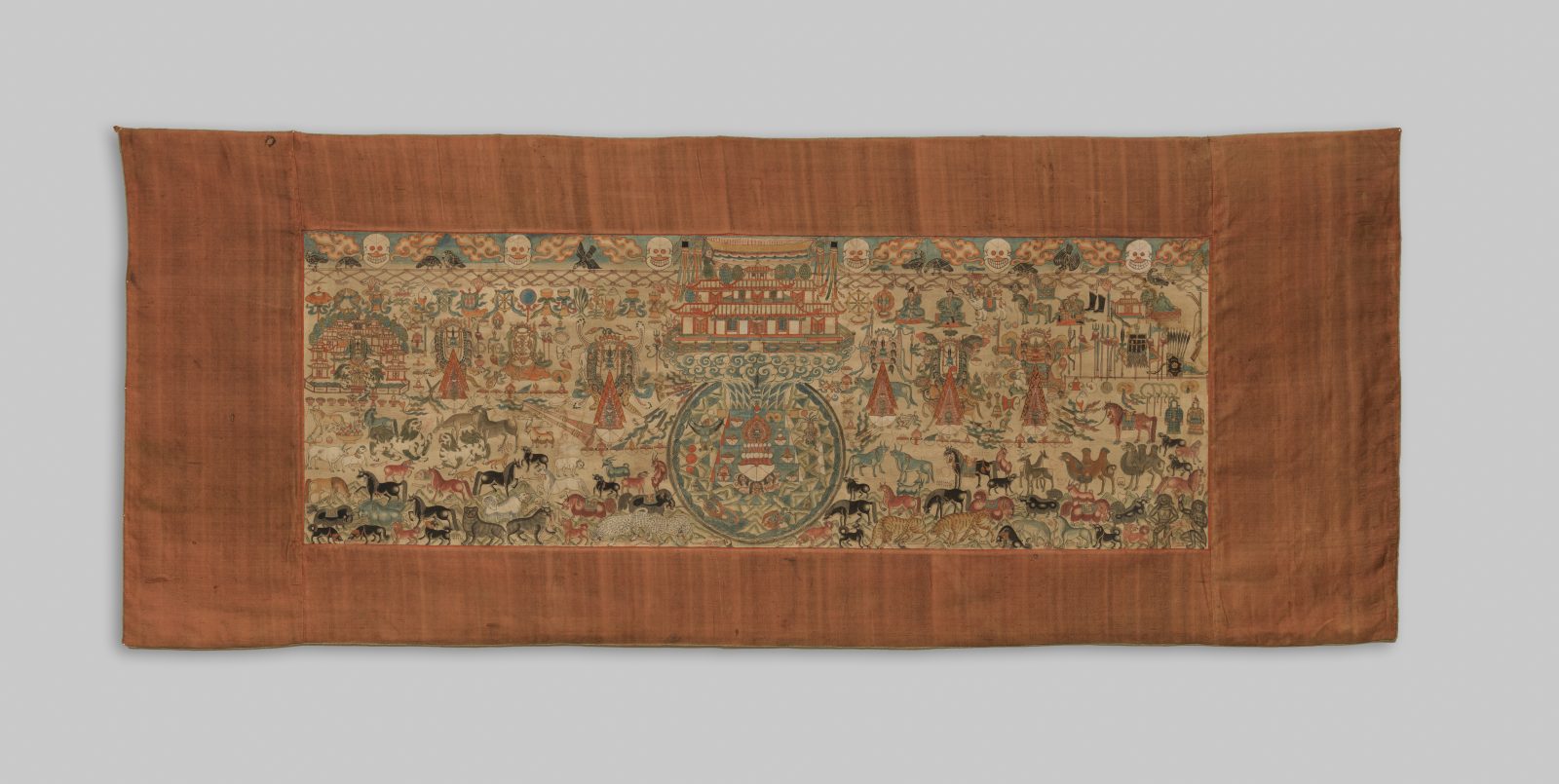
Wrathful Offerings; Mongolia; 19th century; Pigments on cloth; Rubin Museum of Himalayan Art, Gift of Shelley and Donald Rubin; C2006.66.428
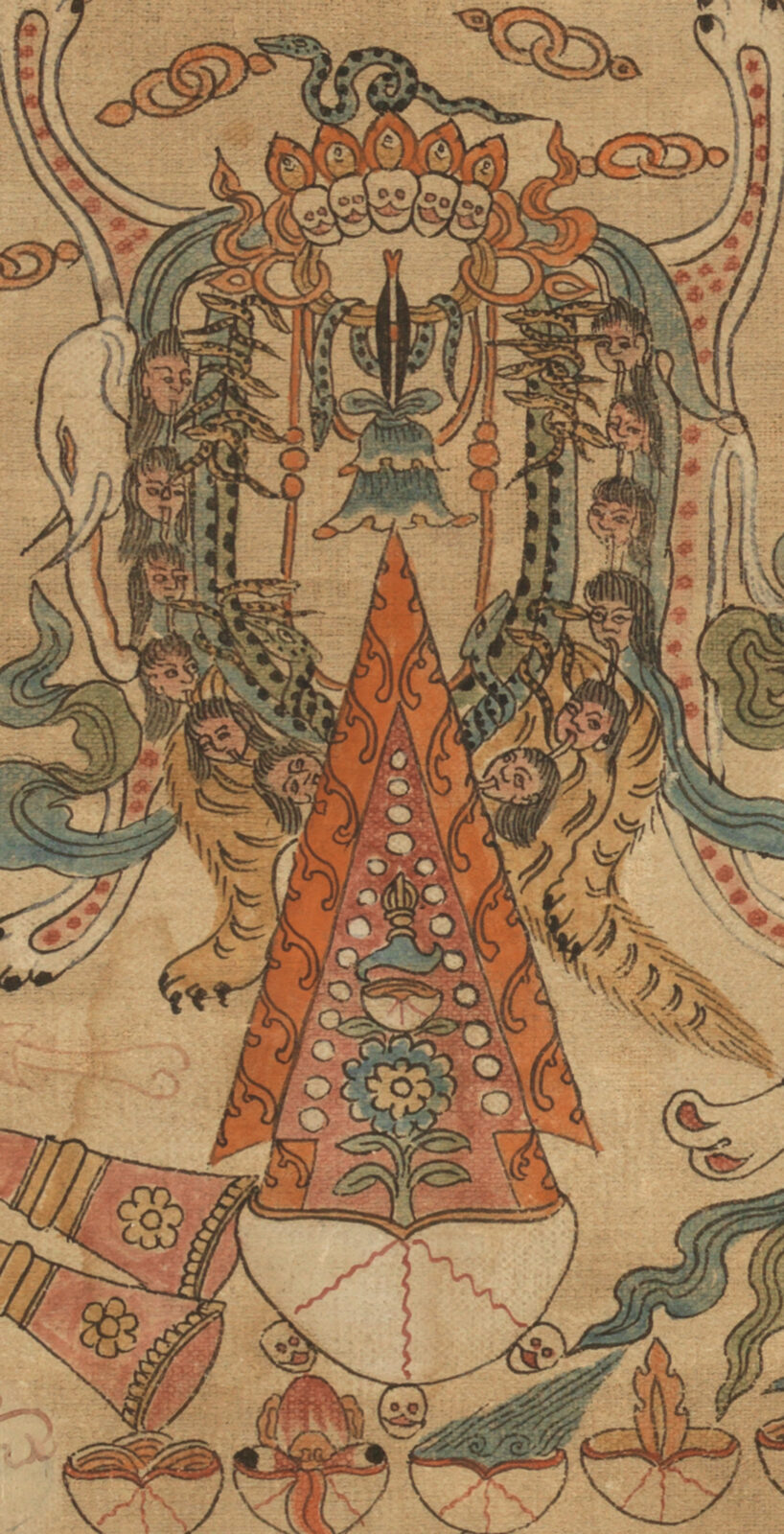
A Mongolian scroll painting depicting offerings to the protectors. Each of the large triangular red objects is a martor dedicated to a specific protector and bearing the protector’s iconic symbol. Detail of Wrathful Offerings; Mongolia; 19th century; Pigments on cloth; Rubin Museum of Himalayan Art, Gift of Shelley and Donald Rubin; C2006.66.428
Visually, tormas meant for protectors often share certain symbolic features in common with the guardian deities to whom they are offered. In this regard, they resemble the next category of tormas.
Some of the most visually elaborate tormas are deity torma (lhator) or main torma (tsator), which serve not only as offerings to deities but also as aniconic (non-figurative) representations of deities and receptacles for their wisdom presence. These lhator often occupy a privileged position high on the altar, and often share their color, symbolic features, and even mantra syllables in common with the wisdom deity they represent.
For example, the mandala, or sacred circle, of the supreme Tibetan Buddhist wisdom goddess and embodiment of divine femininity, Vajrayogini, is said to comprise five goddesses. Vajrayogini, in red, is in the center, surrounded by four attendant goddesses whose colors correspond to the four directions. Accordingly, a Vajrayogini lhator might include a large central red torma surrounded by four smaller tormas. Moreover, lhator often include elaborate ornamental plaques known as a crown assembly (gotrom), adorned with flowers, flames, and symbols associated with the corresponding deity.
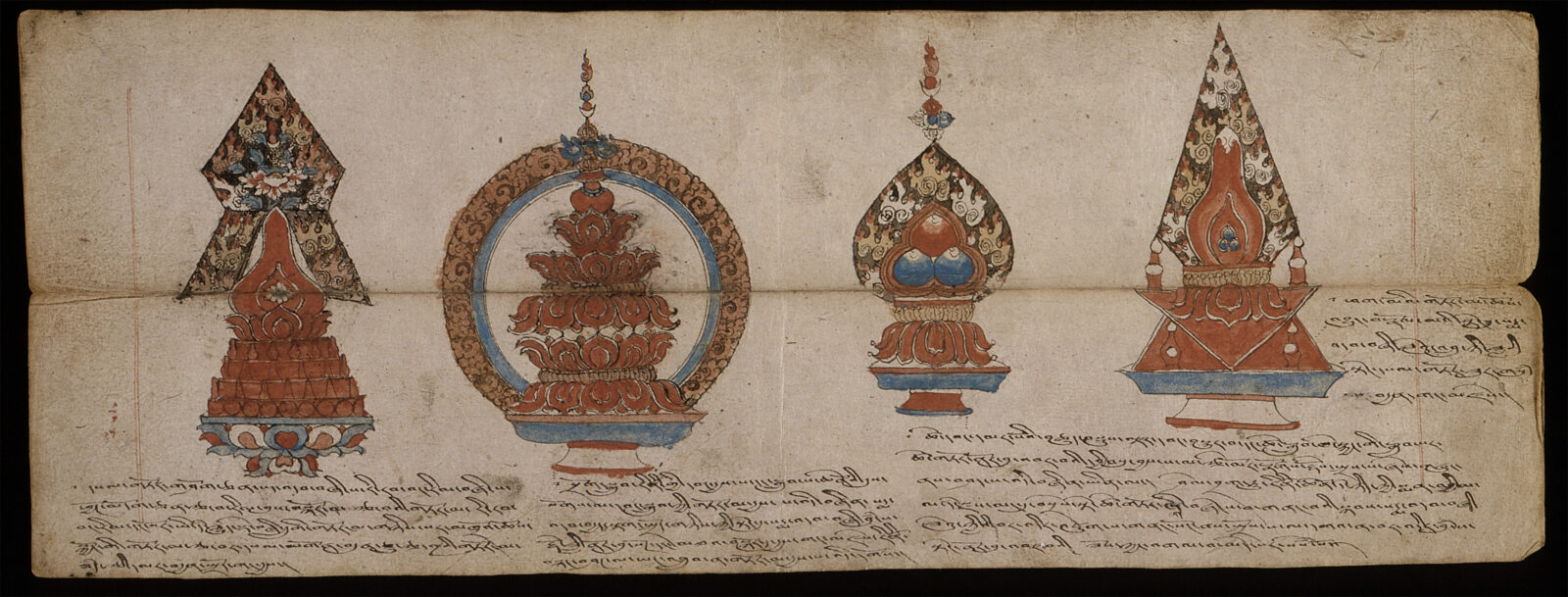
A Tibetan manuscript showcasing several types of tormas. The torma representing the goddess Vajrayogini, also known as Vajravarhi, appears on the far right. The four smaller tormas represent the four other goddesses of the Vajrayogini mandala.
Four Manuscript Pages with Ceremonial Offering Cakes (Torma) and Ritual Objects; Tibet; 17th–18th century; opaque watercolor and ink on paper; Los Angeles County Museum of Art; purchased with funds provided by Daniel Ostroff; M.90.42.1a-d
During the Tibetan Buddhist practice known as deity yoga, the practitioner meditates upon themselves transforming into the form of a particular Buddha or deity, thus cultivating the enlightened qualities associated with that being. Similarly, through the power of imagination and meditative visualization, the lhator also transforms into an embodiment of the deity. In this way, the lhator helps to collapse the distinction between offerer, offering, and offeree, thus aiding the Tibetan Buddhist practitioner in “tasting” the experiential wisdom that all phenomena are interconnected and united.
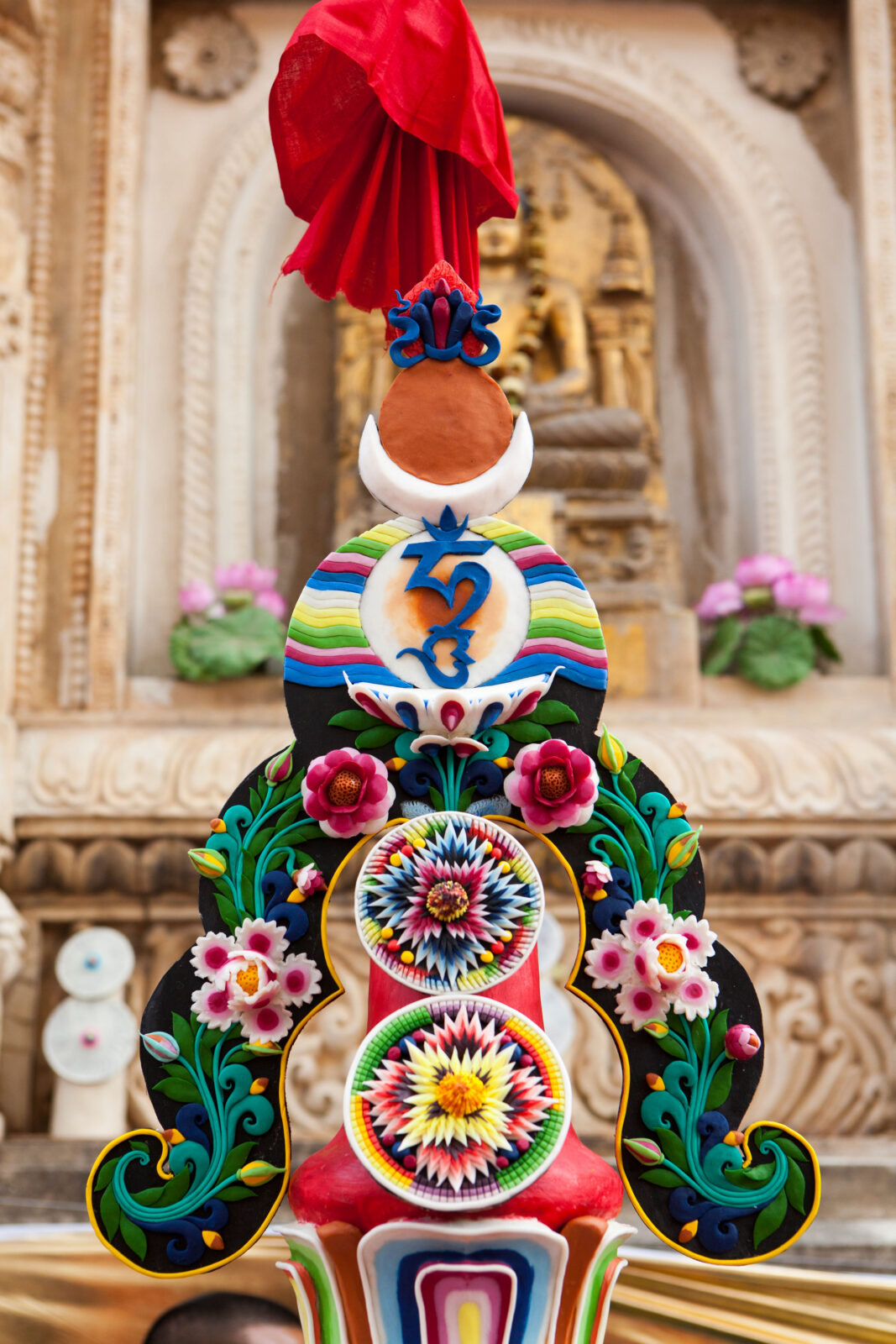
A lhator with a black gotrom placard on top bearing a blue Tibetan syllable particular to its respective deity. Photograph via Alamy
Tormas also play a crucial role in tantric initiation rites. During the initiatory ritual known as permission-blessing (jenang), whereby a lama formally initiates a Tibetan Buddhist practitioner into the worship of a specific buddha or meditational deity, an empowerment torma (wangtor) may stand in for more complex initiatory implements. The lama ritually imbues the torma with the enlightened body, speech, and mind of the deity, then touches it to the disciple’s head to transmit empowerment. Here, the torma becomes a conduit, carrying initiation through touch rather than consumption.
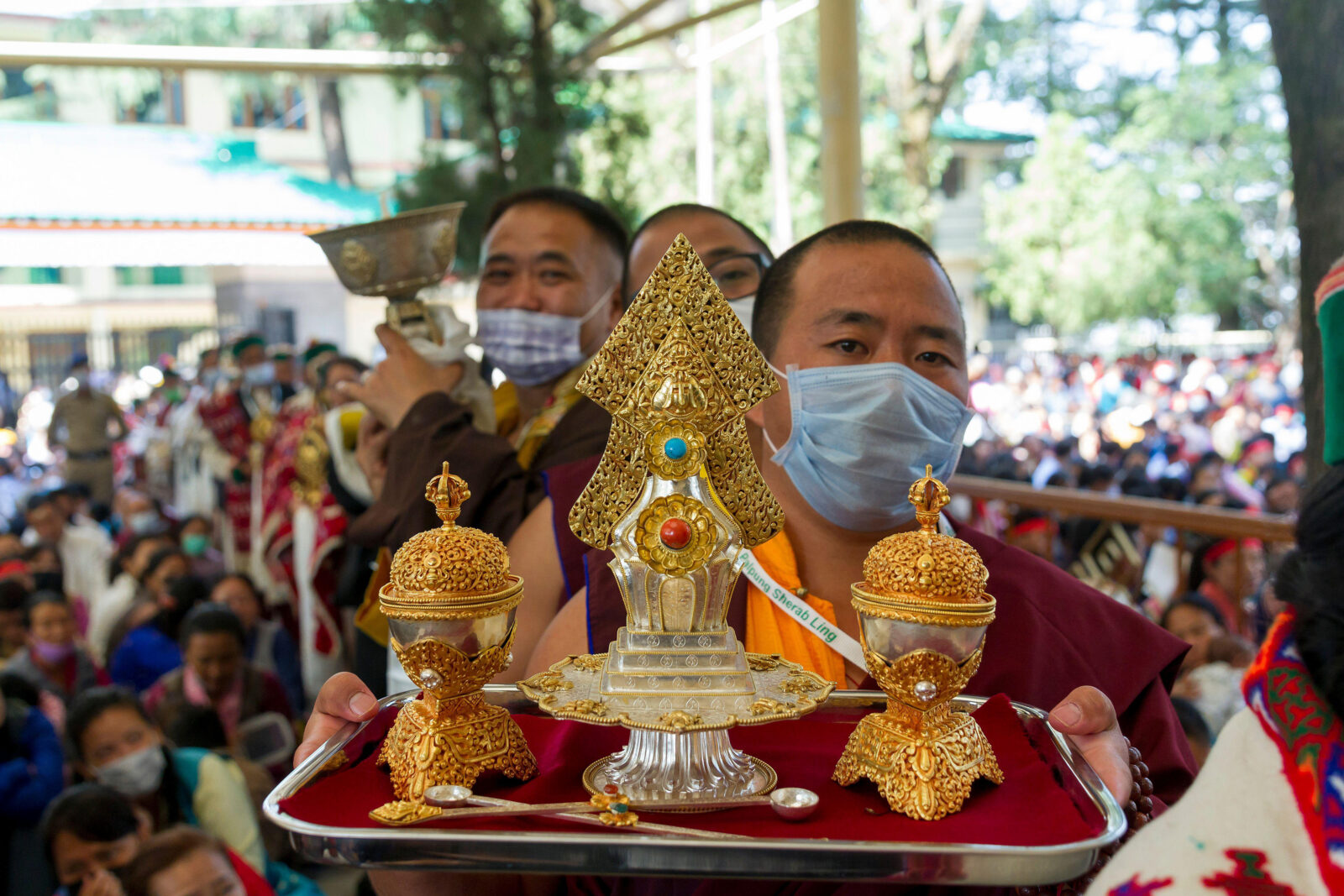
A nonedible wangtor made of silver and gold being consecrated during a public initiation ceremony at the Dalai Lama’s monastery in Dharmsala, India. Photograph by Pacific Press via Alamy
At their essence, tormas are food and are therefore ideally made from edible substances. Over time, however, shifting cultural, environmental, and institutional needs have expanded the range of materials used. Alongside dough and butter, many practitioners now make tormas from more stable materials like wax, wood, ceramic, and even plastic. For example, tormas meant to remain on the altar for extended periods (such as deity-representing lhator) or to be reused across ritual occasions (such as the initiatory wangtor) are the most likely to be made from more permanent materials.
While these durable forms depart from strict edibility, they reflect Buddhism’s emphasis on practicality and willingness to adapt in an ever-changing world. In the end, it matters less what a torma is made of than how it is imagined and offered. In Tibetan Buddhism, mind takes precedence over material, and through meditation, visualization, and mantra, one can transform even the humblest substance—like a ball of dough or a block of wood—into a divine offering.

Westin Harris is the resident scholar in Himalayan cultures at the Rubin Museum of Himalayan Art.
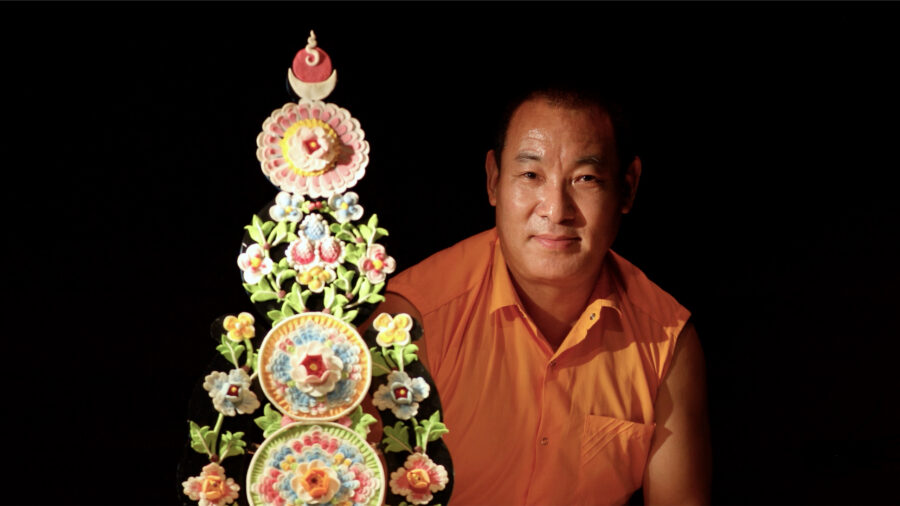
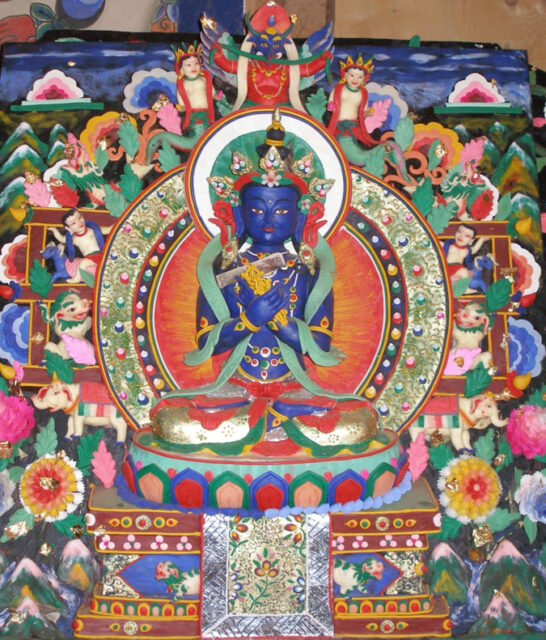
Ritual Offerings Connecting Humans and DeitiesLabrang Monastery, Amdo region, eastern Tibet (Gansu Province, China)
Get the latest news and stories from the Rubin, plus occasional information on how to support our work.