Photo by Adelaide Ryder, courtesy of the Rubin Museum of Himalayan Art and the Utah Museum of Fine Arts
Photo by Adelaide Ryder, courtesy of the Rubin Museum of Himalayan Art and the Utah Museum of Fine Arts
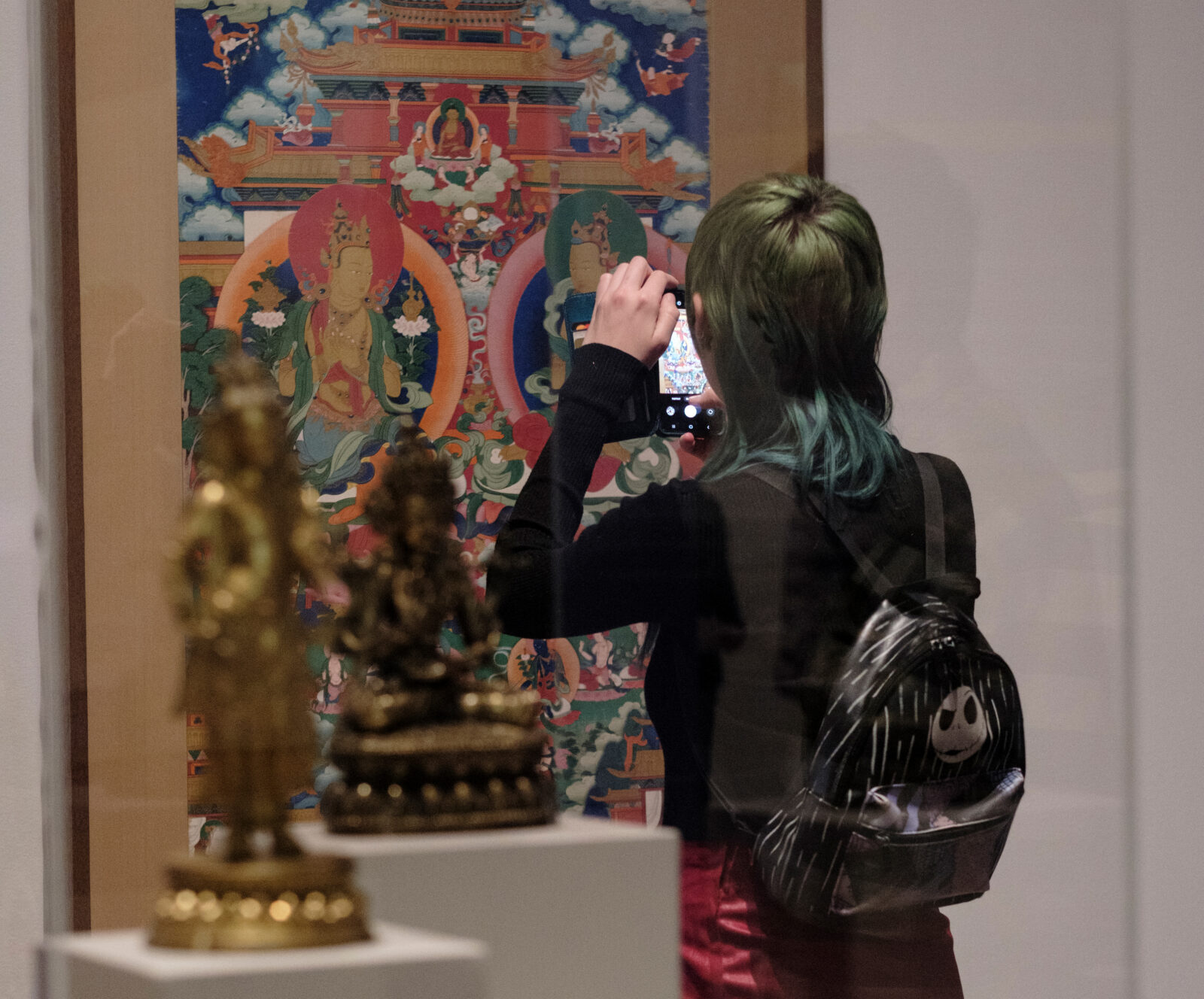
As an art history professor at the University of Utah, I aim to impart to my students the powerful quality of Buddhist art. In the spring of 2025, my advanced seminar on Chinese art coincided with the run of the Rubin Museum of Himalayan Art’s traveling exhibition Gateway to Himalayan Art at our university museum, the Utah Museum of Fine Arts (UMFA). Over the course of the semester, we held half our classes in the exhibition space, allowing students to investigate original works of art within the context of display. While most of these classes were led by visiting curators, art historians, conservators, and myself, participants were also expected to spend time on their own contemplating the exhibit not as students but as art lovers.
Students also used the Rubin Museum’s associated digital platform, Project Himalayan Art, which features object essays, thematic articles, an interactive map, glossary, media library, and more. They found it to be an extremely valuable resource for researching the objects in the exhibition and developing a stronger background in Buddhism of the greater Himalayan region. Indeed, student feedback expressed a clear preference for the digital platform over traditional resources such the monographs and exhibition catalogs that were also assigned. Students also said the most important insight they gleaned from working so closely with an exhibition of Buddhist art was understanding how museums must navigate the complex dynamic between the secular and the sacred.

Professor Winston Kyan with his students in the exhibition Gateway to Himalayan Art at the Utah Museum of Fine Arts, April 2025. Photo courtesy of the author
Gateway to Himalayan Art is divided in three thematic sections that paralleled the pedagogical objectives of the course. Symbols and Meanings introduces the rich pantheon of deities in Himalayan art. We used this section extensively to study iconography, or the identification of subject matter. Materials and Technologies explores how metal, clay, stone, wood, cloth, and paper are manipulated to create images. Here we investigated the social and political contexts of power that stimulated patronage. Living Practices connects the historic and current functions of Himalayan art. In this section, we sifted through and overturned some of the stereotypes about Himalayan art and cultures, learning about how these art forms and practices continue to flourish in the present day.

Photo by Adelaide Ryder, courtesy of the Rubin Museum of Himalayan Art and the Utah Museum of Fine Arts
In Symbols and Meanings, we spent considerable time on the iconography of a 15th-century sculpture of Buddha Shakyamuni. Several symbols identify this as a buddha, or an enlightened being, rather than a bodhisattva, a nearly enlightened being that remains in this world to help others. First, there is a cranial protuberance, or ushnisha—a symbol of wisdom. The head is also covered with snail-like curls, a reference to Shakyamuni cutting off his princely locks when he left his palace to seek the nature of truth. Yet another sign of his renunciation are the elongated earlobes, indicating the weight of his former princely jewels. He holds a begging bowl in one hand, an object of humility, and his other hand touches the earth.
This hand gesture, or mudra, is at the center of the image’s iconography. It is a direct reference to a specific moment in the Buddha’s life, when at the age of 35 he sat down under a bodhi tree and gained insight into the true nature of reality. At the moment he attained enlightenment, Shakyamuni pointed his hand to the earth and called the earth to witness. From this point onward, Shakyamuni could be properly called the Buddha, the awakened one.
The iconography of the Buddha and this moment in his life inspired students to discuss how it contradicts some pop-cultural readings of Buddhist images as symbols of easy bliss. They noted how a Buddhist viewer would read this image as reflecting a hard-earned path to enlightenment that all beings can achieve with extreme effort.
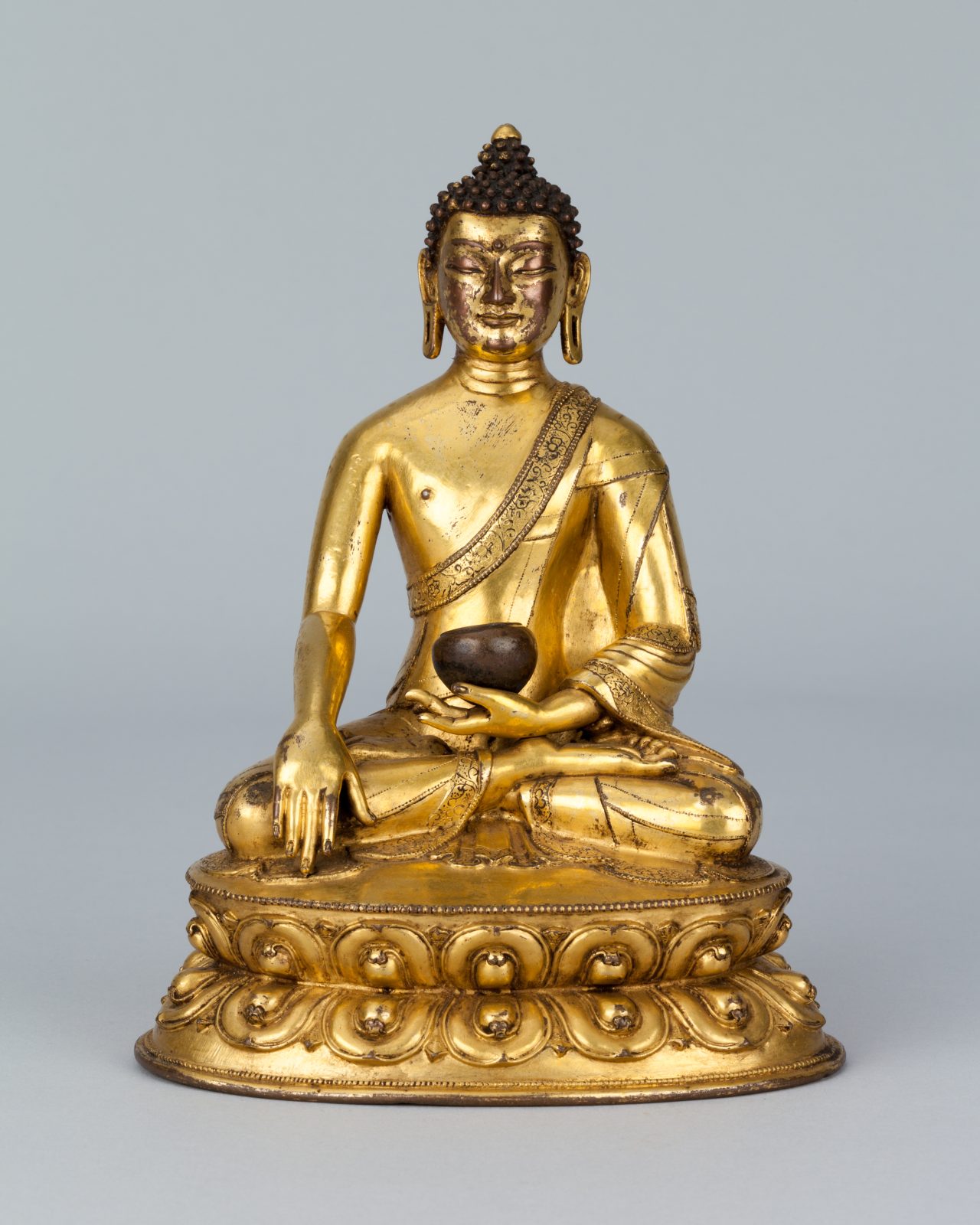
Buddha Shakyamuni; Tibet; 15th century; Gilt copper alloy; Rubin Museum of Himalayan Art, Gift of Shelley and Donald Rubin; C2006.66.656
The next section, Materials and Technologies, contains step-by-step displays that take viewers through the exacting processes of making thangkas, or paintings on cloth, and metal sculptures through the lost-wax casting technique. Traditionally, Himalayan art rarely expressed the unique style of an artist or workshop. Having said that, regional styles did develop given that the Himalayan region bordered on the influential cultural spheres of China to the east and India to the west and south. Accordingly, students considered the social and political contexts of regional style in a side-by-side comparison of two images of The Birth of the Buddha in the exhibition.
On one side, there was an ink-on-paper print from a woodblock from the Derge Printing House, located in current-day Sichuan’s Ganzi Tibetan Autonomous Prefecture. On the other side was a version painted on cloth that is clearly modelled on the print. While the print guided the composition and outlines of the painting, the artist had agency over the use of colors. It is in the colors that we can assume this painting came from Kham, the eastern region of Tibet. The green mountains and blue-white clouds are contoured with back shading, as if these forms are floating on the surface of the painting. This, along with the use of Chinese balustrades and architecture, mark this as a Kham work.
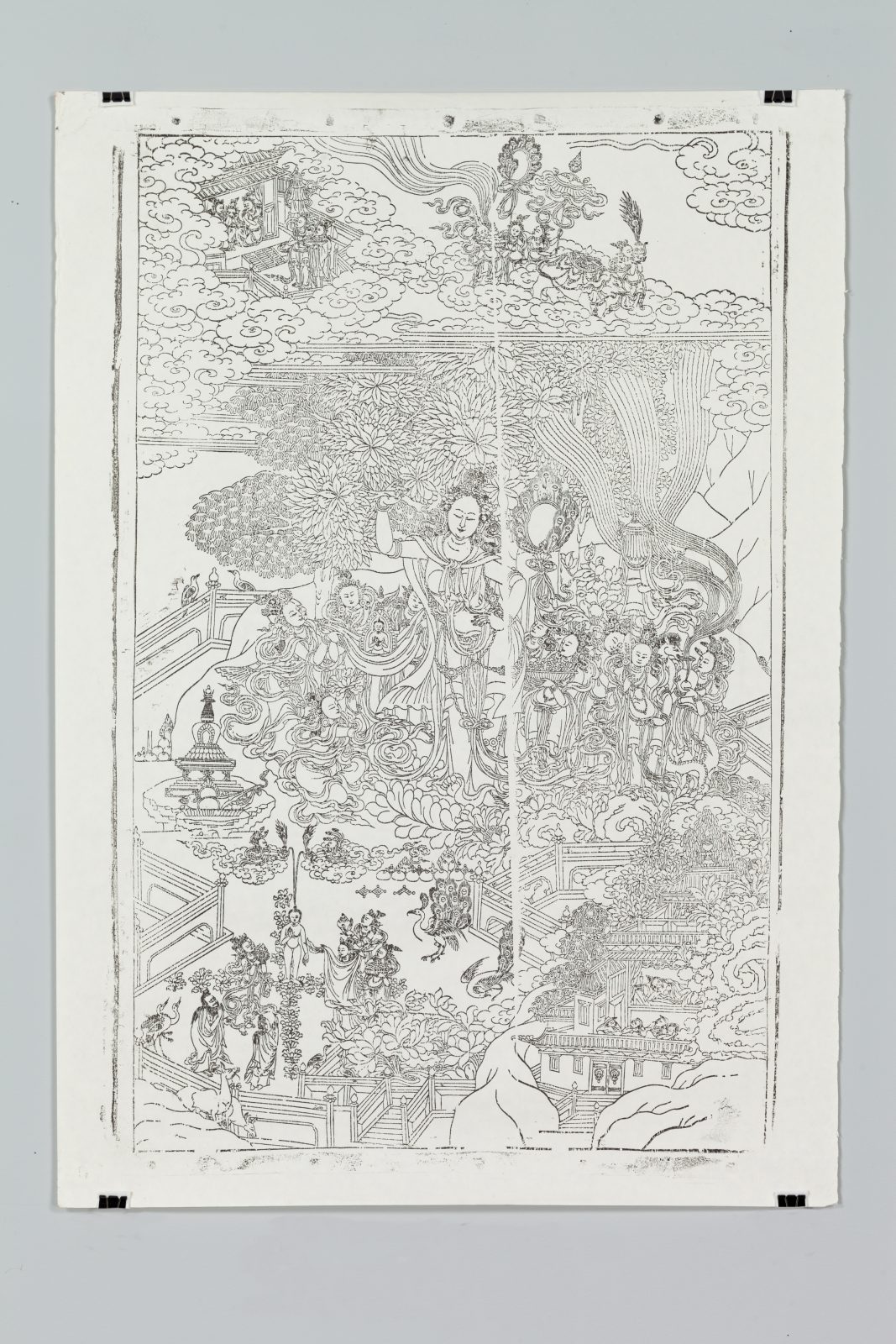
Buddha's Birth, from a set of the Twelve Deeds of the Buddha; Derge Printing House, Derge, Kham region, eastern Tibet; ca 1979; Xylograph, ink on paper; Rubin Museum of Himalayan Art, Gift of William Hinman; C2001.4.2
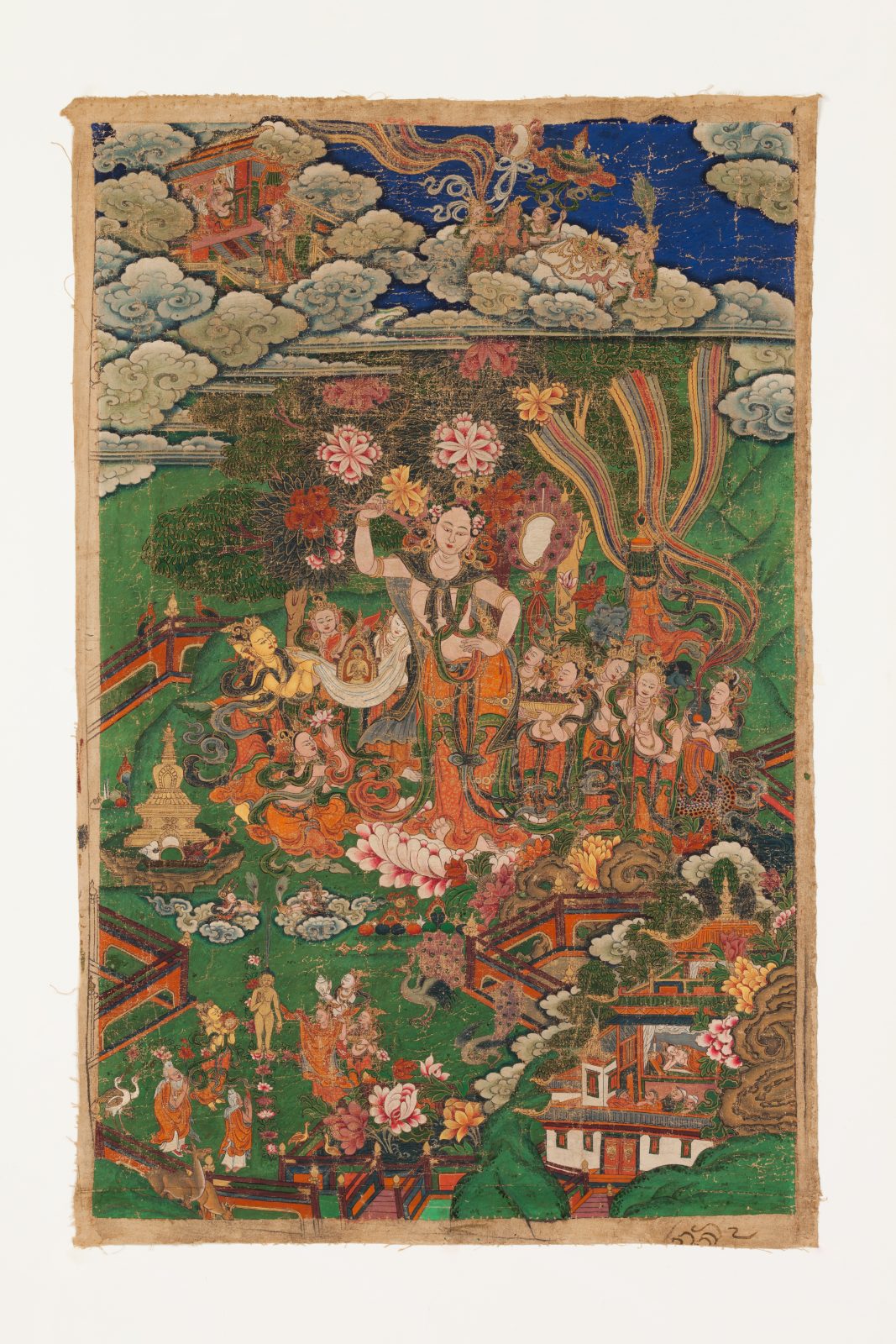
Birth of the Buddha, from a set of the Twelve Deeds of the Buddha, after a carved woodblock composition attributed to Purbu Tsering of Chamdo (active ca. late 19th century); Tibet; 20th century; Pigments on cloth; Rubin Museum of Himalayan Art, Gift of the Shelley and Donald Rubin Foundation; F1997.42.1
These observations became the basis for a lively class discussion on networks of power and patronage between the Imperial Chinese court and major Tibetan monasteries in the Kham region.
Students found the last section, Living Practices, the most fascinating. They saw powerful ritual implements meant to support Buddhist practitioners in their quest for wisdom and compassion, the union of which leads to enlightenment. They also saw secular objects, such as medical instruments and illustrations, that challenge the stereotype that Himalayan art is strictly religious. Students were intrigued by this negotiation between the secular and the sacred in these objects.
Several students chose to write their final papers on the last object in the exhibition, a shrine cabinet, or chosham. This intricately carved and elaborately painted work is covered with decorative floral motifs and fierce protective deities. The installation at the UMFA included sacred books, or pecha, in the top niches, and sculptures of deities in the lower niches. The sculptural buddhas and bodhisattvas featured throughout the exhibit would have traditionally been displayed in a chosham in Himalayan monasteries and homes.
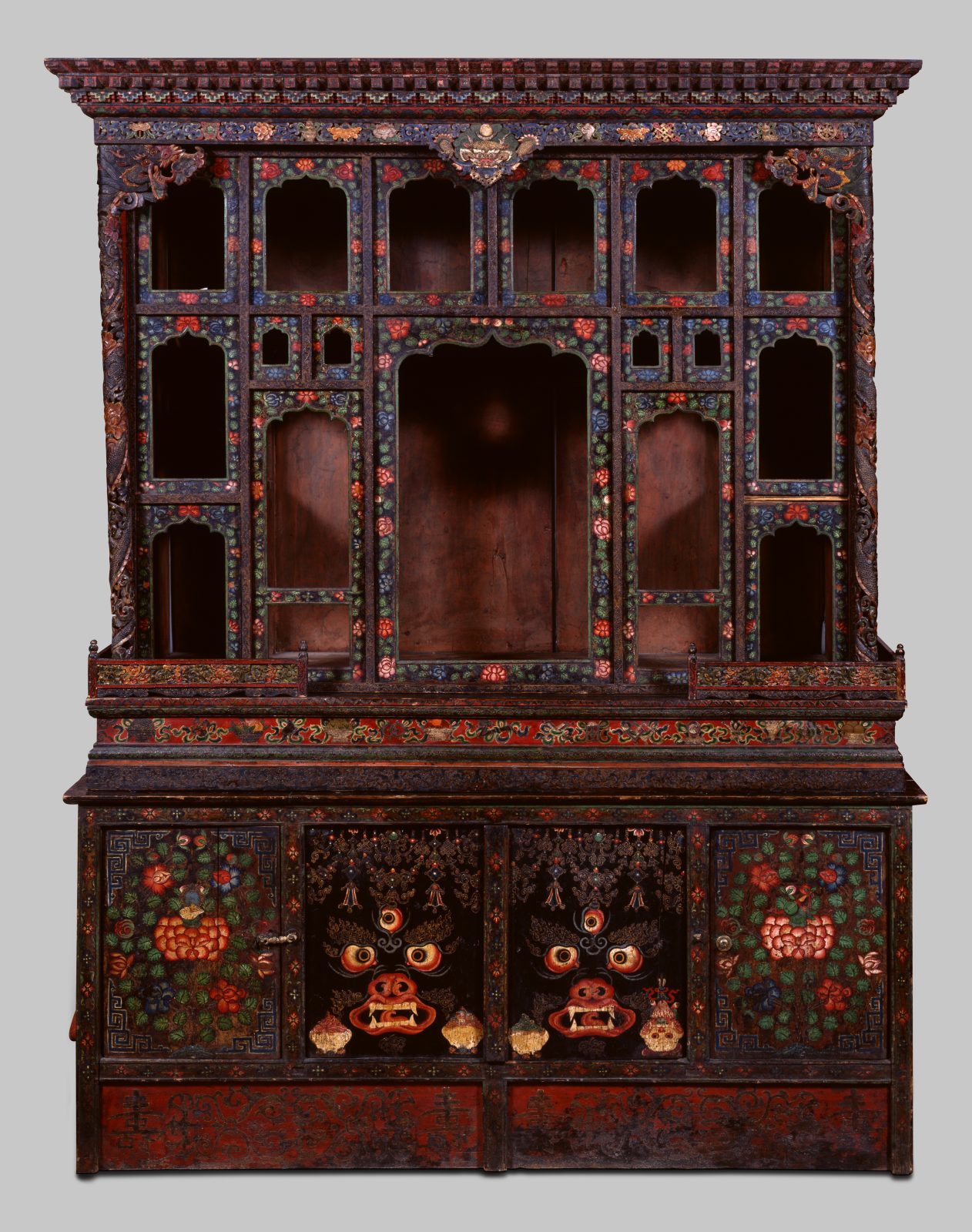
Shrine Cabinet (Chosham); Tibet; Second half of 20th century; Wood, mineral pigments; Rubin Museum of Himalayan Art, Gift of Kingdoms Unlimited; SC2021.2.1a-cc
Thus, the inclusion of the chosham in the exhibition not only provided a context for original display, but the accompanying recording of Buddhist chanting emanating from the chosham transported the viewer from Utah to the Himalayas. For students, this was perhaps the ultimate reinforcement that the secular space of the museum is also a primary site for enacting the sacred.

Professor Winston Kyan with his students in the exhibition Gateway to Himalayan Art at the Utah Museum of Fine Arts, April 2025. Photo courtesy of the author
Winston Kyan is associate professor of art history at the University of Utah. He offers a variety of courses on the art and visual culture of Asia and the Asian diaspora. His own research focuses on Buddhist art in its historic and contemporary contexts. He is currently working on two book manuscripts, Debts of the Body: Filial Figuration and Medieval Chinese Buddhist Art and Transpacific Visuality: Asian American Buddhism and Visuality.
USC Pacific Asia Museum
University of Southern California
Pasadena, California
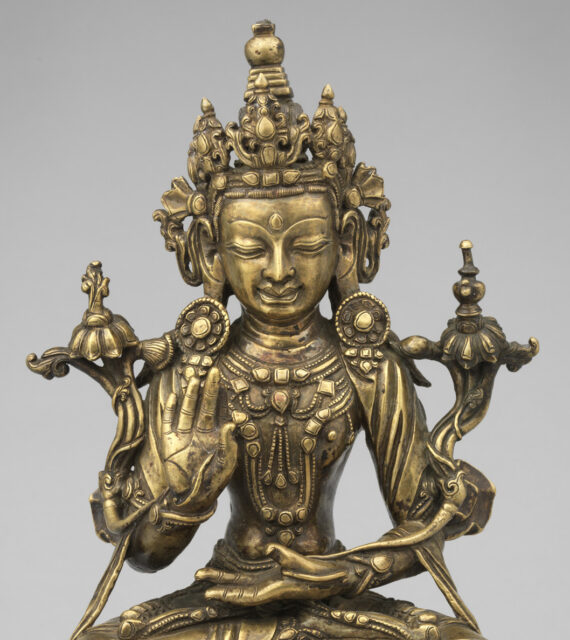
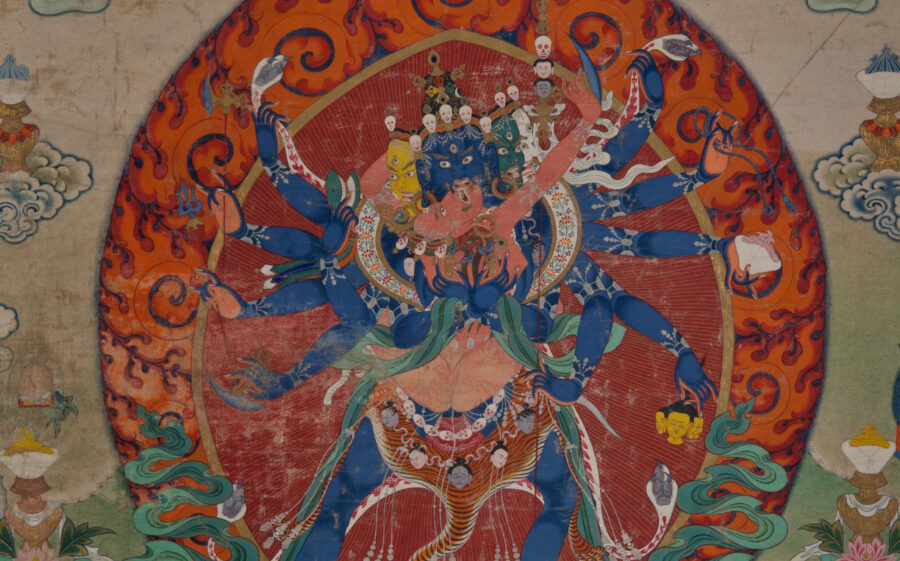
Learn about the art and objects from Himalayan cultural regions and the visual language (iconography) used to convey the meanings of figures and symbols representing religious ideas and concepts.
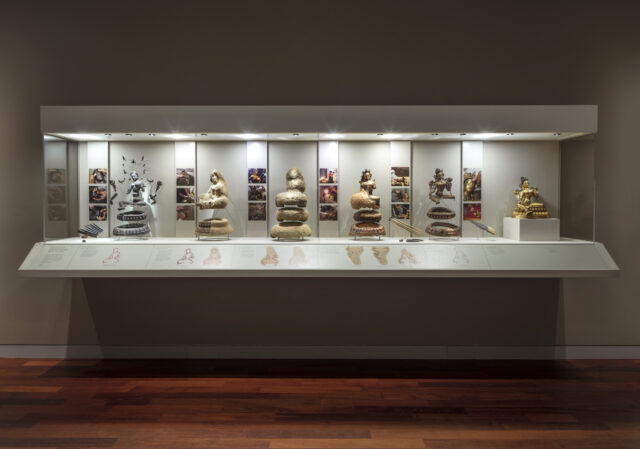
Learn about the processes and methods for creating Himalayan art that were developed over centuries, refined through collaborative efforts of patrons and artists, and encompass all known traditional art making media. To make three-dimensional objects, artists sculpt and carve in clay, stone, and wood, cast images in the round, and hammer repoussu00e9 reliefs in metal.u00a0

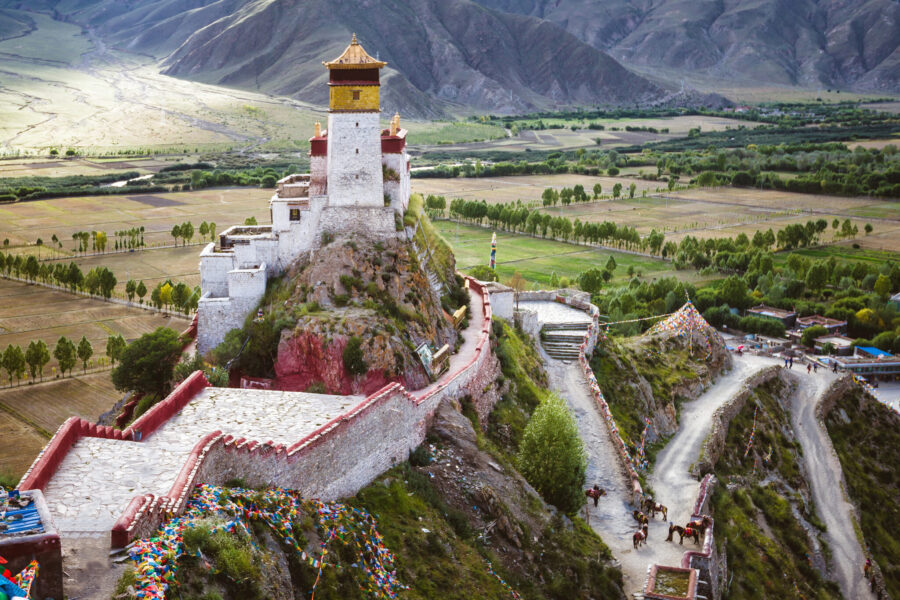
In Himalayan cultures most objects are created with a specific purpose, often in the context of religious practices or special occasions marking life events, but also as part of everyday secular activities. These images and objects function as part of living practices, whether individual, familial, professional, or communal.
Get the latest news and stories from the Rubin, plus occasional information on how to support our work.