Bhutan
19th century
Bhutan
19th century
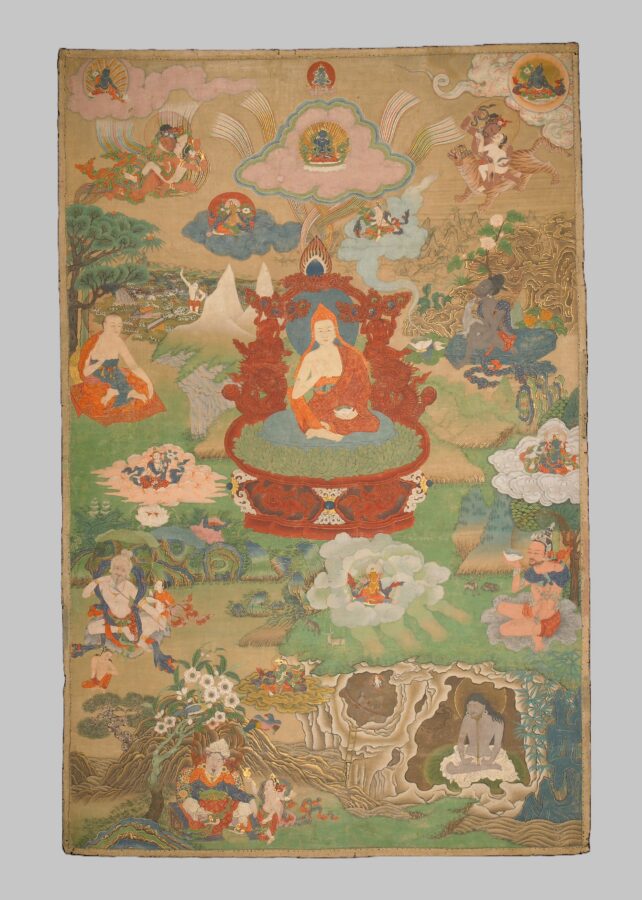
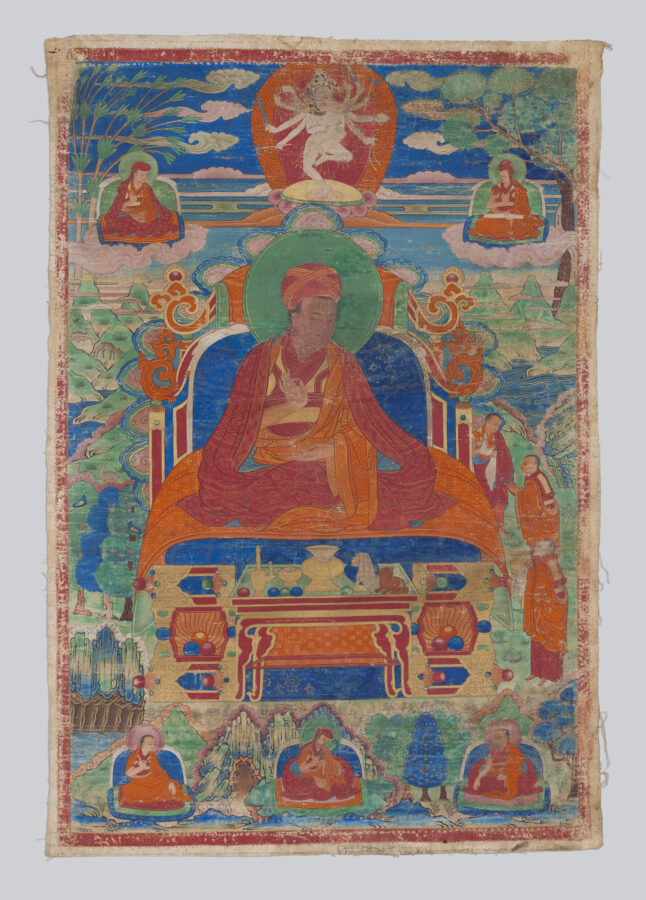
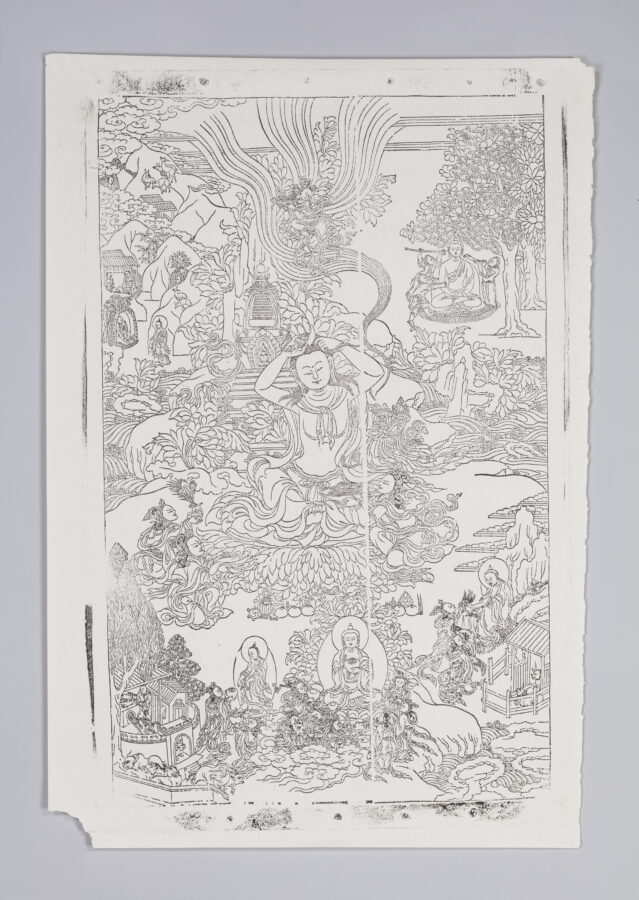
This painting depicts Zhapdrung Ngawang Namgyel (1594–1651), founder of the Drukpa Kagyu theocratic regime of Bhutan. Zhapdrung can be recognized by his long tapering beard and broad red fan-like meditation hat. Depictions of the Zhapdrung have long been the single most important criterion to identify paintings from Bhutan, as most lack inscriptions.
Above is the source and the founding lineage masters of the Kagyu tradition, starting with Buddha Vajradhara above, flanked by the Indian siddhas Tilopa and Naropa, to Tibetan masters Marpa and Milarepa. The four figures below are the Zhapdrung’s successors, most likely his heart incarnations, which could make the last figure the Fifth Zhapdrung Rinpoche Jigme Norbu (1831–1861). This would date the painting to the mid-19th century. The distinctive rounded blue hat worn by the last incarnation of the Zhapdrung is called the “hat of dependent relations” (rten ’drel dbu zhwa). It is said to have originated with the Zhapdrung and is passed down to consecutive abbots, the Je Khenpo.
This painting is extremely symmetrical, which bears some root relationship with painting traditions of Tsang in central Tibet (Tsangri). Green meadows fill most of its landscape, which includes blue-green crags and brownish cliffs that follow Menri conventions. The horizon lies quite high, level with the three highest figures. The painting features two snow-covered conical peaks and five stylized clouds, as well as distinctive yellow, pink-purple, and white cloud clusters below.
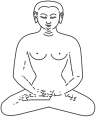
Also known as vajra position, this posture is associated with meditation.
The passing down of authentic Buddhist teachings from a teacher to a disciple or student, often in the form of a text in a ritualistic context.
The transmission of teachings from one generation to the next, from teacher to student, traced all the way back to the Buddha without interruption. A complete lineage is essential in Tantric Buddhist practices as it makes the blessings of the teaching more powerful.
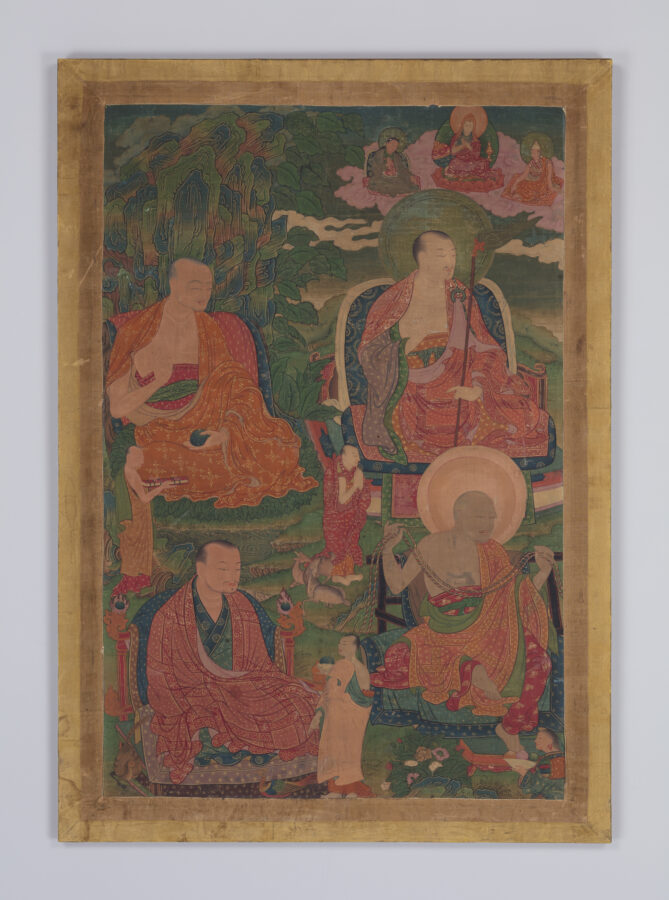
Himalayan art includes portraits of legendary and historical humans, including accomplished religious teachers (lamas), the Buddha’s original disciples (arhats), and spiritually accomplished tantric masters (mahasiddhas).
Bhutan’s earliest Buddhist temples were built in the 7th century, around the same time Buddhism was introduced in Tibet. In the 17th century, Mongol-backed Geluk authorities drove many Kagyu teachers from Tibet to Bhutanese areas. The Drukpa Kagyu teacher Zhabdrung Ngawang Namgyel (1594–1651) unified these regions and established a system of government.

Get the latest news and stories from the Rubin, plus occasional information on how to support our work.