Inner Mongolia or Yonghegong Monastery 雍和宮, Beijing
19th century
Inner Mongolia or Yonghegong Monastery 雍和宮, Beijing
19th century
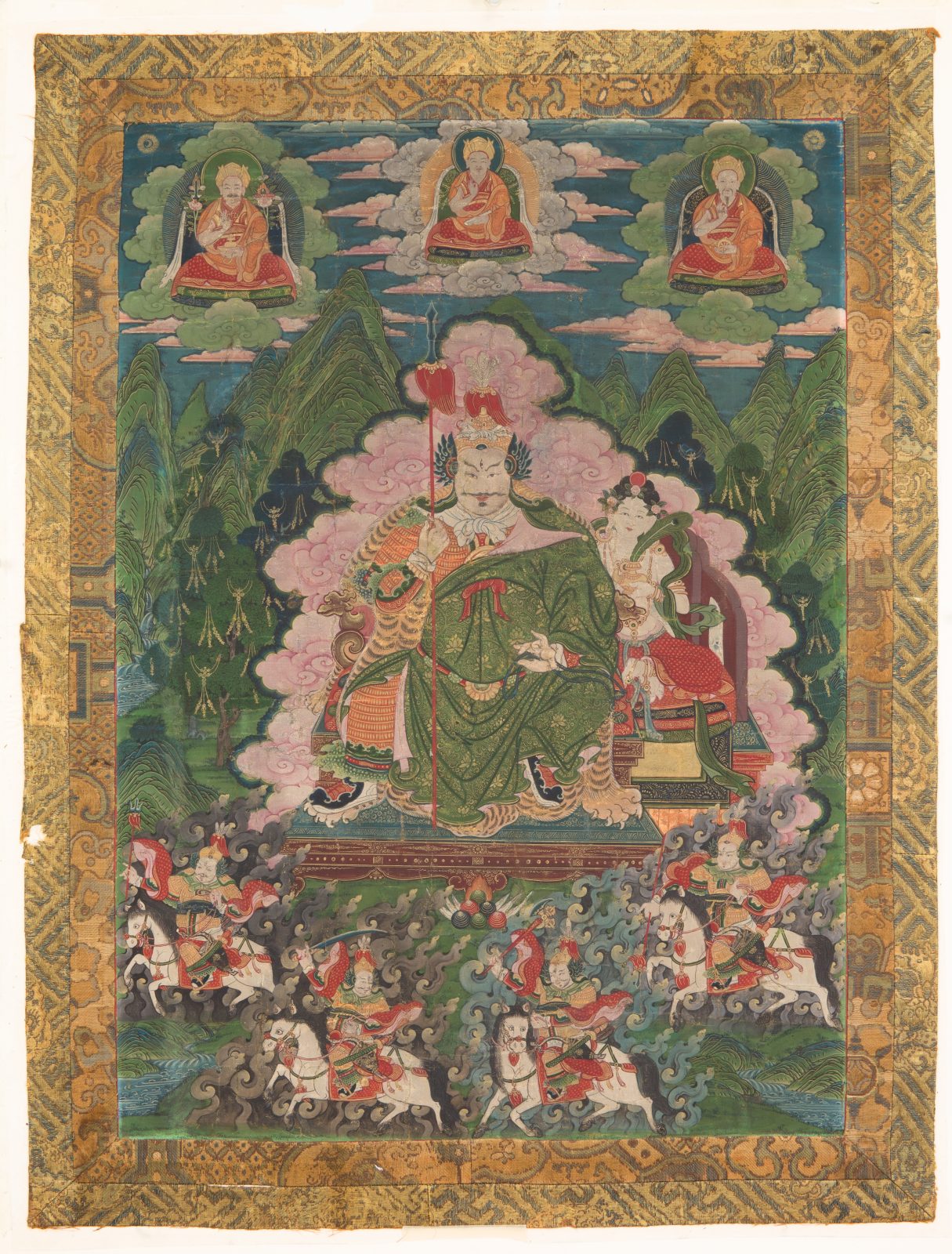
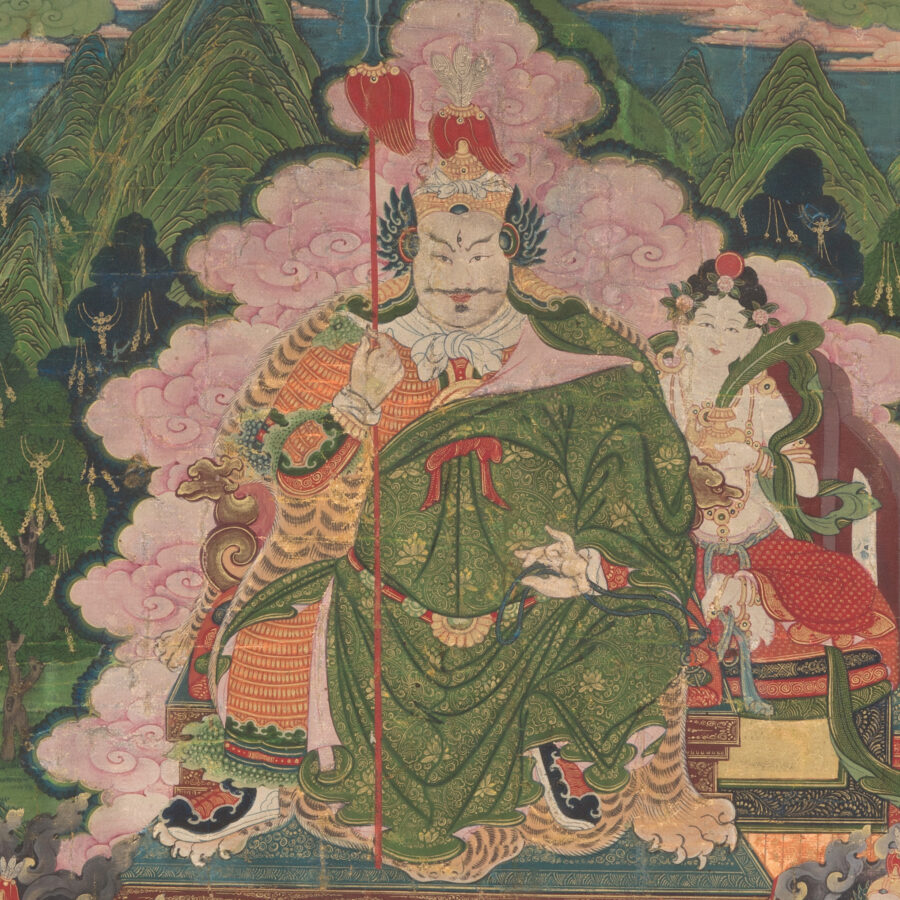
Guan Yu 關羽 (or Guan Di 關帝 “Emperor Guan”) was a Chinese general of the Three Kingdoms period (220–280) who was deified to become a focus of popular religion in China. While not popular in mainstream Tibetan Buddhism, he is found in the Mongolian and Manchu pantheons. How this prominent Chinese martial deity was adopted as a Geluk Tibeto-Mongolian Buddhist protector reflects the close political and military relationship between the ruling Qing and Geluk hierarchies in Inner Asia during the eighteenth century.
The Qianlong emperor’s (r. 1736–1795) state preceptor and close confidant, the Third Changkya Rölpé Dorjé (1717–1786), created a prayer in the Tibetan, Manchu, and Mongolian languages based on his vision of Guan Yu as a protector of the dynasty and war god. This close association with Changkya is affirmed by his appearance at the top left of this painting. At top center is the Sixth Penchen Lama (1738–1780), and at right is the Qianlong emperor dressed as a Geluk monastic, holding the golden wheel of the universal cakravartin ruler. This is a common triumvirate of hierarchs found at the top of Qing Tibetan Buddhist paintings, embodying the center of an envisioned Buddhist empire, depicted over its protector as disseminators of his worship.
A temple dedicated to Guan Yu (Guandi Miao 關帝廟) was built at Yonghegong, Changkya’s monastic seat in Beijing and an imperial center for the practice of Tibetan Buddhism staffed by monks from Inner Mongolia. Yonghegong became the locus of this cult, especially promoted by Changkya’s close student and biographer Tukwan Lozang Chökyi Nyima (thu’u bkwan blo bzang chos kyi nyi ma; 1737–1802). As part of the Manchu state’s policy to promote the worship of Guan Yu as an exemplar of martial loyalty among the Mongols, the Qing court sponsored garrison temples and shrines dedicated to him throughout Inner Asia in the eighteenth century.
Guan Yu quickly became popularly identified with Gesar, a legendary hero of folklore prevalent across Inner Asia. Thus Guan Yu’s appearance here in this Tibetanized form is likely related to this conflated identity. In this painting Guan Yu appears as a martial figure in armor and a rich green brocade robe seated on a Chinese-style throne draped with a tiger skin, as seen in other more Sinitic depictions. In his Tibetan liturgies he is classified as a warrior god (dgra lha), and this new identity is reflected in his iconography and appearance in this painting, including spear, noose, white face, and four attendant horsemen, all features common to local regional gods associated with the land (yul lha) who typically appear as warriors. The consort seen here is also not part of the Chinese tradition, but a wife (or queen) is mentioned in Changkya’s dream of Guan Yu. Similar Tibetanized depictions can be found in a number of extant paintings of Guan Yu, including in the American Museum of Natural History and in the Pritzker Collection, Chicago.
While the clearly recognizable depiction of the triad of hierarchs at the top, as well as the modeling of the landscape, closely resemble Qing court paintings, the depiction of the deity does not conform to the more Sinitic depictions of Guan Yu typical of Qing court painting. Rather this heavily Tibetanized appearance evokes the popular conflation with Gesar among the Mongols, which suggests that this painting might have been made by Inner Mongolian artists employed at Yonghegong, the imperial center of the Tibetan Buddhist Guan Yu cult in Inner Asia.
A consecration inscription on the back invokes the power of gods and gnyan (local spirits), invites them to take residence in this image (rten, support) to be firmly established without distinction (between deity and image), and exhorts the deity to accomplish all enlightened activities of pacifying [harmful forces]; enriching [life span, merit, and pleasures]; subjugating [living beings]; and destroying [enemies].
A kind of energy that can be used, individually and collectively, to effect change.
Prescribed practices that carry symbolic meaning and value within a specific tradition and are intended to attain a desired outcome. Rituals are usually done as part of a ceremony or regular routine.
Himalayan art includes portraits of legendary and historical humans, including accomplished religious teachers (lamas), the Buddha’s original disciples (arhats), and spiritually accomplished tantric masters (mahasiddhas).
Mongolians have been widely active in the Tibetan Buddhist world, playing a key role in Tibetan culture, politics, and relations with China. In the 13th century, the Mongol Empire—the largest contiguous empire in world history—facilitated the spread of Tibetan visual culture.

Get the latest news and stories from the Rubin, plus occasional information on how to support our work.