Uuriintuya Dagvasambuu
Ulaanbaatar, Mongolia
2023
This posture features a triple- bend of the body at the knee, hip, and waist.
Uuriintuya Dagvasambuu
Ulaanbaatar, Mongolia
2023
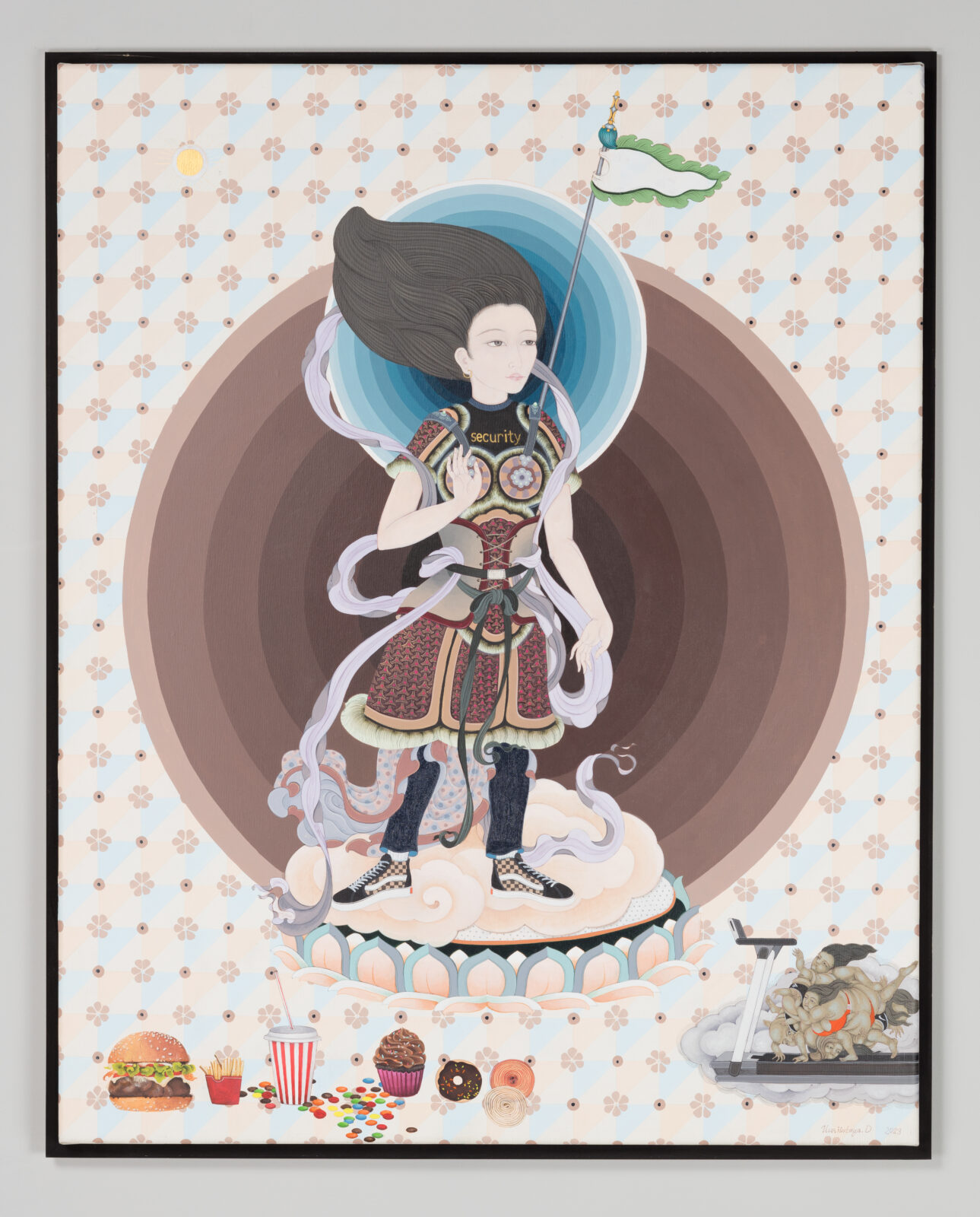
Based in Ulaanbaatar, Uuriintuya Dagvasambuu practices a style of painting known as Mongol Zurag (Mongolian Painting), which has its roots in the Cold War period and was a reaction to the socialist government’s erasure of Mongolian Buddhist visual culture in favor of Socialist Realism. Mongol Zurag combines traditional subjects with motifs and visual language from contemporary life in Mongolia.
The artist’s paintings incorporate elements of Tibetan Buddhist imagery and Asian miniature paintings as well as surrealism and contemporary forms. Her integration of these diverse practices is evident in the conceptual compositions executed with careful attention to details, refined draftsmanship, and flat pigments of selective palettes.
Dagvasambuu’s visual vocabulary draws from Buddhist traditional paintings and Mongolian folk traditions, as well as ideas and images associated with technology, social media, video games, virtual avatars, and changing lived experiences. All her paintings are figurative and feature the artist in some way, suggesting an autobiographical and narrative nature to her art.
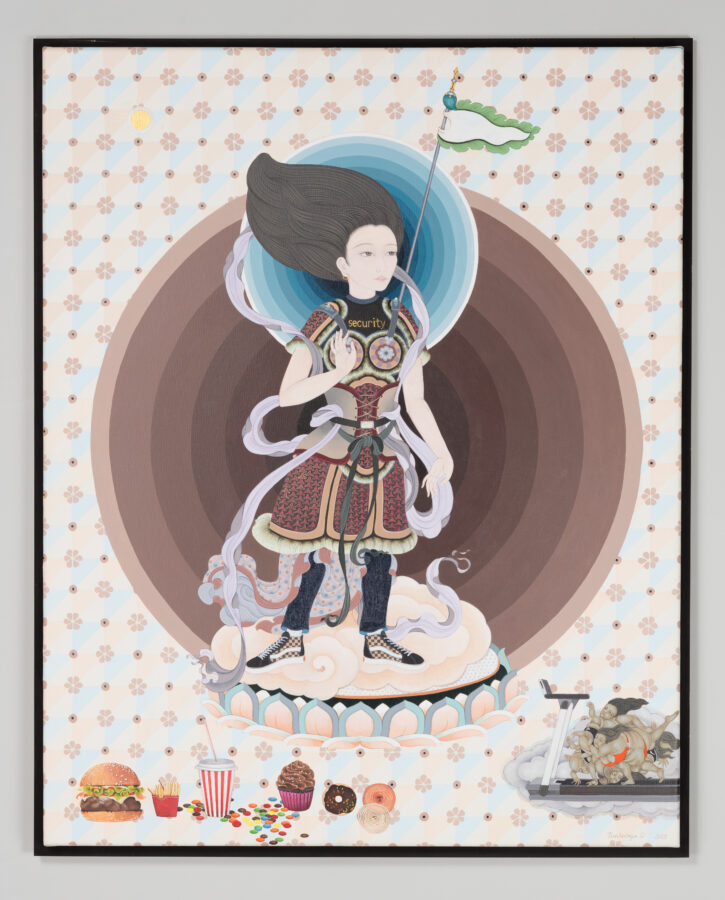
This painting is a part in a series created in 2023 for an exhibition at Sapar Contemporary, New York. It is inspired by her life experiences and world events.
The main figure is androgenous and represents care and protection as well as authority, strength, and ability. The figure’s armor evokes Buddhist martial protector deities who guard the world, such as the powerful guardian kings motivated by compassion.
Additional elements, such as fast food and a treadmill, speak to the mundane realities of existence, the challenges of external or imposed expectations, and habitual and easy comforts people crave but are urged to forego. The artist’s choice to depict the main figure as a Buddhist deity or protector speaks to inner ideals rather than external expectations. The image touches on the complexity of personal choice, character strengths, and inner guidance.
The artist’s distinct style is evident in the meticulous and precise details, such as fine gold lines to delineate the guardian’s hair, textile-inspired background, seemingly flat but skillfully shaded forms, soft color palette, and knowledgeable interpretation of the iconographic elements found in traditional Mongolian Buddhist images
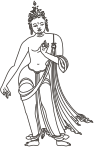
This posture features a triple- bend of the body at the knee, hip, and waist.
A kind of energy that can be used, individually and collectively, to effect change.
In Buddhism gender is considered more fluid compared to some other religions. Certain traditions emphasize the importance of all genders in achieving enlightenment. The feminine is considered an embodiment of wisdom and the masculine is an embodiment of method.
Buddhists believe identity is not fixed but is variable and dependent on causes and conditions. It is a temporary, transitional, and ever-changing interplay of mental and physical elements.
A vehicle for the preservation and transmission of knowledge. The Buddha’s teachings were originally passed down through oral transmission and storytelling, and stories of the Buddha’s past lives are considered an important source of inspiration and guidance.
Mongolians have been widely active in the Tibetan Buddhist world, playing a key role in Tibetan culture, politics, and relations with China. In the 13th century, the Mongol Empire—the largest contiguous empire in world history—facilitated the spread of Tibetan visual culture.
Get the latest news and stories from the Rubin, plus occasional information on how to support our work.