
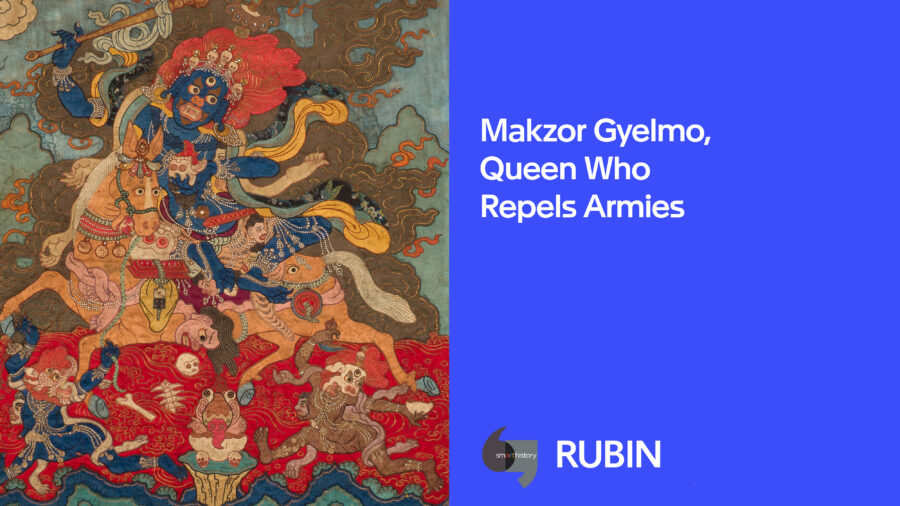
Makzor Gyelmo, Queen Who Repels Armies; Mongolia; 18th century; Silk applique with pearls, coral, horsehair, and gold thread; Rubin Museum of Himalayan Art, gift of the Shelley and Donald Rubin Foundation; F1996.19.1
Makzor Gyelmo, Queen Who Repels Armies; Mongolia; 18th century; Silk applique with pearls, coral, horsehair, and gold thread; Rubin Museum of Himalayan Art, gift of the Shelley and Donald Rubin Foundation; F1996.19.1
Makzor Gyelmo, or “Queen Who Repels Armies,” is one of the most prominent forms of the principal female Buddhist protector deity of Tibet, Palden Lhamo. The Tibetan name Palden Lhamo is a translation from her Sanskrit name, Shri Devi, meaning the “Glorious Goddess,” a term denoting a whole class of female protector deities. More simply called Lhamo, “the Goddess,” she is an important deity among wrathful protector goddesses in Tibetan Buddhism, and she is the only female of the eight great protector deities.
Palden Lhamo takes many different forms, which are considered wrathful manifestations of other deities with their own histories. Her form as Makzor Gyelmo (or Makzorma for short) is considered a wrathful emanation of Sarasvati, goddess of the arts and learning.
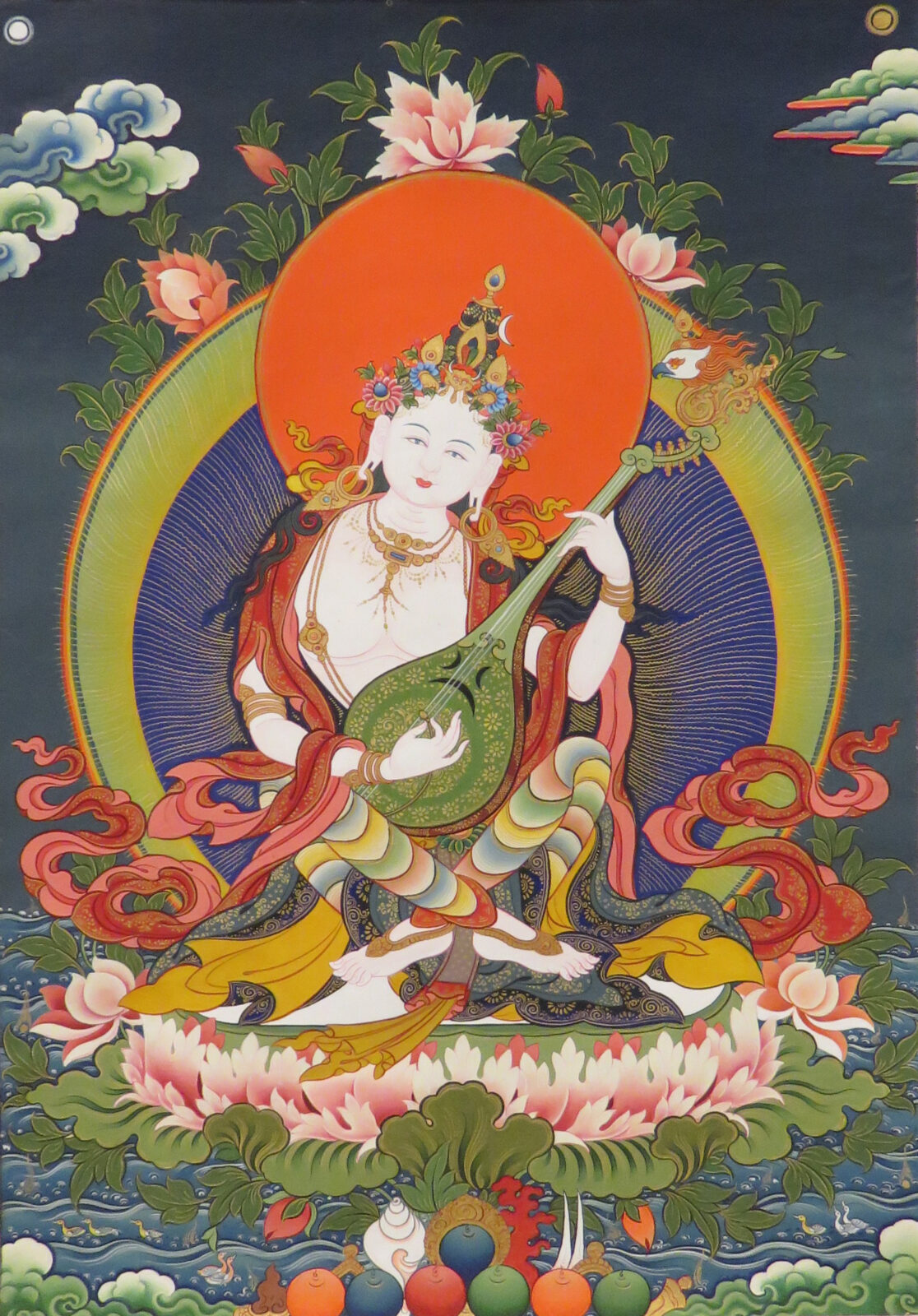
Buchung Nubgya (b. 1979); Sarasvati, Goddess of the Arts and Learning; 2014; pigments on cotton; Rubin Museum of Himalayan Art; SC2014.4.4
An exquisite 18th-century Mongolian silk appliqué lavishly ornamented with pearls in the Rubin Museum’s collection depicts Makzor Gyelmo (see lead image at the top of this article). The artwork is the subject of a SmartHistory video, and this article dives even deeper into the rich historic context in which it was created.
Mak (Tib. dmag) means “army,” and zor (Tib. zor) is a magical weapon a deity can hurl at their enemies for offensive and defensive purposes in battle. Gyelmo (Tib. rgyal mo) means “queen.” Thus her name might be more properly translated as “Queen of the Army[-defeating] Weapon.” As her name implies, she is seen as a powerful protector of Buddhism and especially efficacious in magically intervening in military conflicts.
The goddess Palden Lhamo is typically depicted as an extremely fierce dark blue figure with flame-like hair standing on end. The moon is in her hair, and the sun is in her navel. She is adorned with a crown of five skulls and bone ornaments (here made of pearls) and a garland of severed heads. She rides on a mule riding across a sea of blood. On the mule’s flank is an eye, watching out for enemies of the Buddhist teachings. Her saddle blanket is made from the flayed skin of her son.
In her form as Makzorma, she has two arms and brandishes a sandalwood club with a vajra-finial over her head and holds a skull cup filled with blood at her heart. Another distinguishing feature is a peacock feather canopy above her head. Among her magical implements are a scored divination stick in her belt and divination dice, one white and one black. These objects relate to important divination practices associated with her. She can also unleash her arsenal of weapons on enemies of the doctrine, which include a book of red curses bound by a snake, a bag of diseases, and a magical ball of thread slung from her saddle.
Two of her fearsome attendants are located in the bottom register. The one to the left has the head of a water monster (makara) and leads Lhamo’s mule with a poisonous snake for a lead and bridal. The one on the right has the head of a lion (Simha Mukha). At bottom center are the wrathful offerings of the five senses represented by the actual sense organs: eyes for sight, tongue for taste, ears for sound, nose for smell, and heart for touch.
According to a short history of the worship of Lhamo by the Second Dalai Lama Gendun Gyatso (1476–1542), teachers from Oddiyana (the Swat region in modern-day Pakistan) introduced her cult to Tibet in the 11th century. Although Lhamo is worshiped in many Tibetan Buddhist traditions, Makzor Gyelmo is the most popular form of Lhamo, as well as the most important female protector of the Geluk tradition. She is especially known as the special protector of the Dalai Lamas and his government, the Ganden Podrang. Makzorma has been a major part of the Geluk tradition since the time of the Second Dalai Lama, who greatly popularized her practices.
For instance, during the Gelukpa’s struggles to attain political power in central Tibet, the Fourth Dalai Lama Yonten Gyatso (1589–1617), a Tumed Mongol and grandson of Altan Khan (1507–1582), performed elaborate rites invoking wrathful protectors such as the battle goddess Makzorma to target enemies of the Gelukpa.
A special group of protector deities, foremost among them Lhamo, were an important source of political power and legitimacy for the institution of the Dalai Lamas. It was under the Fifth Dalai Lama Ngawang Lobzang Gyatso (1617–1682) that Lhamo rose to special prominence.

The Fifth Dalai Lama, Ngawang Lobzang Gyatso (1617-1682) with Previous Incarnations; Central Tibet; 18th century; Pigments on cloth; Rubin Museum of Himalayan Art, gift of the Shelley and Donald Rubin Foundation; F1996.29.3
His special relationship with Makzorma was extremely important to his practice of subjugation and aversion rites (offensive and defensive ritual magic) during his rise and consolidation of power in the 17th century. It was under the Great Fifth’s rule that Makzorma’s practices became state-sponsored ritual, and the celebration of her cult became a celebration of the political regime. A key responsibility of the goddess became to safeguard his government, established in 1642, largely with the Qoshot Mongol military support of Gushri Khan (Güüshi, 1582–1655, r. 1642–1655).
Indeed, in recognition of Gushri Khan’s role in establishing the Fifth Dalai Lama’s government, an annual cavalry parade was held during Lhasa’s New Year ceremony. Troops carried military standards depicting the two main protector deities of the Dalai Lamas and the Tibetan government: the Red and Black Protectors, with the black protector being Lhamo. Hugh Richardson, who photographed the procession in 1937, wrote, “Each standard bearer carries a tall lance wrapped in a painted banner and crowned with a trident, which are called the Tensung Mamak, the ‘Red and Black Protectors of the Faith,’ perhaps representing warriors from the retinue of Pehar or Penden Lhamo. They are said to be or to resemble the standards of Gushri Khan’s forces.”
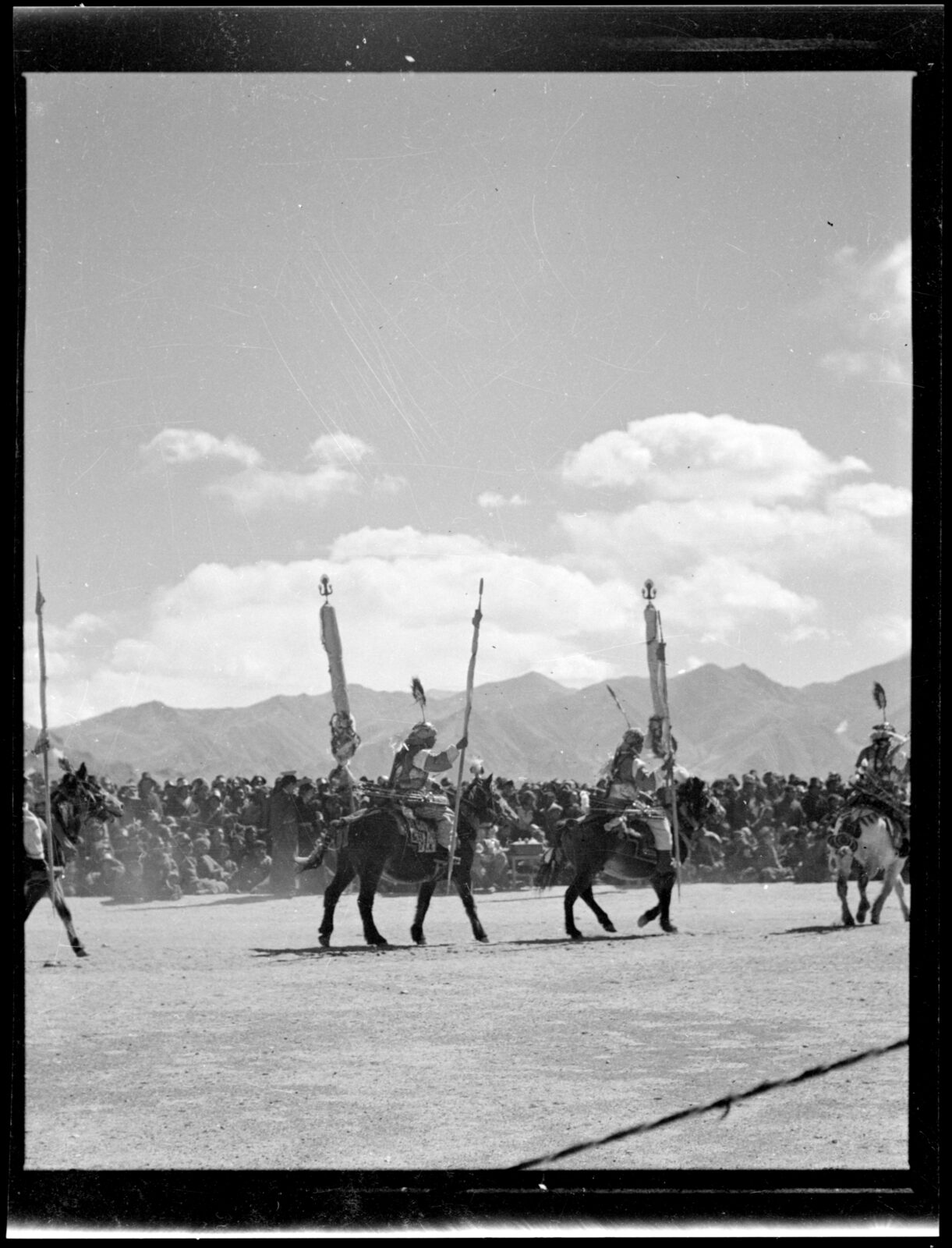
Standard Bearers Carrying Painted Banners of the “Red and Black Protectors of the Faith”; photograph by Hugh E. Richardson, March 5, 1937; From The Tibet Album, “Soldiers dressed in ancient armour at Trapshi Tsisher,” December 5, 2006; The Pitt Rivers Museum, University of Oxford; 2001.59.1.6.1
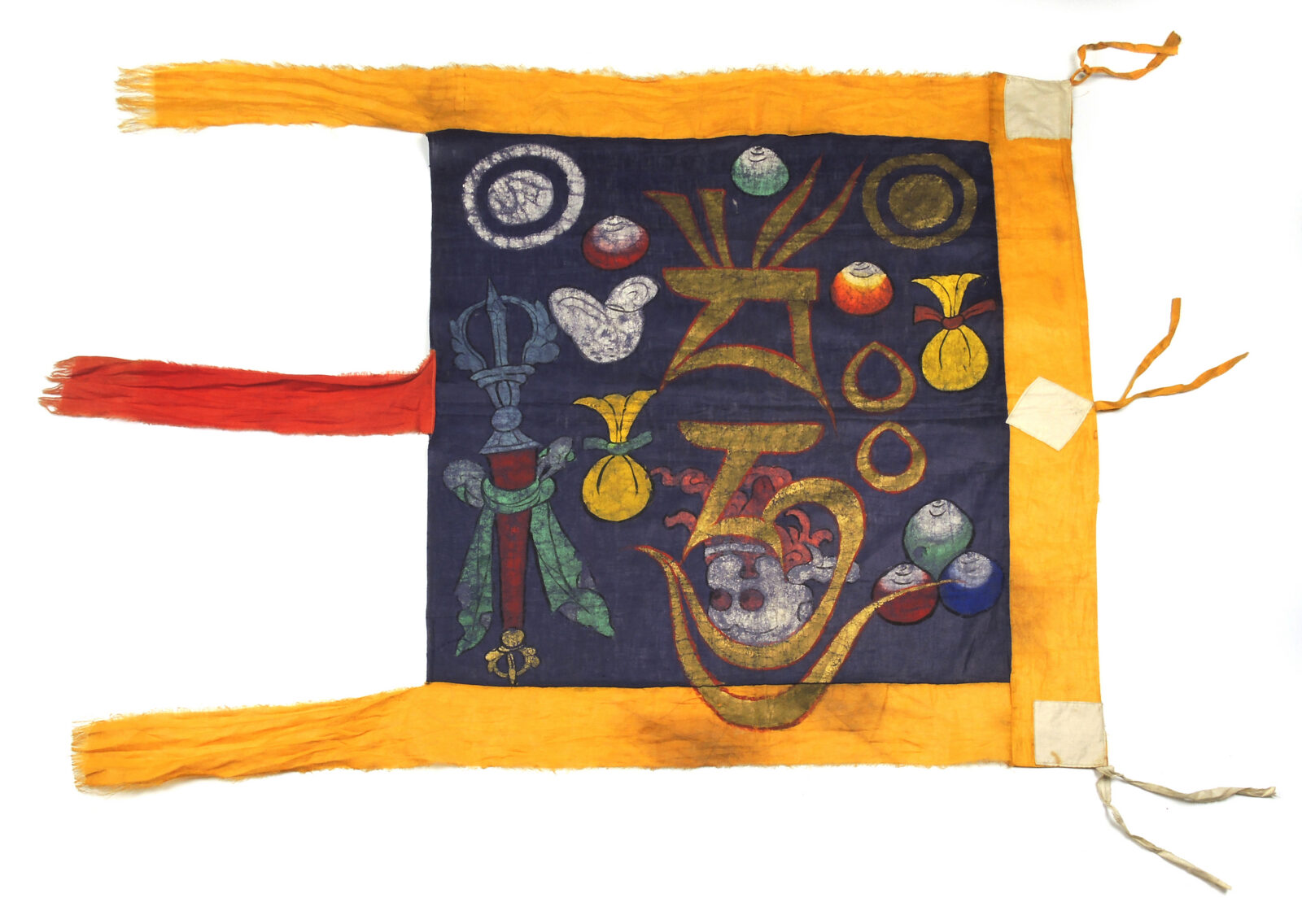
Lhamo flag; pigments on cotton; 95 cm × 81.5 cm; Heinrich Harrer Collection, Ethnographic Museum UZH; inv. no. 14911; photograph by Regula Kreis (Ethnographic Musuem UZH), 2017
Mongolians have long been widely active in the political, religious, and artistic life of the Tibetan Buddhist world. In the 13th century, the Mongols conquered most of Asia and established the largest contiguous empire in world history. They ruled Tibetan regions, and Qubilai Khan and his successors embraced Tibetan Buddhism. Later, in the late 16th century, a massive second conversion of the Mongols to Tibetan Buddhism was more deeply rooted, a conversion so thorough that Tibetan Buddhism became essential to Mongolian identity.
Mongolian Buddhist art is thus similar to Tibetan art, but distinctive in certain subjects, materials, and styles. Deities took on new narratives and meanings in Mongolian contexts as they were integrated into local cosmologies. The vast Tibetan pantheon is not unified or consistent, as deities often merged with local gods and acquired new roles and significance as Buddhism crossed borders. Local understandings of deities change as they traverse cultural realms and spheres, and popular lay beliefs and customs often diverge from doctrinal interpretation. In Mongolia, Lhamo is understood to be a sister (or consort) of Begtse, a war god, another major protector deity in the Geluk tradition, and also special protector of the Dalai Lamas.
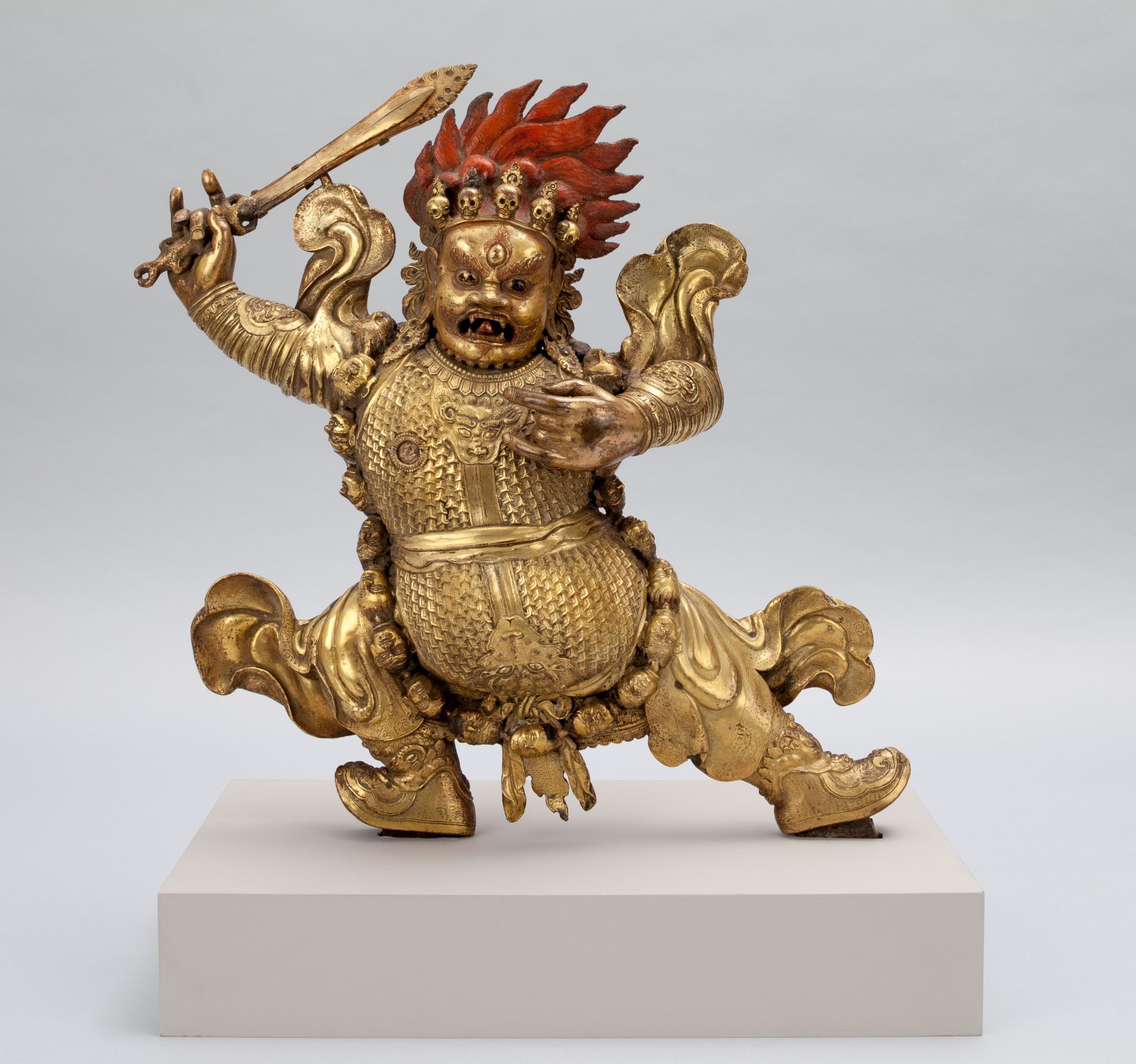
Protector Begtse Chen; Mongolia; late 18th - early 19th century; Gilt copper alloy with pigments; Rubin Museum of Himalayan Art; C2005.12.3
In Mongolia, Lhamo is also called fierce Tara. Mongols of the Gobi especially worship one of her aspects as the Queen of Winter, protector of camels (Hemanta devi).
In Mongolian regions, where many Mongolians are followers of the Geluk tradition, Makzorma is the most popular form of Lhamo. As in Tibet, her role as a powerful protector of Buddhism and the state and her close connection to the Dalai Lama lineage remain important.
In her local Mongolian appropriation, there is a greater emphasis on her function as a war goddess, and she is depicted on military standards carried by warriors into battle. There is a long tradition of carrying protector deity flags at the head of troops, as seen in the earlier photographs of the cavalry processions in Lhasa and their Lhamo banner. Mongols regarded their battle standards as embodiments and abodes of their protector deities. They viewed flags bearing Makzorma’s image as her material receptacles and objects of worship. Her image on battle standards was believed to give strength and courage to soldiers, while also destroying enemies.
For instance, the Kalmyks of the Volga, who are Western (Dzungar) Mongols who migrated to Russia in the 17th century, carried battle standards depicting wrathful deities such as Lhamo.
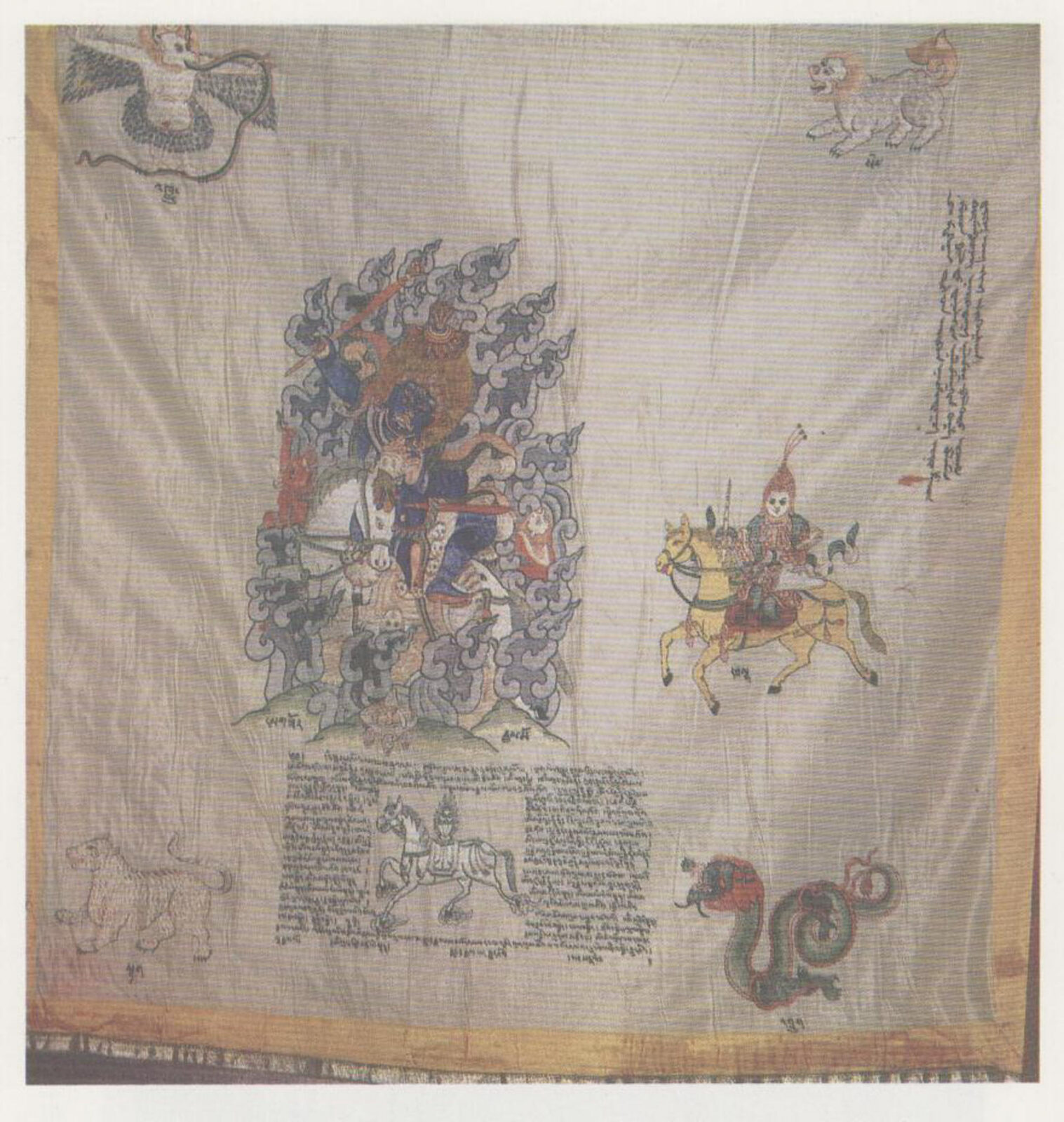
Banner of the Third Don Kalmyk Cavalry Regiment; 1918; silk appliqué, embroidery, and print; Museum of the History of the Don Cossacks (Музей истории Донского казачества), Novocherkassk, Rostov oblast, Russia
An inscription records the head lama of the Don Kalmyks (1903–1919) empowered this standard for the Third Don Kalmyk cavalry regiment in 1918, probably to fight against the Bolsheviks in the Russian Civil War. The appliquéd wrathful figure at the center of the flag is labeled Makzor Gyelmo in Tibetan. There are other accounts of similar banners being used by Kalmyks during Russia’s war with Napoleon in 1812. They were said to bring victories in military campaigns.
In Mongolian regions, Lhamo is also believed to have special healing powers. It is said she can cure all illnesses by swallowing them and breathing them into her bag of diseases, which she can also unleash on enemies. While these might seem like contradictory roles, overlapping functions of healing and prolonging life are not uncommon for protector gods across Inner Asia. Their ferocious power defends against not only enemies but also diseases thought to be caused by demons.
In Mongolia, as in Tibet, Lhamo is also connected to divination practices, as reflected in her iconography.
Textile arts have a long tradition in nomadic societies of Inner Asia, where their animals provided an abundance of fibers. Appliqués made of scraps of silk continue to be extremely popular in Mongolian regions. Traditions of embroidery and appliqué are said to have reached their peak during the Mongol Empire (ca. 1206–1368) when silk became a major medium. Textile arts were so valued that when the Mongols ruled China in the 13th and 14th centuries they elevated the fiber arts above painting in their Yuan dynasty imperial workshops. By the 18th and 19th centuries, when this artwork was made, embroidery and appliqué came to compete with painting.
This example from the Rubin Museum’s collection is typical of the masterful textile images produced in Mongolian workshops from the 18th to early 20th century. Mongolians became especially known for their large appliqués, examples of which can reach several stories tall.
Scraps of multicolored Chinese silks in various patterns are cut to shape and cleverly integrated into complex forms. A variety of embroidery stitches and gold couching (gold-wrapped horsehair fastened to the appliqué with small stitches at regular intervals) delineate the details. Especially distinctive of Mongolian appliqué are tiny seed pearls and small coral beads lavishly stitched onto the textile surface.
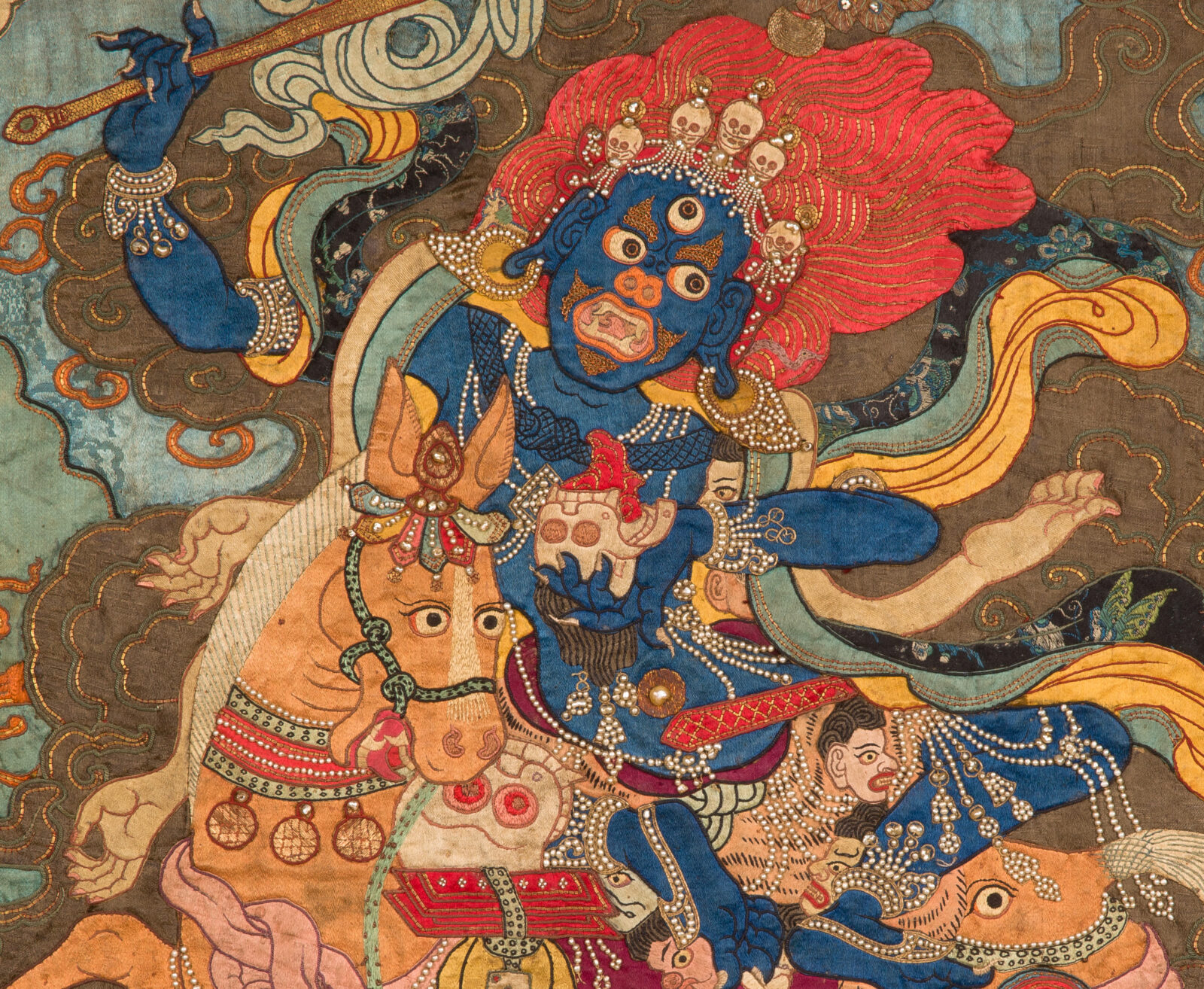
Detail of Makzor Gyelmo, “Queen Who Repels Armies” (F1996.19.1) showing gold-wrapped horsehair (for instance, in Makzor Gyelmo’s hair) and seed pearls as her bone ornaments
In general, master artists or ritual specialists designed sacred textiles such as this by following a traditional system of proportions (iconometry) and iconographic details. Lay women then cut the silk pieces to shape and stitched the works together. Larger compositions typically required several years to produce. Colossal appliqués were often unfurled on mountainsides and exterior monastery walls during important communal Buddhist rituals and celebrations attended by the entire community, such as the Lunar New Year.
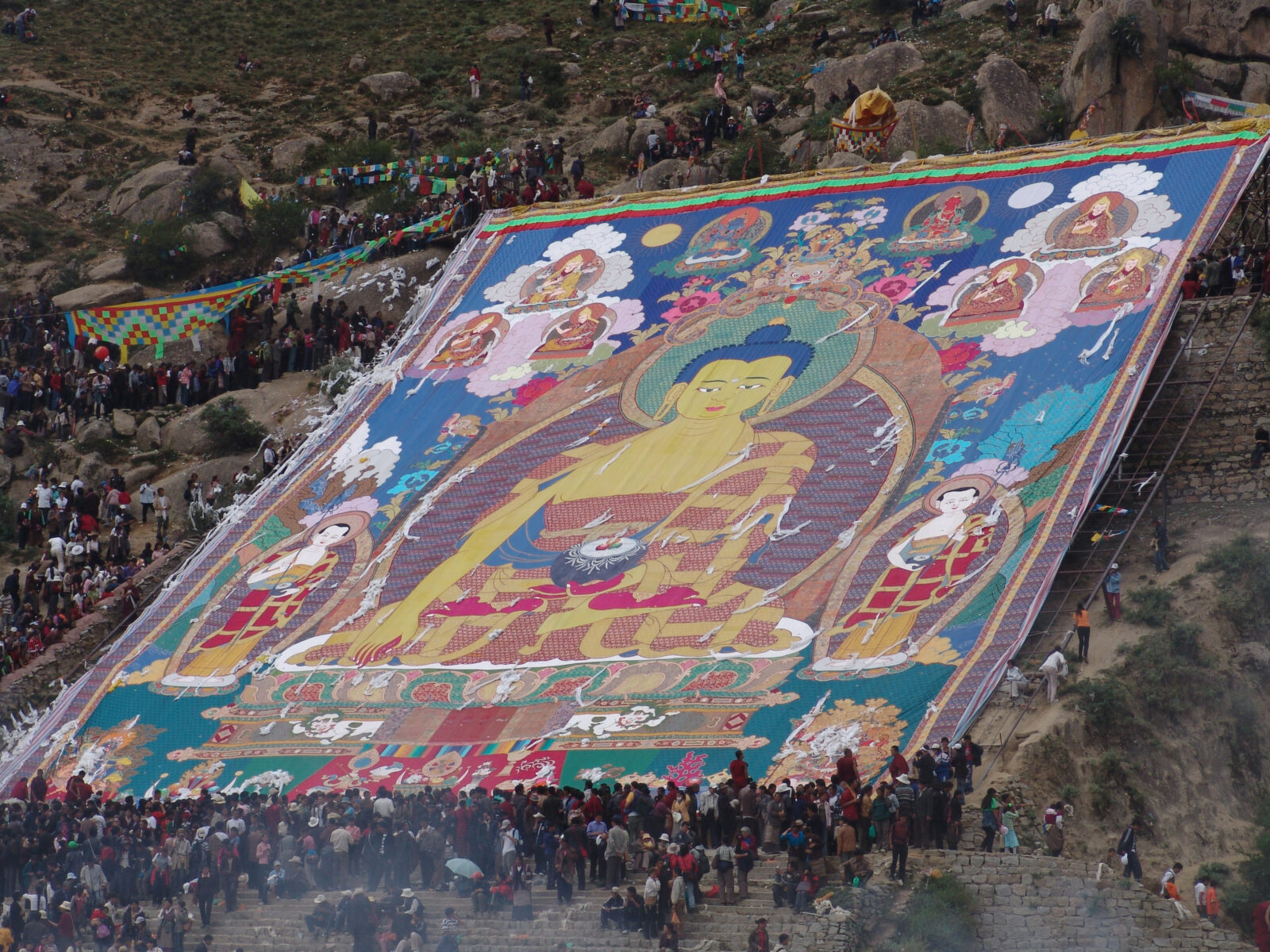
Large-scale appliqué being unfurled; Yogurt Festival, Drepung Monastery, central Tibet; photograph by Karl Debreczeny, 2005
Karl Debreczeny is senior curator, collections and research, at the Rubin Museum of Himalayan Art. His research focuses on artistic, religious, and political exchanges between the Tibetan and Chinese traditions. His publications include The Black Hat Eccentric: Artistic Visions of the Tenth Karmapa (2012) and the coedited The Tenth Karmapa and Tibet’s Turbulent Seventeenth Century (2016). More →

Appliquu00e9 Artistic Tradition and the War God Begtseu2019s Significance in Mongolia
Yekhe Khu00fcriye, Mongolia


Get the latest news and stories from the Rubin, plus occasional information on how to support our work.