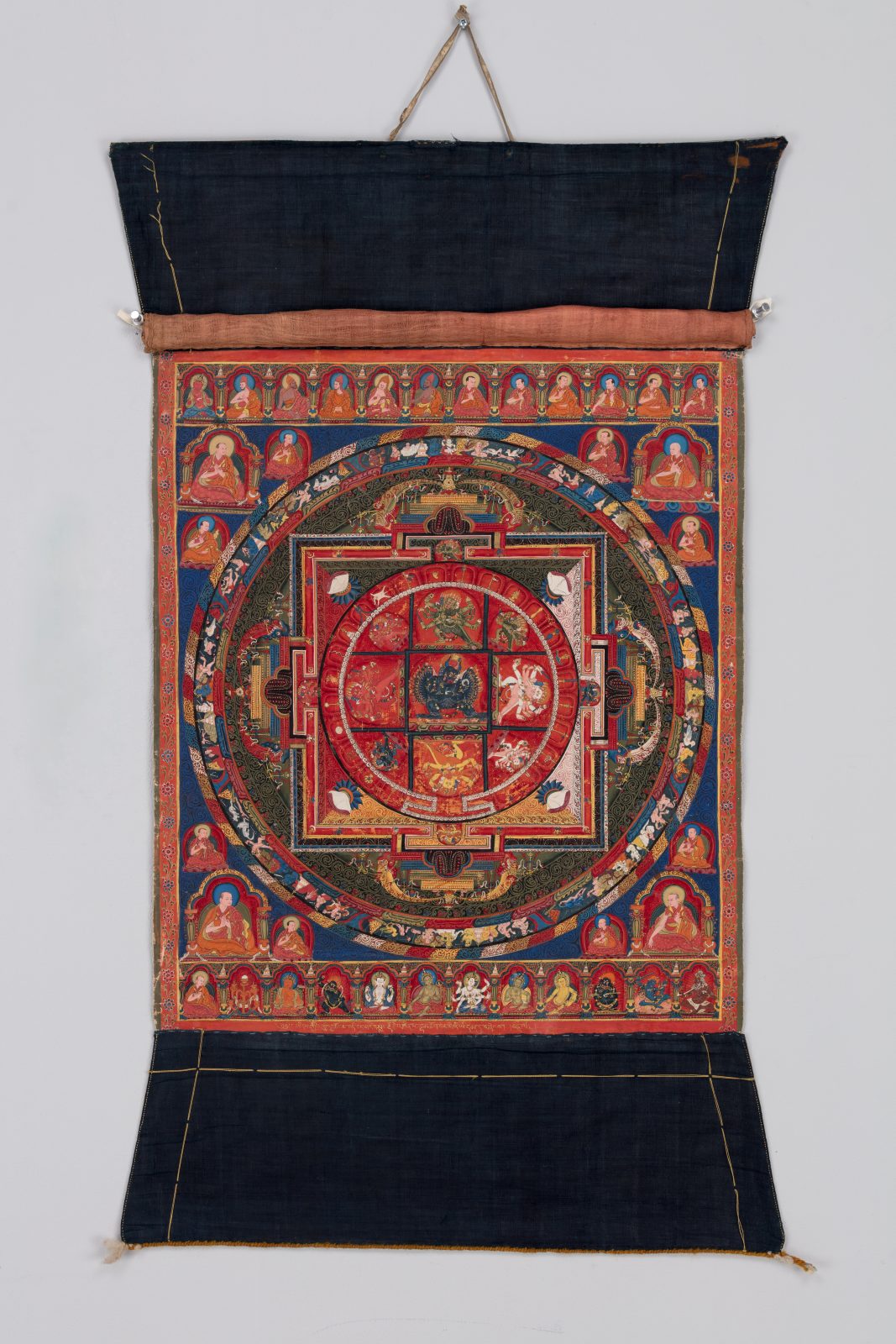
Ngor Ewam Choden Monastery, Tsang region, central Tibet
ca. 1515-1535
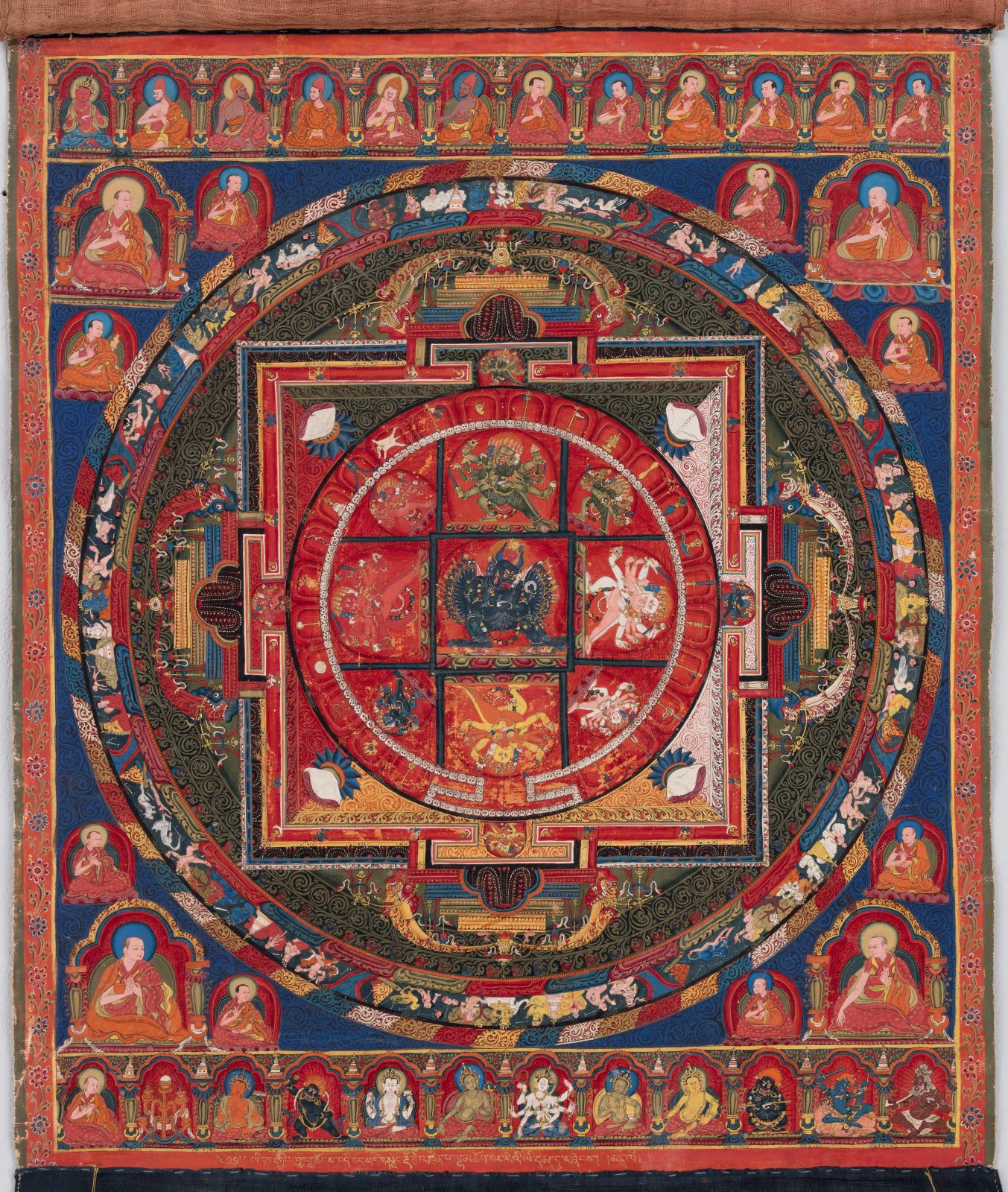


Ngor Ewam Choden Monastery, Tsang region, central Tibet
ca. 1515-1535
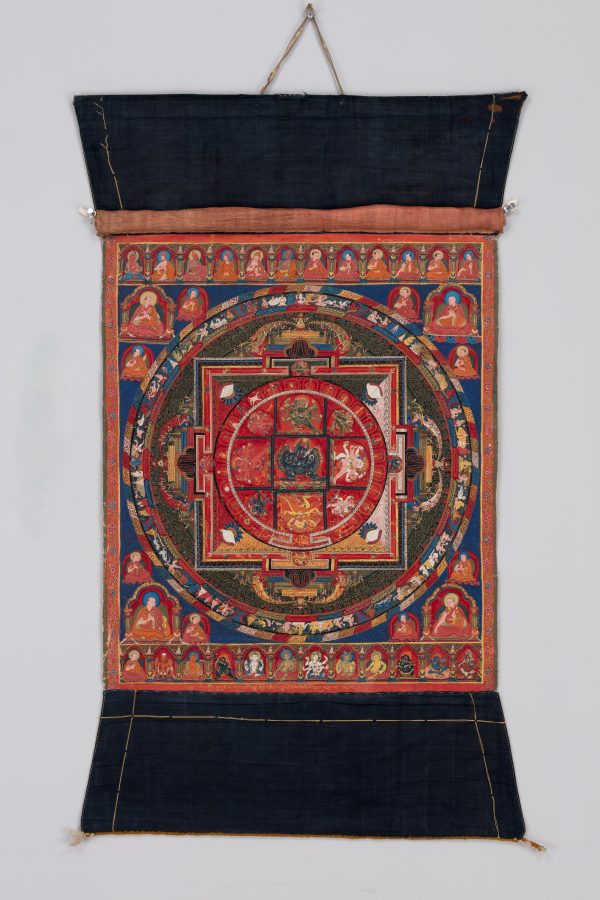
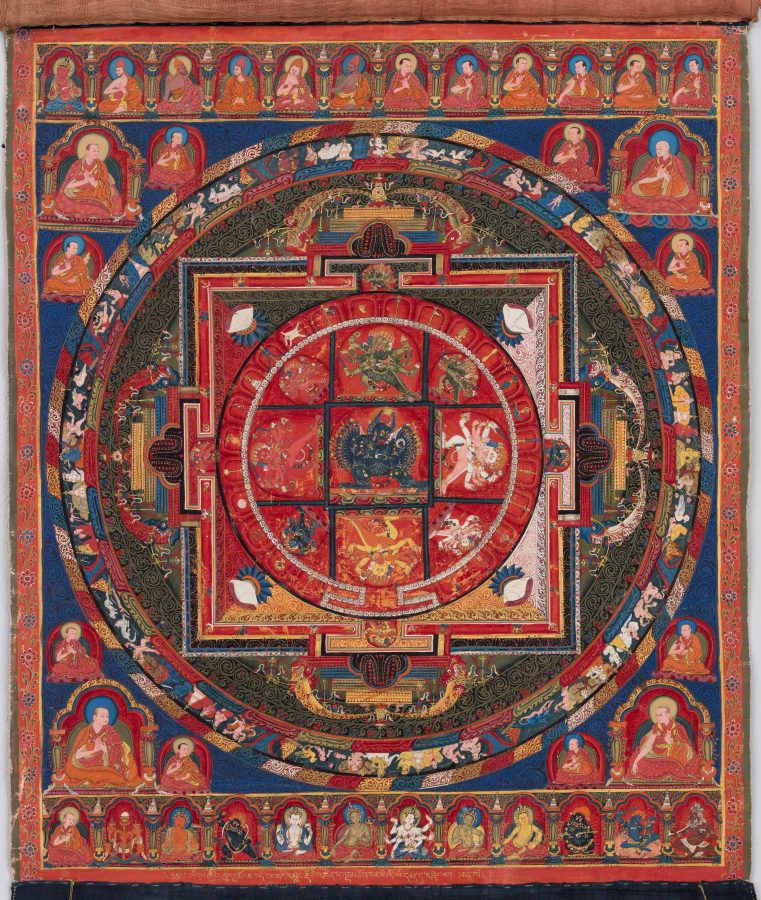
A mandala is the cosmic abode of a deity, usually depicted as a geometric diagram of a circle inscribed by a square. It represents the deity enthroned in their palace, surrounded by members of their retinue. This 13-deity mandala is dedicated to Vajrabhairava, as taught in the tradition of the great translator and tantric ritual master Ra Lotsawa Dorje Drak (1016–1128).
Vajrabhairava is one of the most visually complex of all the Tantric Buddhist deities. He can be recognized by his large buffalo head surrounded and topped by eight additional faces, as well as his 34 four arms and 16 legs. Vajrabhairava is both a meditational deity (yidam) and a protector deity, and he is considered especially powerful for eliminating obstacles. Vajrabhairava is also a wrathful emanation of Manjushri, the bodhisattva of wisdom, whose peaceful head tops his own.
An inscription at the bottom of the painting records it was commissioned by the ninth abbot of Ngor Monastery, Lhachok Sengge (1468–1535), for his personal practice. He is represented in the bottom-left corner. Ngor became well known in Tibet for producing elaborate, intricate mandalas in the Nepalese style.
This extremely fine painting demonstrates the continuation into the 16th century of the Nepalese-inspired painting tradition (Beri) in the Sakya Buddhist monastic centers of the central Tibetan region of Tsang. While certain details, such as the background scroll patterns and the three-lobed arches supported by lotus pillars in the corners, were already prominent in the early 15th century, this later work introduces new elements. The color palette is more varied, and the representation of the teachers in the lineage in the top and bottom registers is more individualized. This painting is particularly remarkable for the fineness of its details, such as the white stupas at the head of each tiny pillar and the refined Newar-inspired scrollwork that fills every empty space.
In Tibet, where Buddhism was imported from many sources and at different times, demonstrating legitimate ties to India was a major priority. The top of the painting traces the lineage of the practice from teacher to teacher, back to authentic Indian masters.
A religious movement that originated in India around the fifth to seventh century with sacred writings and esoteric teachings and practices transmitted from teacher to student through initiation. These remain an important part of Hinduism and Buddhism today.
Buddhist practitioners in some traditions believe that cutting through ordinary perceptions that keep us in the endless cycle of death and rebirth, known as samsara, can create a powerful and enhanced divine identity that leads to enlightenment.
A contemplative practice in which a person uses concentration and visualization to achieve aims such as transforming the mind and generating feelings of compassion. Techniques include focusing on breathing or visualizing oneself as a deity.
A geometrically shaped tool used for meditation and visualization in Buddhist practice. It is a representation of the palace of a deity and the Buddhist conception of the cosmos.
Today, Tibetans primarily inhabit the Tibetan Plateau, situated between the Himalayan mountain range and the Indian subcontinent to the west, Chinese cultural regions to the east, and Mongolian cultural regions to the northeast. During the 7th to 9th century, Tibetan rulers expanded their empire across Central Asia, and established Buddhism as the state religion.




Get the latest news and stories from the Rubin, plus occasional information on how to support our work.