Kham region, eastern Tibet
late 19th century
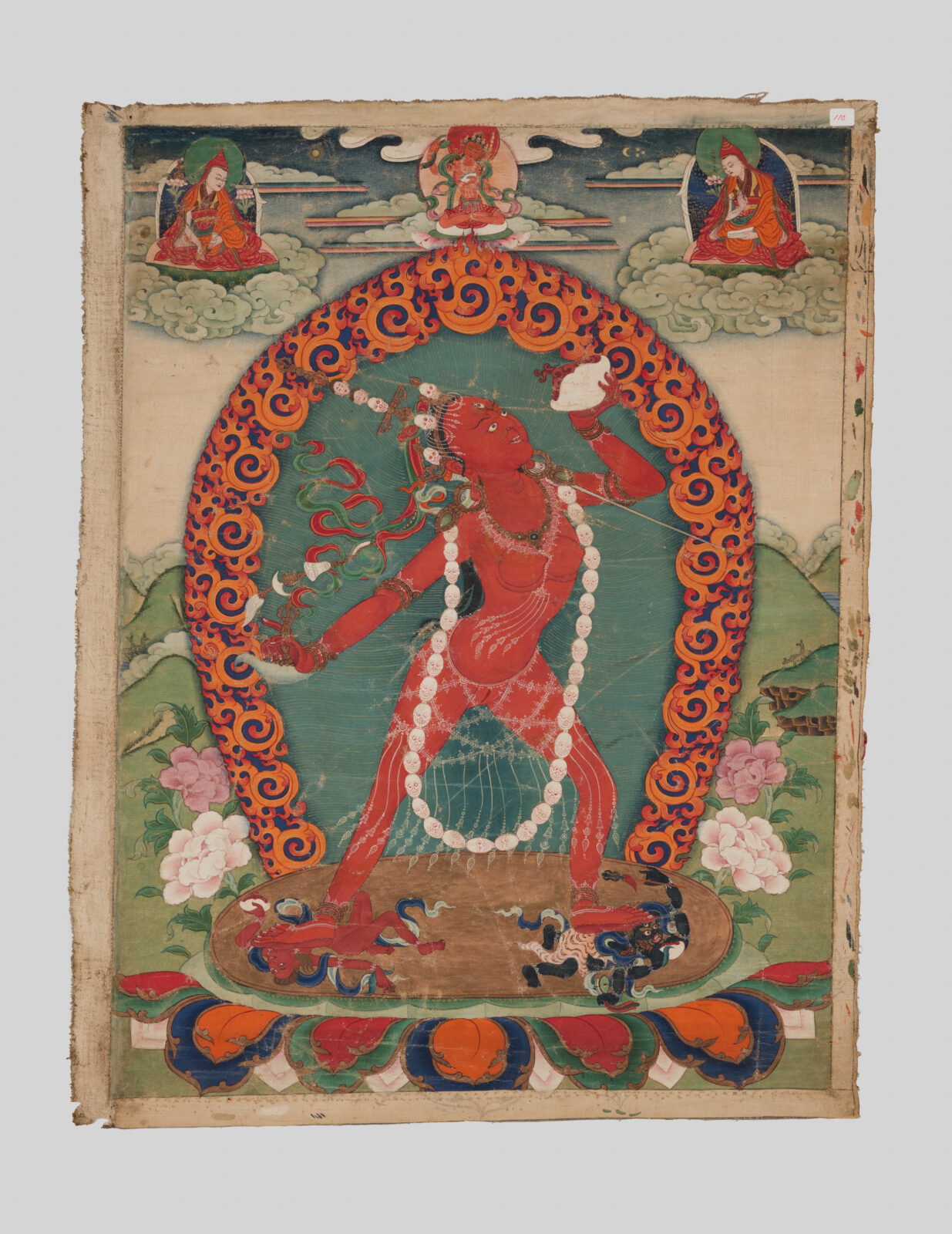
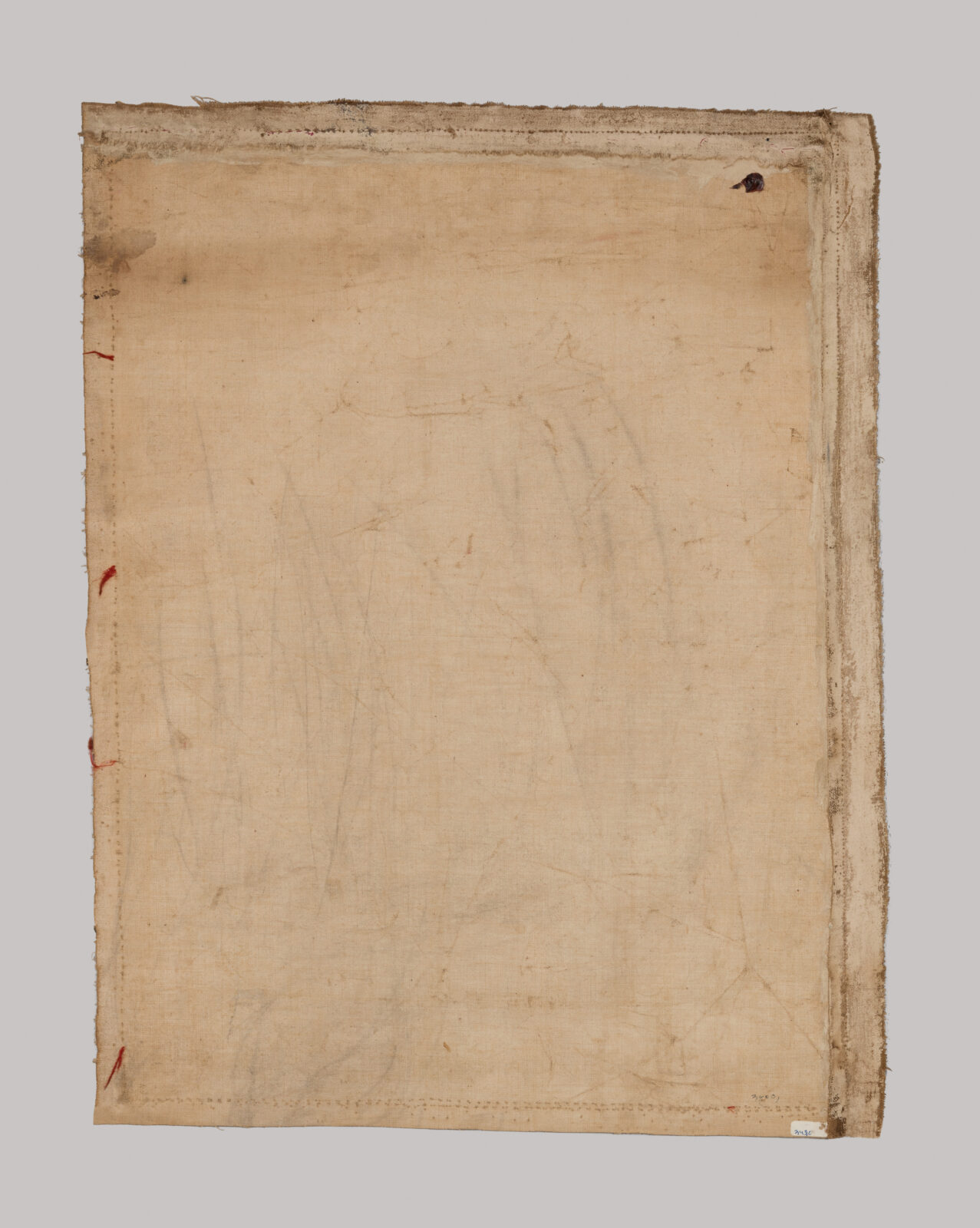

Kham region, eastern Tibet
late 19th century
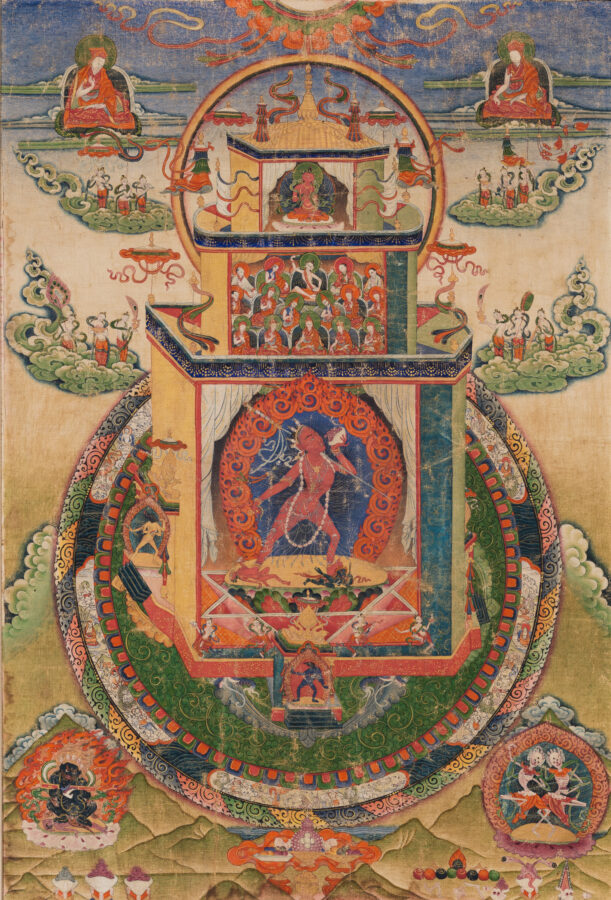
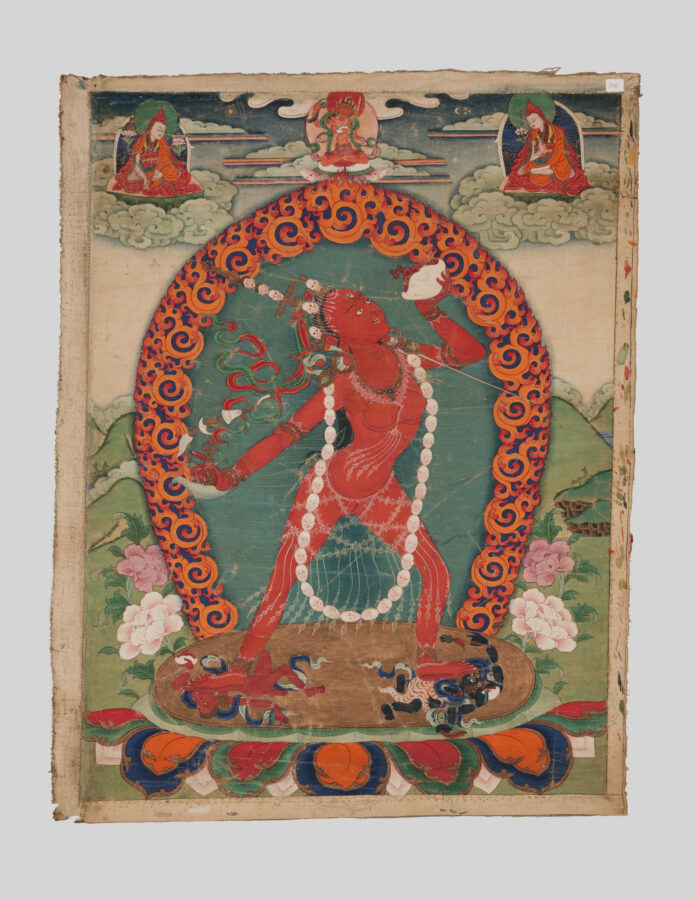
This vibrant semi-wrathful goddess is Vajrayogini in the form Khechari, according to the teachings of Indian tantric yogi Naropa (ca. 956–1040), to whom she is said to have appeared in visions. She is red in color, lunging in a dynamic pose, holding a curved knife in her right hand, and raising a skull cup to her lip with her right hand. A katvanga staff with three severed heads is balanced in the crook of her arm.
Above at top center in the position of the root deity of the teachings depicted is Buddha Vajradharma, a form of the primordial Buddha Vajradhara. He is flanked by two famous scholars of the Sakya tradition of Tibetan Buddhism: Jamyang Kyentse Wangpo (1820–1892) of Dzongsar Monastery, Derge, in Kham, who wrote many texts on Vajrayogini, and his principal student, Jamyang Loter Wangpo (1847–1914) of Ngor Ewam Choden Monastery.
This painting is likely from the Kham region in southeastern Tibet from where Jamyang Kyentse Wangpo hails, as it is consistent with local Khamri painting traditions. Characteristics of Khamri painting seen here include the combination of the strong color palette of the local New Menri with aspects of the local Gardri tradition, such as open airy unpigmented skies and subtle drop-shading, which gives the impression of the flaming body nimbus of the central deity rising off the surface of the painting.
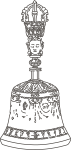
A bell is often paired with the vajra and is another implement used in tantric practices and an attribute of tantric masters and deities. It generally symbolizes wisdom, the feminine aspect of enlightenment, and its ring is said to be the sound of emptiness.

A vajra is a ritual scepter used in tantric practices and an attribute of tantric masters and deities. It generally symbolizes method, the male aspect of enlightenment.

A skull cup is an attribute of tantric deities and is usually paired with a curved knife. It can symbolize a mind filled with the bliss of realizing the true nature of reality.

This weapon is an attribute of tantric deities and is usually paired with a skull cup. When held by female deities it symbolizes wisdom’s destruction of all obstacles to enlightenment. When held by male deities it represents the method aspect of enlightenment.

An attribute of tantric deities, this staff represents the union of the two aspects of enlightenment. When held by a male deity it symbolizes his female consort as wisdom, and when held by a female deity it represents her male consort as method.
A religious movement that originated in India around the fifth to seventh century with sacred writings and esoteric teachings and practices transmitted from teacher to student through initiation. These remain an important part of Hinduism and Buddhism today.
In Buddhism gender is considered more fluid compared to some other religions. Certain traditions emphasize the importance of all genders in achieving enlightenment. The feminine is considered an embodiment of wisdom and the masculine is an embodiment of method.
The antidote to ignorance, with the highest form of wisdom being an understanding of the true nature of reality and all phenomena. In Buddhism studying the nature of interdependence and emptiness is considered an important step for attaining wisdom.
A meditation technique primarily used in tantric practice that involves imagining a deity in one’s mind or imagining oneself becoming a deity and carrying out various activities. Such techniques are intended to help a practitioner transform ordinary perception and achieve enlightened qualities.
The transmission of teachings from one generation to the next, from teacher to student, traced all the way back to the Buddha without interruption. A complete lineage is essential in Tantric Buddhist practices as it makes the blessings of the teaching more powerful.
Female bodhisattvas and tantric deities embody specific enlightened qualities such as wisdom, power, and protection, and can be peaceful or wrathful in appearance.
Tantric deities personify various enlightened qualities and are the focus of esoteric religious practices (tantras) that aim to swiftly and radically transform one’s understanding of reality.
Today, Tibetans primarily inhabit the Tibetan Plateau, situated between the Himalayan mountain range and the Indian subcontinent to the west, Chinese cultural regions to the east, and Mongolian cultural regions to the northeast. During the 7th to 9th century, Tibetan rulers expanded their empire across Central Asia, and established Buddhism as the state religion.

Get the latest news and stories from the Rubin, plus occasional information on how to support our work.