Tibet or Mongolia
18th century
Tibet or Mongolia
18th century
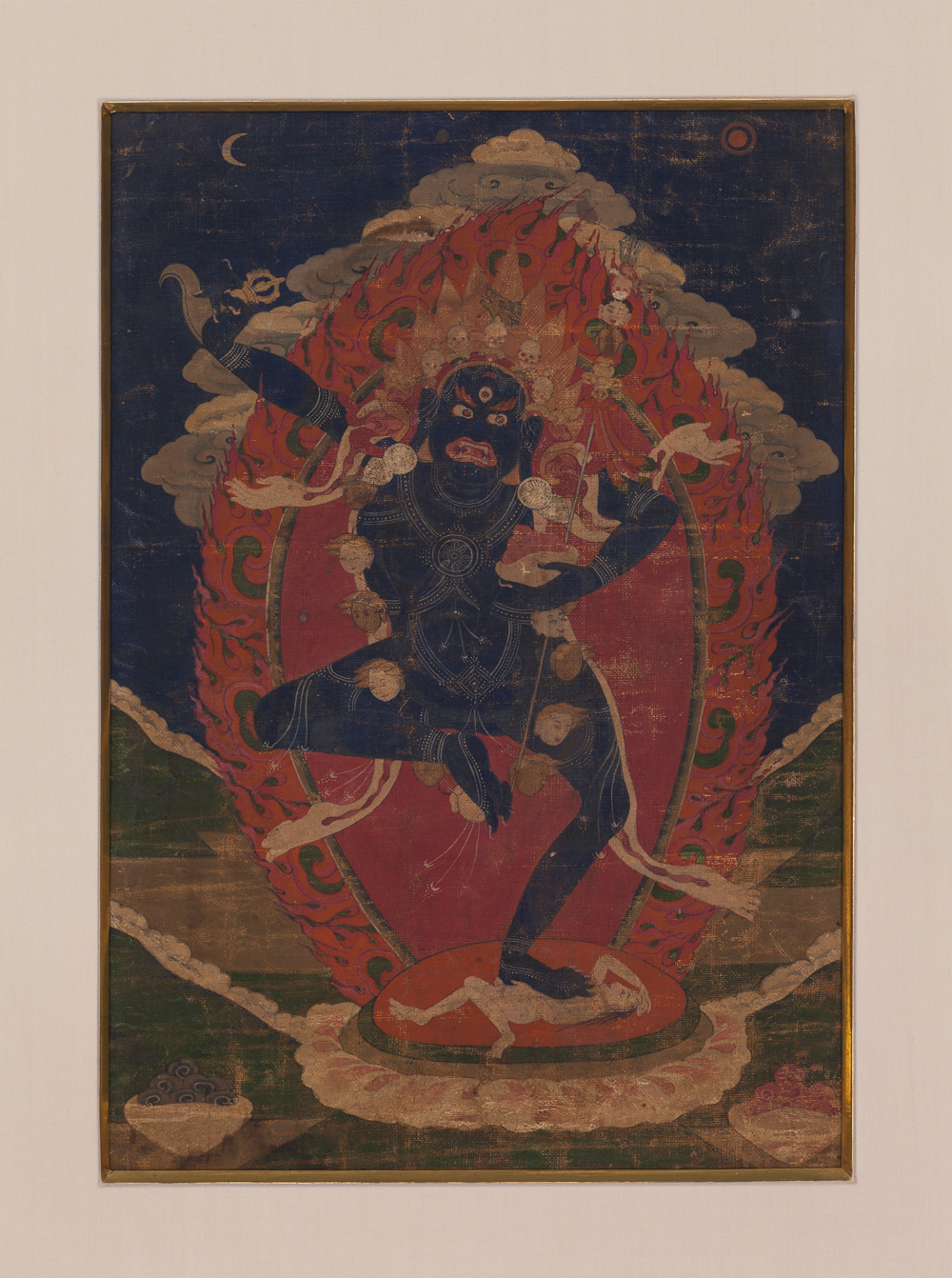
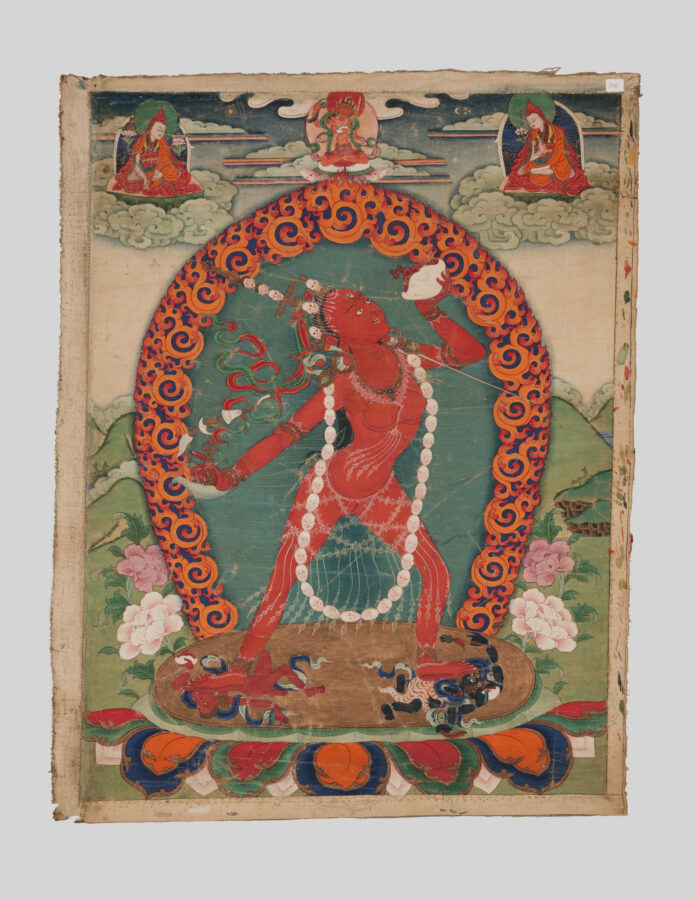
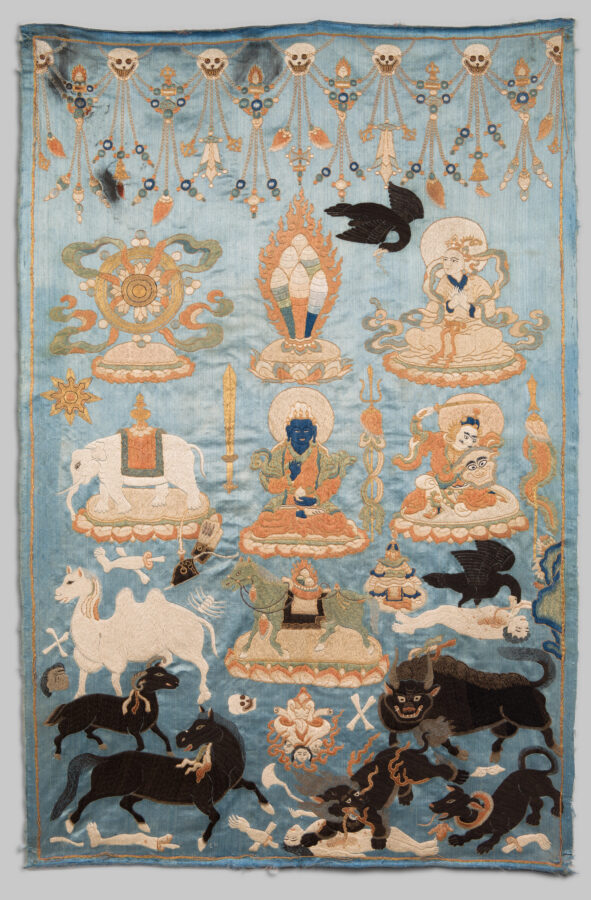
Krodha Kali, or “Black Wrathful Lady,” is the most wrathful manifestation of the supreme Buddhist wisdom goddess, Vajravarahi, also known as Vajrayogini. For Tibetan Buddhists, her frightening form is not an expression of cruelty, but rather symbolizes her fiercely compassionate ability to cut through the ego, fear, and attachments that keep beings trapped in suffering.
According to Krodha Kali’s meditation and ritual manuals, the curved flaying knife in her raised right hand severs illusion, while her black color represents the all-encompassing space of ultimate reality, beyond the dualistic categories of pure and impure. Her nudity signifies freedom from artifice and concealment, and the corpse beneath her feet represents the death of ego-clinging, trampled underfoot rather than feared.
Krodha Kali occupies a central place in the practice of Chod (Severance), a Tibetan Buddhist meditation system that emerged from the broader Zhije (Pacification) teachings brought to Tibet by the 11th-century Indian master Padampa Sangye. His disciple, the female master Machik Labdron, developed Chod as an independent practice, adopting Krodha Kali as a central deity in her system. During the practice of Chod, practitioners visualize themselves transforming into Krodha Kali and offering all their dearest possessions, including their own body, as an act of radical generosity for the benefit of all sentient beings. By imaginatively relinquishing the very things many people cling to most tightly, Chod practitioners cultivate fearlessness in the face of adversity and loosen the grip of self-clinging that Buddhist teachings identify as the root of suffering.

A skull cup is an attribute of tantric deities and is usually paired with a curved knife. It can symbolize a mind filled with the bliss of realizing the true nature of reality.

This weapon is an attribute of tantric deities and is usually paired with a skull cup. When held by female deities it symbolizes wisdom’s destruction of all obstacles to enlightenment. When held by male deities it represents the method aspect of enlightenment.

An attribute of tantric deities, this staff represents the union of the two aspects of enlightenment. When held by a male deity it symbolizes his female consort as wisdom, and when held by a female deity it represents her male consort as method.
An energy wielded with intention, skill, and compassion to offer protection and remove obstacles. In Buddhism, it is considered different than negative emotions like anger or rage.
A religious movement that originated in India around the fifth to seventh century with sacred writings and esoteric teachings and practices transmitted from teacher to student through initiation. These remain an important part of Hinduism and Buddhism today.
In Buddhism gender is considered more fluid compared to some other religions. Certain traditions emphasize the importance of all genders in achieving enlightenment. The feminine is considered an embodiment of wisdom and the masculine is an embodiment of method.
A state of “waking up” from illusion and seeing the true nature of reality. Buddha Shakyamuni attained enlightenment while meditating under the bodhi tree. Buddhist teaching explains that the accumulation of merit and wisdom are essential for achieving enlightenment, also known as awakening.
A state of “waking up” from illusion and seeing the true nature of reality. Buddha Shakyamuni attained awakening while meditating under the bodhi tree. Buddhist teaching explains that the accumulation of merit and wisdom are essential for achieving awakening, also known as enlightenment.
The antidote to ignorance, with the highest form of wisdom being an understanding of the true nature of reality and all phenomena. In Buddhism studying the nature of interdependence and emptiness is considered an important step for attaining wisdom.
A meditation technique primarily used in tantric practice that involves imagining a deity in one’s mind or imagining oneself becoming a deity and carrying out various activities. Such techniques are intended to help a practitioner transform ordinary perception and achieve enlightened qualities.
Female bodhisattvas and tantric deities embody specific enlightened qualities such as wisdom, power, and protection, and can be peaceful or wrathful in appearance.
Tantric deities personify various enlightened qualities and are the focus of esoteric religious practices (tantras) that aim to swiftly and radically transform one’s understanding of reality.
Protectors of Buddhist teachings who destroy obstacles that impede the path to enlightenment. The more frightening and gruesome their appearance, the greater their power.
Mongolians have been widely active in the Tibetan Buddhist world, playing a key role in Tibetan culture, politics, and relations with China. In the 13th century, the Mongol Empire—the largest contiguous empire in world history—facilitated the spread of Tibetan visual culture.
Today, Tibetans primarily inhabit the Tibetan Plateau, situated between the Himalayan mountain range and the Indian subcontinent to the west, Chinese cultural regions to the east, and Mongolian cultural regions to the northeast. During the 7th to 9th century, Tibetan rulers expanded their empire across Central Asia, and established Buddhism as the state religion.

Get the latest news and stories from the Rubin, plus occasional information on how to support our work.