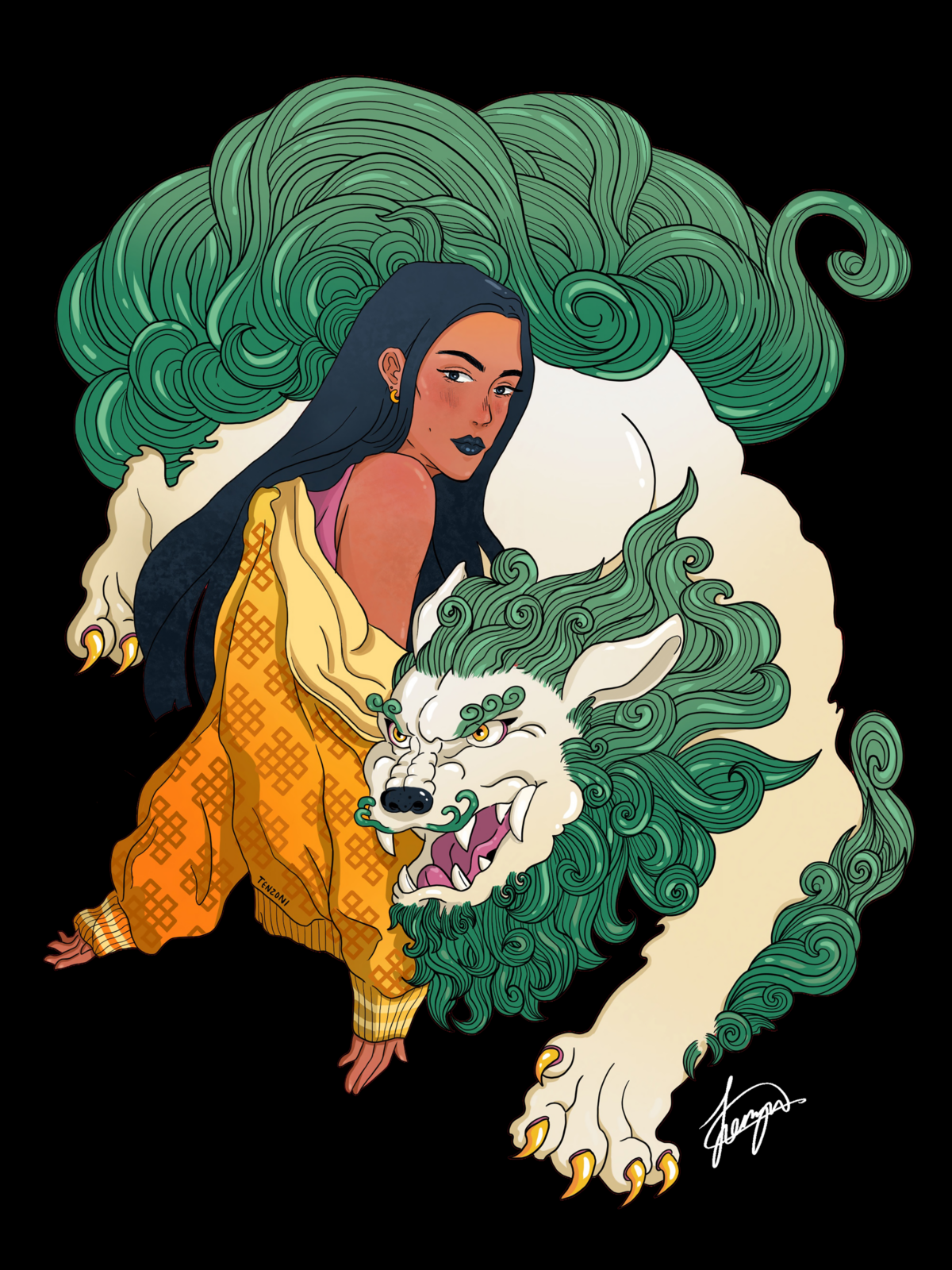
Tenzin Tsering; The Protector
Tenzin Tsering; The Protector
Tenzin Tsering: My creative process started by looking for the perfect story to tell on the theme of wrath, and who came to mind was an author I had worked with previously named Elaine Lai. I knew Elaine would navigate the themes well and in a profound way that I could bring justice to in my art.
When the story was finalized, the next step was to lay out the look of the comic. We knew we wanted it to flow as a spread through two pages, so it was a challenge to think of how to keep the reader’s eye moving from space to space without borders, while also hitting the emotional arcs of the story. I’m very proud of what we created, and I hope the animation we created for the online version can act as a guide to navigate through the comic.
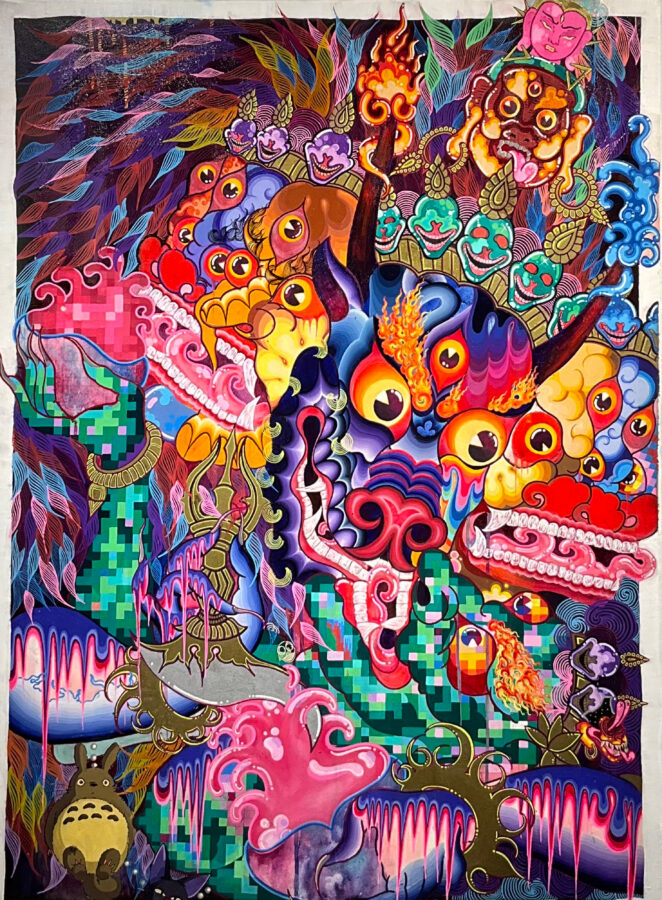
I grew up being acutely aware of the beautiful intricate artworks and design motifs of temples, stupas, and thangka paintings. I was also extremely fascinated with the stories from my father’s life in Tibet. A lot of my work now is inspired by what he shared with me as I was growing up in Canada. I think on some level it is always important for me to acknowledge that I am not a Tibetan from Tibet. I am someone else with my own individual cultural identity, being Canadian and half Filipino. In order not to lose my cultural ties to Tibet, I have always made a conscious effort to at least be somewhat interested in the iconographies, concepts, and patterns of Tibetan and Himalayan art.
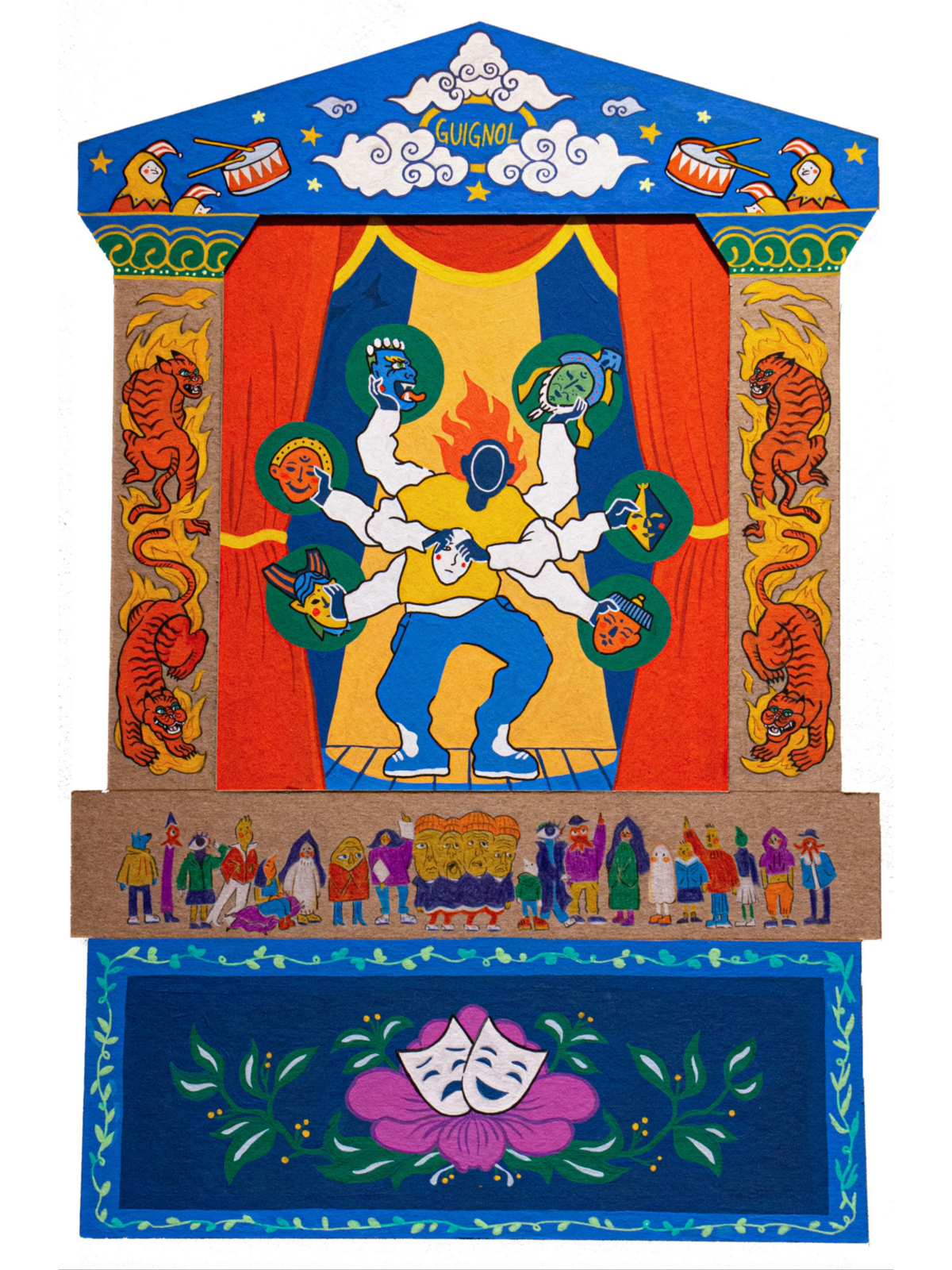
Tenzin Tsering; Act Naturally
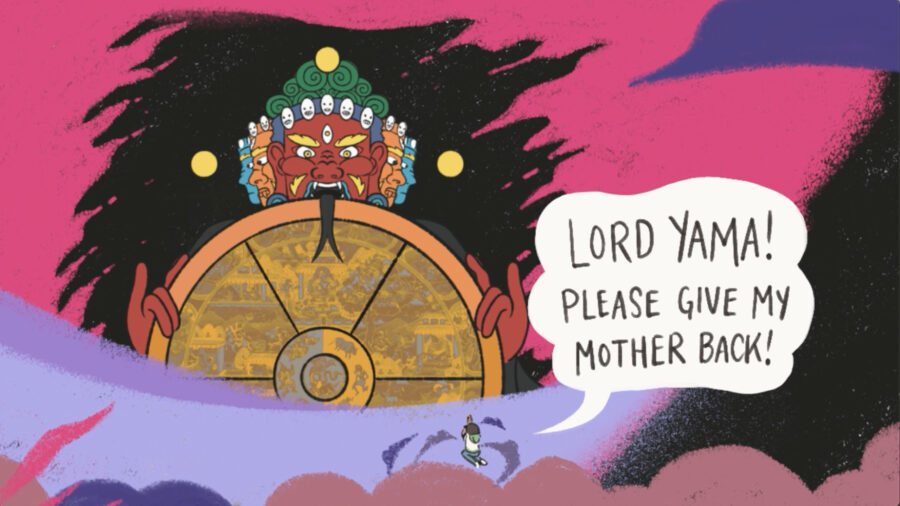
For the comic I drew for the wrath issue of Spiral, it was about reframing or challenging what wrath may look like in the context of loss and grief. It was about showing what the combination of sadness and anger may look like, and what a person can choose to do when they feel these emotions so intensely. In the character of Bellie’s case, it was wishing to meet Lord Yama and choosing kindness over destruction. I didn’t want Lord Yama to be depicted in a horrifying light, but more as a benevolent deity of choice.
Some of my work reflects issues like environmentalism or political activism. But on a larger scale, I think my work reflects the human need to perpetuate identity, whether it be cultural, spiritual, or personal.
It involves a lot of thinking, researching, and feeling. When I have an idea, I need to sketch it down on paper with a pencil, but sometimes when I’m feeling bold, I can go right into digitizing my sketch by drawing on my iPad.
Then, I refine the sketch, add line art or block in color, and then finalize it with light and shadow, or by cleaning up my colors so they feel harmonious and convey the right emotion I want to communicate with the piece.

Tenzin Tsering; Clearly Misunderstood
Slow days, reading physical books, taking hot baths, walking or sitting in nature, talking to loved ones, cleaning my space, daydreaming. Creative blocks are inescapable, and I’m learning to be kinder to myself in order to work through them.
I think it was a self-portrait drawn with pencil crayon where I looked like a very large and very burnt potato wearing a pair of little red glasses.
I have found that the evolution for artists first starts with drawing like your favorite artists, to drawing what other people tell you is good, then drawing what you yourself love. Then usually it’s a happy medium of all three.
I love the art of Hayao Mizakai of Studio Ghibli so much. I think I’ve downplayed to myself how much his sense of storytelling and character writing has inspired my artwork throughout the years. I grew up watching his films and being in awe of almost every single one. And his recurring themes of environmentalism, pacifism, strong female leads, and complex morality have always stuck out to me and informed my own writing.

Tenzin Tsering; Mountain Climbing and Pollution
Yes, always! It’s usually never pinned down to one genre. Sometimes it’s of the lofi jazz variety. Other times it’s Frutiger Aero, Midwestern emo, or movie soundtracks. I mostly listen to songs without words when I’m drawing, so I can focus on the emotion of the song and not the lyrics. Sometimes the music will relate to the drawing and the drawing will be inspired by the music. Those are fun, too!
I’m still trying to figure this one out, because making art full time requires a level of distinction between the two. I have recently been setting the intention of giving myself deadlines for working on personal art, because otherwise it just won’t be done! I am also trying to be more choosy with the projects that come my way, otherwise I tend to say yes to everything, burn myself out, and have no time for personal work. It’s an ongoing process!
I am so grateful to be awarded a Rubin Grant! It will no doubt change the trajectory of my career, because it is my dream to create my own graphic novel. With the grant, I can dedicate time to the project without some of the burden of financial stress, at least for a while. I’m sure the process of creating it will teach me new things, allow me to grow, and open up doors, both for me and for readers who will interact with it.
On one hand, I hope my art can evoke a sense of cultural representation of Tibetan and Himalayan heritage in a contemporary way. I hope others can see their spirituality, their characters, and their family members represented in my art.
I also want to imbue the world with more narratives about my lived experience of being a second-generation Southeast Asian woman. I do that through stories, comics, and paintings with lots of color. I hope that I inspire others to keep creating art and narratives in their own worlds so we can keep the beautiful tradition of art making alive.
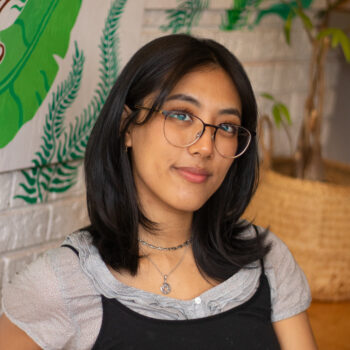
Tenzin Tsering is a Tibetan Filipino illustrator and 2D artist based in Toronto, Canada, known for her vibrant use of color and dynamic storytelling through visual art. Drawing from her rich South East Asian cultural heritage and the whimsical world of comics, she creates immersive artworks in many creative fields such as mural painting, editorial art, book covers, comic illustrations, and character design.

Christina Watson is the digital editor at the Rubin Museum of Himalayan Art.
Get the latest news and stories from the Rubin, plus occasional information on how to support our work.