The Seattle Asian Art Museum (SAAM) is displaying artworks from the Rubin’s collection in Boundless: Stories of Asian Art, a sweeping exhibition which aims to redefine how stories about Asia are told. Rather than organizing the exhibition by geography, the installation unfolds through 12 thematic sections, creating a nonlinear narrative that encourages connections across cultures and histories.
Although SAAM is one of the few museums in the United States dedicated to Asian art, they hold limited representation of Tibetan and Mongolian works. Recognizing that the Rubin could help weave a richer narrative, Senior Curator Karl Debreczeny suggested objects from the Museum’s collection that would support a more inclusive and interconnected story of Asian art.
Read on to learn about these artworks and how they relate to the themes in Boundless: Stories of Asian Art. The objects will be on rotation through 2031.
This overarching section comprises the subsections below and reflects Asia’s many faiths from across East Asia to South Asia and the Middle East, including Hinduism, Buddhism, and Islam.
Ritual Implements
In most religious traditions, certain objects hold symbolic meaning and some believers use them during rituals. These implements are often used to engage the senses (sight, hearing, taste, touch, smell) of both the worshipper and the divine.
Usually depicted as a geometric diagram of a circle inscribed by a square, a mandala is the cosmic abode of a deity, enthroned in their palace, surrounded by members of their retinue. Mandalas are important objects in Tibetan Buddhism, used for initiation ceremonies, visualized by a practitioner as part of deity yoga, consecrated and used to represent the divine presence within ritual space, and offered to deities as representations of the entire universe.
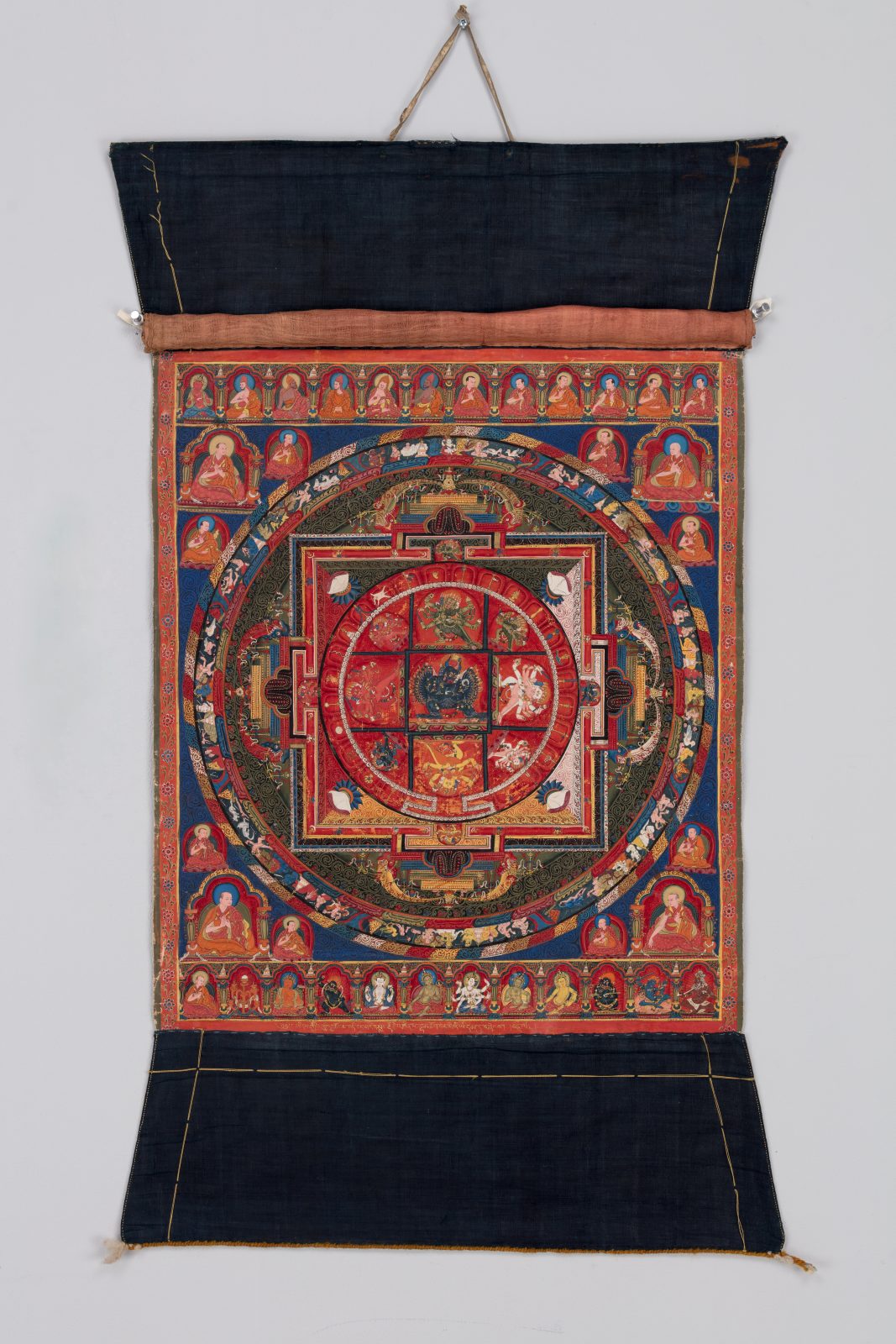
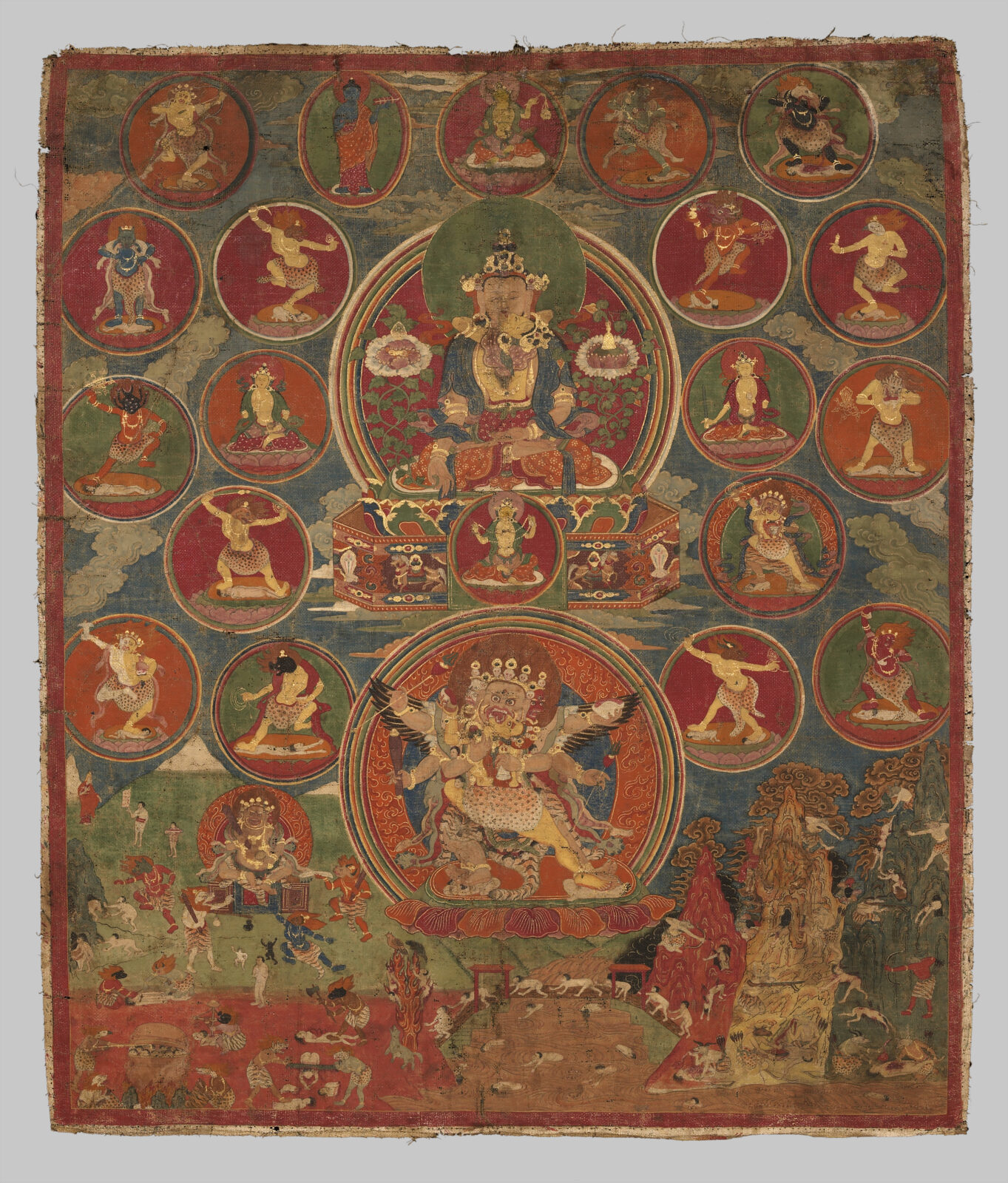
This 13-deity mandala is dedicated to Vajrabhairava, taught in the tradition of translator and tantric ritual master Ra Lotsawa Dorje Drak (1016–1128). Vajrabhairava is one of the most visually complex of all the Tantric Buddhist deities, recognizable by his large buffalo head with eight other faces, 34 arms, and 16 legs. He is both a meditational deity (yidam) and a protector, and especially powerful for eliminating obstacles.
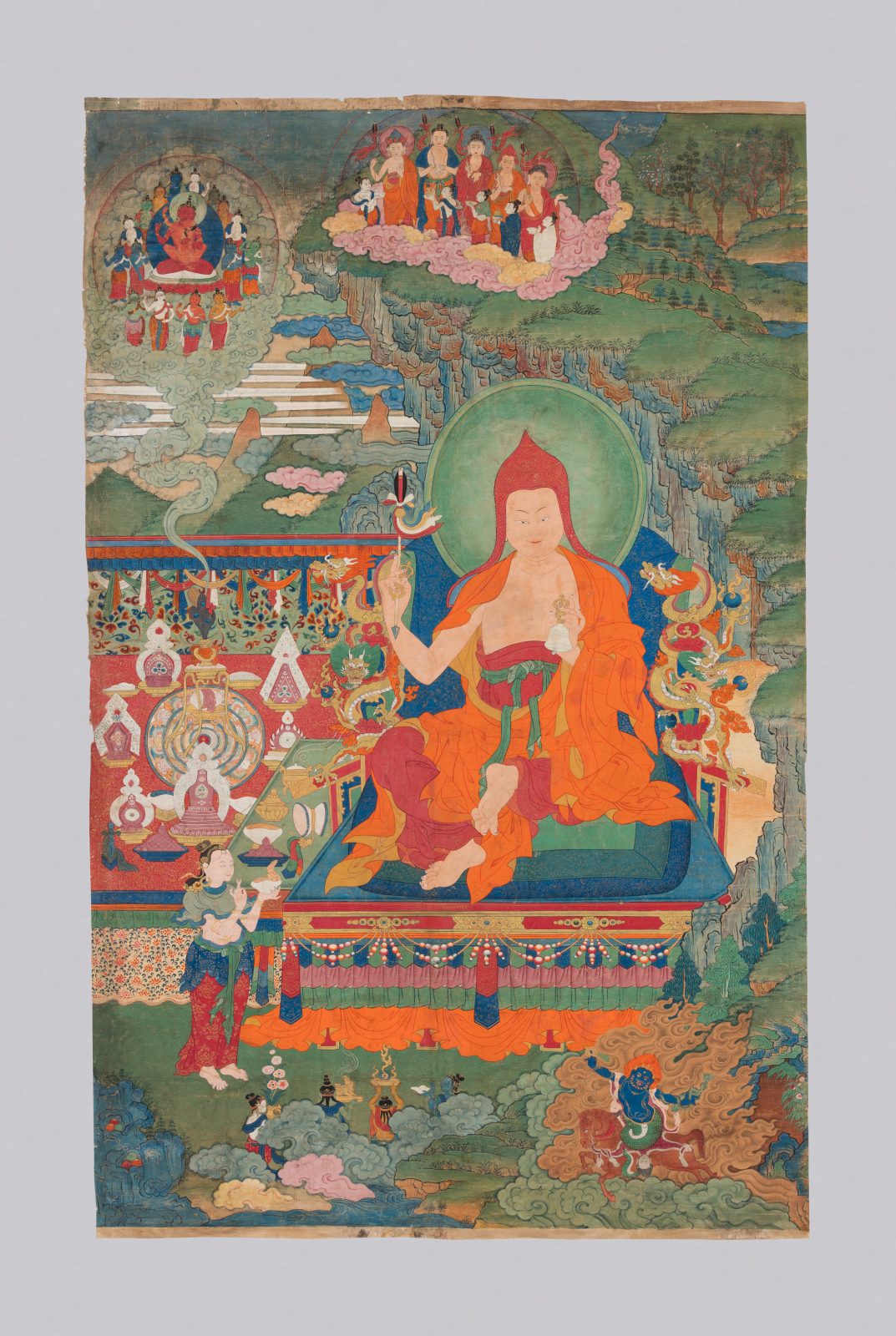
This painting depicts the performance of a ritual meant to extend life. The eighth-century master Namkhai Nyingpo is shown dressed in monastic robes and holding an arrow symbolizing longevity in his right hand. He was one of the 25 disciples of a founding figure of Tibetan Buddhism, Padmasambhava. To Namkhai Nyingpo’s right is a ritual space arrayed with materials to perform a long-life ritual. This assemblage centers on a sacred circle, or mandala.
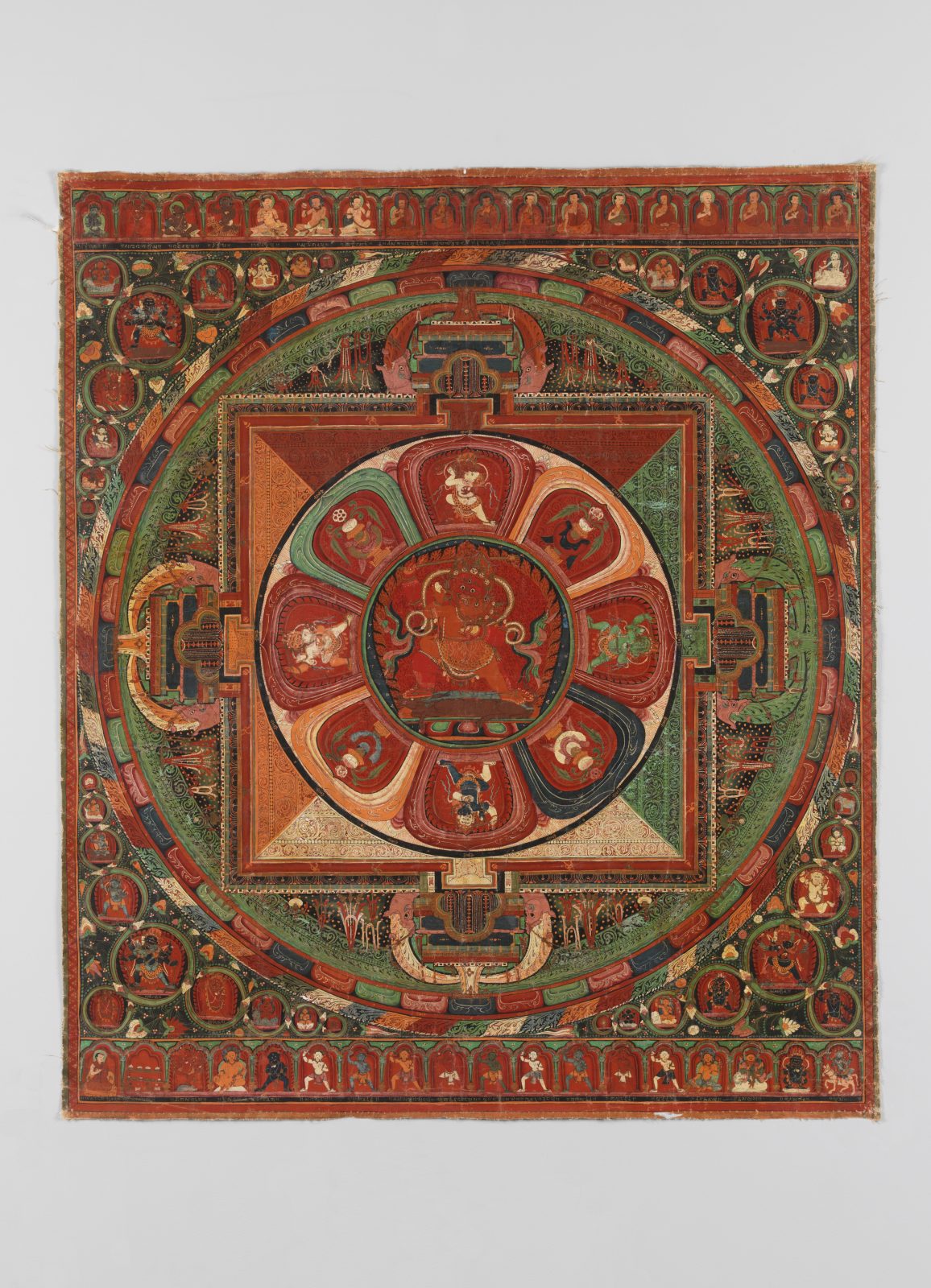
The central deity of this five-deity mandala is Red Yamari, the enemy of death, embracing his consort Vajravetali. This mandala is largely inspired by Nepalese art, but it features the color scheme, bold outlining, and three-lobed arches characteristic of 15th-century Tibetan art. Green rivals red as the dominant color, and it is used for many elements of the mandala, including the scrolling lotus stems and the background of the top and bottom rows.
When We Die
The philosophical religious traditions that began on the Indian subcontinent, such as Hinduism and Buddhism, understand time as a cycle where each living being experiences multiple reincarnations. Individuals may live on Earth, in a heaven-like paradise, or in a hell, but all are temporary abodes. Accruing bad karma from earthly desires and negative deeds tethers us to the cycle of samsara (birth, death, and rebirth), which prevents us from perceiving the true nature of reality. Gaining good karma allows one to find moksha or nirvana (release from the cycle of samsara) and perceive reality as it truly is.
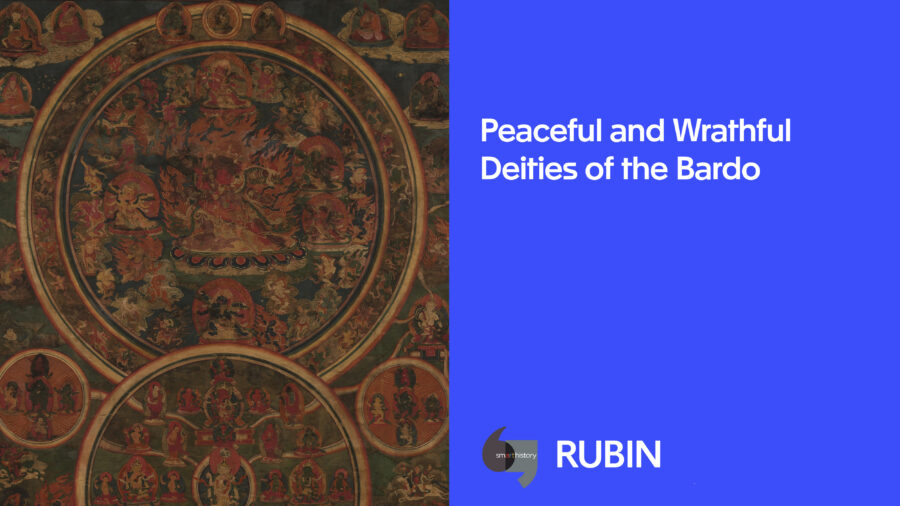
Buddhists believe that at the moment of death one’s consciousness transitions to an intermediate state called the bardo. For a period of 49 days, consciousness wanders, propelled by the person’s karma, or accumulated positive and negative actions. This painting is a visual representation of the bardo from the Liberation through Hearing in the Intermediate State (Bardo Thodrol), known in the West as the Tibetan Book of the Dead.
The central figures in the upper half of the painting are Buddha Ratnasambhava and his consort Mamaki, who are said to appear on the third day of the bardo. After the peaceful deities, their wrathful manifestations appear, who are depicted below. The lower register portrays scenes of excruciating tortures inflicted on those condemned to the hell realms by their karma.
This painting depicts the Liberation through Hearing in the Intermediate State (Bardo Thodrol), known in the West as the Tibetan Book of the Dead. Here, Buddha Vairochana is shown above, holding a wheel and bell in his hands and embracing his consort. Below is the wrathful three-headed and six-armed Buddhaheruka flanked by wealth deities. On the back of the painting are mantras written in the shape of a stupa.
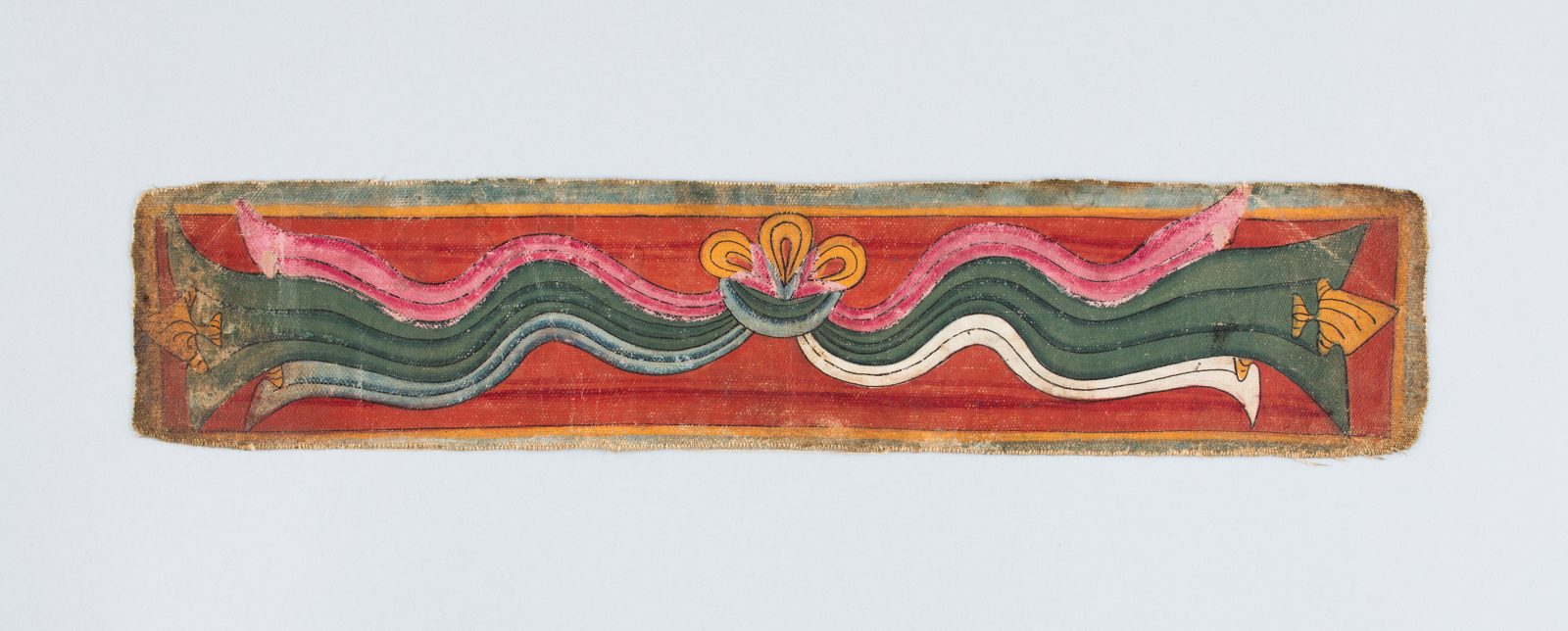
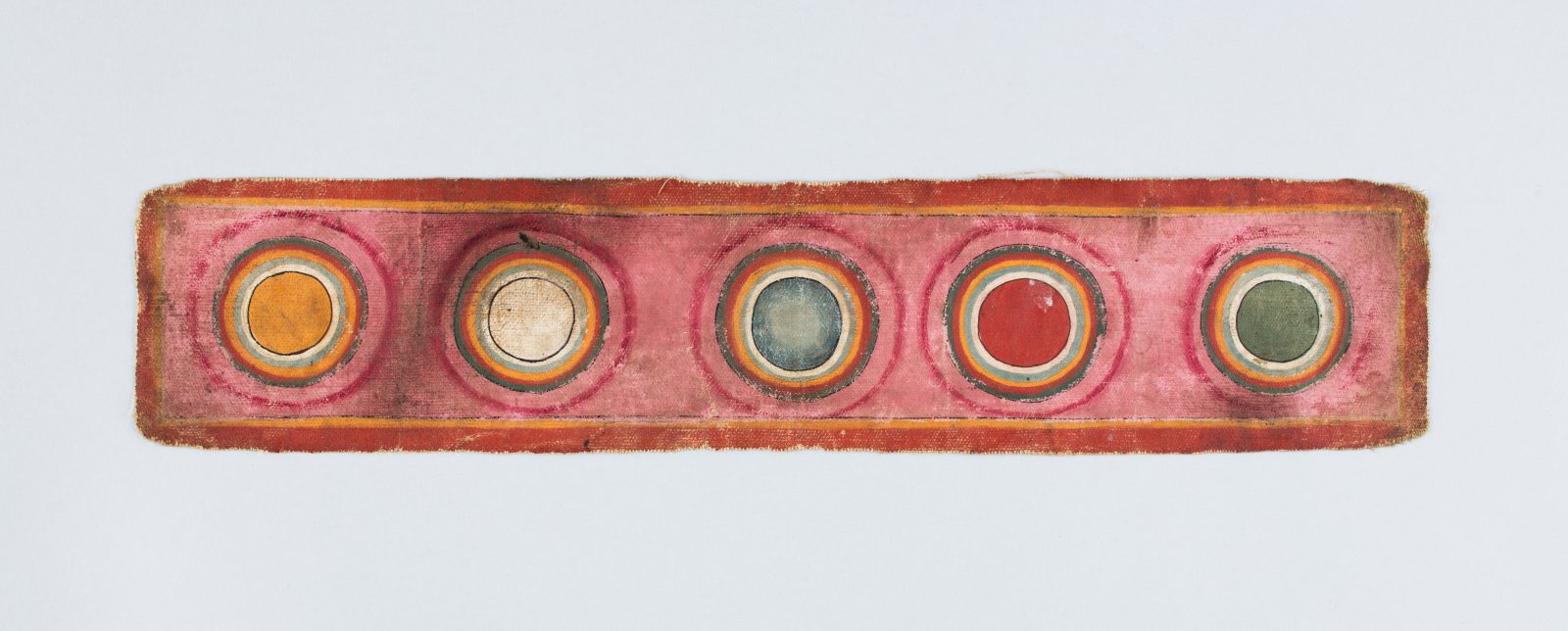
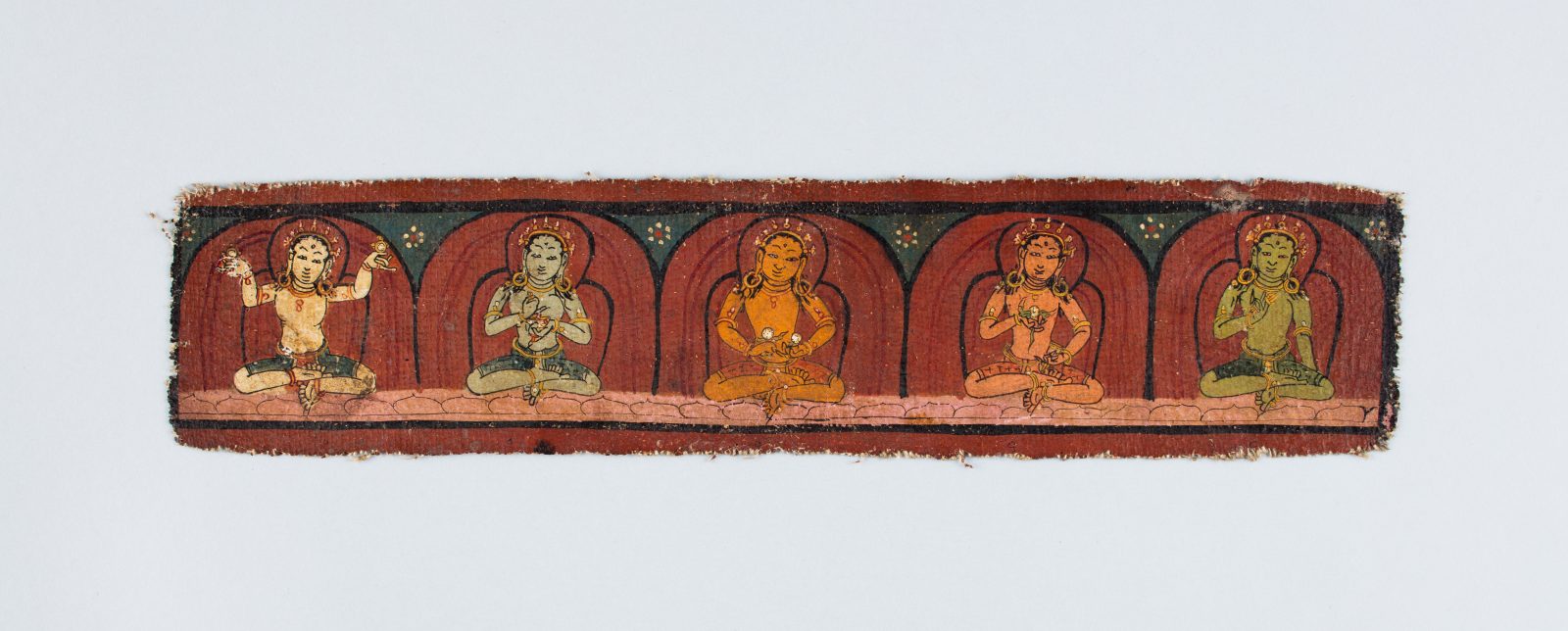
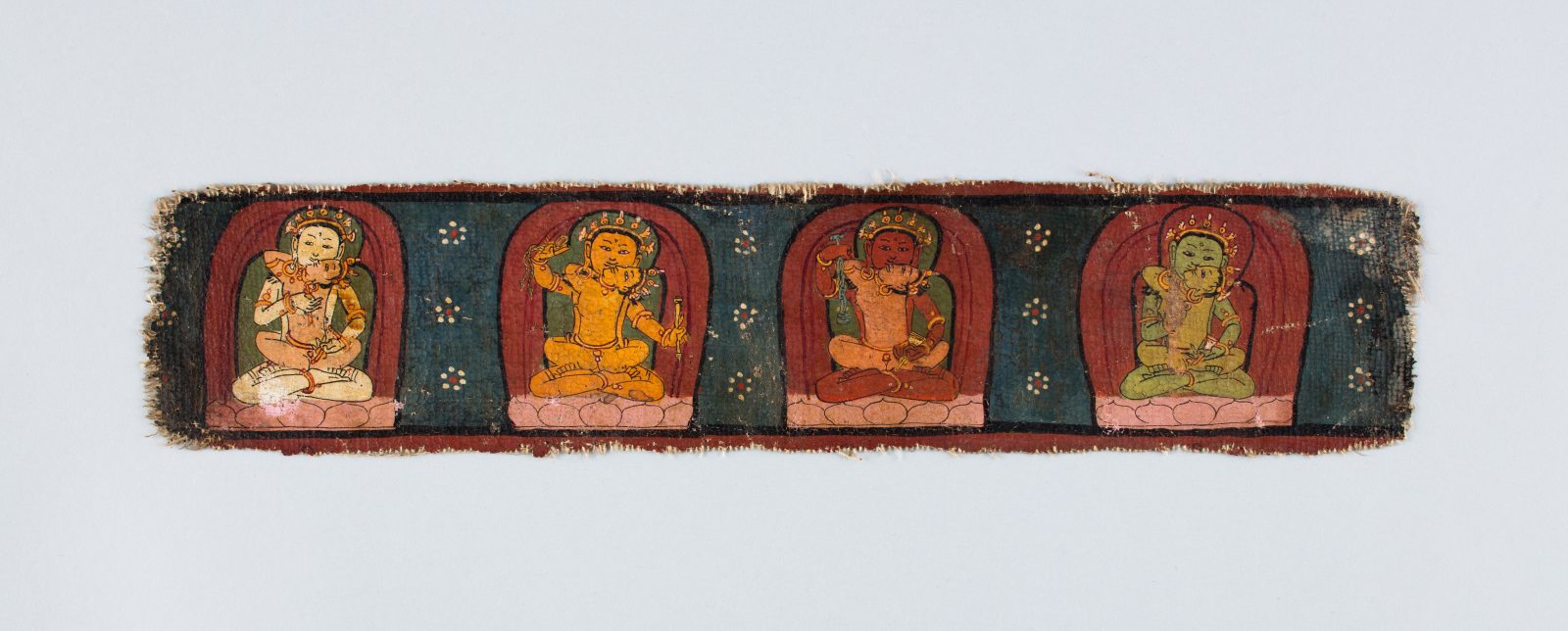
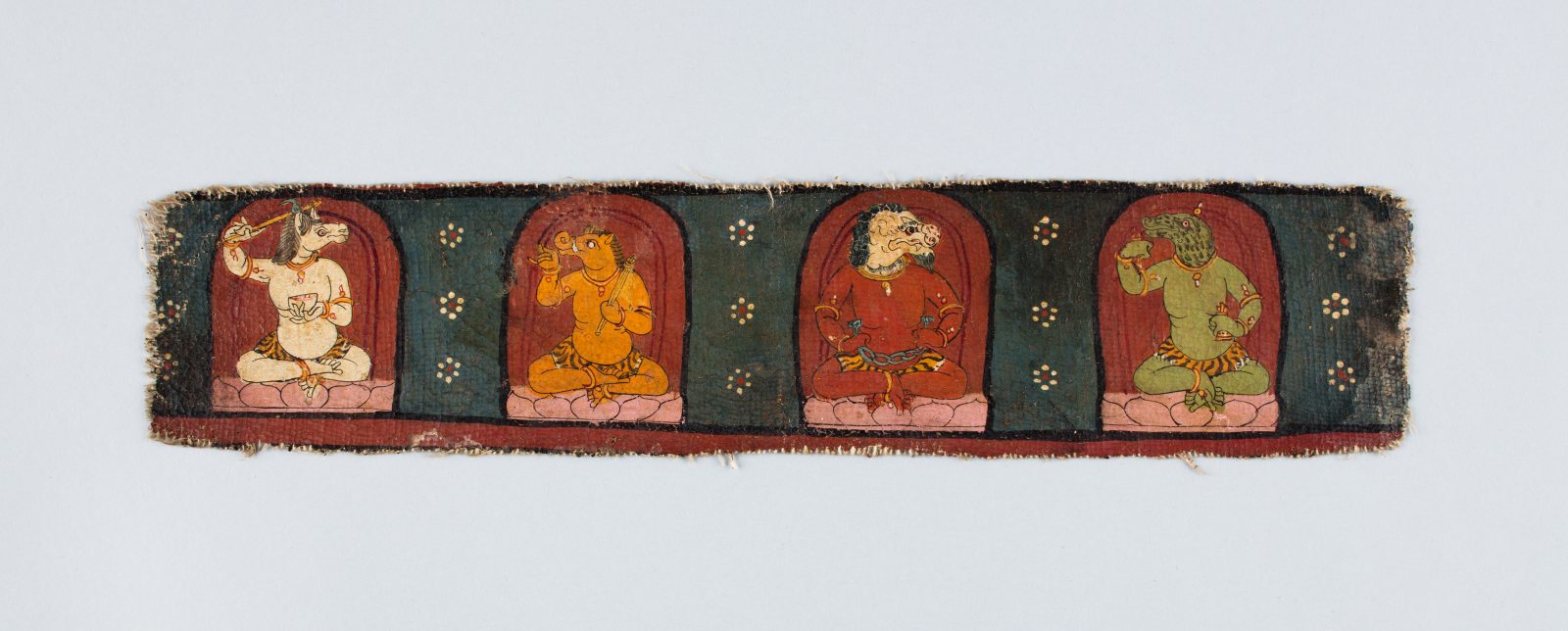
These painted illuminations are visual representations from the Liberation through Hearing in the Intermediate State (Bardo Thodrol), which are from an incomplete illuminated manuscript. It acts as an “empowerment” (wang), which grants permission and offers blessings of support to a practitioner before they study the teachings. The images depict colored lights and deities that are described at great length in the ritual text.
Divine Bodies
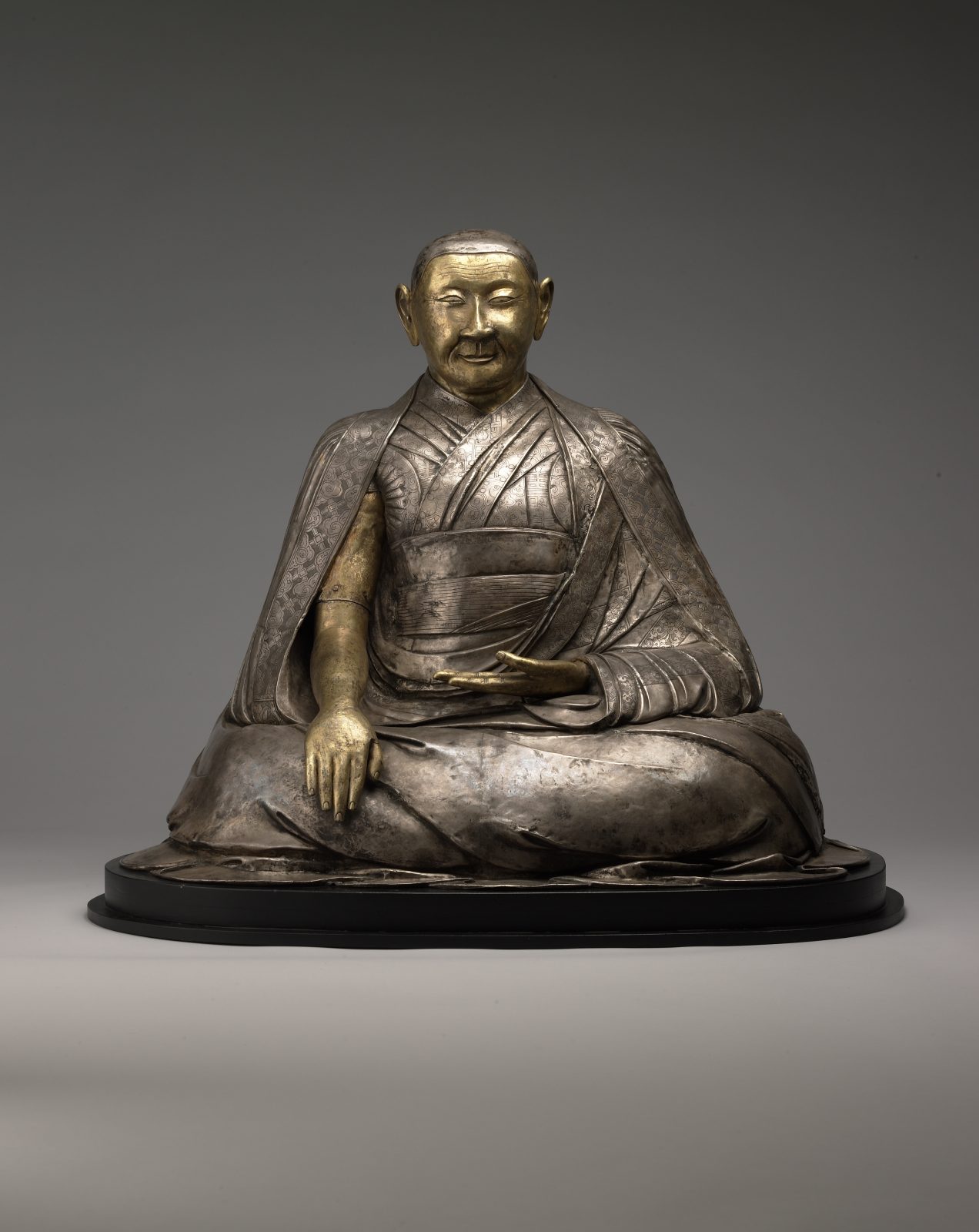
The human body is imperfect and finite, yet for many cultures it is a vehicle for the divine, making the forms of sacred beings tangible and recognizable. This section focuses on how artists have expressed divine power and transcendence through three physical features: the face, the body, and the hands.
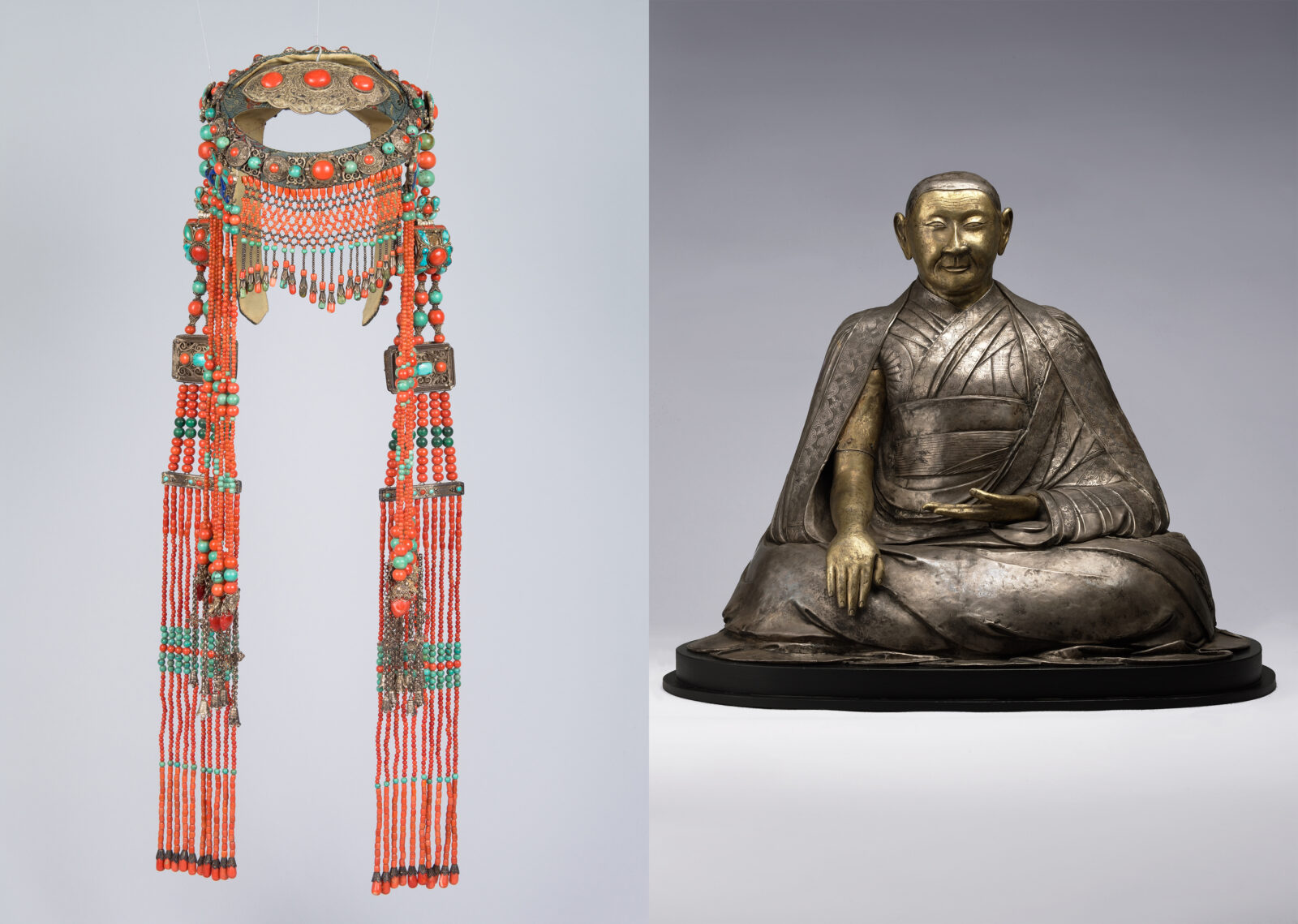
This work conveys the great psychological power of this religious master through his facial expression. His half-closed eyes are an indication of profound meditative absorption, and his hands in the gesture of touching the earth signify his awakened state. The robe features many auspicious symbols, from the Chinese character for longevity (shou壽) to auspicious flower and cloud motifs. The scarf is also decorated with auspicious symbols, including the seven jewels of a universal ruler, such as a rhinoceros horn, coral, and pairs of square and round earrings.
Sacred Places
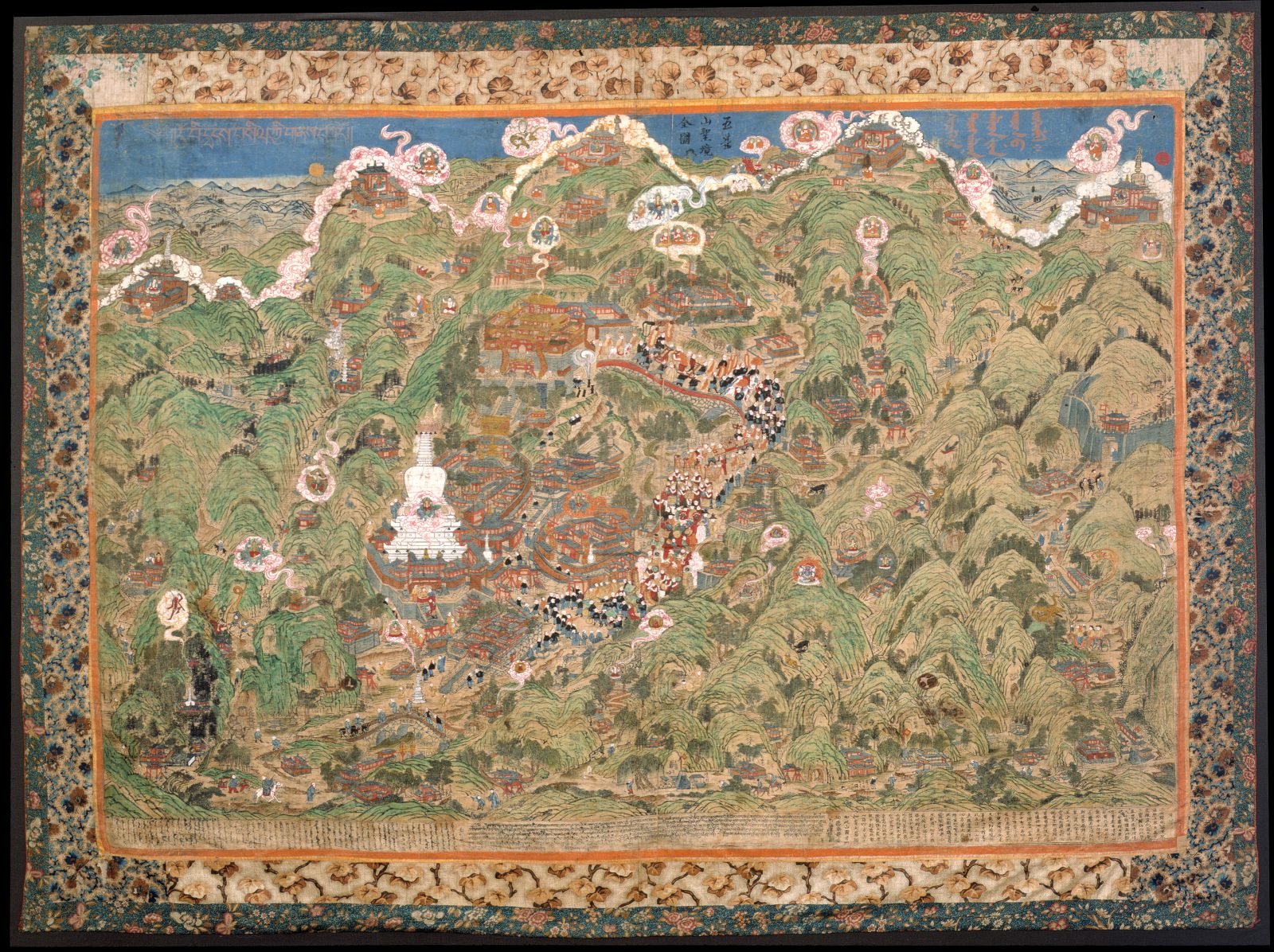
In Asia, the divine is found in purpose-built structures, including temples, stupas, mosques, churches, and carved caves. But the divine may also appear in natural landscape features, such as mountains, lakes, and rivers, and even in landscapes of the mind. Visiting or envisioning sacred places has long been a crucial part of many people’s spiritual journeys, and sharing such experiences helps to bind communities together.
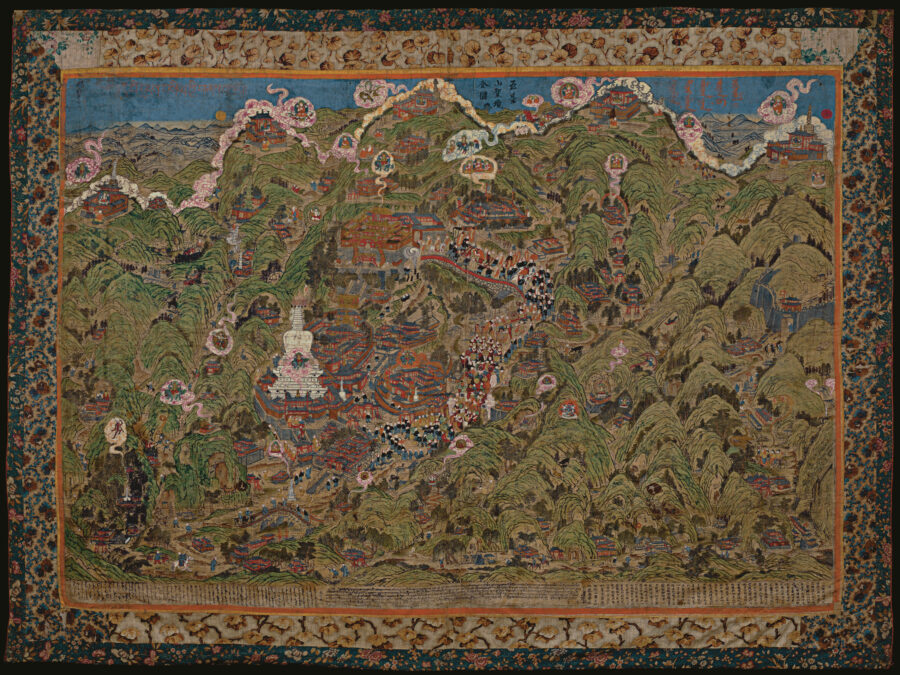
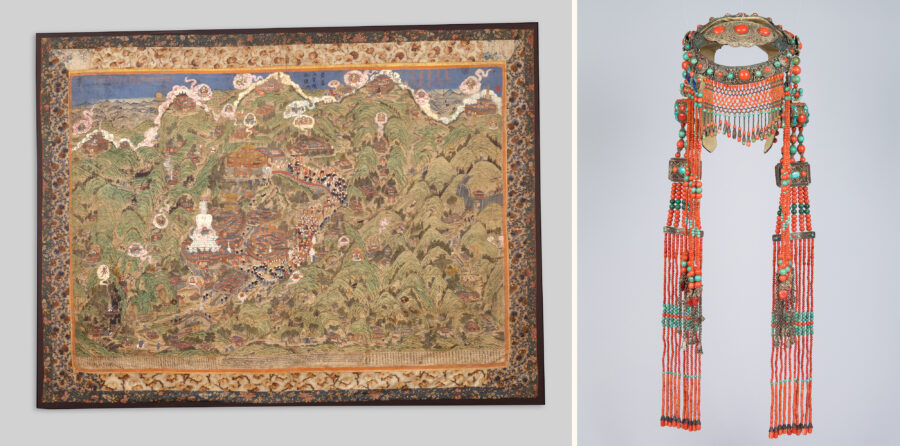
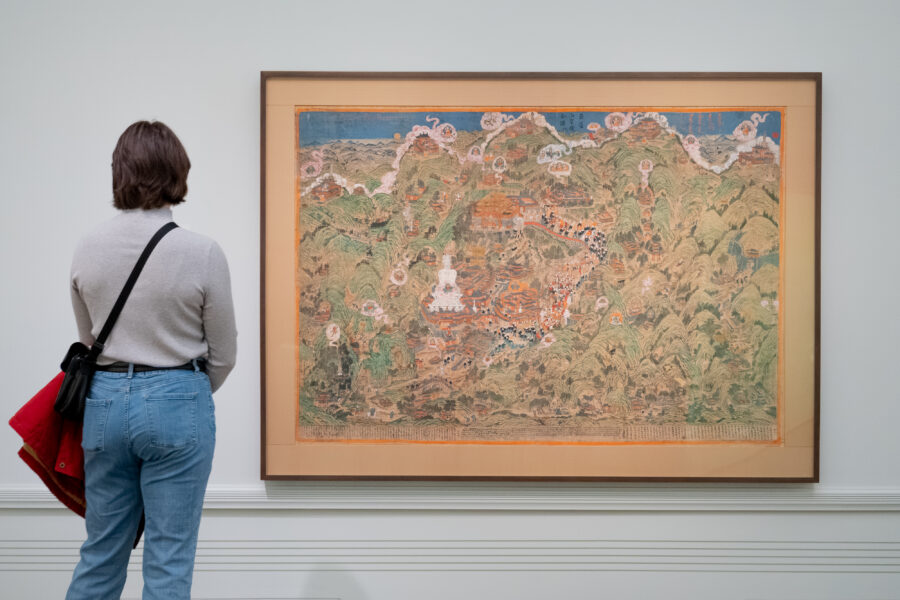
This panoramic view depicts the sacred mountain Wutai (Wutaishan 五臺山), located in Shanxi Province, China. It is believed to be the earthly abode of the bodhisattva of wisdom Manjushri. This map contains more than 150 sites of interest to the pilgrims who ventured to Mount Wutai. Each are labeled with Chinese and Tibetan inscriptions, including Buddhist monasteries, Taoist temples, villages, sacred objects, and locations of events, both historic and miraculous. Pilgrims traveled to this sacred mountain to see divine visions, which took the form of miraculous light and cloud formations.
Learn more about Mount Wutai in this Himalayan Art Up Close video and art interactive.
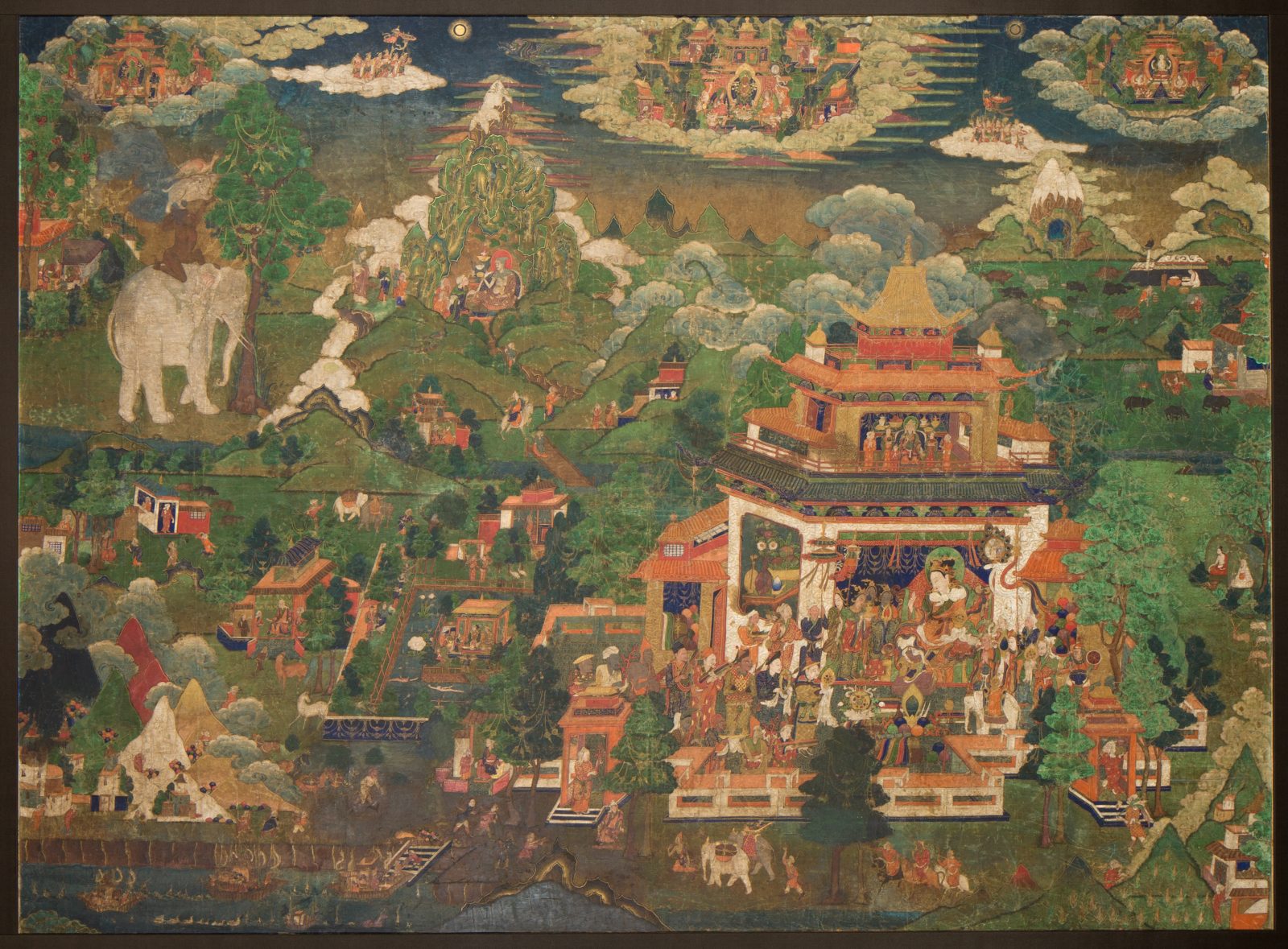
Tibet’s sacred geography is mapped out as a terrestrial paradise, with Mount Wutai and its distinctive five multicolored peaks to the east (bottom left) and Mount Kailash’s snowy peaks towering over nomadic scenes of the Northern Plains to the west (top right). The central imagery in this painting accords with a prophecy in which a universal ruler transforms the world into an ideal realm.
This overarching section comprises the subsections below and presents objects that demonstrate power and authority through their sumptuous materials, exceptional craftsmanship, and resplendence.
Material Power
Like many elites, Asia’s historic rulers advertised their might through lavish consumption. They demonstrated their ability to command the extraction of raw materials and to import goods from faraway lands. The Rubin objects in this section exemplify patronage—a practice of hiring and commissioning artists to create works of art. In religious context patrons were often rulers, religious leaders, as well as ordinary people.
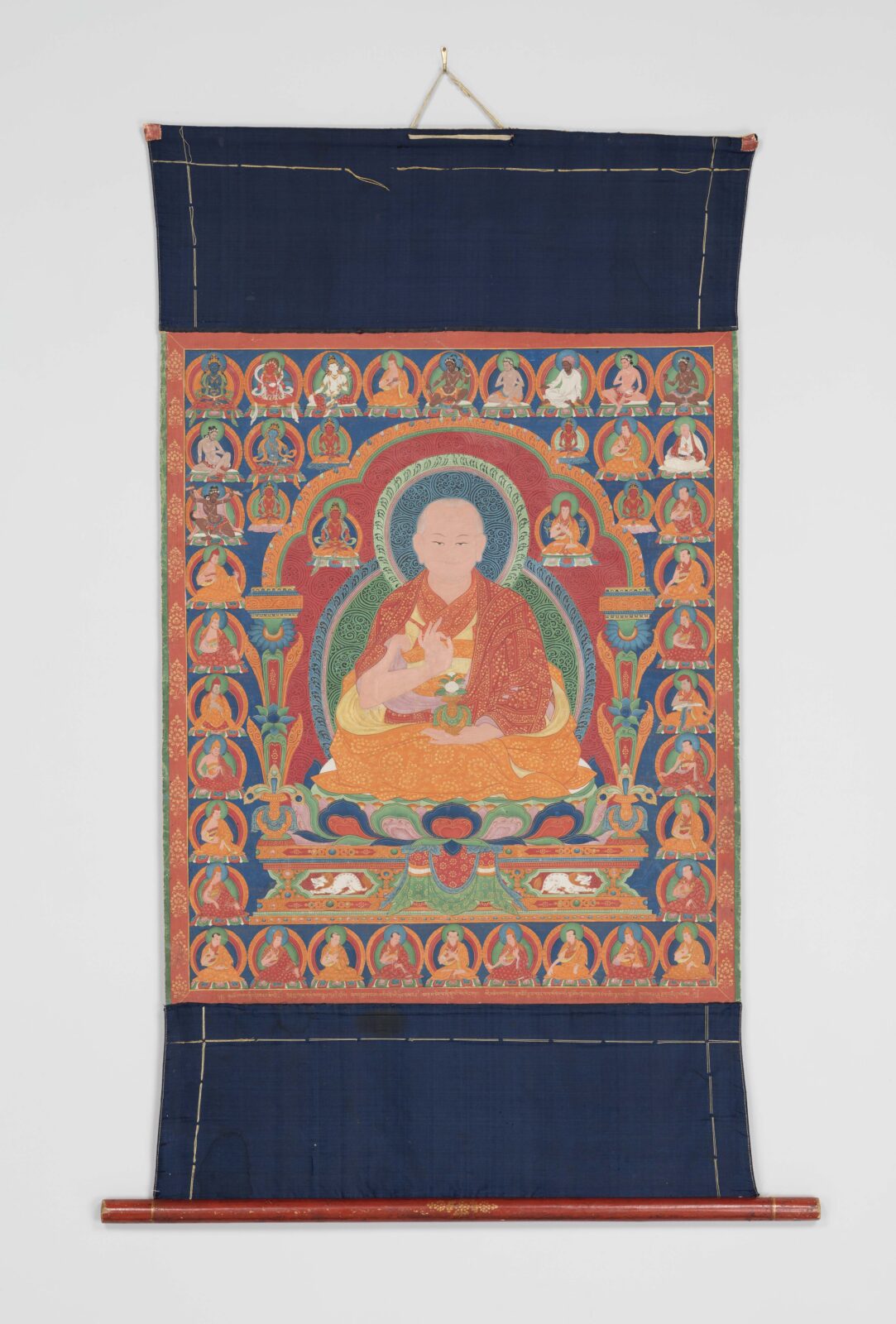
The eleventh abbot of Ngor Monastery, Sanggye Sengge, was a great patron of the arts. This painting belongs to a famous series of portraits depicting the abbots of Ngor Monastery and teachers of the “Path with the Fruit” (Lam ‘bras) lineage. Commissioned in the late 16th century, it is the last-known major set of its type in the Nepalese-inspired painting style (Beri). It prominently employs Newar decorative scrollwork and the Beriof blues and greens.
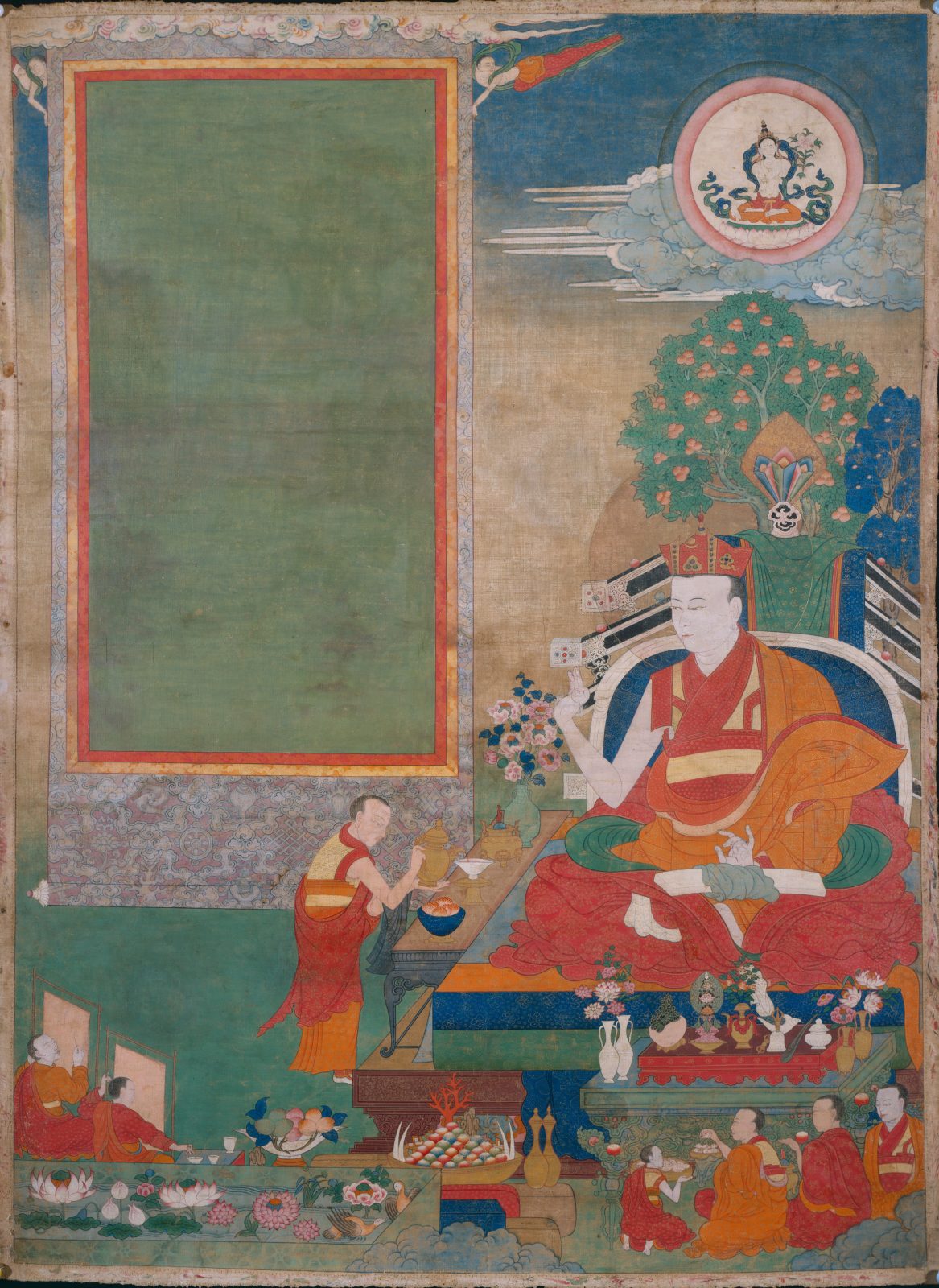
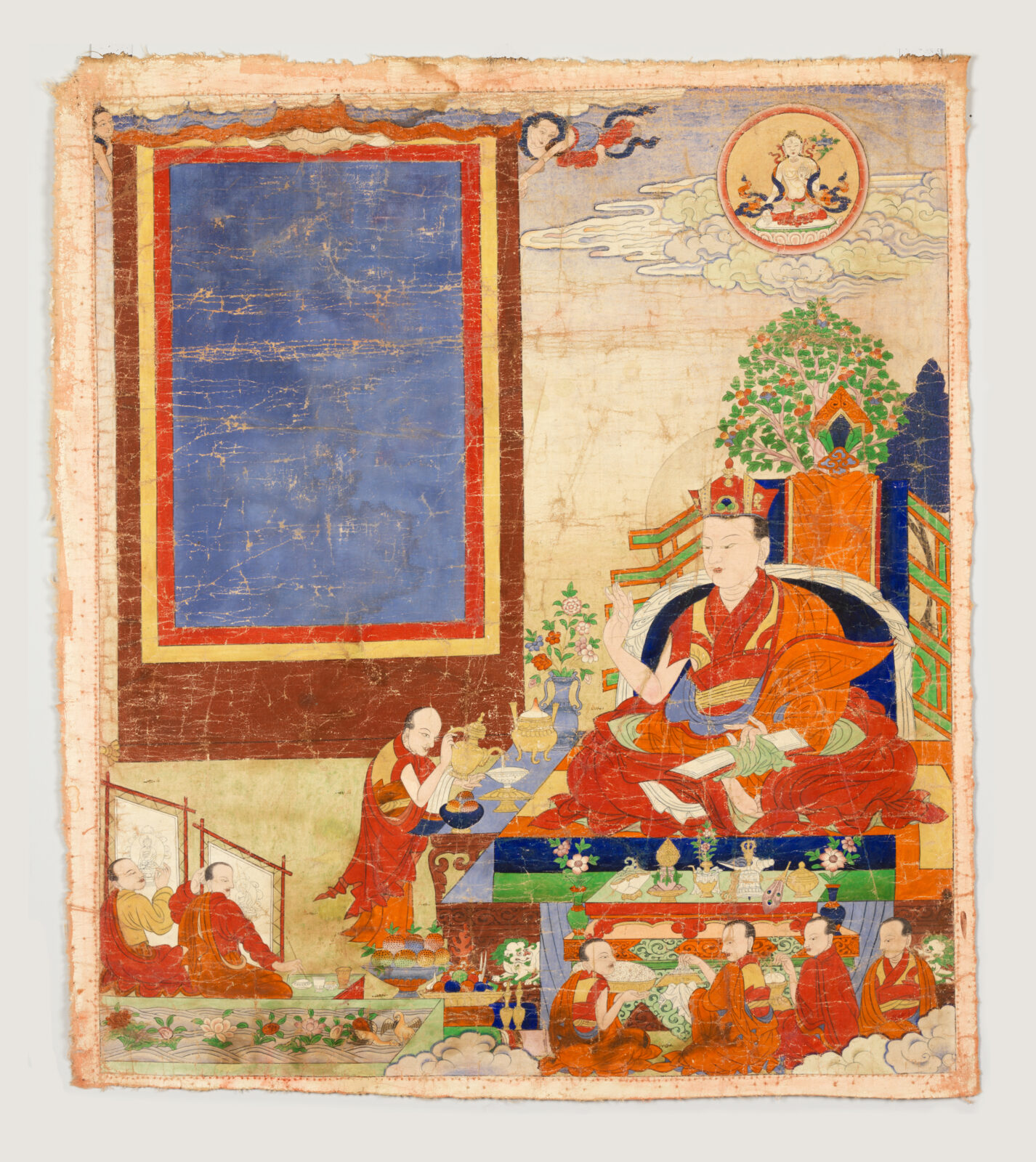
The scholar and artist Situ Panchen (1700–1774) is largely credited with reviving the Encampment Style (Gardri) in his native Kham after it was nearly eclipsed in central Tibet due to civil war. Situ commissioned many paintings, and this portrait commemorates him in the role of patron. Two painters sit in the bottom-left corner, brushes poised, as if awaiting Situ’s instructions.
Situ Panchen’s role as a commissioner of paintings is commemorated through this portrait of him as patron. In 1736 Situ composed a long inscription to suggest the all-encompassing nature of his artistic vision. The inscription was intended to appear in the large blank scroll held up by goddesses:
I have followed the Chinese masters in color, in mood expressed, and form, and I have depicted lands, dress, palaces, and so forth as [I have] actually seen in India. Even though all the discriminating skill of Menthang—[both] New and Old—and the Khyen[ri] tradition followers, Jeugangpa and the Encampment masters are present here, I have made [these paintings] different in a hundred thousand [particulars of] style.
Are We What We Wear?
What we wear signifies aspects of personal identity and also an affiliation with a community. What does dress say about a person’s community or cultural heritage? How does a pattern on fabric or the material of a necklace convey the wearer’s gender, age, wishes, beliefs, and place in a social hierarchy? Such questions about what we wear prompt us to consider fundamental issues of self-fashioning.
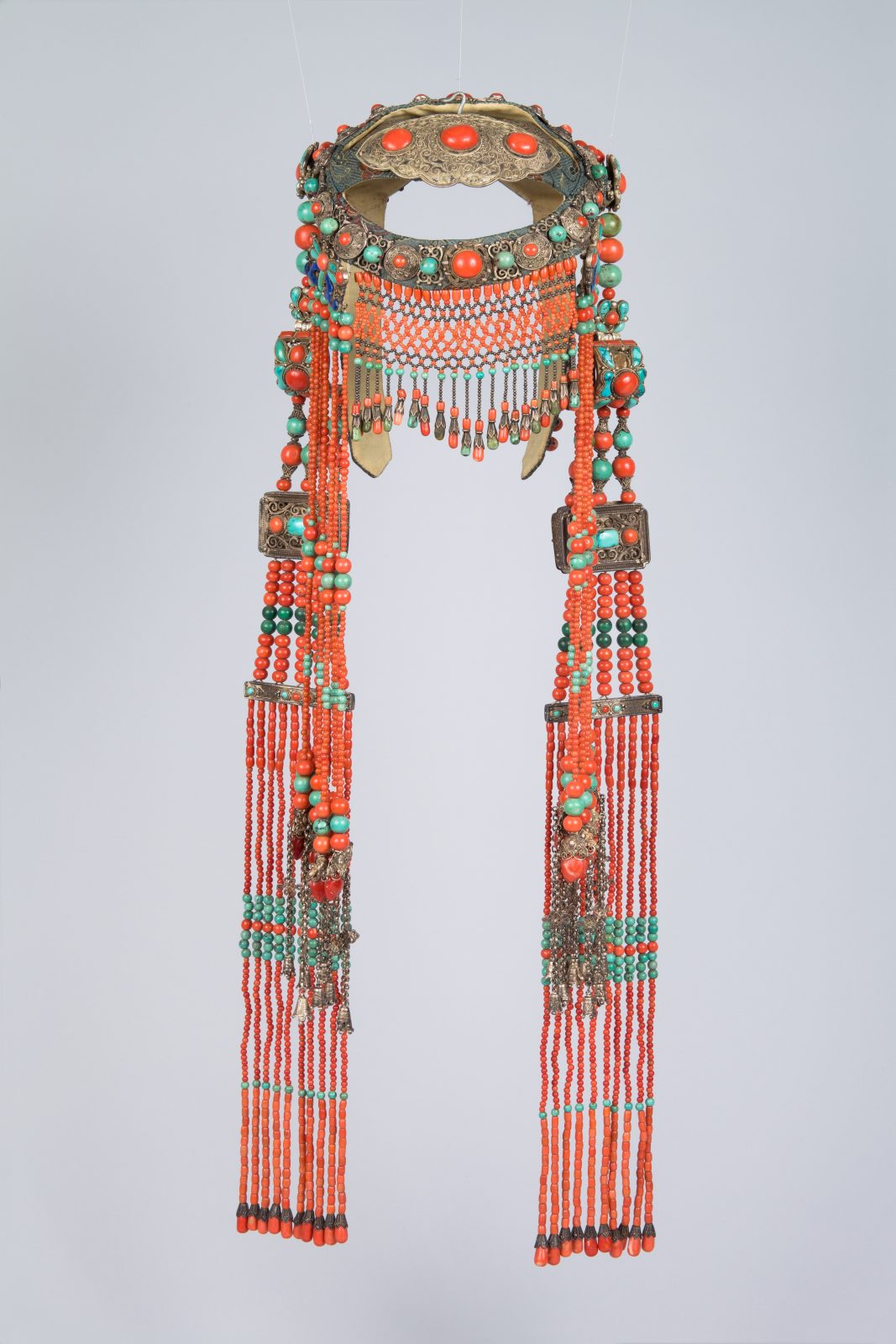
The distinctive shape of this woman’s headdress (Mongolian: djasal) identifies its wearer as a member of one of the eight banners of Chakhar (Chahar) in central Inner Mongolia. Long strings of coral and turquoise beads end in auspicious images, including silver bats holding peaches, which are in turn carved from lozenge-shaped red carnelian. A pair of heavy ear-ornaments (süike) and a pair of silk-covered lapels decorated with large coral beads complete the opulent display of wealth and status.