Mongolia
19th century
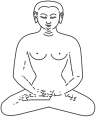
Also known as vajra position, this posture is associated with meditation.
Mongolia
19th century
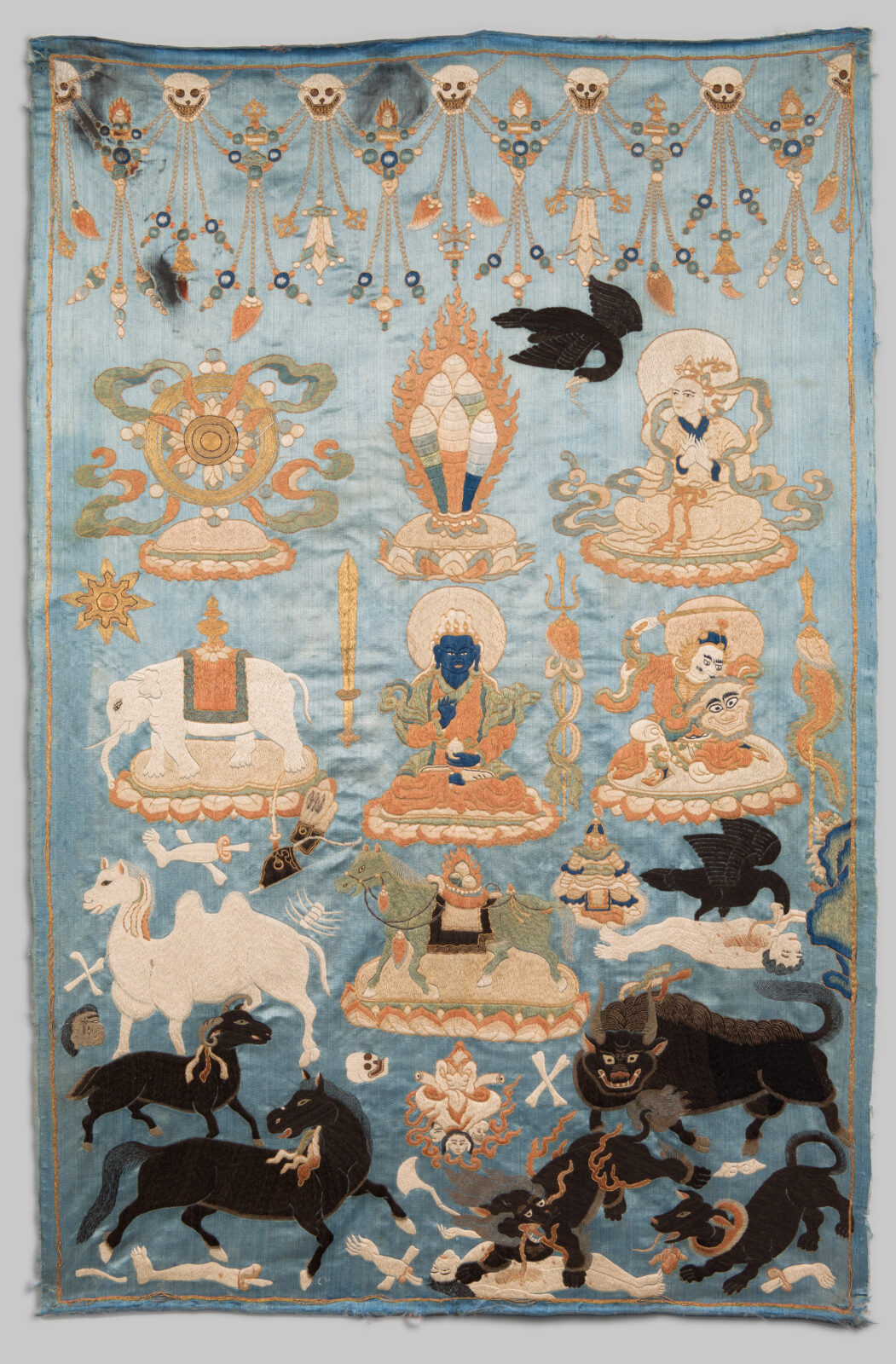
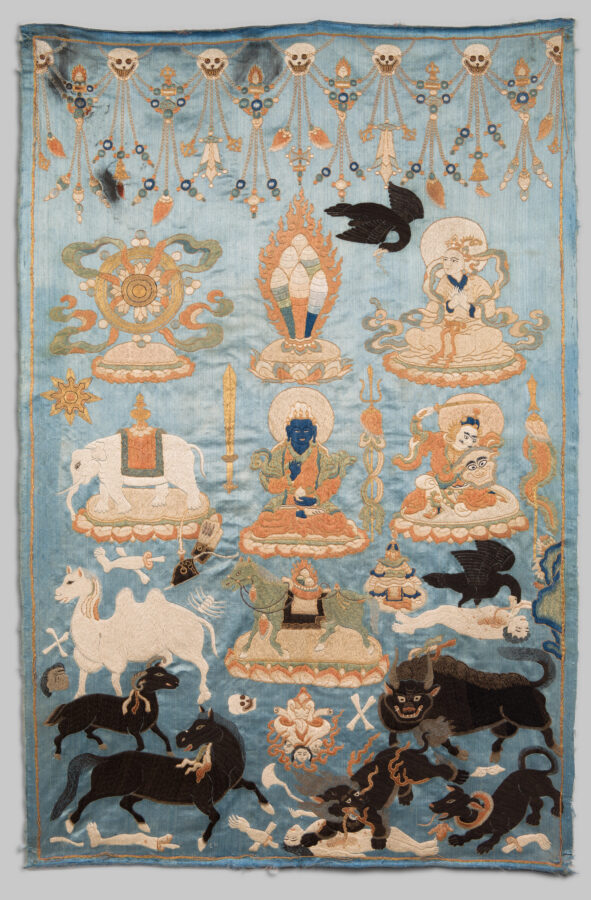
This embroidered banner presents peaceful and wrathful symbolic offerings. At the center is a group known as the Seven Jewels of a Monarch or Seven Royal Symbols—the wheel, queen, elephant, minister, general, horse, and triple jewel. The triple jewel symbol positioned in the top-center represents the Buddha, his teachings, and the monastic community he founded. Seven weapons, which include a dagger, bow and arrows, and suit of armor, are dispersed in between and thematically relate to the wrathful offerings in the lower portion of the composition. The offerings consist of seven animals, notably a white Bactrian camel and a black snow lion ravaging a corpse. The skull cup between them contains an offering of the five senses.
The offerings are evenly spaced, with peaceful offerings in the upper area and wrathful ones in the lower. The flying black raven with entrails in its beak bridges this symmetrical composition. The warrior holding a shield featuring a wrathful face is a distinctive East Asian motif. Starting at the top edge with the suspended jewel garland with skulls, the almost uniform blue background transitions to a darker blue at the bottom. The small blue-green rock at the right edge creates a sense of depth and dimensionality.
Also known as vajra position, this posture is associated with meditation.

These seven offerings are symbolic representations of the seven welcoming gifts given to guests in ancient India. They are presented to deities and can include water, flowers, incense, light, perfume, food, and music.

A skull cup is an attribute of tantric deities and is usually paired with a curved knife. It can symbolize a mind filled with the bliss of realizing the true nature of reality.

An attribute of tantric deities, this staff represents the union of the two aspects of enlightenment. When held by a male deity it symbolizes his female consort as wisdom, and when held by a female deity it represents her male consort as method.
An energy wielded with intention, skill, and compassion to offer protection and remove obstacles. In Buddhism, it is considered different than negative emotions like anger or rage.
The idea that everything is temporary, constantly changing, and moving through stages of development, decay, and dissolution. Impermanence is a reminder to avoid strong attachments and focus on the present moment.
A religious movement that originated in India around the fifth to seventh century with sacred writings and esoteric teachings and practices transmitted from teacher to student through initiation. These remain an important part of Hinduism and Buddhism today.
A kind of energy that can be used, individually and collectively, to effect change.
The end of this life marked by the cessation of bodily functions followed by decay. According to Buddhism, after death consciousness transitions to an intermediate state known as the bardo before embarking on another life.
Prescribed practices that carry symbolic meaning and value within a specific tradition and are intended to attain a desired outcome. Rituals are usually done as part of a ceremony or regular routine.
Tantric deities personify various enlightened qualities and are the focus of esoteric religious practices (tantras) that aim to swiftly and radically transform one’s understanding of reality.
Protectors of Buddhist teachings who destroy obstacles that impede the path to enlightenment. The more frightening and gruesome their appearance, the greater their power.
Mongolians have been widely active in the Tibetan Buddhist world, playing a key role in Tibetan culture, politics, and relations with China. In the 13th century, the Mongol Empire—the largest contiguous empire in world history—facilitated the spread of Tibetan visual culture.

Get the latest news and stories from the Rubin, plus occasional information on how to support our work.