Tibet
18th - 19th century
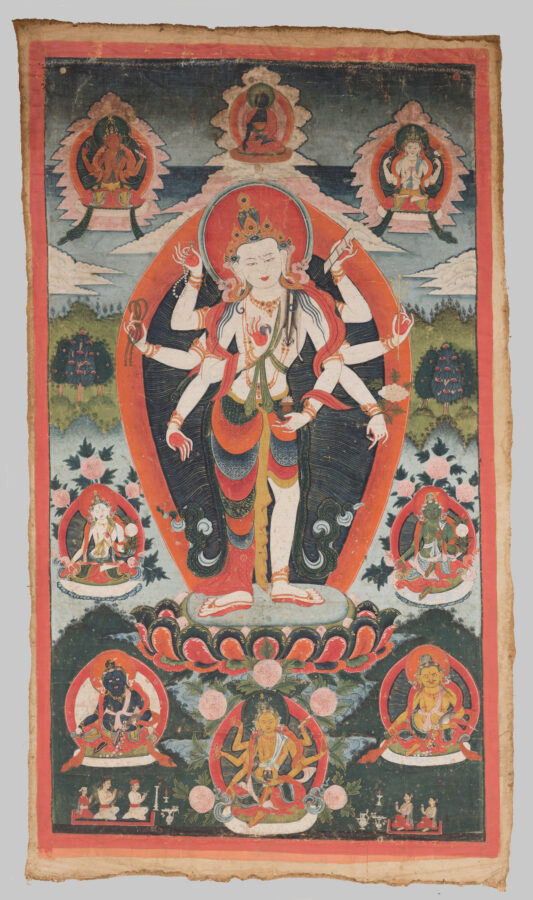
The right hand is extended in a giving gesture.
Tibet
18th - 19th century
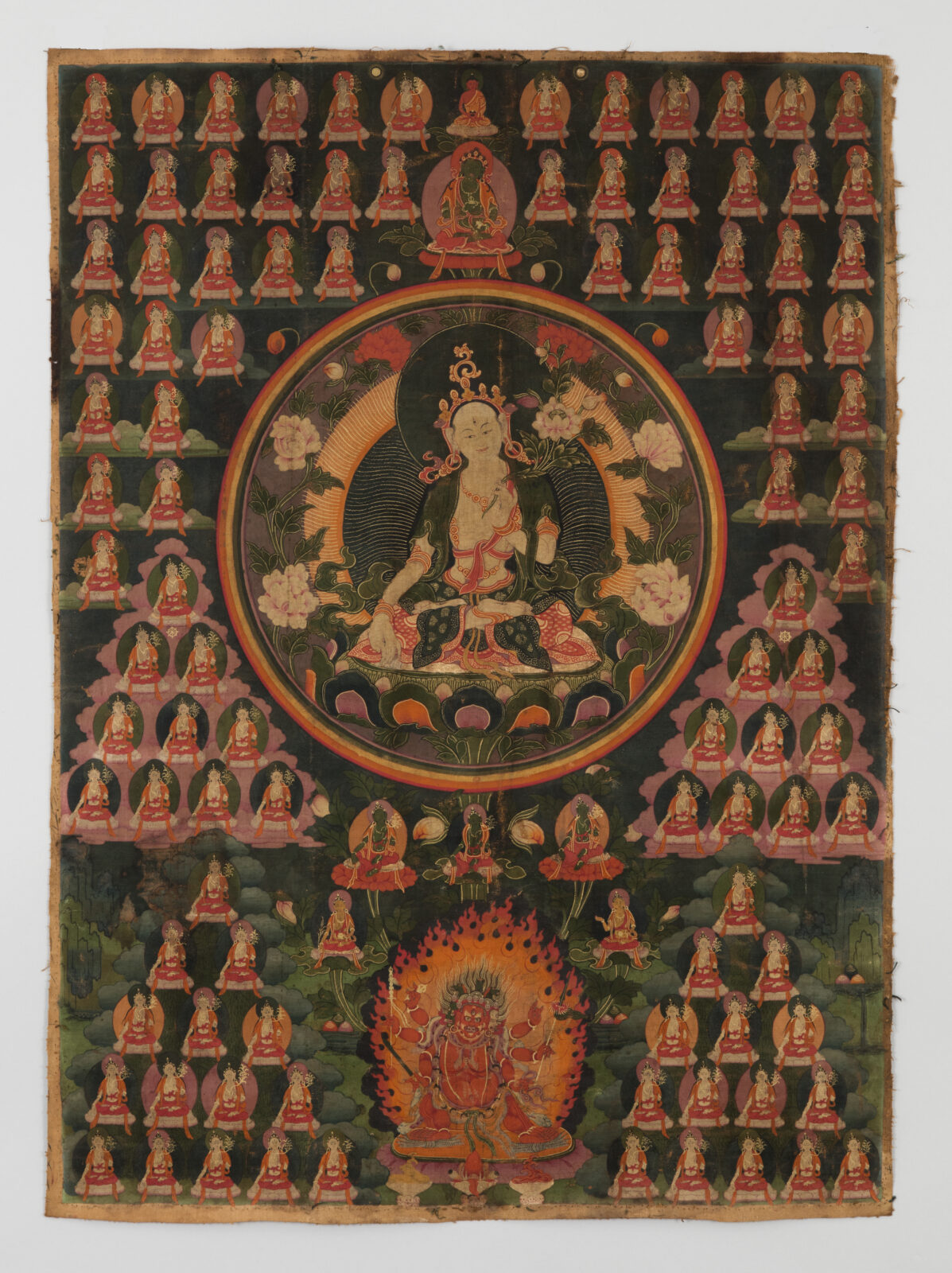
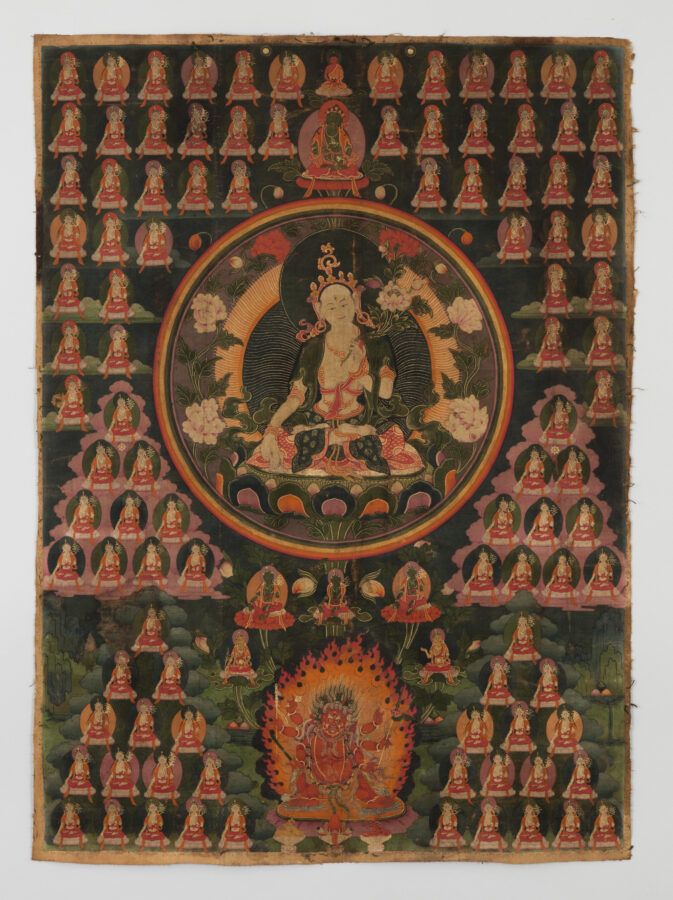
A smiling White Tara—with a third eye on her face and eyes on her palms and feet—sits upon a moon disc on a lotus seat encircled by a rainbow aura. Tara is considered a female buddha and a bodhisattva, and in this example, in her white form, she is a long-life deity with the power to grant longevity. She embodies the compassionate power of all the buddhas: in one narrative tradition, she is born from the tears of Avalokiteshvara, the bodhisattva of compassion, while in another, she vows to appear as a woman until all sentient beings are awakened. Tara is surrounded by one hundred smaller versions of herself, symbolizing her ability to manifest infinitely to help all beings in need.
The figures directly above the central Tara indicate her lineage and connections to other deities. Below her are three figures of Green Tara seated with the right legs extended. Further below to the right and left are two forms of Vasudhara, the goddess of wealth, yellow in color. At the bottom center is the protector Hayagriva, who is red in color, with three faces and six hands, standing in the flames of pristine awareness. Arranged in front are three skull bowls filled with wrathful offerings. The gold paint used as an offering makes all the white Taras appear yellow. Religious practices focused on Tara are common to all Tibetan Buddhist traditions and can be traced back to the Indian master Atisha (ca. 982–1054) who traveled and taught in Tibet.

The right hand is extended in a giving gesture.

Also known as vajra position, this posture is associated with meditation.
In Buddhism gender is considered more fluid compared to some other religions. Certain traditions emphasize the importance of all genders in achieving enlightenment. The feminine is considered an embodiment of wisdom and the masculine is an embodiment of method.
A virtuous feeling and deep respect toward an authentic teaching, teacher, or path. Buddhists believe that expansive study, analysis, and meditation are essential steps for cultivating a healthy and enduring devotion.
Buddhist practitioners in some traditions believe that cutting through ordinary perceptions that keep us in the endless cycle of death and rebirth, known as samsara, can create a powerful and enhanced divine identity that leads to enlightenment.
A state of “waking up” from illusion and seeing the true nature of reality. Buddha Shakyamuni attained enlightenment while meditating under the bodhi tree. Buddhist teaching explains that the accumulation of merit and wisdom are essential for achieving enlightenment, also known as awakening.
A state of “waking up” from illusion and seeing the true nature of reality. Buddha Shakyamuni attained awakening while meditating under the bodhi tree. Buddhist teaching explains that the accumulation of merit and wisdom are essential for achieving awakening, also known as enlightenment.
In Buddhism merit is accumulated through engaging in positive actions that lead to positive results, such as better rebirths. Buddhists gain merit by making offerings, donating to those in need, reciting mantras, and other good deeds.
A meditation technique primarily used in tantric practice that involves imagining a deity in one’s mind or imagining oneself becoming a deity and carrying out various activities. Such techniques are intended to help a practitioner transform ordinary perception and achieve enlightened qualities.
The cultivation of a strong aspiration to help sentient beings overcome suffering. In Buddhist Mahayana teaching, compassion is the seed for attaining full enlightenment.
Buddhism teaches that all life is sacred and should be respected, as all sentient beings have the potential to attain enlightenment. This notion encourages a positive view and compassion for others.
The central goal of Buddhism is the liberation of all beings from suffering and the cycle of life, death, and rebirth, known as samsara, through applying the teachings of the Buddha.
Prescribed practices that carry symbolic meaning and value within a specific tradition and are intended to attain a desired outcome. Rituals are usually done as part of a ceremony or regular routine.
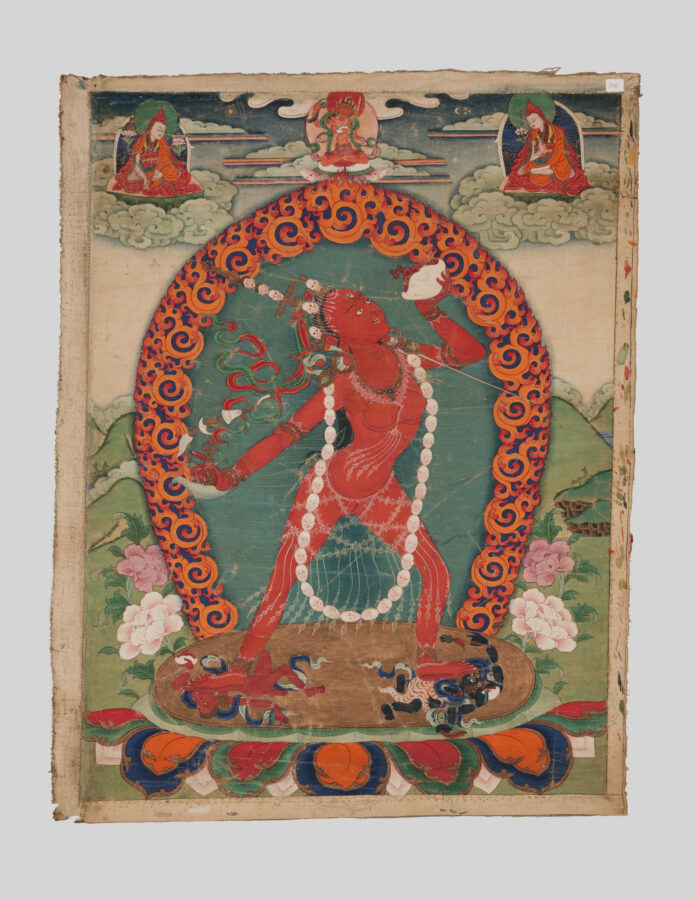
Female bodhisattvas and tantric deities embody specific enlightened qualities such as wisdom, power, and protection, and can be peaceful or wrathful in appearance.
Tantric deities personify various enlightened qualities and are the focus of esoteric religious practices (tantras) that aim to swiftly and radically transform one’s understanding of reality.
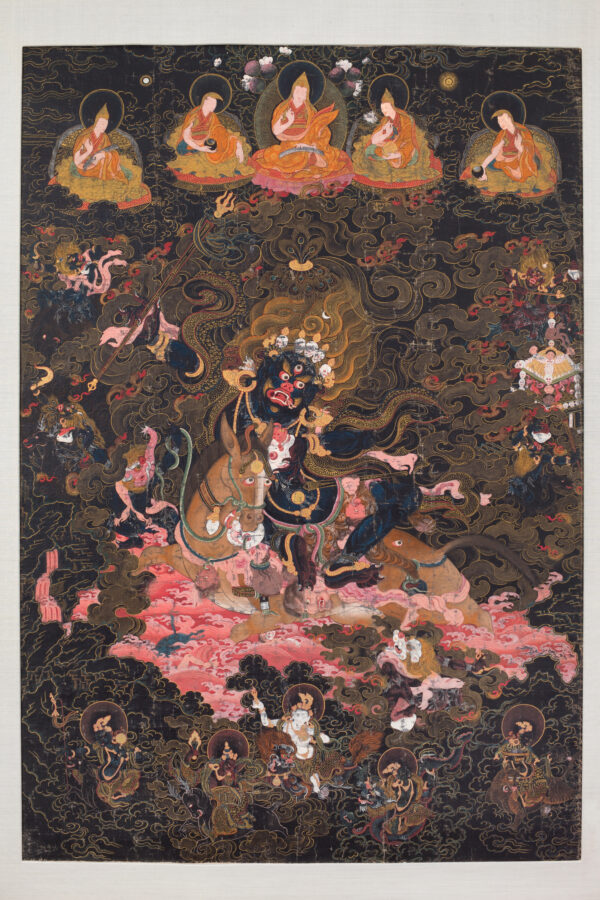
Protectors of Buddhist teachings who destroy obstacles that impede the path to enlightenment. The more frightening and gruesome their appearance, the greater their power.
Today, Tibetans primarily inhabit the Tibetan Plateau, situated between the Himalayan mountain range and the Indian subcontinent to the west, Chinese cultural regions to the east, and Mongolian cultural regions to the northeast. During the 7th to 9th century, Tibetan rulers expanded their empire across Central Asia, and established Buddhism as the state religion.

Get the latest news and stories from the Rubin, plus occasional information on how to support our work.