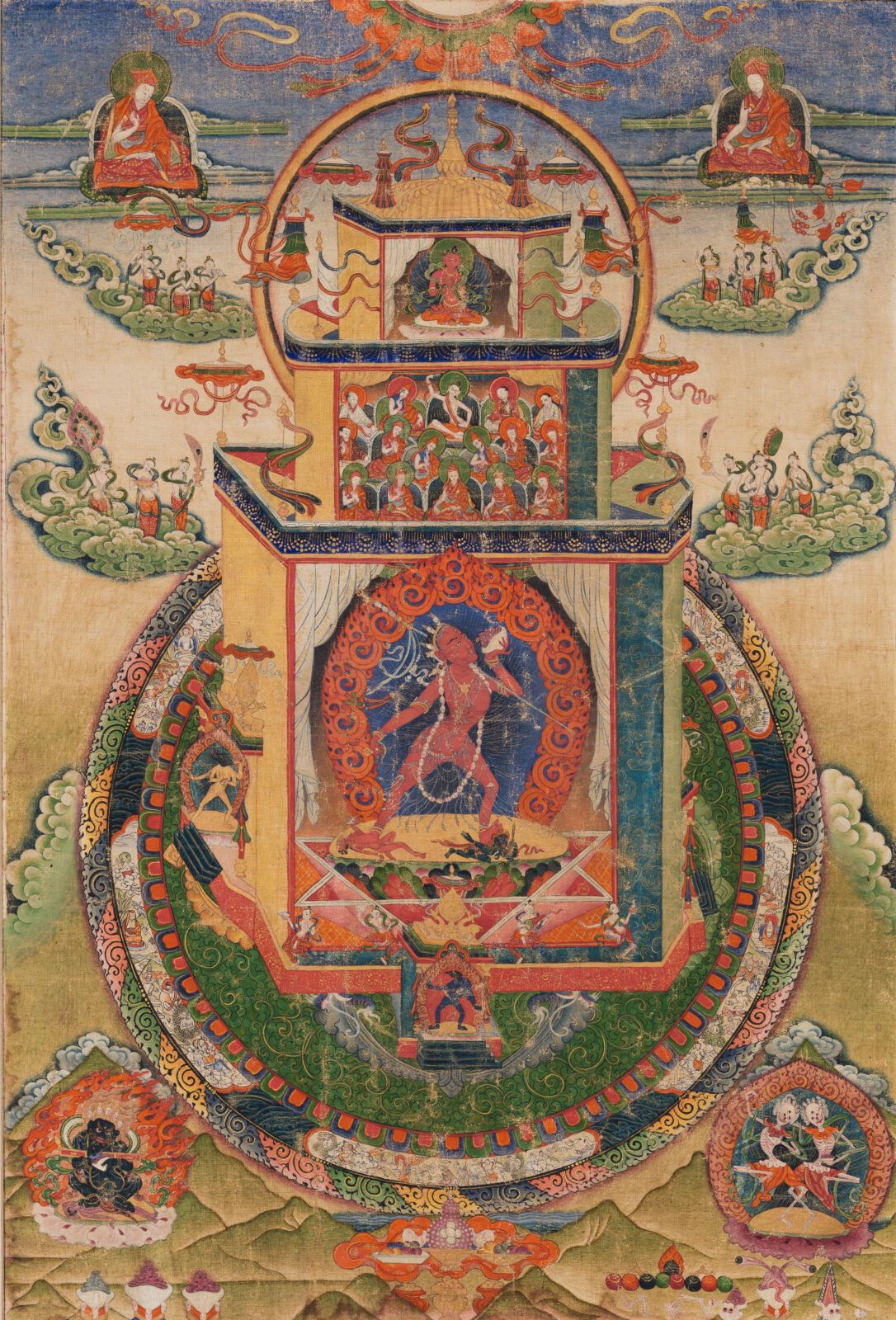
Kham region, eastern Tibet
19th century
Kham region, eastern Tibet
19th century
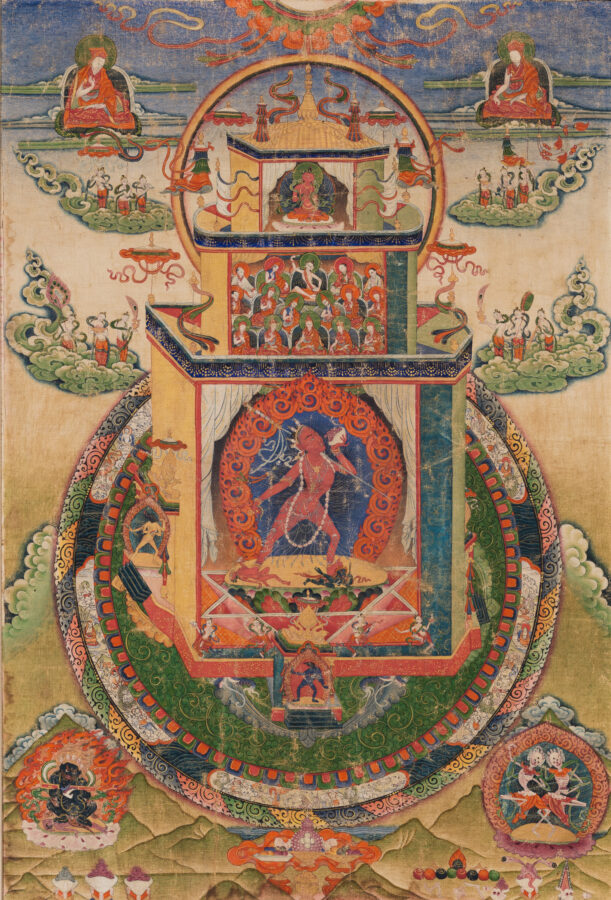
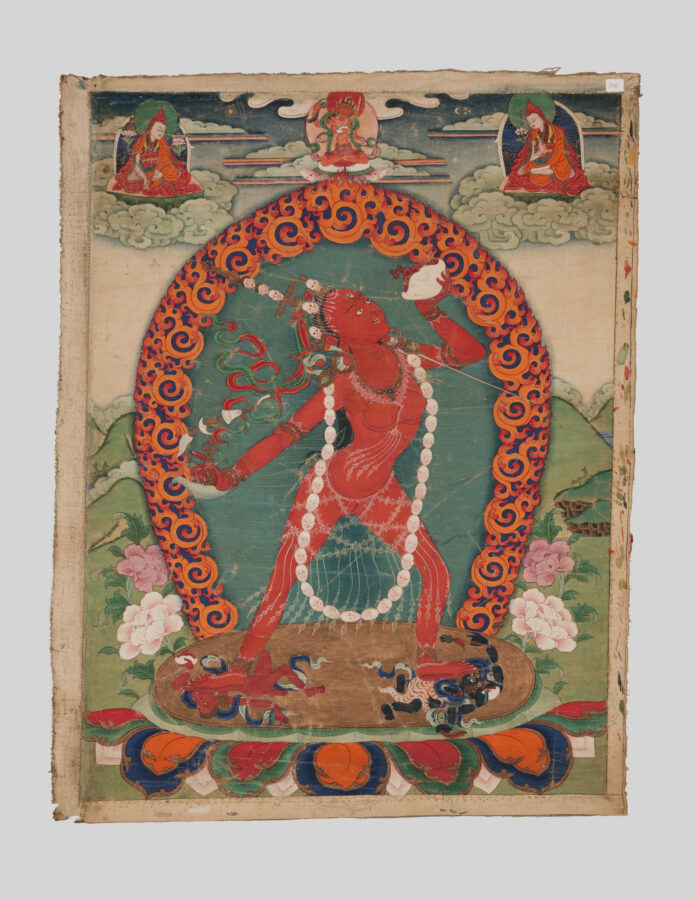
The focus of this painting is a form of the female deity Vajrayogini, who appeared in a vision to the Indian tantric yogi Naropa (ca. 956–1040). Vajrayogini stands at the center of her Khechara pure realm, posed in an archer’s lunge, while tasting nectar from a skull cup. Animal-headed goddesses guard the gates to her three-dimensional palace, or mandala. Her consort Chakrasamvara occupies its top structure, and the masters of the transmission lineage are in the middle level. The meditations and rituals relating to Vajrayogini are considered secret, as they cannot be studied or practiced without the requisite initiations, teachings, and instructions from a master. The meditational practice focused on this form of Vajrayogini is a specialty of the Sakya and Geluk Tibetan Buddhist traditions.
This painting’s composition and iconography derive from compositions carved into a set of woodblocks intended to propagate this form among monasteries of the same Tibetan Buddhist tradition. See the woodblock print:
Vajrayogini in Her Khechara Pure Realm
Print design by Dzinglha Jamyang
Derge Printing House, Derge, Kham region, eastern Tibet (present-day Sichuan Province, China); after 1979 (printed ca. 1990s)
Xylograph, ink on paper
Rubin Museum of Himalayan Art, Gift of William Hinman
C2001.4.69 (HAR 87569)
The Rubin collection includes another painting of the same subject in almost identical composition but varied in the application of pigments and details. See:
Vajrayogini in Her Pure Realm of Kechara
Central Tibet; 19th century
Pigments on cloth
Rubin Museum of Himalayan Art, Gift of the Shelley and Donald Rubin Foundation
F1997.22.1 (HAR 334)
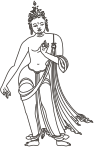
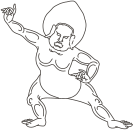
This posture features a triple- bend of the body at the knee, hip, and waist.

A skull cup is an attribute of tantric deities and is usually paired with a curved knife. It can symbolize a mind filled with the bliss of realizing the true nature of reality.

This weapon is an attribute of tantric deities and is usually paired with a skull cup. When held by female deities it symbolizes wisdom’s destruction of all obstacles to enlightenment. When held by male deities it represents the method aspect of enlightenment.

An attribute of tantric deities, this staff represents the union of the two aspects of enlightenment. When held by a male deity it symbolizes his female consort as wisdom, and when held by a female deity it represents her male consort as method.
A religious movement that originated in India around the fifth to seventh century with sacred writings and esoteric teachings and practices transmitted from teacher to student through initiation. These remain an important part of Hinduism and Buddhism today.
A kind of energy that can be used, individually and collectively, to effect change.
In Buddhism gender is considered more fluid compared to some other religions. Certain traditions emphasize the importance of all genders in achieving enlightenment. The feminine is considered an embodiment of wisdom and the masculine is an embodiment of method.
Buddhist practitioners in some traditions believe that cutting through ordinary perceptions that keep us in the endless cycle of death and rebirth, known as samsara, can create a powerful and enhanced divine identity that leads to enlightenment.
A contemplative practice in which a person uses concentration and visualization to achieve aims such as transforming the mind and generating feelings of compassion. Techniques include focusing on breathing or visualizing oneself as a deity.
Buddhism is fundamentally about transformation, as changing one’s attitude and conduct are required to end suffering and attain enlightenment.
The passing down of authentic Buddhist teachings from a teacher to a disciple or student, often in the form of a text in a ritualistic context.
A state of “waking up” from illusion and seeing the true nature of reality. Buddha Shakyamuni attained enlightenment while meditating under the bodhi tree. Buddhist teaching explains that the accumulation of merit and wisdom are essential for achieving enlightenment, also known as awakening.
A state of “waking up” from illusion and seeing the true nature of reality. Buddha Shakyamuni attained awakening while meditating under the bodhi tree. Buddhist teaching explains that the accumulation of merit and wisdom are essential for achieving awakening, also known as enlightenment.
A meditation technique primarily used in tantric practice that involves imagining a deity in one’s mind or imagining oneself becoming a deity and carrying out various activities. Such techniques are intended to help a practitioner transform ordinary perception and achieve enlightened qualities.
The transmission of teachings from one generation to the next, from teacher to student, traced all the way back to the Buddha without interruption. A complete lineage is essential in Tantric Buddhist practices as it makes the blessings of the teaching more powerful.
A mental affliction that binds sentient beings to the cycle of death and rebirth, known as samsara, and distorts one’s perception of reality. According to Buddhism, this distortion leads to the formation of desires that result in feelings of pain, frustration, and loss.
The central goal of Buddhism is the liberation of all beings from suffering and the cycle of life, death, and rebirth, known as samsara, through applying the teachings of the Buddha.
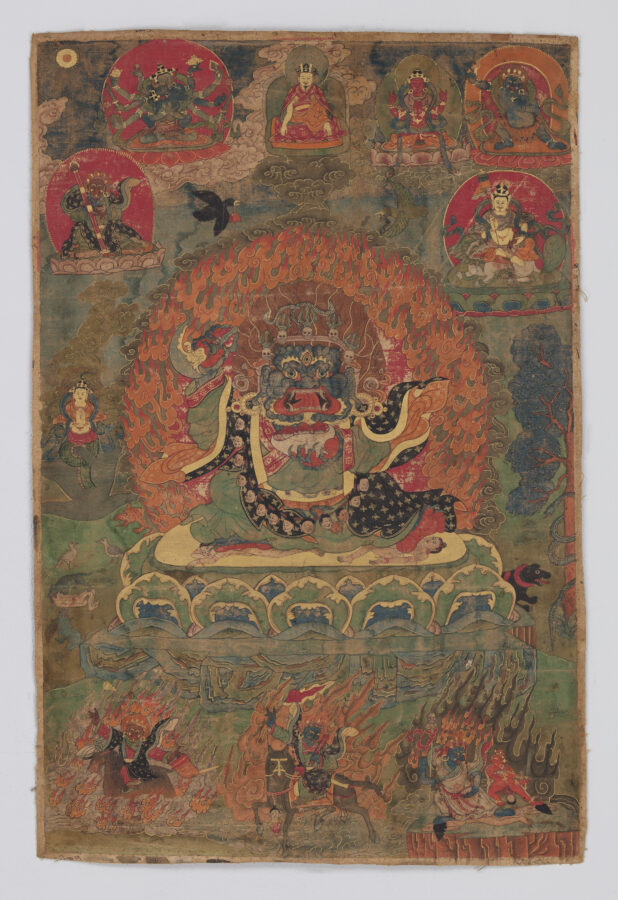
Female bodhisattvas and tantric deities embody specific enlightened qualities such as wisdom, power, and protection, and can be peaceful or wrathful in appearance.
A geometrically shaped tool used for meditation and visualization in Buddhist practice. It is a representation of the palace of a deity and the Buddhist conception of the cosmos.
Tantric deities personify various enlightened qualities and are the focus of esoteric religious practices (tantras) that aim to swiftly and radically transform one’s understanding of reality.
Today, Tibetans primarily inhabit the Tibetan Plateau, situated between the Himalayan mountain range and the Indian subcontinent to the west, Chinese cultural regions to the east, and Mongolian cultural regions to the northeast. During the 7th to 9th century, Tibetan rulers expanded their empire across Central Asia, and established Buddhism as the state religion.

Get the latest news and stories from the Rubin, plus occasional information on how to support our work.