
Season 6 · Episode 3
Julie Gottman:
Most of us have cracks inside our hearts. And so one has to be so exquisitely careful when you’re speaking a truth to somebody.
Kathleen Hanna:
Doctors Julie and John Gottman are world-renowned psychologists and researchers who have devoted their lives to understanding marital conflict and fostering healthy relationships.
John Gottman:
It’s important to be truthful. You can do it in a way that is gentle and loving, but suppressing it is likely to lead to a quagmire.
Kathleen Hanna:
Welcome to season 6 of AWAKEN, a podcast from the Rubin Museum of Himalayan Art about the dynamic path to enlightenment and what it means to “wake up.” I am Kathleen Hanna, punk singer, writer, and frontwoman of the bands Bikini Kill and Le Tigre, and your host for this season of AWAKEN.
At a time when anger seems more present—and potent—than ever, how can a better understanding of wrath help us transform this challenging emotion into an effective catalyst for change? In this season, we explore the concept of wrath as a powerful force for awakening and transformation. Experts in the realms of art, philosophy, Buddhism, and more share how wrath can be used for protection and meaningful action when applied with intention, skill, and compassion.
Buddhist and Hindu art have long been a pathway to insights and awakening, illuminating perspectives on how to navigate the world. Over the course of eight episodes we look at artworks of wrathful deities from the Rubin Museum’s collection to learn what these terrifying figures can teach us about harnessing wrath for the benefit of all. In this episode, we look at the relationship between wrath and fierce compassion. Because compassion is what really distinguishes anger from wrath.
Myisha Cherry:
Typically we have a tendency to think that compassion is about suffering along with the person who is suffering.
Kathleen Hanna:
Myisha Cherry is an associate professor of philosophy at the University of California, Riverside, the director of the Emotion and Society Lab, and the author of several books including The Case for Rage: Why Anger is Essential to Anti-racist Struggle and the forthcoming How to Love.
Myisha Cherry:
And what that requires a certain kind of empathy, it requires a certain kind of attunement and attentiveness, certain kind of humility, certain kind of sacrifice, so suffering with.
Julie Gottman:
I think of compassion as connecting with the interior world of another individual and feeling what they’re feeling, empathizing with what they’re feeling, really I’m trying to understand what they’re feeling.
Myisha Cherry:
When you do experience that pain, and not to say that your pain will be on par with that other person, we would say that you’re experiencing compassion. And I think that’s a way, for one, I think immediately it’s a way to kind of test or recognize if we’re still alive, that is in tune with other human beings, which to me is the fullest way of being alive. But it also, the co-passion, it’s not just the suffering part, but you’re also willing to do something to help the person be relieved of the suffering. So it’s not just enough to watch the video, or read the report or witness your loved one across the hall experiences these things, you want to do something to relive it.
Kathleen Hanna:
At the most basic level, compassion means “feeling together.” It’s about building relationships and connecting to other’s experiences. And anger, when expressed appropriately, can be a healthy part of relationships. That’s one thing the Gottmans have learned in their 50 years of researching marriage.
John Gottman:
One of our findings about anger that was so interesting was that a couple dealing with a conflict topic in a 15-minute conversation in the laboratory, the expressions of anger by both men and women were related to lower marital satisfaction. But when we followed them longitudinally, the expression of anger, particularly by women, was related to ultimate happiness in the relationship. So it might’ve been uncomfortable at time one, but at time two, it was associated with an improvement in marital satisfaction, especially for women so that marriages where women’s anger gets listened to, get happier over time.
Julie Gottman:
What we have seen, at least in our research, is that anger is a very positive thing potentially because it wants to right a wrong.
Kathleen Hanna:
Julie Gottman
Julie Gottman:
It wants to clear a channel. It wants to ultimately approach the other individual and connect with them and be heard at the same time be listened to, but also there’s a cleansing quality to it. And I think it’s quite harmful for individuals in relationships to sit on their anger, suppress their anger, withdraw with their anger, withdrawing when you’re angry ultimately can lead to self-loathing, which is very sad to see, or it can be reversed and lead to much more aggression.
And so the way that it’s expressed is so fundamentally important and the emphasis when it is expressed needs to be on “I”—I feel this, I am experiencing this as opposed to you, you, you, you, which is blaming contemptuous, critical, damaging to the relationship and ultimately pushes the individual backwards from connecting with you rather than drawing them forwards.
Kathleen Hanna:
There are lots of strategies for helping to express anger more effectively. Clear communication, curiosity, and compassion for yourself and the other are useful tools to bridge a divide.
Julie Gottman:
One of the best questions to ask after your partner has expressed their anger is simply to say, “Help me understand this. Tell me more. Help me understand this. Tell me more.” Just very, very simply because what that indicates is that you do want to understand, you do want to use this moment as a bridge between you through which to connect and have in fact a deeper understanding of your partner. No matter how many years you’ve been together, there’s always more to understand, always. So many people see conflict as a win-lose situation. Who’s going to win the fight? Who’s got more logic behind their point of view or whatever it is. And one thing that we need to understand that our culture doesn’t do a good job teaching us is emotion is just as important as logic, as rationality, as intellect. You are entitled to be angry no matter what is going on. And you have a choice as to what you do with that anger, whether you want to use it for yourself in order to ferret out inside you. “What the heck is this? How come I’m feeling so angry about this? What is getting triggered in me? Is it a past thing? Is it an injustice? What about that injustice? How come I’m so angry?”
And I think it oftentimes is a good idea for folks when they are angry to do that little piece of self-reflection first before bringing the anger to their partner so that in part they can say, “This is coming from me. This may not be the way you feel or the way you think and so on, but this is about me and my emotional world that I really want you to see and to hear.”
Part of dealing with anger to move into curiosity is to make sure that the communication of it is clean and one repair if you’re hearing criticism or blame, first of all, when that defensiveness comes up is one of my favorite repairs is to say, I’m feeling defensive. Can you say that another way? Could you just describe to me what it is that you’re angry about? What’s the situation? And tell me about that feeling that you’re having and maybe tell me what is it that you need that would really make this better for you? So asking questions is another wonderful way to slow things down, but also the repair initially if you’re feeling defensive is really important in terms of you staying in your body, staying present, and bringing your whole mind and heart to the conversation.
Kathleen Hanna:
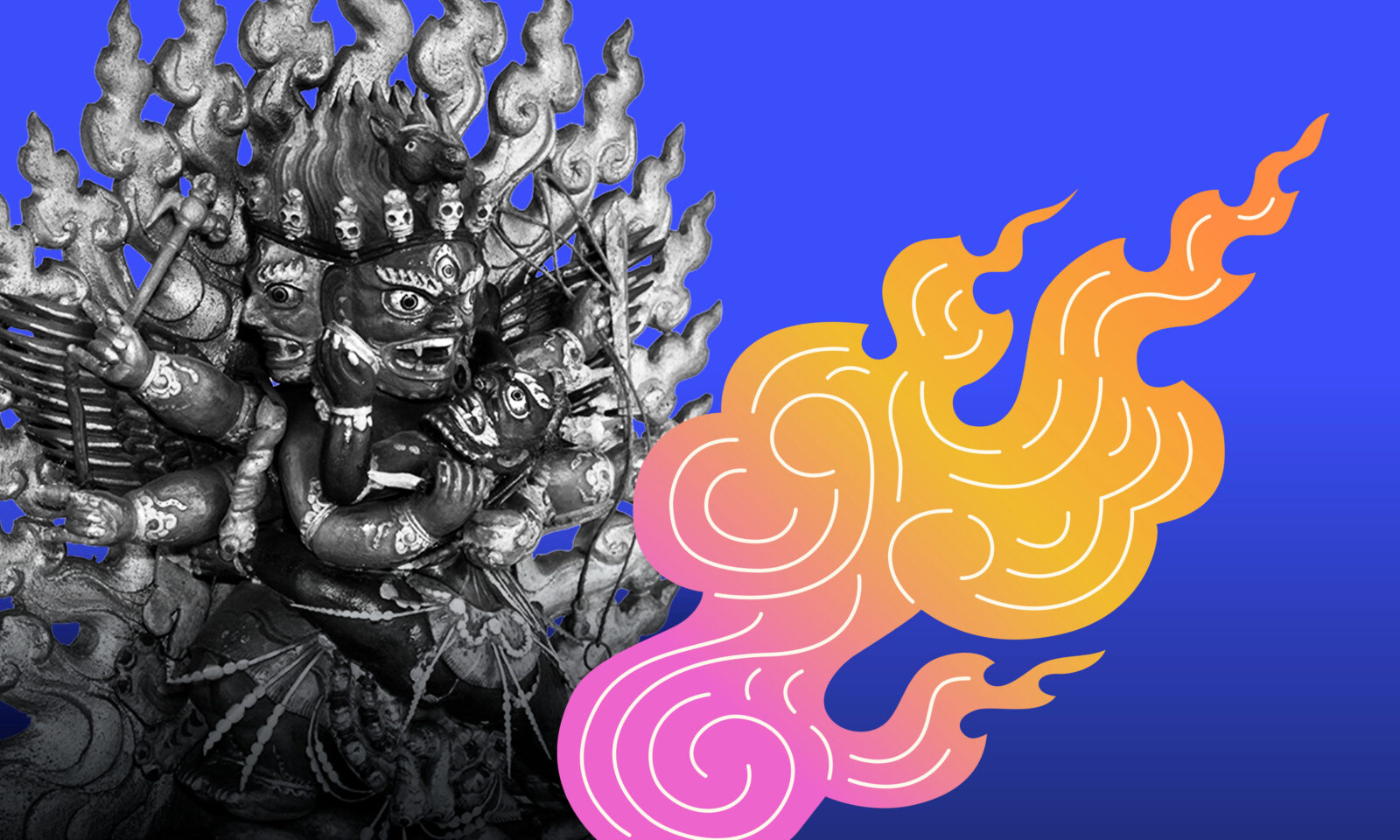
This season, we are exploring images of wrathful deities from the Rubin Museum’s collection. In Buddhist and Hindu art wrathful deities are fierce embodiments of compassion and awakening in action. In this episode, professor Annabella Pitkin looks at an 19th-century Mongolian sculpture of Hayagriva, the wrathful emanation of the bodhisattva of compassion Avalokiteshvara.
For tantric Buddhists, Hayagriva is associated with fierce compassion and is revered for his ability to overcome obstacles, illness, and harmful forces. In this particular image, Hayagriva stands in union with his divine consort, who is sometimes identified as Vajrayogini-Krodhakali, the goddess described in episode two. The image of two deities embracing like this is known as “yam bum” or “father=mother” in Tibetan and symbolizes the ultimate nature of reality, which is a state of oneness that is beyond duality. To see this artwork, visit rubinmuseum.org/awaken
Annabella Pitkin:
Here we see some images like the three eyes, the fangs, the skulls, the flames, the wrathful pose that are familiar as images of fierce compassion and wrathful deities. We see the father, mother deities, trampling on two human bodies, human-like bodies. So symbolizing the negativities, the negative emotions and negative mental states that are being removed, eradicated, subdued, eliminated because of the blaze of this wrathful compassion and the blazing flames of blissful awareness, again, awaken the viewer and kind of call them out of their delusions, out of their selfishness and self cherishing. Importantly, the idea of fierce compassion is very explicit in this image. This is a particularly wrathful image. There are some peaceful images of enlightened beings, there are intensely wrathful images of enlightened beings, and then there are semi-wrathful images of enlightened beings.
This is a fully intensely wrathful image of enlightened beings. Hayagriva is the wrathful aspect of the Buddha of perfect compassion. So this is compassion in compassion’s fierce form. And here Hayagriva has a horse head above his head. It has the swords that cuts through delusion just to set us free and has the symbols of the union of blissful awareness in the fact that we see here the father/mother buddhas in union. So Hayagriva has the female consort in embrace, and they are both wearing wrathful ornaments of bones and skulls. They’re both unclothed except for these wrathful ornaments and for their royal jewelry, and they’re terrifying animal skin decorations. And this unclothed qualities because there’s a kind of nakedness to enlightenment, to freedom from delusions, freedom from all conventional concepts that can be depicted as a kind of unadorned state. And the union of the mother/father buddhas is a symbol of the non-dual nature of the union of wisdom and compassion, the non-dual nature of the union of blissfulness and emptiness of awareness and emptiness. And so this union pose shows that this wrathful display is an enlightened raffle display that brings together these two strands of the practitioners meditative and ritual practice, and also of the two strands that conduced to buddhahood, the compassion strand, which is also the activity and the skillfulness strand and the wisdom strand, which is the emptiness strand. And these are brought together blazing with the terrifying power that banishes all negativity.
Kathleen Hanna:
Again, Julie Gottman.
Julie Gottman:
I think that one thing we have to understand when we’re speaking the truth to somebody is that they may not hear it, they may do nothing with, it may bounce off them, they may take it the wrong way, et cetera. You can’t speak truth to somebody else with the assumption that that’s going to help them. You can’t do that. It’s too controlling. You’re assuming that your words are so magnificent that they’re going to change your friend’s perception. And there ain’t no guarantee that that’s going to happen. So in some ways, the way I tend to think about things is to think, okay, who am I really being loyal to? Well, I’m being loyal to my friend, of course, in this situation, but I’m also speaking my own truth instead of suppressing my own truth. And ultimately, there’s some compassion towards yourself in that. You’re being an ally to yourself in not stepping upon your own truth and squelching it, but instead speaking that truth no matter how your friend may take it.
Kathleen Hanna:
Expressing our wrath with the well-being of ourselves and others in mind is the throughline of fierce compassion.
Sharon Salzberg:
Why are we motivated to act? If we are motivated by something like compassion, it’s not mandating or determining a particular course of action.
Kathleen Hanna:
Sharon Salzberg is a meditation pioneer, world-renowned teacher, and New York Times bestselling author of books including Loving Your Enemies, Real Change, and Finding Your Way.
Sharon Salzberg:
And here’s the place where wrath kind of figures in as a sort of fiery energy of manifestation. We can be motivated by compassion, but our best guess based on discernment, based on wisdom of the most skillful way to act in a particular situation might be kind of intense. It might be fierce. It might not be so gentle and sweet. This is a kind of fear a lot of people express like, were I to be motivated by something like compassion? I could only say yes. I could only give them more money. I could only let them move back in. I can only let them keep hurting me or hurting someone else. And it doesn’t mean that at all because that second area of action, the skillfulness or unskillfulness is really based on discernment. And it’s very, usually very specific.
How can compassion as a motivation and a really intense kind of fierce action coexist, but they can. I’ve been helped by looking back at the motivation, realizing I’m not actually trying to hurt somebody in the sense of harming them or destroying them. I’m trying to stop an action or rechannel something in a better direction. And I always, and this is part of such as a long-term meditation background, I always use myself and my reactions to myself as the kind of laboratory. What does it mean to be inflamed with anger at myself? What does it feel like? What are the consequences? What good comes from it? What harm comes from it? And paying attention. It’s like if you bring up a time when you really are just so furious at yourself and you bring it up and you study it, you see like, oh, there’s a lot of information that’s actually lost.
Maybe I did five great things that same morning. I said that stupid thing that I’m so angry at, but those five things, they’re gone. It’s such a wholesale condemnation of myself and I’m so despicable and I’m such a loser and I’ll never learn. And you watch how you pile on yourself and how useless it is and how harmful it is. And yet you don’t want to pretend that that mistake was inconsequential. Maybe it was very consequential, whatever it was. And so learning that balancing act of being motivated more by kindness or compassion and having clarity and even sometimes intensity in the resolution of a particular problem, that’s what we’re trying to balance.
Julie Gottman:
I think we really need to appreciate that most people are fragile, right? None of us had perfect upbringings. None of us have egos like rocks where we can hear anything about ourselves. Fierceness is like an arrow, right? It’s direct. Boom. And most people don’t like being pierced by arrows, even if they’re true arrows because it hurts and it can make somebody feel very insecure. It’s that thinking that we have to be sensitive to and be gentle.
Kathleen Hanna:
You just heard the voices of Myisha Cherry, John Gottman, Julie Gottman, Annabella Pitkin, and Sharon Salzberg.
I am Kathleen Hanna, your host.
To see the artwork discussed in this episode, go to rubinmuseum.org/awaken
If you’re enjoying the podcast, leave us a review wherever you listen to podcasts, and tell your friends. Leaving a review is one of the best ways to support us. It really helps us reach listeners like you.
For more stories and news from the Rubin, follow @rubinmuseum on Instagram and sign up for the Museum’s monthly newsletter at rubinmuseum.org.
AWAKEN season 6 is an eight-part series from the Rubin, a global museum dedicated to presenting HImalayan art and its insights.
AWAKEN is produced by the Rubin Museum of Himalayan Art with Westin Harris, Kimon Keramidas, Christina Watson, Sovah Woydak, and Sarah Zabrodski in collaboration with SOUND MADE PUBLIC including Tania Ketenjian, Philip Wood, Kristin Mueller, Christine Driscoll, and Aaron Siegel.
Original music has been produced by Hannis Brown with additional music from Blue Dot Sessions.
AWAKEN season 6 is supported, in part, by the Charina Endowment Fund, The Prospect Hill Foundation, and Shelley and Donald Rubin, with generous contributions from the Rubin’s Board of Trustees, individual donors, and Friends of the Rubin.
This program is supported, in part, by public funds from the New York City Department of Cultural Affairs, in partnership with the City Council.
This program is supported, in part, by the New York State Council on the Arts with the support of the Office of Governor Kathy Hochul and the New York State Legislature.
Thank you for listening.
Beneath the ferocity of wrath is a deep sense of compassion. What is the relationship between anger and love? And how can we access empathy for others in difficult situations? A sculpture of Hayagriva, the wrathful emanation of the bodhisattva of compassion Avalokiteshvara, exemplifies the tireless dedication of such deities to the well-being of all.
This episode features psychologists and researchers Julie and John Gottman. AWAKEN season 6 is hosted by singer, writer, and frontwoman of the bands Bikini Kill and Le Tigre Kathleen Hanna. Other guests include author, professor, and philosopher Myisha Cherry, professor of Buddhism and East Asian religions Annabella Pitkin, and meditation pioneer, mindfulness and lovingkindness teacher, and author Sharon Salzberg.
Complete our listener survey for a chance to receive a copy of the book Himalayan Art in 108 Objects.

Hayagriva; Mongolia; 19th century; Wood, cord, metal wire with pigments; Rubin Museum of Himalayan Art; C2006.68.2

Kathleen Hanna is a punk singer, writer, artist, and frontwoman of the influential bands Bikini Kill and Le Tigre. Her memoir Rebel Girl was an instant New York Times and Sunday Times bestseller. She is a leading voice in the feminist movement and has been named one of the best live performers of our time. Follow @mskathleenhanna on Instagram, @thekathleenhanna on TikTok, and subscribe to Future Windows on Substack.

Julie Gottman, PhD, is the co-founder of The Gottman Institute and Affective Software, Inc. A highly respected clinical psychologist, she is the author of many books, including the national bestseller Eight Dates and New York Times bestsellers Fight Right and The Love Prescription. Julie co-created the “Gottman Method” for couples therapy, which integrates research-based interventions to enhance relationship stability and satisfaction. Her work on trauma, abuse recovery, substance abuse treatment, and gay and lesbian parenting has significantly impacted therapeutic practices, establishing her as a leading figure in relationship counseling.

John Gottman, PhD, is world renowned for his work on marital stability and divorce prediction. For over 50 years, John has conducted breakthrough research with thousands of couples. He is the cofounder of The Gottman Institute and Affective Software, Inc., as well as the author of over 200 published academic articles, and he has authored or coauthored more than 50 books, including the New York Times bestsellers The Seven Principles for Making Marriage Work, The Love Prescription, and Fight Right, as well as the national bestseller Eight Dates.

Myisha Cherry is an associate professor of philosophy at the University of California, Riverside. She writes about the role of emotions and attitudes in our moral and public lives. Her books include The Case for Rage, Failures of Forgiveness, and the forthcoming How to Love. She is also the director of the Emotion and Society Lab, and hosts the UnMute Podcast, where she interviews philosophers about the social and political issues of our day. Myisha has written for the Los Angeles Times, The Atlantic, Salon, and New Philosophers Magazine, and her work has been featured in the New Yorker, Essence, and Publisher’s Weekly.

Annabella Pitkin is a scholar of Tibetan Buddhist intellectual history, philosophy, and literature, and associate professor of Buddhism and East Asian religions at Lehigh University. Her research explores themes of renunciation, power, and the bodhisattva ideal. She is the author of Renunciation and Longing: The Life of a Twentieth-Century Himalayan Buddhist Saint about the life of the meditator-poet Khunu Lama Tenzin Gyaltsen (1895–1977). She is on the editorial committee of the Treasury of Lives: A Biographical Encyclopedia of Tibet, Inner Asia, and the Himalaya, and is a member of the review committee for the Rubin Institute.

Sharon Salzberg is a meditation pioneer, world-renowned teacher, and New York Times bestselling author. She was among the first to bring mindfulness and lovingkindness meditation to mainstream American culture over 50 years ago, inspiring generations of meditation teachers and wellness influencers. Sharon is cofounder of the Insight Meditation Society in Barre, MA, and the author of 14 books, including the New York Times bestseller Real Happiness, now in its second edition, and her seminal work, Lovingkindness. Sharon’s podcast, The Metta Hour, has amassed eight million downloads and features interviews with thought leaders from the mindfulness movement and beyond.

Get the latest news and stories from the Rubin, plus occasional information on how to support our work.