
Season 6 · Episode 1
Annabella Pitkin:
When we speak conventionally in English, wrath is just another kind of anger.
Kathleen Hanna:
Professor Annabella Pitkin teaches Buddhism and East Asian Religions at Lehigh University.
Annabella Pitkin:
But when we’re using it as a Buddhist translation term, the intention is to try to make a subtle but extremely important distinction between an egocentric, harmful, toxic, poisonous, diluted kind of anger and something else, a kind of liberating, fiery, fierce, but ultimately protective and freeing kind of energy.
Kathleen Hanna:
Welcome to season 6 of AWAKEN, a podcast from the Rubin Museum of Himalayan Art about the dynamic path to enlightenment and what it means to “wake up.”
I am Kathleen Hanna, punk singer, writer, and frontwoman of the bands Bikini Kill and Le Tigre, and your host for this season of AWAKEN.
At a time when anger seems more present—and potent—than ever, how can a better understanding of wrath help us transform this challenging emotion into an effective catalyst for change?
In this season, we explore the concept of wrath as a powerful force for awakening and transformation. Experts in the realms of art, philosophy, Buddhism and more share how wrath can be used for protection and meaningful action when applied with intention, skill, and compassion.
Buddhist and Hindu art has long been a pathway to insights and awakening, illuminating perspectives on how to navigate the world. Over the course of eight episodes we look at artworks of wrathful deities from the Rubin Museum’s collection to learn what these terrifying figures can teach us about harnessing wrath for the benefit of all.
Again, Annabella Pitkin.
Annabella Pitkin:
From the earliest part of the Buddhist transmission from the earliest text that we have from the earliest accounts of the first Buddhist communities, we hear very, very precise and targeted critiques of anger as one of the three poisons that traps living beings in an endless cycle of suffering.
We hear about anger as a kind of force for violence and also a force that takes us over and makes us do things that we wouldn’t necessarily choose to do in a calmer moment.
Anger is terrifying. Anger is destructive. Anger is toxic. Anger is a poison. There’s a really clear, precise Buddhist psychology around anger as connected to ignorance and to kind of delusion and misunderstanding, and also around anger as connected to the ego and to focusing on one’s self instead of paying attention to others.
And the word wrath, the choice of this slightly archaic English word wrath for English users to try to identify something else that’s not the same as the poisonous kind of anger. That’s an attempt to show that Buddhists have wanted to point to a kind of latent power or capacity or potentiality that has something to do with the poisonous kind of anger, but isn’t the same as it. That is liberating. That is a kind of fierce energy, but not necessarily a harmful energy.
adrienne maree brown:
It’s almost a totality of rage or a totality of a feeling, like an intensity of I’m really all in.
Kathleen Hanna:
adrienne maree brown is an emergent strategist and author of many books including Emergent Strategy and Pleasure Activism.
It feels like there’s a pure feeling. And I’m always trying to tie everything back to love. So I’m just like, oh, it’s the form of love when you’re just like something I love has been hurt or something I love is being attacked. And wrath is this greater than life power that can come through us to protect and to change.
We need massive actions that are only possible if a lot of people are like, “I’m feeling my anger and I’m letting it actually organize me into a new formation.”
Kathleen Hanna:
Wrath takes the energy of anger and turns it into action. There’s an element of egolessness within it. It’s not about you. It’s about a condition that needs to change, something you care deeply about.
Again, Annabella Pitkin.
Annabella Pitkin:
Wrath is not self-righteous. Wrath is a kind of pure energy that comes with clarity and awareness, and that burns away delusions like attachment to the self, like narcissism, like self-righteousness, and also that burns through illusion, delusion, ignorance about what’s really true. So wrath has a kind of truthful quality to it. It has a courageous quality to it. It’s free from self-righteousness and it’s free from attachment. So the minute it’s done its job, it’s gone. It doesn’t hold grudges, it’s not there to laugh at you, it’s skillful. It’s aimed at liberating. It’s aimed at freeing the situation. The beings in the situation from whatever is harmful or is making them stuck. It has a really different kind of quality than ordinary anger.
Lama Rod Owens:
First of all, it’s about awareness.
Kathleen Hanna:
Lama Rod Owens is a self-proclaimed “Black Buddhist southern queen” and the author of Love and Rage: the Path of Liberation Through Anger.
Lama Rod Owens:
And secondly, it’s not about you. So therefore, you’re telling the truth or exposing the truth to someone with no hopes or with no agenda except for that person to be free. Even if the consequences are that that person will end the relationship with you, that we can’t be friends, we can’t be in relationship because you did this, you said this, but you know 100% that you had to do this because ultimately they’re going to get free having received this expression from us. So you put everything on the table.
Khenpo Yeshi Rinpoche:
That’s why wrathful deities rise from the Buddhist idea of compassion.
Kathleen Hanna:
Buddhist scholar and teacher Khenpo Yeshi Rinpoche.
Khenpo Yeshi Rinpoche:
Compassionately, not kind of hatred way to subdue this being, but compassionately, this person or this being prevent harming others. So that’s why they can liberate, we say they can liberate his or her mind.
Annabella Pitkin:
Wrath is described as liberating, as just burning up all the negativity. And then it’s gone like a thunderstorm, like a thunder clap, like a bolt of lightning. And afterwards you feel better. You feel free. You feel kind of set to rights like the physical adjustment from the massage therapist or the doctor has aligned your joints, and now you feel supple and things feel good. Now things feel awake and possible. So that’s one way of thinking about the way wrath is a kind of enlightened transmutation of the powerful qualities of anger.
Myisha Cherry:
Being angry doesn’t on the whole feel good. And we want to feel good. We want to feel joy. We want to feel happiness. We want to feel love.
Kathleen Hanna:
Myisha Cherry is an associate professor of philosophy at the University of California, Riverside, the director of the Emotion and Society Lab, and the author of several books including The Case for Rage: Why Anger is Essential to Anti-racist Struggle and the forthcoming How to Love.
Myisha Cherry:
So that’s the picture that I think makes us uncomfortable, but there’s no doubt that there’s another picture. And it’s that other picture that I’ve been interested in, that other picture that I have experienced when I experience anger, that other picture that I have seen people when they experience anger. When I think about like right now, you feel like your rights are not being respected. You feel like people’s dignity is being taken away and people’s lives are being taken away. And if anger is a response to wrongdoing, that is one of the emotions that you’re going to have in response to that. And of course, that’s not going to feel good, but anger is also motivational.
Kathleen Hanna:
Valarie Kaur is an activist, documentary filmmaker, lawyer, educator, and faith leader.
Valarie Kaur:
I see wrath as sacred. And the first time I really saw it in my own life was in the eyes of my mother. The first time I broke my silence around sexual assault, it was in a room of people who wanted me to stay silent and my mother stood between me and the rest of the room and there was rage in her.
And it was my mother who put her body between me and the rest of the people in the room and said, “No, not my daughter. She will be free.” And there was rage roaring inside of her, such fury in her eyes. I had never seen so much rage in my mother before. And I realized that she was showing me that I was worth protecting, that rage is the force that we harness to protect that which we love. And that she was inviting me to connect that energy inside of me to protect, to fight for what I love, including my own self.
How many of us have been taught to suppress our rage and the name of love and forgiveness? I mean, growing up as a young woman, a young woman of color, I always thought that I was only as good or spiritual or lovable as my ability to choke down my rage. But I learned the hard way, right? That rage choking that down only makes us ill. We know that the science now tells us about all of the illnesses that come from suppressed rage, especially for women. We know that exploding rage, letting it explode the way that so many men and boys are conditioned to do only causes destruction. You only have to look around the world to see what kind of reality that produces. So the solution is not to suppress our rage or to let it explode, but to process our rage in safe containers.
We have to move that energy in our bodies. And once we move that energy, we can ask ourselves, “What information does my rage carry? What is it saying about what’s important to me and how do I wish to harness this energy for what I do in the world?” I call that harnessed energy divine rage. The aim of divine rage is not vengeance. The aim of divine rage is to reorder the world.
Myisha Cherry:
You’re angry in response to people’s suffering, so you feel compassion and you feel love towards them.
Kathleen Hanna:
Again, Myisha Cherry.
Myisha Cherry:
Sometimes you’re angry about one particular target, but you also have an emotion about something else. I may have a kind of anger directed towards ICE, but then I also have compassion towards people that suffer. And then I also have love for people that I’m in solidarity with. And it’s that picture, that nuanced picture, I think also that realistic picture that I think gets lost when we have kind of the negative view or the kind of narrow view of what anger is and what it feels like to be angry.
Kathleen Hanna:
Again, Valerie Kaur.
Valarie Kaur:
I think about here in LA in the wake of the wildfires when I was holding my son close to me, not knowing if the fires were going to take us, not knowing if we were in the zone of harm or not. I remember feeling so much grief and then feeling so much rage at the corporations and the governments that allowed our earth to get hot so that climate catastrophes one after another are just a routine part of being alive.
I felt so much rage.
When a few months later, when this government sent masked armed men into our streets to disappear our neighbors, watching children terrorize, watching families ripped apart, watching a young mother, Selena, ripped from a Jakaranda tree she was clinging, stuffed into a white van, removed from her own baby. I could only see my baby in hers. I can only see myself in her and I could feel this immense amount of rage for what was being done in our name. Rage is so important for us. It’s a necessary healthy response to trauma and to social injustice and to oppression and to authoritarian violence. And so the question is not whether we should honor our rage or not. The question is, what would you like to do with that energy?
Kathleen Hanna:
This season, we are exploring images of wrathful deities from the Rubin Museum’s collection. In Buddhist and Hindu art wrathful deities are fierce embodiments of compassion and awakening in action.
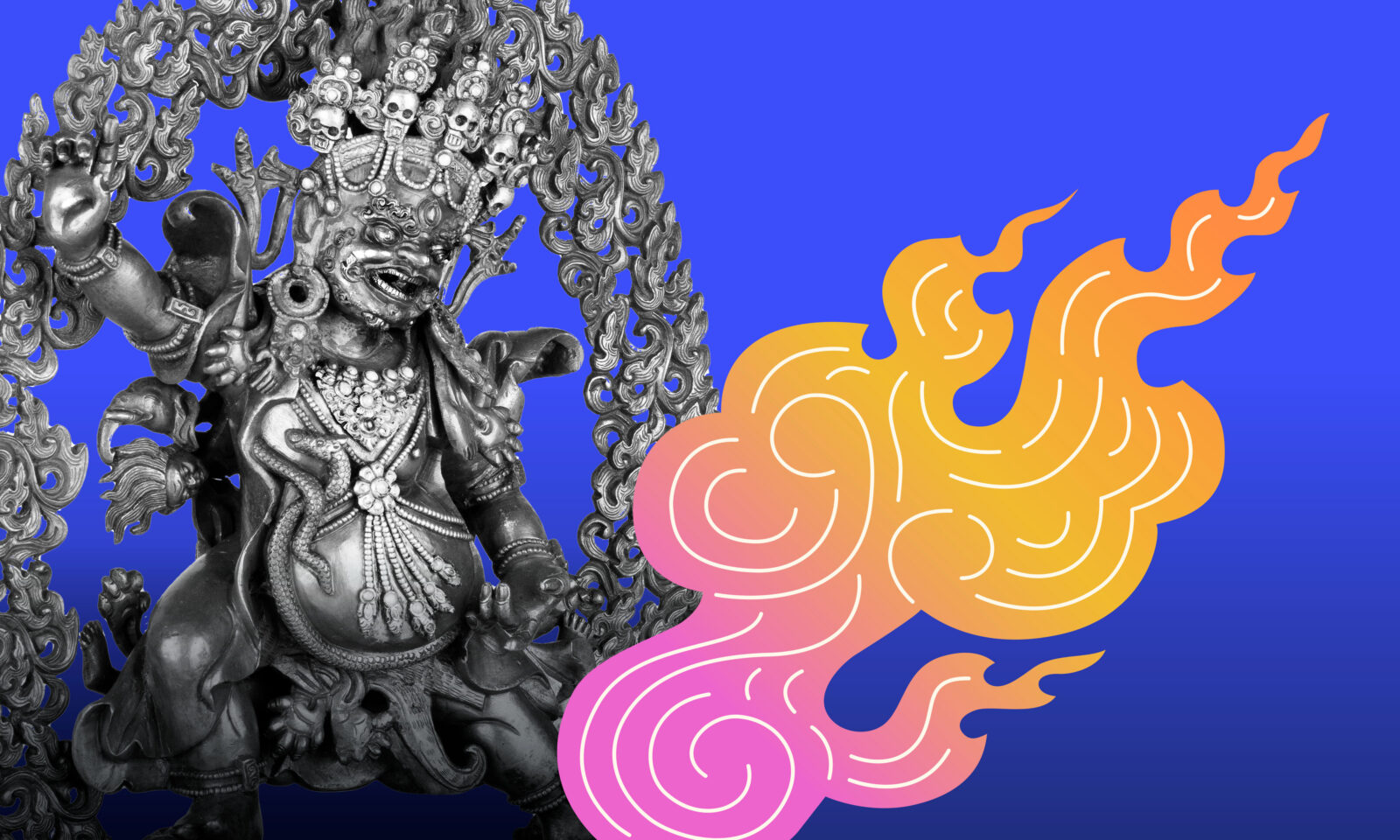
In this episode Annabella Pitkin looks at an 18th-century Tibetan sculpture of Vajrapani.
Vajrapani gets his name from the vajra-sceptor he holds in his right hand, which is a stylized representation of a lightning bolt. His vajra represents the indestructible nature of awakened consciousness, which, like a diamond, can cut through even the most stubborn illusions. Today, Vajrapani is revered as the principal guardian of Tantric Buddhism and the supreme embodiment of enlightened heroism and wrath’s transformational potential.
To see this artwork, visit rubinmuseum.org/awaken
Annabella Pitkin:
This is a really beautiful sculpture, and we see Vajrapani in wrathful aspect surrounded by an aura of flames and standing on a lotus and also pressing down with his feet on two bodies. And so these bodies represent negative forces and negative mental states and negative external forces as well, that Vajrapani is compassionately and courageously subduing for our benefit, for the benefit of practitioners in the tradition. And so one of the things that often it’s really important to say up front is this is a frightening image, right? This is wrath, this is fire, this is trampling two bodies. There’s a crown of skulls. We can see fangs and we can see fierce gestures, and we can see that there is a kind of posture of dancing warrior stance. And all of these details are absolutely very intimidating.
Khenpo Yeshi Rinpoche:
These two deities has two forms. The idea is this we call degenerate time, that is times getting worse and worse, means people’s emotions are more intense and anger jealous are much more stronger than good old days. So almost every tradition we have wrathful deities that we practice.
Annabella Pitkin:
But the idea is not that this is a harmful figure or that this is a figure to make practitioners in the community that might see this image afraid. On the contrary, this is a protective figure. This is like if your parent stood between you in danger, if someone who really loved you said, don’t worry, you’re absolutely safe with me. I will a hundred percent defend and guard you from what’s negative. That’s the energy that a figure like this is presenting, and Vajrapani is associated with the bodhisattva quality of power. And so we see this wrathful aspect of powerful, the wrathful compassionate aspect that manifests power to blast through negativities to remove them so that practitioners are safe and are protected. And these details like the flames and the skulls and the teeth and the staring eyes, all of that kind of ferociousness is to drive away negativity.
We’re not just getting protection from whatever problem we’re having in the day-to-day. We’re actually getting the real protection in Buddhist terms, which is the freedom from addiction to the ego, the freedom from delusion, the freedom from misapprehending reality most fundamentally. And so it is our own delusions that are burning up in this fire of enlightenment, and it is our own delusions that we see imaged as human looking figures that vajrapani is trampling, freeing us from our own suffering, addiction, negativity, and actually from our own hatred and anger.
Lama Rod Owens:
Wrath is nothing but compassion.
Kathleen Hanna:
Again, Lama Rod Owens
Lama Rod Owens:
It feels wrathful because it gets to the truth, the thing that we struggle to name, to admit to ourselves. It is, however, I would say part of the contract that we establish with our teachers, that the teacher has a right to do what they feel is necessary to get us free from suffering, which means showing up sometimes and pointing to the thing that we are most afraid of admitting.
Valarie Kaur:
Every great nonviolent movement in history has been a model of that focused fury. People channeling that rage into the boycotts and the sit-ins and the singing resistance choirs and the underground networks of care.
Kathleen Hanna:
Valarie Kaur.
Valarie Kaur:
I think of it as a dance. I step away to rage, return to listen, reimagine solutions together. That’s what Audre Lorde taught us, the great black visionary. She said, our anger is loaded with information and energy. Our task is to listen to it as if we are listening to a symphony, to understand its rhythms, its cadence, and then to move with it, to move with it instead of cutting ourselves off from it, to move with it, to harness that for what we choose to do now and next and next, and next. That’s the invitation.
Myisha Cherry:
And one of the things we know about social psychology, they say that when you’re angry, it makes you optimistic, right?
Kathleen Hanna:
Myisha Cherry.
Myisha Cherry:
So you think that things can change. And not only do you think that things can change, you think that you can change things. So when you’re angry, you think this wrong is going on. It doesn’t have to be like this, right? Things can be better and I can do something about it. Its aim is for change and transformation. It motivates you to kind of pursue that change and transformation, given what it does to our psychological beliefs. And for those who are concerned about it being destructive, it can be managed and one way to manage it is talk about it.
Sharon Salzberg:
The first aspect is the motivation.
Kathleen Hanna:
Sharon Salzberg is a meditation pioneer, world-renowned teacher, and New York Times bestselling author of books including Loving Your Enemies, Real Change, and Finding Your Way.
Sharon Salzberg:
What’s the intention behind an action? It’s like I might offer you something and maybe I’m giving it to you because I see you have that nifty little thing that I covet. And I think, well, maybe I’ll give you this and you’ll give me that. Or maybe I give it to you because I like you and I want you to have it. Or maybe I don’t like you and I think it’s going to be a burden to own. But it’s the same smile. It’s the same gesture on the surface. It looks totally identical, but it’s coming from a completely different place. Okay. So that’s the first part, the intention.
And here’s the place where wrath kind of figures in as a sort of fiery energy of manifestation. We can be motivated by compassion, but our best guess based on discernment, based on wisdom of the most skillful way to act in a particular situation might be kind of intense. It might be fierce. It might not be so gentle and sweet. How can compassion as a motivation and a really intense kind of fierce action coexist, but they can.
Kathleen Hanna:
Valarie Kaur.
Valarie Kaur:
Rage is part of love. Rage is the biological force that protects that which we love. Rage is the spiritual energy that connects us to the ability to fight for what we love. Our ancestors teach us that. My mother taught us that. What sickness in our modern culture thinks that we have to exile parts of our human response to trauma or injustice or what’s wrong as the opposite of love. Rage is not the opposite of love. Indifference is the opposite of love. Everything is part of it. All of us, all of us, engaging all of us as part of the labor of loving.
It’s all about how we wish to focus it, right? If we dance with it, if we explore it, if we investigate it, if we learn from it, then you take a breath. How do I wish to focus it? And that’s where those safe containers are really important.
Defection has been a common practice in all the great nonviolent resistance movements in history. We have safe containers for rage here in our organizing spaces. And then when we go out there from that rage that we have alchemized and that ferocity, we are singing justice, we are singing liberation and we are singing invitation that leaves no one behind, not even them. That is how we’re going to rebirth this country, rebirth the world. We cannot do it without that love, without that mothering love that leaves no one outside our circle of care.
Kathleen Hanna:
You just heard the voices of adrienne maree brown, Myisha Cherry, Valarie Kaur, Lama Rod Owens, Annabella Pitkin, Sharon Salzberg, and Khenpo Yeshi Rinpoche.
I am Kathleen Hanna, your host.
To see the artwork discussed in this episode, go to rubinmuseum.org/awaken
If you’re enjoying the podcast, leave us a review wherever you listen to podcasts, and tell your friends. Leaving a review is one of the best ways to support us. It really helps us reach listeners like you.
For more stories and news from the Rubin, follow @rubinmuseum on Instagram and sign up for the Museum’s monthly newsletter at rubinmuseum.org.
AWAKEN season 6 is an eight-part series from the Rubin, a global museum dedicated to presenting HImalayan art and its insights.
AWAKEN is produced by the Rubin Museum of Himalayan Art with Westin Harris, Kimon Keramidas, Christina Watson, Sovah Woydak, and Sarah Zabrodski in collaboration with SOUND MADE PUBLIC including Tania Ketenjian, Philip Wood, Kristin Mueller, Christine Driscoll, and Aaron Siegel.
Original music has been produced by Hannis Brown with additional music from Blue Dot Sessions.
AWAKEN season 6 is supported, in part, by the Charina Endowment Fund, The Prospect Hill Foundation, and Shelley and Donald Rubin, with generous contributions from the Rubin’s Board of Trustees, individual donors, and Friends of the Rubin.
This program is supported, in part, by public funds from the New York City Department of Cultural Affairs, in partnership with the City Council.
This program is supported, in part, by the New York State Council on the Arts with the support of the Office of Governor Kathy Hochul and the New York State Legislature.
Thank you for listening.
Wrath is often perceived as interchangeable with anger or rage. But in the Buddhist tradition, wrath has a very particular meaning as a liberatory, fierce, and protective force of transformation. Wrathful deities embody this energy to aid all beings on the path to enlightenment. What can they teach us about the nature of wrath and its relationship to awakening?
This episode features activist, documentary filmmaker, lawyer, educator, and faith leader Valarie Kaur. AWAKEN season 6 is hosted by punk singer, writer, and frontwoman of the bands Bikini Kill and Le Tigre Kathleen Hanna. Other guests in this episode include author and emergent strategist adrienne maree brown, author, professor, and philosopher Myisha Cherry, Black Buddhist Southern Queen Lama Rod Owens, professor of Buddhism and East Asian religions Annabella Pitkin, meditation pioneer, mindfulness and lovingkindness teacher, and author Sharon Salzberg, and Buddhist scholar and teacher Khenpo Yeshi Rinpoche.

Vajrapani; Tibet; 18th century; Copper alloy with gilding and inlays of stones; Rubin Museum of Himalayan Art; C2002.17.2

Kathleen Hanna is a punk singer, writer, artist, and frontwoman of the influential bands Bikini Kill and Le Tigre. Her memoir Rebel Girl was an instant New York Times and Sunday Times bestseller. She is a leading voice in the feminist movement and has been named one of the best live performers of our time. Follow @mskathleenhanna on Instagram, @thekathleenhanna on TikTok, and subscribe to Future Windows on Substack.

Valarie Kaur is a renowned social justice leader, lawyer, award-winning filmmaker, faith leader, mother, and bestselling author of See No Stranger, Sage Warrior, and World of Wonder. She leads the Revolutionary Love Project, building a movement to reclaim love as a force for justice. A daughter of Punjabi Sikh farmers in California, Valarie earned degrees at Stanford University, Harvard Divinity School, and Yale Law School and holds several honorary doctorates. She lives in Los Angeles in a multigenerational family.

adrienne maree brown (she/they) is growing a garden of healing ideas. Informed by decades of movement facilitation, somatics, science fiction scholarship, and doula work, adrienne has nurtured Emergent Strategy, Pleasure Activism, Radical Imagination, and Loving Correction as ideas and practices for transformation. adrienne is the New York Times bestselling author and editor of several published texts, a ritual singer-songwriter, co-generator of the Lineages of Change Tarot Deck, and co-creator and host of the How to Survive the End of the World podcast with Autumn Brown.

Myisha Cherry is an associate professor of philosophy at the University of California, Riverside. She writes about the role of emotions and attitudes in our moral and public lives. Her books include The Case for Rage, Failures of Forgiveness, and the forthcoming How to Love. She is also the director of the Emotion and Society Lab, and hosts the UnMute Podcast, where she interviews philosophers about the social and political issues of our day. Myisha has written for the Los Angeles Times, The Atlantic, Salon, and New Philosophers Magazine, and her work has been featured in the New Yorker, Essence, and Publisher’s Weekly.

Lama Rod Owens is a Black Buddhist Southern Queen and an international influencer with a Master of Divinity degree in Buddhist studies from Harvard Divinity School. A leading voice featured by various national and international news outlets, he is the author of the bestsellers The New Saints: From Broken Hearts to Spiritual Warriors and Love and Rage: The Path of Liberation through Anger, as well as co-author of Radical Dharma: Talking Race, Love and Liberation. His teachings center on freedom, self-expression, and radical self-care. Learn more at lamarod.com

Annabella Pitkin is a scholar of Tibetan Buddhist intellectual history, philosophy, and literature, and associate professor of Buddhism and East Asian religions at Lehigh University. Her research explores themes of renunciation, power, and the bodhisattva ideal. She is the author of Renunciation and Longing: The Life of a Twentieth-Century Himalayan Buddhist Saint about the life of the meditator-poet Khunu Lama Tenzin Gyaltsen (1895–1977). She is on the editorial committee of the Treasury of Lives: A Biographical Encyclopedia of Tibet, Inner Asia, and the Himalaya, and is a member of the review committee for the Rubin Institute.

Sharon Salzberg is a meditation pioneer, world-renowned teacher, and New York Times bestselling author. She was among the first to bring mindfulness and lovingkindness meditation to mainstream American culture over 50 years ago, inspiring generations of meditation teachers and wellness influencers. Sharon is cofounder of the Insight Meditation Society in Barre, MA, and the author of 14 books, including the New York Times bestseller Real Happiness, now in its second edition, and her seminal work, Lovingkindness. Sharon’s podcast, The Metta Hour, has amassed eight million downloads and features interviews with thought leaders from the mindfulness movement and beyond.

Khenpo Yeshi Rinpoche was born in 1969 in Nakchu, eastern Tibet, where he developed an early dedication to the study and practice of the Dharma. At 13, he received empowerments and teachings in the Longchen Nyingthig tradition from eminent Dzogchen masters. At 20, he traveled to South India and trained extensively in the Geluk, Kagyu, and Nyingma traditions at Sera, Dzogchen, and Drikung Jangchup Ling monasteries, excelling in both sutra and tantra.
In 1993, he completed a traditional three-year retreat in Nepal under Tulku Urgyen Rinpoche, receiving profound Dzogchen instructions. He later taught at Ka-Nying Shedrup Ling Monastery and Rangjung Yeshe Institute, contributing to monastic and academic curricula.
Since 2001, he has taught internationally. He holds degrees from the University of California, Berkeley, and is completing a PhD in Dzogchen.

Get the latest news and stories from the Rubin, plus occasional information on how to support our work.