Tibet
17th–18th century
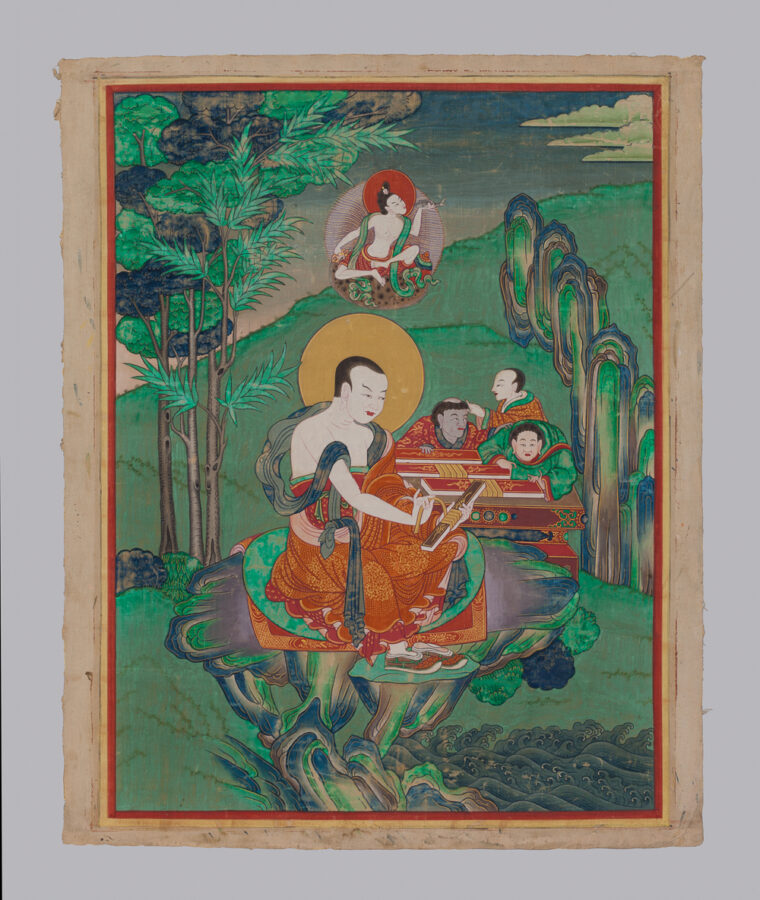
The hands form the shape of a wheel, symbolizing the “turning of the wheel of dharma,” a reference to teaching the Buddha’s doctrine.
Tibet
17th–18th century
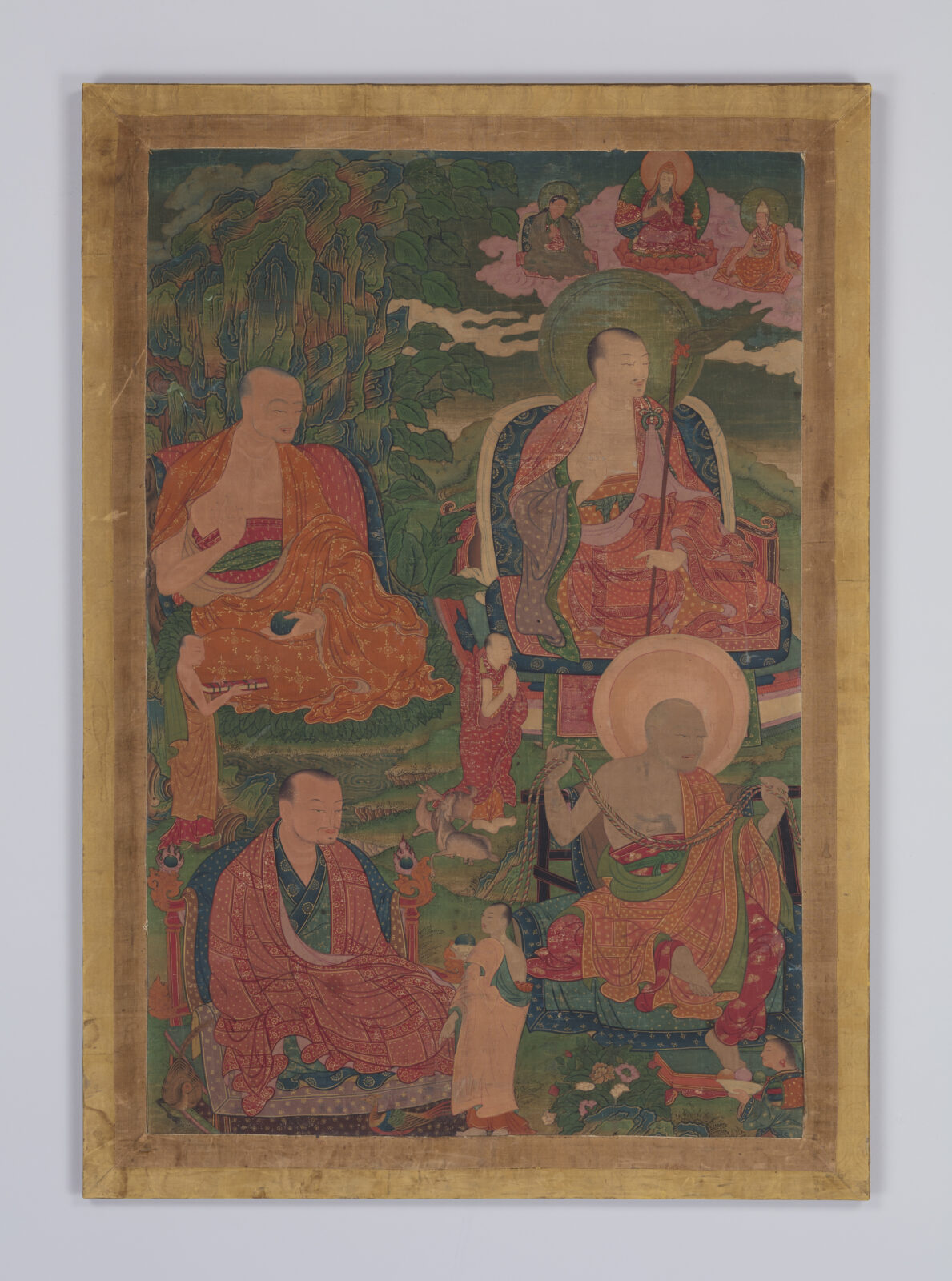
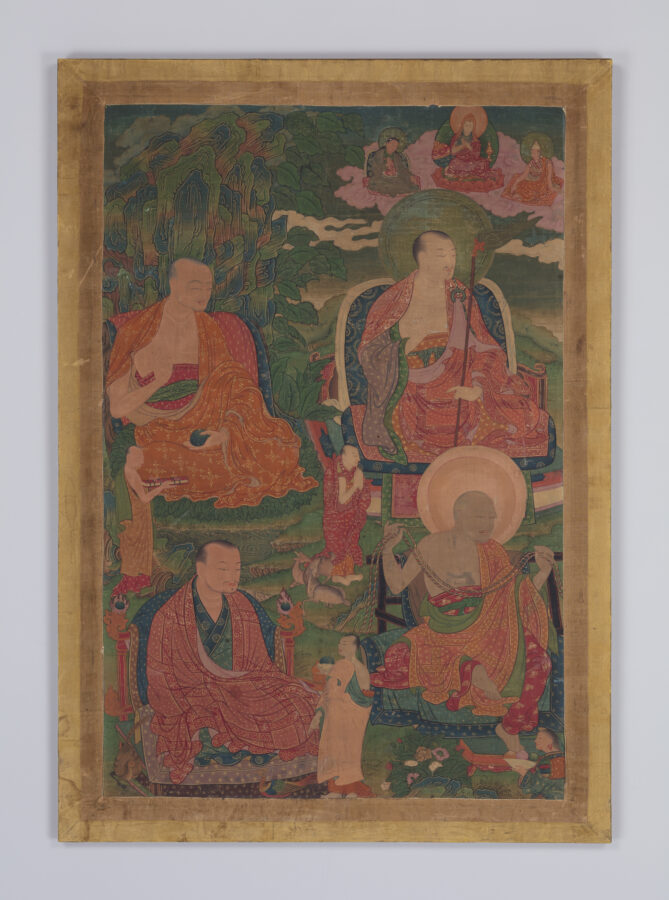
This painting features four of the sixteen arhats, the original disciples of the Buddha: Bhadra with his right hand raised (top left); Vajriputra holding a flywhisk in his left hand (top right); Kanaka Bharadvaja with hands folded in his lap (bottom left); and Kanakavatsa holding his distinctive attribute, a jewel lasso (bottom right). At the top right is a group of historical figures important to the later transmission of Buddhism to Tibet: Atisha (982–1055) with his Tibetan student Dromton (1005–1064) is on the left side, and the translator Ngok Lotsawa (1059–1109) wearing a yellow pandita hat is on the right. This presence of this group of scholars, who were founders of the Khadampa tradition, suggests the patrons of this painting were from the Geluk School of Tibetan Buddhism, as they saw themselves as inheritors of the Khadampa tradition.
Arhats represent the monastic ideal and preservers of the monastic code of conduct (vinaya). The arhats are often invoked in rituals of confession and mending vows, which are performed before images such as this one.
Tibetan artists adopted Chinese conventions of depicting arhats as wizened sages with exaggerated features, living in secluded mountain caves hidden in decorative Chinese-inspired landscapes of azurite (blue) and malachite (green), drawn from Daoist immortal imagery. Arhats are typically depicted as a group of sixteen, along with additional figures of a patron, an attendant, and four guardian kings, all flanking a central image of the Buddha Shakyamuni. Based on this figural grouping of four arhats, this painting is possibly from a set of seven.

The hands form the shape of a wheel, symbolizing the “turning of the wheel of dharma,” a reference to teaching the Buddha’s doctrine.
A state of “waking up” from illusion and seeing the true nature of reality. Buddha Shakyamuni attained enlightenment while meditating under the bodhi tree. Buddhist teaching explains that the accumulation of merit and wisdom are essential for achieving enlightenment, also known as awakening.
A vehicle for the preservation and transmission of knowledge. The Buddha’s teachings were originally passed down through oral transmission and storytelling, and stories of the Buddha’s past lives are considered an important source of inspiration and guidance.
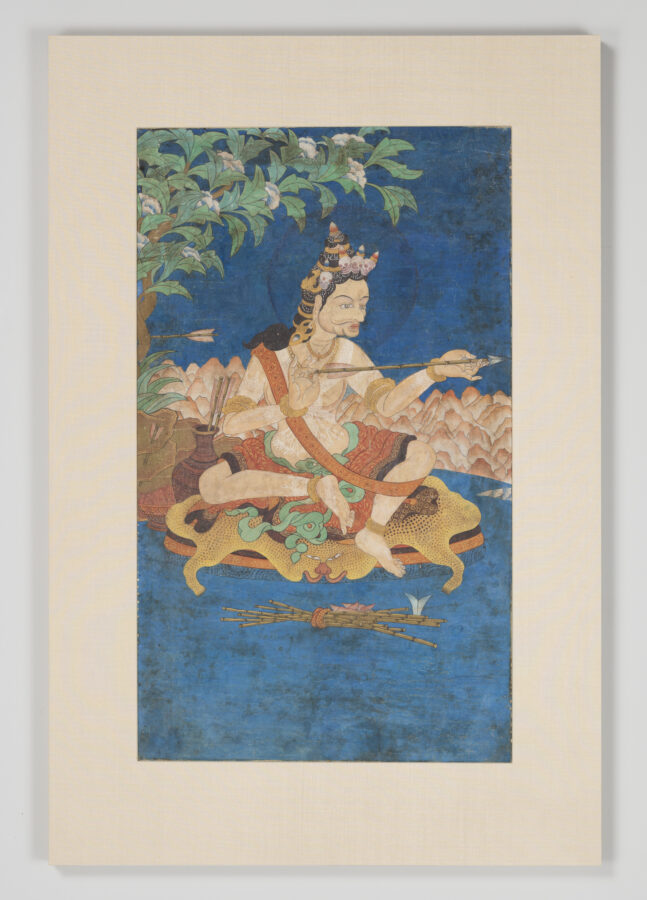
Himalayan art includes portraits of legendary and historical humans, including accomplished religious teachers (lamas), the Buddha’s original disciples (arhats), and spiritually accomplished tantric masters (mahasiddhas).
Today, Tibetans primarily inhabit the Tibetan Plateau, situated between the Himalayan mountain range and the Indian subcontinent to the west, Chinese cultural regions to the east, and Mongolian cultural regions to the northeast. During the 7th to 9th century, Tibetan rulers expanded their empire across Central Asia, and established Buddhism as the state religion.

Get the latest news and stories from the Rubin, plus occasional information on how to support our work.