Tsang region, central Tibet
18th century


Tsang region, central Tibet
18th century
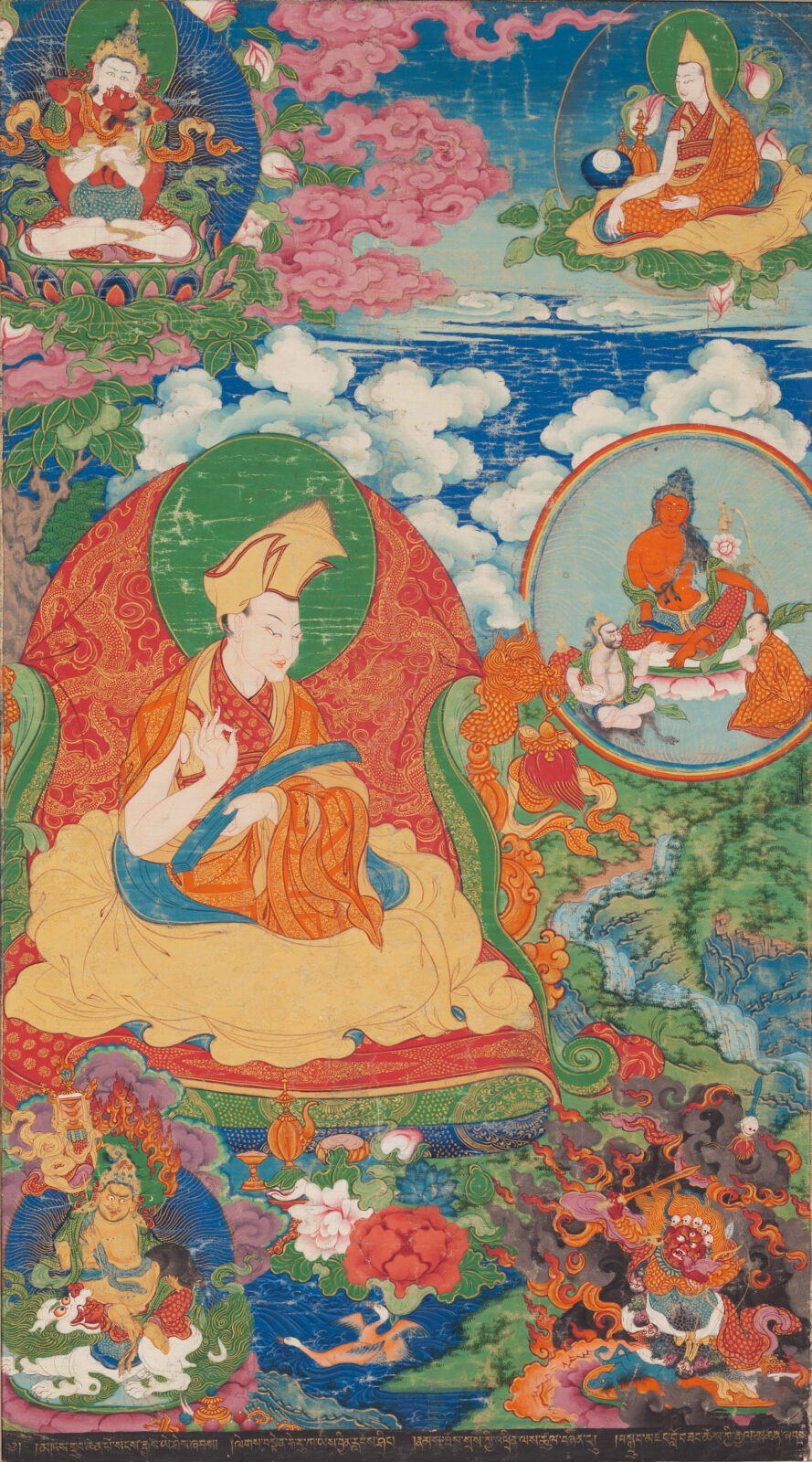
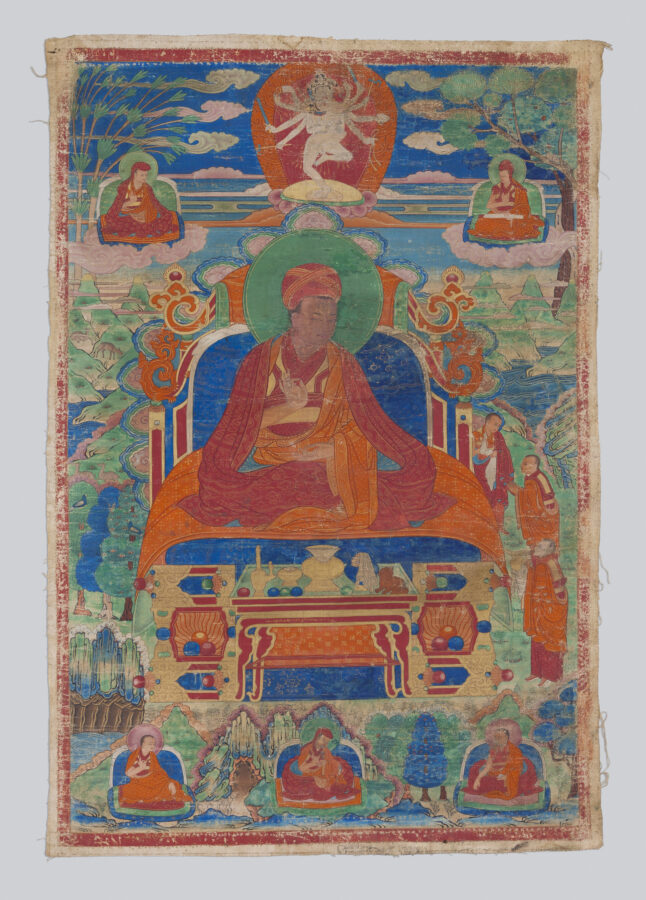
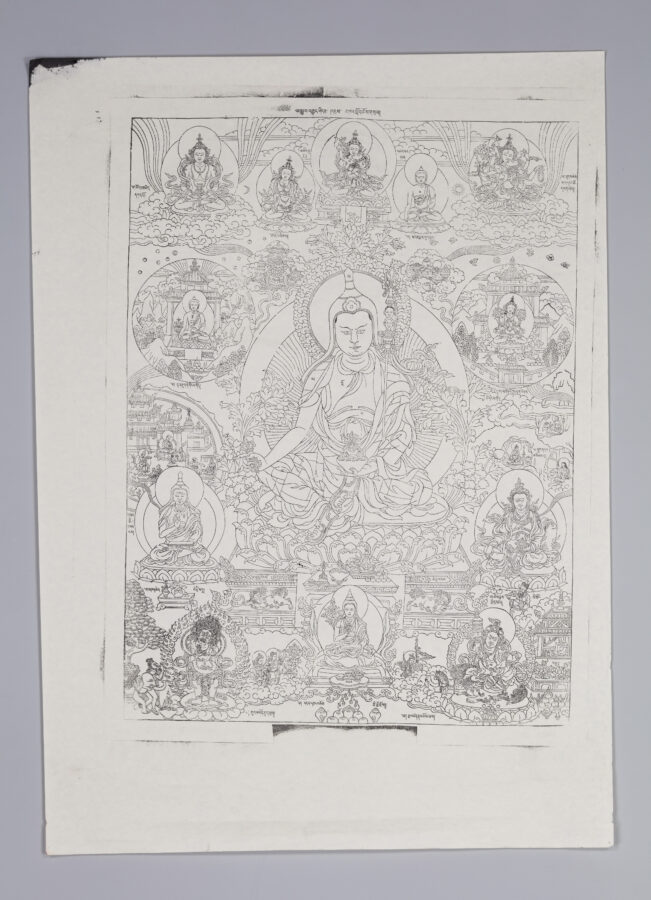
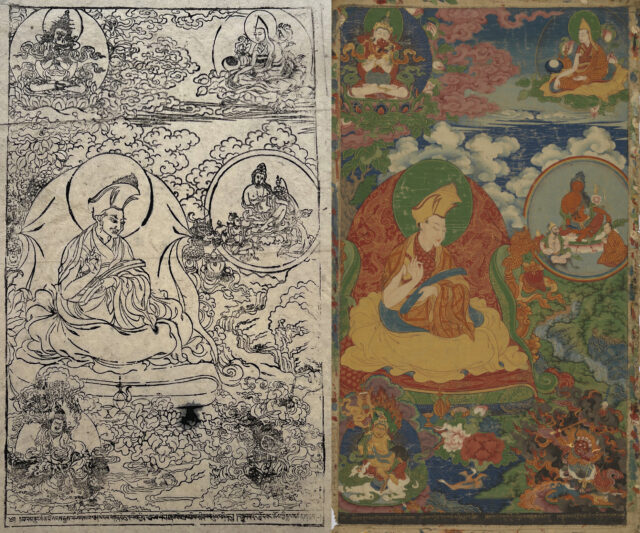
This painting is based on a work created by the founder of the New Menri painting tradition, Chöying Gyatso (chos dbyings rgya mtsho; active 1640s–1660s). He was a painter in the court of the Fourth Penchen Lama (1570–1662), the subject of this portrait and the second highest figure after the Dalai Lama in the hierarchy of the Geluk tradition of Tibetan Buddhism. Lozang Chökyi Gyeltsen (blo bzang chos kyi rgyal mtshan; 1570–1662) was an extremely important figure. He served as abbot of Trashilhünpo Monastery (bkra shis lhun po) and tutor to the Fifth Dalai Lama, establishing a close teacher-student relationship between these two incarnation lineages that continues to be important to this day. He is considered an emanation of Amitabha, spiritual father of Avalokiteshvara. The Dalai Lamas are considered emanations of Avalokiteshvara, implying an even deeper “father-son” relationship, with the older ones becoming responsible for identifying and teaching the younger ones. He was the first to receive the title Penchen Lama, meaning “greatly learned guru,” and his erudite status is reflected in his portrait here: he wears a pandita hat, holds a book, and makes a teaching gesture with his upraised hand. An inscription at the bottom praises him while calling out several other figures in the composition, including the wealth deity Vaishravana beneath him and his main teacher, Sanggyé Yéshé (sangs rgyas ye shes; 1525–1590/91) at top right. Various characteristics of the New Menri style are evident in this painting, such as humans portrayed in realistic partial profile. While the central figure is quite idealized, there is some reflection of his physiogomy, such as a strong square chin. Asymmetrical compositions featuring dramatic landscapes are also a hallmark of the style, seen here in the craggy rocks, rushing, twisting stream, two different kinds of billowing clouds, and pair of water fowl cavorting in rolling waves. The rich use of colors such as malichite and azurite combined with an elaborate patterning of textiles in gold, such as a pair of winding gold dragons on the red throne back, conveys a sense of opulence and authority. The New Menri style was an elaboration of the Menri style of the fifteenth century, which introduced Chinese-inspired blue-green landscapes to Tibetan painting. Chöying Gyatso worked at the courts of both the Penchen and Dalai Lamas, and his New Menri style was adopted as one of the main state-supported artistic traditions promoted by the Ganden Podrang government. They propagated their authority through incarnation lineage depictions such as the Penchen and Dalai Lamas, which were distributed throughout the Tibetan Buddhist world as the Gelukpa expanded their territory and construction projects. This wide dissemination was achieved through woodblock printing at Narthang Monastery in Tsang, central Tibet, beginning in the second quarter of the eighteenth century. The many painted copies, from the Rubin Museum’s example to the ones produced in the Qing imperial court for the Sixth Penchen Lama’s visit to court in 1780, demonstrate that the Narthang designs were accepted as authoritative visual representations of the Penchen’s lives, authority, and prestige.
Buddhists believe identity is not fixed but is variable and dependent on causes and conditions. It is a temporary, transitional, and ever-changing interplay of mental and physical elements.
The passing down of authentic Buddhist teachings from a teacher to a disciple or student, often in the form of a text in a ritualistic context.
The transmission of teachings from one generation to the next, from teacher to student, traced all the way back to the Buddha without interruption. A complete lineage is essential in Tantric Buddhist practices as it makes the blessings of the teaching more powerful.
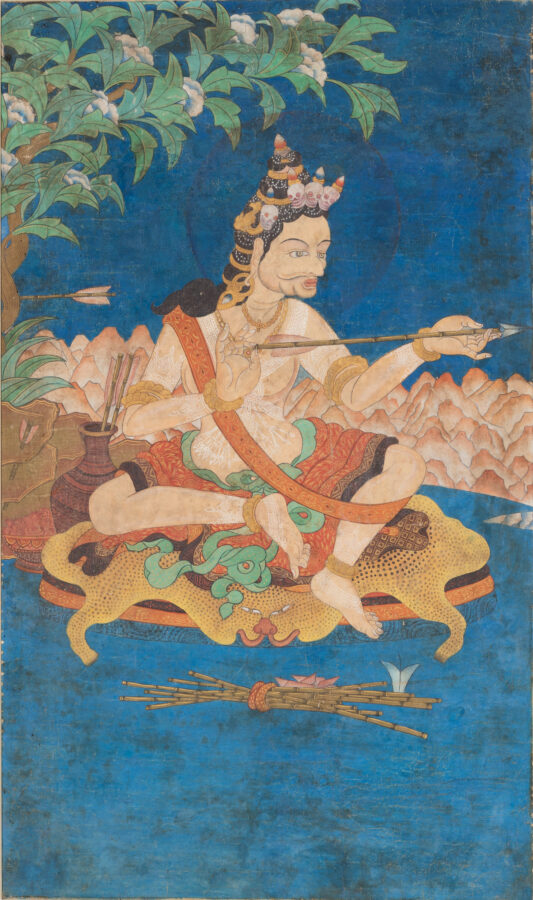
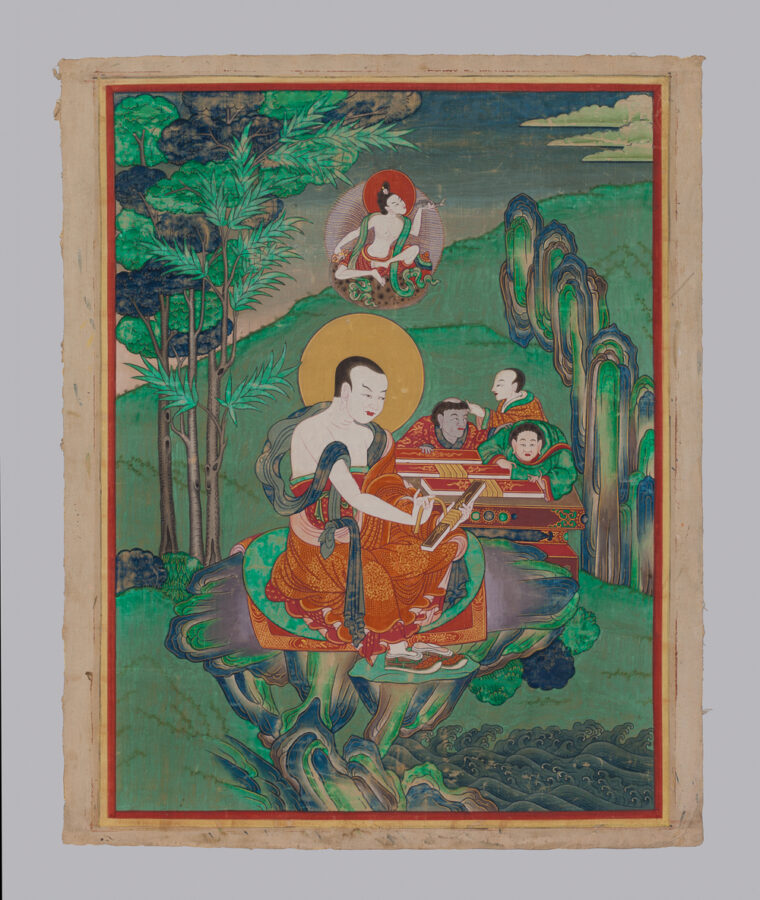
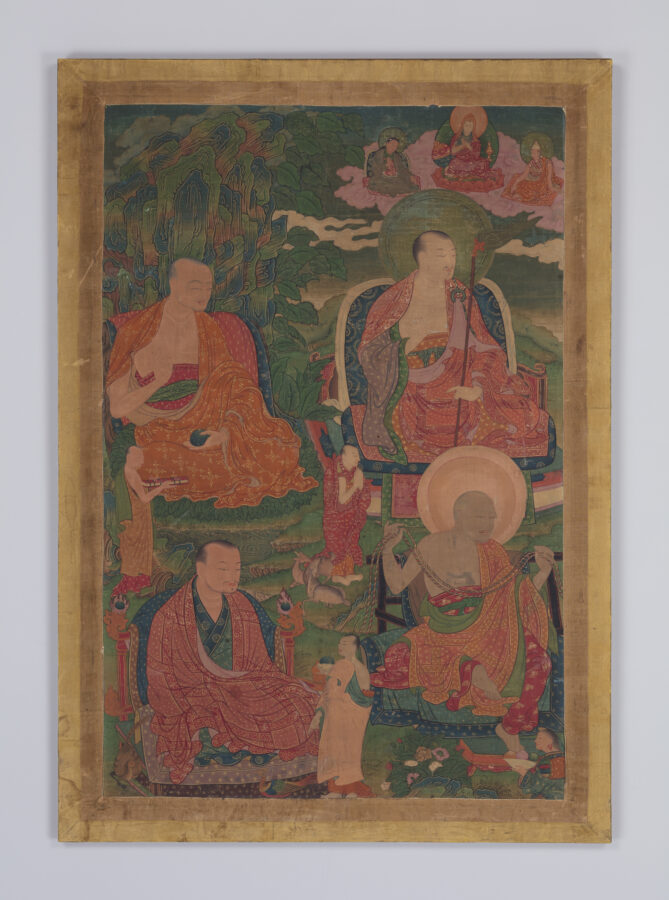
Himalayan art includes portraits of legendary and historical humans, including accomplished religious teachers (lamas), the Buddha’s original disciples (arhats), and spiritually accomplished tantric masters (mahasiddhas).
Today, Tibetans primarily inhabit the Tibetan Plateau, situated between the Himalayan mountain range and the Indian subcontinent to the west, Chinese cultural regions to the east, and Mongolian cultural regions to the northeast. During the 7th to 9th century, Tibetan rulers expanded their empire across Central Asia, and established Buddhism as the state religion.

Get the latest news and stories from the Rubin, plus occasional information on how to support our work.