Nepal
19th century
Nepal
19th century
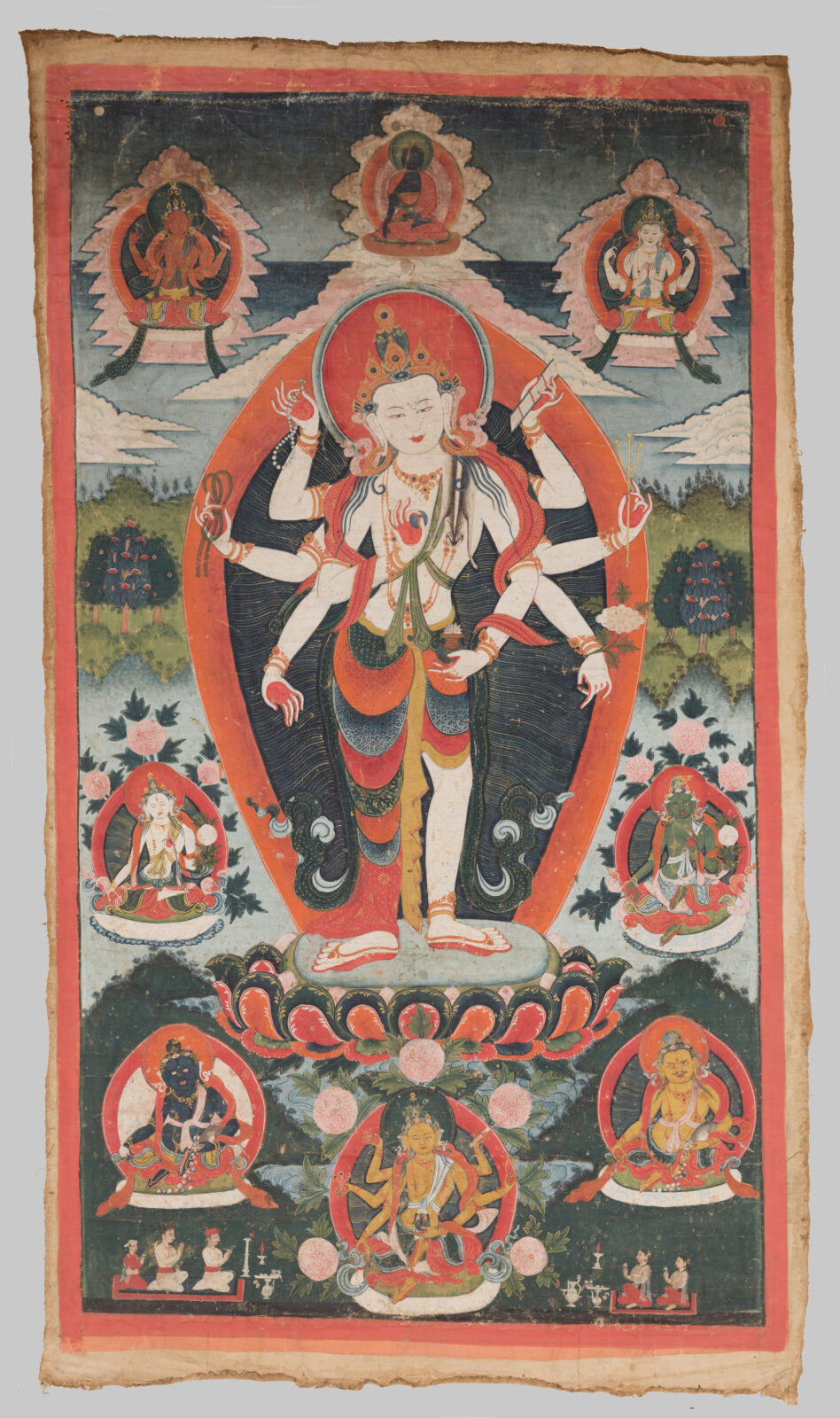
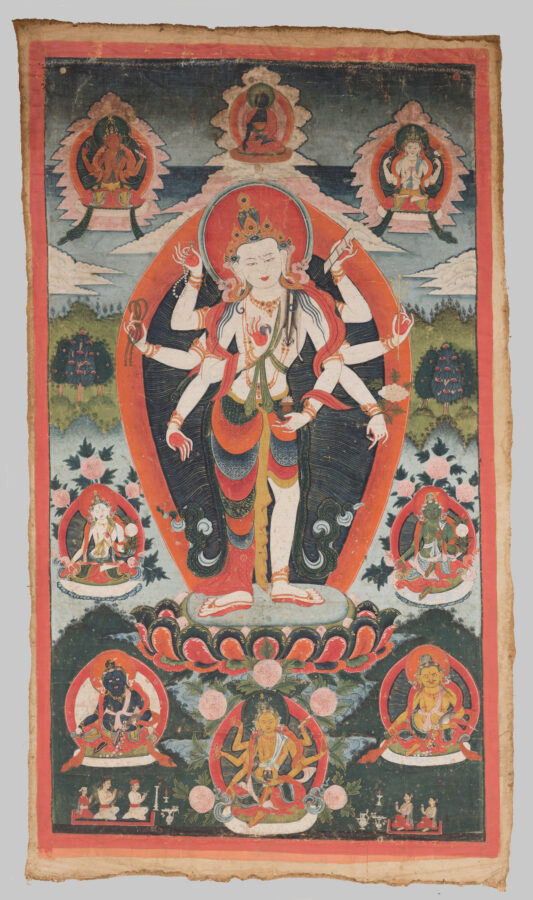
This painting depicts the Buddhist deity Amoghapasha Lokeshvara at the center. He stands on a lotus, which is said to be the world lotus. He is pure white in color with one face and eight hands. His principal right hand shows the gesture of fearlessness (abhaya), the lower right hand is in the boon-granting gesture (varada), the middle right hand holds a lasso, and the top right hand holds a string of prayer beads. His left hands hold a trident, scripture, white lotus, and water pot. These implements symbolize his abilities to help all beings become free from the cycle of birth, death, and rebirth known as samsara.
He is surrounded by other deities; some are above, floating within clouds, while others are situated within the landscape. At the top center is the Medicine Buddha, blue in color. At the top left is the goddess of wisdom Prajnaparamita. At the top right is Avalokiteshvara, the embodiment of compassion. To Amoghapasha’s right is the goddess Tara, green in color, seated with one leg pendent. She is the protectress from dangers. To his left is White Tara, who has eyes on the palms and soles of her feet and her forehead. She is the deity who grants long life. Two forms of the wealth deity Jambhala are below to the lower left and right. At the bottom center is Vasudhara, the goddess of prosperity and abundance. On either side of Vasudhara are small figures of donors, men on the left and women on the right. These people are probably the family who commissioned the painting as part of the ritual Uposadha Vrata of Amoghapasa Lokeshvara. The ritual, often referred to in Nepal as Astha, is a day when lay people take on the eight precepts for a day to create religious merit. The ritual usually occurs on the full moon or the half-moon days of the lunar calendar.
Among notable compositional and stylistic elements in this painting are the hierarchy of scale, color choices, and depiction of the landscape. The central deity, as the most important figure, is the largest. The human figures of the donors are the smallest, but their individual sizes demonstrate various levels of prominence. Its darker shaded inlets are bordered by a green landmass with several rhododendron trees. The green ground, its edges peaked by evergreen trees, extends further towards the horizon. This landscape is likely representative of the Kathmandu Valley and its environs. Yet, the clouds and flowers framing the Buddhist deities are distinct from this natural background. They demonstrate characteristic conventions of traditional Tibetan painting. The artist’s inventiveness and attention to detail are further evident in the rendering of Amoghapasha’s patterned lower garment (dhoti), flowing scarves, and bold choices of pigments.

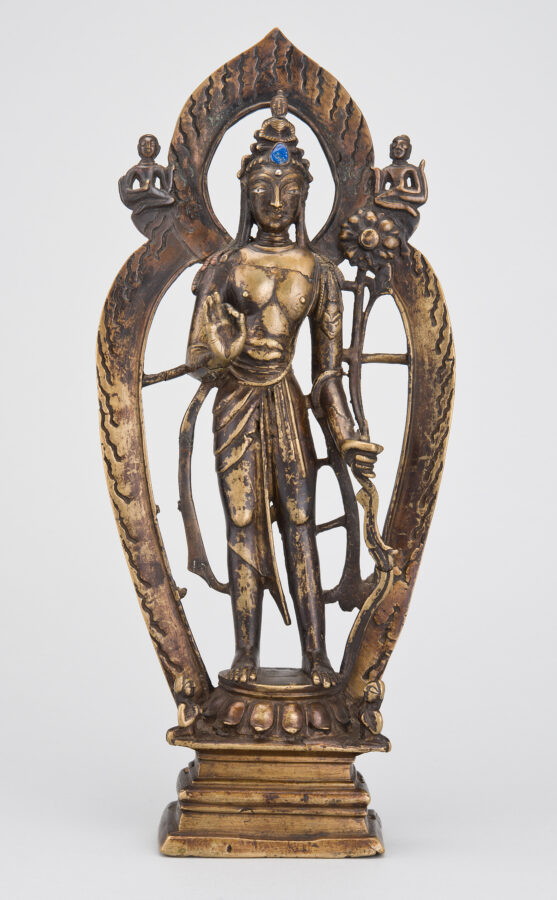
The right hand is extended in a giving gesture.
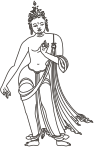
This posture features a triple- bend of the body at the knee, hip, and waist.
A virtuous feeling and deep respect toward an authentic teaching, teacher, or path. Buddhists believe that expansive study, analysis, and meditation are essential steps for cultivating a healthy and enduring devotion.
The functioning of cause and effect across time. Buddhists believe that everything we experience is the result of past actions, and everything we initiate has future consequences. Karma encourages actions to bring about positive outcomes and a better future.
In Buddhism merit is accumulated through engaging in positive actions that lead to positive results, such as better rebirths. Buddhists gain merit by making offerings, donating to those in need, reciting mantras, and other good deeds.
The cultivation of a strong aspiration to help sentient beings overcome suffering. In Buddhist Mahayana teaching, compassion is the seed for attaining full enlightenment.
Prescribed practices that carry symbolic meaning and value within a specific tradition and are intended to attain a desired outcome. Rituals are usually done as part of a ceremony or regular routine.
An awakened being who understands the true nature of reality and is free from the cycle of birth, death, and rebirth. While there are many buddhas, Siddhartha Gautama is the historical Buddha, whose teachings became the foundation of Buddhism.
Beings who aspire to become fully awakened like the Buddha and are dedicated to helping others on the path to enlightenment.
Female bodhisattvas and tantric deities embody specific enlightened qualities such as wisdom, power, and protection, and can be peaceful or wrathful in appearance.
The Himalayan kingdoms of the Kathmandu Valley were significant centers of Buddhist culture. Nepalese kings, Buddhist institutions, and ordinary people patronized the vibrant art guilds. The artistic traditions of the regions are well-known in Tibetan areas and beyond, and Newar artists have always been in high demand throughout Tibetan regions and Inner Asia.

Get the latest news and stories from the Rubin, plus occasional information on how to support our work.